Showing posts with label animal fetishes. Show all posts

Friday, 8 December 2023

Bringing the inanimate to life.

The Japanese artist Maruyama Okyo was reported to have painted a ghost so "realistically" that it came to life and frightened him. 

Tsukioka Yoshitoshi: Maruyama Okyo frightened by his own art

Tsukioka Yoshitoshi was fascinated by ghosts and depicted them regularly during his long career. He loved the fact that Maruyama Okyo had been so good at their depiction that he became frightened by his own work. I suspect Tsukioka Yoshitoshi was having a moment of fun at Okyo's expense, but if you do look at some of Okyo's ghosts you can see why he might have frightened himself. he was able to hold that fine line between life and death in an image by using a language that is as much about what is there, as what is not. There is something about making images of ghosts that I think of as being central to the depiction of animism. The ghost is a spirit form, one that usually is some form of representation of the dead. Another way of thinking about this is that these are images that attempt to give life to things that are now inanimate, even if once alive. This opens a door into that territory between the animate and the inanimate. Many cultures think of spirits as being things that animate all life, Central to animism is an understanding that everything has a spirit; humans, plants, animals, landscapes, words and weather systems can all be animated and have some sort of personhood, and so of course can the dead and other things that have past lives. 


Tsukioka Yoshitoshi: Images of ghosts
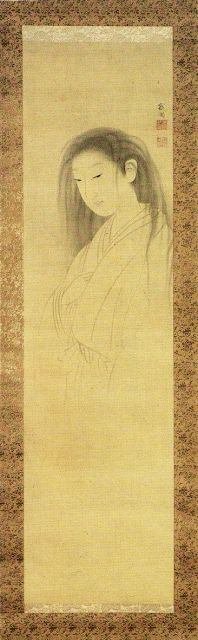
Ghost: Maruyama Okyo

The ghost drawn by Maruyama Okyo above sits on that representational razor edge between the animate and the inanimate. She looks back at you, however she is only just there, her hair without volume, her lips thin, and she has no legs to stand on, her wispy body floating into view; she is there and not there.

A ghost in the lantern: Utagawa Kuniyoshi

Ghosts because they are no longer alive, can inhabit other things and the spirit of those other things can be conjoined or animated with the ghost's spirit. The ghost in the lantern above suggesting a hybrid spirit, one that perhaps gets its malevolence from its human aspect. What is animate and what is inanimate, is unclear; in the case of ghosts and similar spirits, the line between life and death is crossed. For an artist that makes representations of things, this is a really fascinating area, because I am often concerned with what gives life to an inanimate image. How can I make or draw or paint something that although inanimate can become 'active' or 'alive' in someone else's mind? 

Making art that comes to life is an old myth and one often debunked. Goya depicted Pygmalion with his legs spread wide, cock sure, readying himself to take a mighty swing of the chisel, which is aimed directly at Galatea's crotch. Leaning slightly forward, she looks out with a fearful expression. Goya's interpretation of the well-known myth being a satire on an artist's fantasy. All this artist wants is to open up the woman with his chisel. Goya had seen enough of reality to become very cynical, but as he gets older, his mind also became prey to ghostly images. 

Goya: Pygmalion

14th Century manuscript 

In this image from a 14th century manuscript, Pygmalion looks as if he is raising Galatea from the dead. 
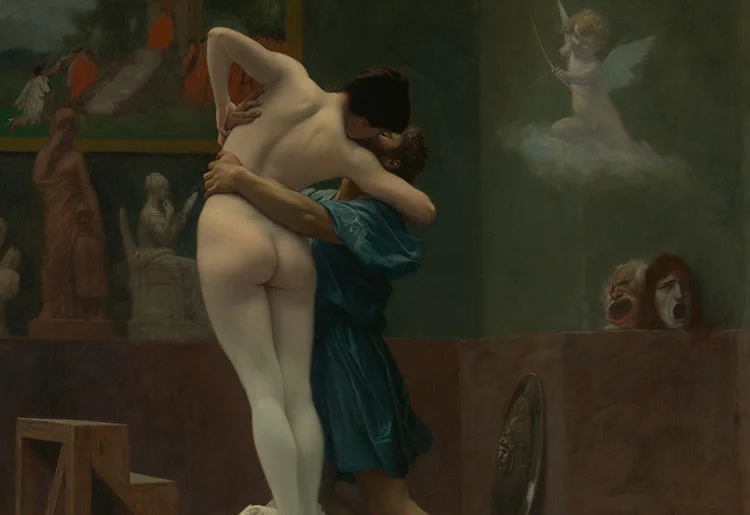
Detail: Pygmalion and Galatea' by Jean-Léon Gérôme

The image we are more familiar with is the one made popular during the Victorian age; Jean-Léon Gérôme's idea of being able to have access to a nude nubile woman in the privacy of the studio, being typical of the way classical art subjects were used as a sort of cover up for the fact that some men just wanted an excuse to be able to put pornography up on their walls. The central issue with the Pygmalion myth being that it suggests that the only relationship humans have with the inanimate is one of desire. We want things to be moulded in our image; we pride ourselves on being superior to everything else. In Genesis, it is stated then God said, “Let Us make man in Our image, after Our likeness, to rule over the fish of the sea and the birds of the air, over the livestock, and over all the earth itself and every creature that crawls upon it.” A statement that has in many ways led to an uncomfortable relationship with the rest of the world. How can you have a proper dialogue with all the other things that you are entangled with, if you believe in your innate superiority to everything else? To rule suggests that you make your subjects give you tribute; you take the things you want. In contrast, animism suggests that you are just one voice amongst many and that in order to make your way in this world you need to find an accommodation or mediated position between the needs you have and the needs that all other things have. Reciprocity is central to the animist world view. 

However there is a totally different approach to the idea of bringing the inanimate to life and that is to depict what is inanimate in such a way that it feels like it is alive. Jim Dine's drawings and prints of tools are a good example of how the techniques normally involved in giving expression and atmospheric quality to representations of human beings, can be applied to inanimate objects in order to suggest that they too have a life of their own. 

Jim Dine: Etching

Jim Dine: Lithograph

These images of tools could also be seen as 'portraits' of inanimate objects. Their bi-lateral symmetry makes for a very easy human/tool association; after all tools are extensions of ourselves. 

Wayne Thiebaud 

The knife stuck into the watermelon is easily seen as a substitute for a possible human tragedy. 
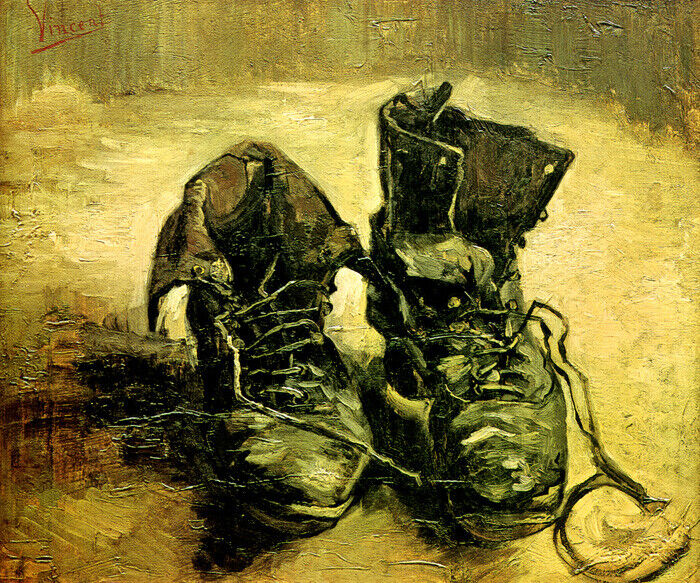
Van Gogh: Boots

These boots have as much life in them as the person that has just taken them off. They can also be thought of as a type of 'synecdoche', whereby a part of something can represent the whole. For instance a boot could represent an army, in this case two old worn shoes, stand in for the person who would normally wear them, a working peasant, and thus all working peasants. 

But this is just a small step into the world of the animist. These objects are extensions of ourselves but as we become aware that an old boot can have some sort of élan vital, then perhaps anything inanimate or animate can too, not just things that have a close association with ourselves.

It is the Earth itself that we need to find a proper relationship with. If it has any sort of consciousness I would have thought it would be pretty fed up with humans right now. The Earth's spirit is something we ignore, repress or deny at our peril but we can learn to begin a new relationship with it by turning to other cultures. There is a Japanese term, 'Tsuchi' that as well as being a symbol for the Earth, is also something that can stand for mud, clay or earth. In some  animist thought the Earth itself can therefore be held in our hands when a form is made in ceramic. A spirit inhabits the clay, which is itself part of the spirit of the world, the Earth itself.  A ceramic vessel can therefore, become a holder of a part of the primordial Earth's soul.
Meditation and deep contemplation, may begin a new dialog between a material and ourselves and once a basic material such as clay and mud is seen as being worthy of our love and care, then hopefully all the other materials and inhabitants of the Earth; animal, vegetable and mineral, become linked to an awareness of a pulse beyond our own, one that gives us a sensual and tactile connection with the charge of life forces that vibrates through everything. An awareness that activates for us what some people used to think of as the non-moving stillness of the inanimate or the dead. In fact the inanimate is never that, all things are in reality animate; the dead are also therefore still alive. Deep within all matter lies energy. 

Iranian area: 1,000 BC

You can sense that when this vessel was made that the maker saw many things at once. The material possibilities of the making and a love for the clay, an awareness of the spirits of animal forms and a feeling for how this vessel would be integrated into daily life. It pulls together various conversations with the non-human world and makes them also very human. You feel that this object is of the Earth not something ripped out of it to make some form of profit. 

As my own work develops and I have more time for it since retiring, I'm drawn more and more towards animist ways of thinking and the idea of objects being mediators between ourselves and the world. In this case an awareness of how as a boy I used a Sooty puppet as a mediator between myself and the frightening complexities of the adult world; it was in psychiatric terms, a 'transitional object'. I was a young animist, but never realised it.

Sooty rises above a fear of insects

See also:

Tuesday, 10 October 2023

Why I'm making animist images

A while ago I put up a post asking questions as to why artists continue to need to draw animals. I have also referred several times to the fact that I believe that many artists need to also be 'animists' if they are to make images that connect humans with the rest of the world. So I thought it is perhaps about time to revisit the subject.
I have been making a series of images that relate to my boyhood and the fact that for a while I had a Sooty puppet that I definitely in my mind entered into when I needed to commune with someone or something that was both other than myself and yet at the same time an extension of myself. My mother was a cinema usherette, sometimes her shift was still ongoing when primary school finished, and so I would be told to walk up to the Gaumont cinema and go in and wait for mom, who would collect me from the back row, as soon as her shift had finished. It was a magical time, watching films that were far too old for me, that were sometimes totally incomprehensible, but which were still amazing. Faces were huge things, the horrors of two people kissing on such a scale were intensely embarrassing for me, and everything was seen as always in those days through a haze of cigarette smoke. To protect me though I had Sooty and Sooty would watch the films for me, he would interpret and go places I couldn't, sometimes in my mind even leaving my hand and engaging directly with the film world. Looking back at the way I related to this small golden coloured puppet bear, I suspect my relationship with it was little different to that of people who believe in animist practices.
Native Americans believe the spirits of animals and associated spiritual powers dwell within animal fetishes. These powers may be invoked to aid and guide the possessors of these fetishes, and in particular in North America there were six animals that were and I presume in some areas that are still occupied by indigenous peoples, still are, designated as being most powerful. They also acted as guardians of the six directions: North: Mountain Lion, West: Bear, South: Badger, East: Wolf and then the Zenith or upper region is guarded by the Eagle and finally the Nadir or lower region is presided over by the Mole. As well as these guardian duties these animal spirits also take on wider roles, so that for instance the eagle is the messenger between Earth dwellers and the spirits above. The bear as well as being a guardian of the west, has an ability to pass on to its fetish owner a portion of its own strength, it is supposed to help in processes of introspection and can use its spiritual strength to help empower the soul of whoever is locked into the bear/human fetish relationship and in this way the bear is also able to help lighten emotional burdens.  
Bear and other fetishes are still being made, especially by Zuni craftspeople, an indigenous people who not only made fetishes for their own use, but for other tribes as well. 

Zuni Turquoise Bear Fetish by Leekya Deyuse, c.1940

The bear fetish above was carved from a single piece of natural blue turquoise with a brown matrix. Attached to the bear with sinew is a shell carved into an arrowhead form and 'heishi' beads. The tying of these objects to the fetish would have allowed the bear's power to be absorbed into the tightly connected objects. For instance the beads might eventually become attached to a bracelet, the bear's power then would help protect the bracelet wearer.
My earliest memories of associations with what I now think of as being animal fetishes, were of a stuffed octopus and my Sooty puppet. Both these creatures played a powerful role in my adjustment to the world around me and they mediated between the known and unknown, as I began to make sense of who and what I was.

Ceramic octopus fetish made from a memory of a fabric one

Ceramic Sooty fetish made from a memory of a fabric one

As a man remembering being a boy


Sooty in the cinema

Looking back I can now see what was going on as a type of powerful fetish magic, especially as Sooty was supposed to be a magician. By casting my mind back into the world of a young boy, if I try hard enough I can begin to believe again, or at least get a sense of what these fetishes meant to me at the time. Although many people will I know see these images as childish things, I see them as intimations of a type of innocence we lose as we get older and by taking them very seriously, I am trying to re-create the intensity of the feeling tone of the time and am suggesting that it only takes a moment's reflection to step sideways and back into an older world when animist beliefs were central to everyone's experience. 


Sooty interjecting into various events

The more I try to make images that represent the spiritual or psychic power that I felt Sooty represented to myself as a boy, the more I find myself trying to build an intensity of colour to suggest the heightened emotional feeling tones that were associated with those very intense experiences. However if I am to take this even further I decided that I needed to appropriate what is usually seen as the most spiritual form of religious image construction, stained glass window making. 

Therefore the next series of posts will be my attempt to explain how I managed to achieve this with a bursary from AN (The artist's newsletter).

See also: