Showing posts with label paper. Show all posts

Tuesday, 28 November 2023

Paper: A material conversation

I have been going through some old folders of work and came across some images I made when I used to work with Foundation students paper making. The images were from 40 years ago, but I decided that paper making could still offer interesting possibilities and that it might be something to return to once I have completed the various projects I'm now engaged in, in particular as a way of making surfaces that can have things embedded into them.

The first and possibly most important issue is the 'conversation' that it is possible to have with both the various processes involved and the materials that go into the making of a sheet of paper. Now that I am more aware of animism as an approach to making connections with the world, I'm finding it much easier to let my mind drift into the lives of things that are not human. As to the material nature of paper, the 'ur-history' of cotton rags could also include the previous lives of cotton clothing wearers, as well as rag pickers, whilst some papers may have embedded into their histories stories of mass tree planting for re-forestation. Hand made papers might include vegetable materials available locally, therefore the lives of local plants might be woven into the story. I went to an interesting exhibition in Leeds over the weekend by Invisible Flock, 'This is a Forest'; an exhibition that tells the story of the artists’ journey across sites in Leeds in an attempt to reclaim a part of the city as a forest. I could easily see how paper making could have become much more embedded into the project they were developing, especially if paper had been collected from the various sites explored and then pulped and mixed with plant fibres also available from plants now growing on the sites. There was a handout available made of handmade paper, that used sawdust made from a tree that had died in the Yorkshire Sculpture Park, something that perhaps triggered my thoughts for today's ramble, but I wanted the paper making to be more conceptually embedded into the process. However that was my own 'this is what I would do' response, and it was great to see a big space devoted to a serious attempt to get an idea across in a visual art form. In fact Leeds has been lucky lately and we have had some excellent visual art to experience, such as 'And She Built a Crooked House' by Gemma Anderson-Tempini an exhibition that is still on and which fills the rooms of Burton Grange house in Headingley, as well as the opening last weekend of Hibiscus Rising by Yinka Shonibare. I. e. art matters and if you are a student studying art in Leeds this is a great time to get out and visit these exhibitions. 

However, back to paper making.
If you are going to make a practical start and want to have some results quite quickly there is a basic set-up.
First of all you will need a mould and deckle. The mould is a frame covered with metal or nylon mesh, and the deckle is the frame that sits on top of the mould. This how to do it video suggests that you use two ready made picture frames as a simple and quick way to get these made.


How big your frame is will be vital to how you proceed. If only small you can overlap each sheet as you transfer it and gradually construct much larger sheets.


Your mould and deckle will need to be pushed down into a tub of water with suspended particles of fibre floating in it. But you can get over the need for a deep tub by pouring the paper suspension directly into the mould if you keep it in a large jug. You then need to transfer the wet paper suspension onto a flat absorbent surface, such as a felt mat. 

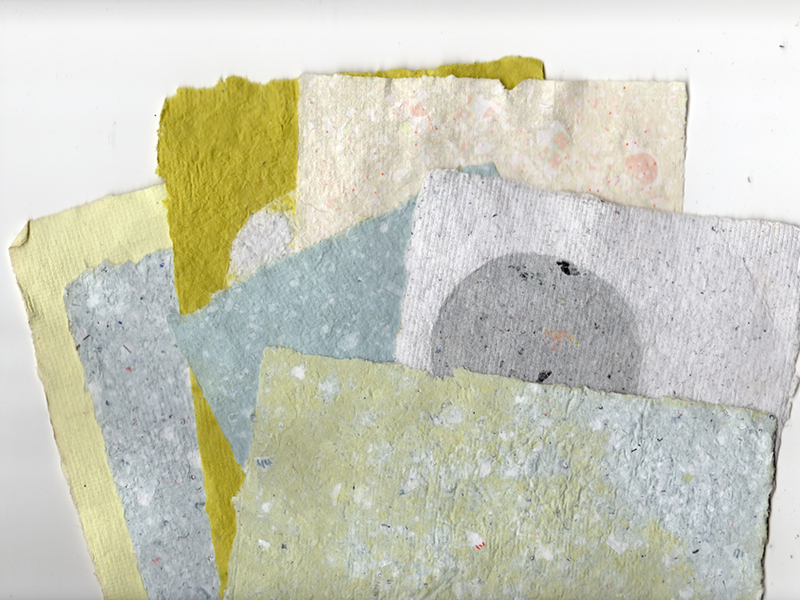
Typical papers made by recycling 


If you follow the simple steps in the guide, one thing you might consider is overlapping the small sheets as you transfer them from your frame, so that you can build larger and larger sheets. As you do this you can also embed other things into the gradually growing area of paper. This takes far more time, but much more ambitious projects can emerge from this. 

David Hockney: From the Paper Pool series

Essentially you are making what is normally thought of as a surface on which to make marks, into a substance that will make your visual communication directly. Either as in Hockney's 'Paper Pools', as a substance that carries the image directly by being 'painted' with, or as a material that can be applied as a new surface on other things, or as in papier-mâché, as a building material.

David Hockney came across the technique of working directly in paper pulp at the Tyler Graphics studios in upstate New York. This involved dyeing wet pulped rag papers, which were then applied in various ways to recently-created and still wet paper substrates, until once a satisfactory image was made, they were finally pressed flat and dried. There were opportunities for Hockney to manipulate the application of colour at all stages and the final result was a cross between paper-making, print-making and painting. I am learning new techniques in stained glass manufacture and in their very restrictions find invention. Hockney also found learning a new technique and its specific restrictions, facilitated invention. He realised the process could be very conducive to variations on a theme, in particular, swimming pools and the effects of different lights and movements on their water. In Paper Pools, Hockney addresses a formal and paradoxical problem: how do you depict the elusive, ever-changing qualities of a body of water, using a flat, stationary, two-dimensional medium? In these images, colour does not sit on the surface, it is fused and completely integrated. Like water itself, light and movement are subsumed into these works, and in doing this, Hockney is able to close a conceptual loop between what is represented and how to represent it.

Peter Gentenaar and Patricia Torley are a couple who specialise in organic paper making. Their website also gives tutorials on how they work with paper, Patricia Torley in particular offers some fascinating insights into possibilities for painting directly in paper and Peter Gentenaar uses paper to develop three dimensional structures. 

Patricia Torley

Peter Gentenaar

Hockney has a much clearer grasp of the conceptual issues surrounding this type of approach to image making, but you can learn a lot of techniques and technical approaches to paper working from specialists like Torley and Gentenaar. 


Anthony Caro: Paper sculptures

Anthony Caro used paper casting processes to work through ideas for sculpture. He would press paper pulp onto smooth plaster forms, then cut, fold, squash and join the dried sheets to create ideas for sculpture. 

The artist Wangechi Mutu, often uses paper pulp. In her case she uses an oatmeal-like mush made from a range of papers and added ingredients that are chosen to give the work specific meaning, such as particular soils or coloured dyes. Mutu first came up with her paper formula when adding the final layers to the Afrofuturist sculptures she created for the 2015 Venice Biennale, wanting to recreate the organic look of mud-brick houses traditionally built by women in Kenya. 

Wangechi Mutu: Mirror, 2016
Paper pulp, soil, wood glue, and mirrors

This is her basic recipe:

Step 1: Shred enough paper to fill a one-gallon container. Fill three-quarters full with boiling water. The paper will absorb the water. Mix contents with a wooden spoon. 

Step 2: Cover container with an airtight lid and put mixture aside for a week. (If you have a strong good quality blender, at this point you might blend) Add two cups wood glue, and stir until all shreds are soaked in water and glue. The glue will lighten and fluff the mixture. 

Step 3: After the mixture sits for a week, it will be time to strain the pulp. Place a sieve over a bowl and pour the paper mixture in.

Step 4: Press on the pulp in the sieve with a spoon to remove excess liquid; discard liquid. Add half a cup of rubbing alcohol to the remaining paper pulp to kill bacteria. The texture should be the consistency of tacky oatmeal.

Step 5: Wearing plastic gloves, take a handful of the mixture and form a ball. Knead and shape it in your hands.

Step 6: Place the ball on a flat surface and sprinkle with coffee grounds, tea leaves or paint pigment on the surface. Compress the ball and add more pigment to stain it further and form a coloured coating. Add more liquid pigment to the mixture for additional colour. It now works like paper clay.

Step 7: Shape the paper clay mixture into a sphere, a sausage or whatever shape you desire and begin to explore its formal possibilities. Some forms will work but others will not. 

Step 8: Mould the paper clay over anything you might want to cast, or simply cover, by putting cling film over objects and pressing the paper onto them and then you can link to any other forms you might have made by laying more paper clay around, over and into joint areas and once again pressing tightly to adhere the mixture. 

Step 9: Set the forms to dry (ideally outside in the sun), where the colours will change and cracks may form. As you get used to this process you may begin to add reinforcing materials such as muslin. 

Wangechi Mutu: Sentinel IV 2020: Paper pulp, wood glue, soil, emulsion paint, charcoal, ink, coconut hair, Natal Rhus (Rhus Natalensis), Silver Oak (Grevillea robusta), Croton (Croton Megalocarpus) and Jacaranda (Jacaranda Mimosifolia)

Wangechi Mutu uses paper pulp to bring together various materials, so that they have one harmonious surface. She also mixes into her pulp locally sourced earth and colourants. The materials embedded into her 'Sentinels' all have specific meanings, for instance the African tree 'croton megalocarpus' is known for its high nitrogen content, and its leaves are often therefore used for mulch. Traditional medical uses for croton include the bark, seeds, roots and leaves being used for medicinal purposes such as the cure of stomach ailments, malaria, wound clotting, and pneumonia. This Sentinel also acts as a healer, and as a harbinger of the acute imperative to improve our relationship with each other and our planet or we will have to accept that environmental destruction will inevitably decide the fate of us all.

There is so much paper around that it is a natural material to use for anyone that wants to reflect on a society that creates too much waste. I am suggesting very home made ways of working with paper, but commercial print operations take the making of paper pulp prints to high levels of technical sophistication, in particular it is fascinating to see how the artist Chuck Close used paper pulp technology to have prints made of his portrait work. 

Paper pulp printmaking processes 

Paper pulp printmaking processes: Chuck Close paper prints

See also:

Paper and sustainability
On line books on paper
Research into paper
More thoughts about paper
Paper sizesPaper: Folding and the songs of trees

Friday, 7 October 2022

Paper: From conservation to art material


During the first few weeks of a fine art course the one material that is nearly always supplied for people to work on is cartridge paper. The fact that it's called cartridge paper because it used to be used to make cylinders or cones containing both the bullet and its gunpowder is though nearly always forgotten. 
A paper cartridge

History and the fact that everything ages are stories that can be woven around all materials and paper is so central to the production of art that it's worthwhile considering some of these narratives in more depth. If you go to the 'see also' list at the bottom of this post you will find links to stories already told about paper in this blog, but there are many more. 
There will be times when you need to either repair an old drawing or be in a position whereby someone wants to buy a drawing and wants to be reassured that you have thought about conservation issues. On the other hand it may be that you want to work with papers as building materials and want to make sure that all the materials you use will last and be compatible. 
If you need to ensure that your papers are of the highest quality just make sure that you get your paper from a reputable manufacturer or art supplier such as Atlantis, Lawrence, Strathmore, Canson, Arches or Fabriano etc. however you may not want to use expensive acid free papers, you may want to make your own, embed found papers into your work or use the fact that some papers are acidic and easily light damaged as a specific quality that is used as part of your idea. Paper is a material that is easily effected by dampness, acidity, dirt, insects or fungi and can have a very short life span and if you don't have to worry about conservation issues, you can work with a cheap paper's propensity to be easily effected by the changing world and build in an acceptance that your work will change over the years. 

Daniele Del Nero: After Effects

Daniele Del Nero uses the mould that grows on paper to give life to the miniature models he makes out of it. He uses damp paper's susceptibility to mould as a central aspect of his working process. 
In many ways we are foolish in thinking that we can hold back time and I strongly believe that artworks are for the moment, Del Nero's work bridges both these aspects, on the one hand he doesn't try to hold back time and yet on the other hand his work suggests the long unfolding of time, in that his models work like a speeded up film of a full sized world.  However some think that art is eternal, that old quote 'ars longa, vita brevis' suggests that art is long-lasting and life is brief. Perhaps as usual it is in the dialogue between these two standpoints that interesting things emerge. If you look closely at the image at the top of this post the classical head drawing is surrounded by mould spots, that look like a constellation of fungal stars. These signs of ageing add a second layer of meaning to the drawing's attempt to attach itself to classical values. The age spots verify the age of the paper and therefore enhance the drawing's associations with an ancient culture. The fact it is old gives the drawing a certain gravitas or worth. I'm reminded of the difference between icon paintings as used in Russian orthodox Christian ceremonies and the mud sculptures used in Indian Durga Puja ceremonies. In the case of the icons, they are often encrusted in gold leaf, and have semi-precious stones embedded within them and are treasured as doorways into an eternal religious experience, many of them are hundreds of years old, their value as spiritual guides related to their centuries of use, as well as the fact that their value in terms of materials used in their making, reflects their owners' awareness of a link between spiritual value and material cost. In contrast the Indian Durga Puja ceremonies have short lived statues of the Goddess Durga at their centre. These statues are made each year especially for the ceremony and use local materials, often from examples of earth taken from various local sites and once the ceremony is over the sculptures are put into the river Ganges and they dissolve back into the world they came from. Both objects are central to people's religious experience, but one is valued more and more as time unfolds and the other has a very limited use, the Goddess only 'inhabiting' her statue during the period of the Puja ceremony. 

A statue of the Goddess Durga being pushed out into the Ganges

Spiritual value can be earned over long periods of use within a religious context or it can be something that only enters into the situation at special heightened moments of ritual and both these situations can be seen to affect the way we might work with a material. 

Whether or not you are using paper at its archival best, or full of acids that will act to destabilise it and make it fall apart after a few years, a deep knowledge of the processes involved can be very useful. 

Sometimes you will want to engage with your paper in such a way that you want to ensure its integrity and if this is the case then you might need to think about your work from a paper conservationist's viewpoint. For instance, sometimes I tear or rip my paper and then later I want to repair it. I often use Document repair tape or transparent mending tissue for this. These are readily available from suppliers of paper conservation materials as are glues that are also designed to be used in conservation.

Acid free PVA

You might not think that glue is very important, but if you are working using various collage materials it will be vital. I have some collages that I made over 50 years ago and they have deteriorated considerably by now. 
The big issue with papers is acidity, for instance in an earlier post on Oak Gall ink I pointed out that some drawings and early documents written in this ink are now falling apart, because the ink is acidic, over time it will gradually corrode through a paper's surface. 
Sometimes you will need to use paper pulp to repair holes in your paper, this can also be supplied by specialist suppliers for the conservation industry. Once again what is initially used for one purpose can easily be used for another. Try drawing directly with the pulp, first of all to add texture to the paper surface, gradually as you get more used to it, you can dye the pulp different colours and employ it as an image making material in its own right. 

David Hockney: Paper pool 6: Coloured and pressed paper pulp

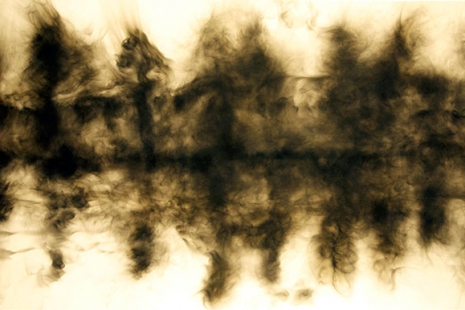
Conservationists use a wide variety of tools, many of which can be put to use by inventive artists. For instance, specialist dry sponges such as 'smoke sponges' made of either vulcanised or natural rubber, will effectively remove soot and smoke damage from papers but can also be used in conjunction with fumage techniques to make very interesting drawings.


Antti Keitilä: Fumage drawing

Some conservation specialists have ranges of tools that you cannot get elsewhere. For instance the American company Talas supplies a wide range of brass tools designed to work with paper, that you won't find anywhere else.  They are though very expensive and you would need items shipping. Even so the idea of exploring the possibilities specialist tools open out for you is a powerful one and it ties in very neatly with media specificity. Every tool that is new to you as an artist opens out the imagination and takes you places you have never been before. 

A Japanese push drill for cutting round holes in paper

A punch set for punching holes or embossing circular forms

Sometimes tools made to do other jobs, can be repurposed. The process of getting to know paper and what it is capable of is one that could take a lifetime and become a way of earning money as well as a way of making art. 

Jihyun Park: Using burning incense sticks to burn holes into rice paper

Jihyun Park

Just as with an icon, that becomes more powerful the longer it has been operating as a religious artefact, layers of meaning can build up around any object if there is a long term engagement with it. It is as if bits of the human lives that it touches rub off and become integrated into its fabric. Paper conservation also adds layers of meaning into the materials you are working with. The more an old sheet of paper is repaired and holes in it filled, over the years it develops a patina of use that becomes meaningful and the further away from its original use the more it seems to develop another meaning due to a nostalgia for lost uses. The old ledger papers below reflect the rise of computer technology, spreadsheets having replaced ledgers in most parts of the world. 


Old hand made papers

Edward Allington used old ledgers to draw on and the combination of a drawing style based around cross hatched pen and ink drawings and the old ledgers made for fascinating images, their subject matter suggesting questions about the status of Classical art within a modern context and the role of history in our lives. 

Edward Allington

Like everything else the more you research it the more interesting it gets.  
Of course if you are to repair papers you also need to know how they are made. For 500 years European paper makers could only produce Laid papers. This was a process whereby the papermaker would dip a mould into a vat containing diluted pulp of hemp or linen fibres, then lift it out, tilt it to spread the pulp evenly over the sieve and as the water drained out between the wires, shake the mould to lock the fibres together. In the process, the pattern of the wires in the sieve was imparted to the sheet of paper and the wet paper was then 'laid' down on a sheet of thick cloth or felt to dry.  Many artist's papers are still made in this way. In 1757 John Baskerville the printer began to use a new kind of paper, called Wove (known in Europe as Vélin). This paper is smoother because the mesh that the paper is strained over was 'woven' thus creating a much finer surface for the paper to sit on; one that could also work with shorter fibres, a fact that allowed for even finer papers to be manufactured.  James Whatman's name, the man who invented the process, still survives in the name of the company that produces industrial filter papers.  With the establishment of the papermachine (1807), the manufacture of paper on a wove wire base became the norm. Key to this process was the introduction of the Fourdrinier Machine, which uses a moving woven mesh to create a continuous paper web by filtering out the fibres held in a paper stock and producing a continuously moving wet mat of fibre. This is dried in the machine to produce a strong paper web, and today more than 99% of the world's paper is made in this way. 
You can however reverse engineer the process. If you tear sheets of paper up, soak the results overnight and put the soft torn fragments in a blender with plenty of water, you can reduce the sheets back into paper pulp and with pulp and paper sheet combinations you can just about shape any forms you like and when dry they can be coloured. Adam Frezza and Terri Chiao are just two of a wide range of artists that have built practices around the possibilities inherent in paper as a construction material. For LAU students if you want to try it out, the ceramics technicians have all the equipment you need as well as sheets of wood pulp that you can add into any paper mix to get a blend that is perfect for your needs. For anyone else there are lots of videos on YouTube about how to make your own paper and you don't need to invest in frames if you just want to start by using paper pulp to make things. 


Adam Frezza and Terri Chiao

However it could be that you approach paper from a very different angle, that of its position within a performance or action. In an earlier post on the languages of paper I pointed out that in certain prisons paper becomes central to an underground communication process. Within the average 6′ by 8′ cell with its toilet and two bunks, paper is one thing that is thin enough not to take up room and it can be used in a variety of ways.  Prisoners have access to books and magazines, writing and drawing paper, legal paperwork, letters and toilet paper. What most prisoners do with all those paper things ,  besides reading and writing ,  is make other things. Some of these items, like kites (messages, see earlier post) and crafts, (the prison paper mâchè recipe is toilet paper and water: wetted, moulded, dried and wetted again), are mostly benign, but some, like the paper or cardboard knife   are a threat to the safety of the prison. The act of creation is empowering and gives prisoners some measure of control over their strictly monitored lives. Yet even the unaltered paper object can hold power, such as the information and ideas found in books and magazines. All prisoners have access to a library, and there exists another, perhaps busier, underground lending library: books and magazines are passed around and letters shared, porn is bartered, and original pencil drawings are swapped for cigarettes. And so an environment of oppression becomes the mother of invention. With nothing but time on their hands, prisoners find ways to communicate, play, trade and fight each other and the system with altered paper, often in ingenious ways. New York Times report found that the narcotic Suboxone was getting into prisons using paper. Pills are crushed and then mixed into a paste and then very inventive ways are used to get the Suboxone into or onto papers. For instance in one case it was spread across the page of a child’s colouring book, its yellow stain then coloured over with crayon. Prison social worker Edward Matthews had this to say about the situation, “paper absorbs drugs like a lover’s perfume..." Paper in this case is a central performer in a powerful drama and as an artist this might be a very useful direction to take an idea into, especially if you felt the more traditional methods of working with paper were getting stale. I'm sure many of you have your own stories about paper and stories have a way of making themselves visible. 

Greig Burgoyne has used paper several times in his performances and it is interesting to see how he builds a very personal relationship with his materials as the performances develop. 


Greig Burgoyne 

As well as making art in a variety of ways with paper, there are of course jobs in this area and it could be that an interest in paper conservation could lead to a career that you had not thought about before. If you are interested in this area, look out for paper and photograph conservation technician traineeships, which are often associated with big national museum collections. 

See also:

Friday, 24 January 2020

About paper, about mobile phone screens and fingertips

Up close it's easy to see why paper is good at holding on to the grainy bits of charcoal or graphite as they break off. 

Rag paper

Cartridge paper

The fact is that a micro-world is going on all the time whilst we are drawing but is usually just below the levels of our perceptual awareness. Whatever we are doing, our consciousness of what is happening is very limited and we are therefore unaware of many of the consequences of our actions.
However we don't use pencils as much as we use our mobile phones in present day society, so I have decided to look at the contact made between the human fingertip and a mobile phone touchscreen. But before I do that I think its important to remind everyone that in many ways using our fingers to make drawings on our mobile phone screens links us back to a time of drawing with our fingers in mud or sand, the brush and the pencil being less sensitive devices that we are learning to do without. 

A close up view of a finger and a mobile screen

Touch relies on some pretty sophisticated physiology. 
Using a mobile phone requires using your fingertips to do lots of swiping and sliding (haptic tasks), therefore an awareness of how touch works is important if you are to begin thinking about what is happening just beneath the everyday surface of your consciousness. Touching something else is central to the process of change, it is contact that forms other things; for instance as wind blown dust touches a rock it slowly and inexorably begins the process of erosion, or if you want to get technical, aeolian processes are at work.

This sandstone outcrop has been carved by the wind

Contact can be rough and sudden, a bullet cuts into a wall as its force is spent, or slow and gentle, as the tiny shards of shells of micro organisms drift down through sea waters and settle to build up what will one day become chalk deposits or spasmodic, like the breaking off of flakes of charcoal as an artist makes a drawing on sheets of paper. 

Think of those things that you or others have touched over and over again, the polished toe of a venerated statue, the handle of a door that has been used for many years, you don't notice a change at the time, but something always happens when one thing comes into contact with another. 

The polished toes of a statue of bishop Grgur 

Touch shapes things, both the thing being touched and the touching finger is shaped by the contact. But we hardly notice what happens. It takes thousands of touches to polish Grgur's toes and each of those touches would have knocked a few cells off the end of someone's fingertip. Each stroke of your fingers across the screen of your mobile is also making things happen, a very complex series of changes are taking place, and you are being changed by the contact, so lets see how.
Human fingertips can feel the difference between a smooth surface and one with a pattern embedded just 13 nanometres deep, or about a human hair width. Epidermal ridges on the surface of our fingertips allow us to differentiate between a wide range of textures, materials, temperatures, and pressures. We all have a unique pattern of these fingerprints but the pattern is not crucial to the function. Their importance is that just underneath the ridges are mechanoreceptors that respond to tactile stimulus. Friction caused by movement of the fingertip along the surface of the computer screen stimulates these mechanoreceptors, which then transmit tactile information to the brain. Your skin has three layers and receptors that let the body sense touch are located in the top two layers of the skin; the epidermis and the dermis.


The epidermis, the outermost layer of skin, also provides a waterproof barrier and creates our skin tone. The dermis, beneath the epidermis, contains tough connective tissue, usually hair follicles (our fingertips are hairless) and sweat glands and the deeper subcutaneous tissue (hypodermis) is made of fat and connective tissue. 

The epidermis has itself five different layers. Stratum basale, stratum spinosum, stratum granulosum, stratum lucidum and stratum corneum and if you look at the diagram below you can see how the shape of the cells allows the top layers to flake off, (dead cells) providing an ever changing and very interesting surface that is central to what happens when we touch anything. We in effect leave traces of ourselves on whatever surfaces we come into contact with. Just as the charcoal is flaked off on contact with the drawing paper, we are ourselves being flaked off as we drag our fingers across the surface of our mobile phone screens. This is an on-going process, new cells being formed at the junction between the dermis and epidermis, which slowly work their way towards the surface of the skin ready to be released in a process that constantly replaces shed skin cells. 

The epidermis

The receptors in our fingers are all part of the body’s somatosensory system, a huge network of nerve endings and touch receptors. This system is responsible for all the sensations we feel; cold, hot, smooth, rough, pressure, tickle, itch, pain, vibrations, and more. The four main types of receptors are; mechanoreceptors, thermoreceptors, pain receptors, and proprioceptors.
Different receptors collect different information, for instance a rapidly adapting receptor can respond to a change in stimulus very quickly, which means that it can sense right away when the skin is touching an object and when it stops touching that object. However, these receptors can’t sense how long the skin is touching an object. Slowly adapting sensors do not respond to a change in stimulus very quickly. These are very good at sensing the continuous pressure of an object touching or indenting the skin but are not very good at sensing when the stimulus started or ended. Both rapid and slow receptors respond to changes in pressure as you push your fingers across the surface of your mobile phone, these are ‘mechanoreceptors’; receptors that respond to sensations such as pressure, vibrations and texture and their only function is to perceive indentions and vibrations as they effect the skin. The four types are; Merkel’s disks, Meissner’s corpuscles, Ruffini’s corpuscles, and Pacinian corpuscles. The most sensitive being Merkel’s disks and Meissner’s corpuscles. Merkel’s disks being slowly adapting receptors and Meissner’s corpuscles rapidly adapting receptors, enabling your skin to perceive both when you begin touching something and how long the object is touching the skin. Therefore that moment when you first touch your mobile phone screen is signalled to the brain by your Meissner corpuscles, Merkel’s disks then take over telling the brain that this is a continuous activity and when you take your finger off the screen, Meissner corpuscles signal the change. This is all going on in the epidermis and outer layers of the dermis and located deeper in the dermis and along joints, tendons, and muscles of your finger are Ruffini’s corpuscles and Pacinian corpuscles. These mechanoreceptors can feel sensations such as vibrations traveling down bones and tendons, rotational movement of limbs, and the stretching of skin. These are helping you control that finger and apply changes in direction and pressure to it as you decide to do the things you need to do with your phone. However that is not all that’s happening, the screen might be warm or cool to your touch, depending on perhaps how the system is working, for instance a flaw could be causing the device to overheat and you will be made aware of the danger by ‘thermoreceptors’; receptors that pick up sensations related to the temperature of objects the skin feels. They are found in the dermis layer of the skin and they are divided into hot and cold receptors. 
Your phone’s screen may however be broken, and if so you might prick your finger on one of the edges of the broken screen and in this case ‘pain receptors’ will come into play; these are the nocireceptors. They can detect pain that is caused by mechanical stimuli (cut or scrape), thermal stimuli (burn), or chemical stimuli (poison from an insect sting).These receptors cause a feeling of sharp pain to encourage you to quickly move away from a harmful stimulus such as a broken piece of glass or a hot stove top. They also have receptors that cause a dull pain in an area that has been injured to encourage you not to use or touch that limb or body part until the damaged area has healed. 

There are other receptors that are vital to your holding a phone and these are the ‘proprioceptors’ or one’s own awareness-of-self receptors. They sense the position of the different parts of the body in relation to each other and the surrounding environment. Proprioceptors are found in tendons, muscles, and joints. These cells detect changes in muscle length and muscle tension, i.e. without them you would be dropping your phone all the time because you would become totally uncoordinated. 
While many receptors have specific functions to help us perceive different touch sensations, you never find just one type active at any one time. When using your phone, your hand can perceive many different sensations just by holding it.

Mechanoreceptors can sense that your hand is stretching around your mobile, whilst at the same time sensing that pressure is being exerted to both hold the phone and push your fingers around the phone's screen surface. 
It’s also important to remember that when your fingertip touches that screen, the mechanoreceptors that are activated begin a chain of events by signaling to the nearest neuron that they touched something. This neuron then transmits this message to the next neuron which gets passed on to the next one and on it goes until the message gets to the brain. Now the brain can process information received about the surface that your hand touched and send messages back to your hand via this same pathway to let the hand know what to do next in order for the brain to carry on getting more information. 

Your brain though gets wildly disproportionate information about touch from different parts of your body. The fingers you are using are packed with sensors, but other parts of your body, such as your back, have very few, reflecting the fact that we have very different relationships with various parts of our body. 

How touch sensors are represented in the brain

The part of your brain that processes touch information has embedded within it a very distorted map of your body. It over-represents areas that have lots of fine touch receptors (like the face, the lips, the tongue, and the fingers) and under-represents areas that don't have many receptors. This ‘map’ is constantly changing, because areas of the touch-sensing parts of your brain that you use a lot tend to expand and take over neighbouring territory. Therefore the area of your brain that processes information from fingers used to control your mobile, will expand the more you use them. 
This relationship that we have with the mobile is very important because there is another system at work, the emotional touch system, which is mediated by special sensors called C tactile fibers, and it conveys information much more slowly. It's vague in terms of where the touch is happening, but it sends information to a part of the brain called the posterior insula that is crucial for the development of socially-bonding touches; such as a hug, holding hands, or sexual foreplay. 

This is where it gets creepy; the touch screen of your mobile is looked at with the same intensity as you would look at a person that you were sexually attracted to, when you brush your fingers over the touch sensitive screen, it is exactly that, touch sensitive, just like those people who we have intimate relations with. The screen is made in layers just like human skin, it’s smooth texture is very like skin, it gives slightly as you touch it, just like skin, its slightly warm because you keep it on your person and most importantly you have built up an emotional relationship with it just as you would another human being. Therefore unlike most other objects, engaging with your mobile can cause C tactile fibres to be triggered. You adjust the speed of your finger as you stroke, so your vibrational senses are able to detect slippage and friction, but you are not just seeking surface change, you are adding in an emotional feeling as you would when relating to another human being. This sort of makes sense because the mobile is mainly used to communicate with other humans, but because we invest so much of our emotional energy in this device, we have little left for other humans. 

But what about the thing being touched? The mobile phone screen often gets pretty battered in the contact improvisation dance it has with human beings. 

 
A detail of Duchamp's large glass

Formally the broken glass is reminiscent of Duchamp's 'Bride Stripped Bare' which was also broken by accident, and the results finally embraced as a chance action that seemed to be an acceptable part of the work's journey. An example of contact improvisation, where  the artist accepted that the elements outside of his control were giving as much to the work as himself. 

However, the screen is not designed to be broken, it is designed to be touched and there are various ways that designers have come up with to make sure that when you touch a screen the information is transmitted to a phone's operating system. 

The touch screen on a mobile phone is a display that can locate the presence and location of a touch within the display area. It needs a minimum of three components to be able to get information to the phone's operating system, a touch sensor, controller and software driver. 

I was still at art college when the first touch sensor was developed in 1971 by Sam Hurst at the university of Kentucky, so you are working with technology that is already 50 years old. 


The touch sensor is usually a clear glass panel with a touch responsive area, this is placed over a display screen, so that the responsive area covers the viewable area of the screen.  I.e. if you can see an icon you can touch the touch responsive area above it.  An electric current is made to pass through the touch sensor, this carries signals which are changed when pressure is exerted on the screen and the change in a signal is used to determine the location of touch on the screen. The controller connects the touch sensor to the computer operating system in your phone. It takes data from the touch sensor and translates it into information that the computer can understand. 


A controller component, in this case a MPR121, is designed to work with the specific technology that the screen uses to collect data and has lots of pin connections because of the need to connect up a complicated array of sensors all collecting information about where your finger is touching the screen. In this case the technology is capacitive, which is the system an I-Phone uses. 


Diagrams showing typical connections and links to electrical power supply 


Before I move on to look at the workings in more detail, it's I hope worth reminding you how important drawing is to coming to an understanding of all this complex information, the diagrams above are both beautiful and informative, and cross over disciplines. 


The software driver allows the touch screen and the computer to work together. This is very like what happens when you add a new printer to your PC, you always need to install new driver software in order to get access to the printer. The driver ensures that a touch on the mobile screen operates the same way that clicking and moving your mouse operates in relation to a computer monitor.  It tells the mobile phone’s operating system how to interpret the touch information event that is sent from the controller. 

A capacitive screen such as that used on an I-Phone, consists of an insulator like glass, coated with a transparent conductor like ITO, (Indium-tin-oxide). Touch then distorts the screen's electromagnetic field, which is measured as changes in signal intensity along both x and y axis. More than one layer is used so that separate information can be collected from each axis and then coordinate points plotted. 


Projected capacitive panels have multiple sensors, which means that they can detect more than one pressure difference at the same time, i.e. you can use more than one finger at the same time. 

When a fingertip comes into contact with a capacitative touchscreen, it uses the electrostatic conductivity of the human body as a means for input. Unlike resistive type touchscreens, electrostatic capacitive touchscreens are highly responsive, but if you turn your finger over and try and use your fingernail, you will find that nothing happens. This is a good way to test out what sort of screen technology your phone uses, it also explains why I-Phones are so sensitive to wet conditions. 


So if you are making a drawing on your I-Phone, your own body's electricity is being used at the point of contact. Capacitive touch-screen technology means that you aren't limited to simply pressing the screen in one place. The iPhone can detect the difference between your pressing the screen with one, two, three or four fingers. It can also detect gestures such as swiping or pinching. This sensitivity gives you a much wider range of controls for each individual application. It also helps make the user interface much more intuitive. For example, programmers can map your finger swipes to scrolling through a long page, or pulling two fingers apart to zoom in on an image. However for drawing purposes when you might want more pressure sensitivity a resistive type touchscreen could be better. Going back to that graphite pencil point breaking off onto the surface of the paper, its H or B grade could be seen as analogous to whether the touch screen is capacitive or resistive. 

Just as your internal sensing system uses a variety of inputs to determine what is happening at your fingertip, the mobile phone is using a variety of inputs to determine what is going on at the point of contact, so when you draw on your phone, as with all media, it is partly you and partly the media that shapes what happens.

Technical drawing of an I Phone

However the I-Phone was once an idea in someone's mind, and as such this was realised as a technical drawing before it was manufactured. Therefore you might want to think about its fascinating 'thing' history in more detail, especially as information begins to become entangled into a knot of correspondences. For instance indium-tin-oxide (ITO) a material that is used in mobile phones because of its electrical conductivity and optical transparency  as well as the ease with which it can be deposited as a thin film, is also very expensive. The high cost and limited supply of indium is a real problem, as well as the fact that during the process of mining, production and reclamation, workers are exposed to it. It is mainly mined in China, Japan, USA, the Republic of Korea, and Canada. Indium lung disease is developed through contact with indium containing dusts and there are several proven cases of workers coming into contact with indium, developing conditions such as pulmonary fibrosisemphysema, and granulomas. As I drag my fingertip across my phone's surface in order to make a small drawing in its note application, at the same time a mine worker is developing granulomas when his or her immune system attempts to wall off substances it perceives as foreign but is unable to eliminate because their body doesn't usually have to ward off long term exposure to indium. 

A granuloma

As usual with these long posts I'm beginning to ramble, but hopefully the point has been made. As I pointed out at the beginning of this post, our consciousness of what is happening is very limited and we are unaware of most of the consequences of our actions. Drawing on a mobile phone is no different to drawing with a pencil, both are about the contact made between one thing and another, both are media specific, both on contact with something else cause change to happen at a macro and a micro level and our awareness of all these things is always partial. Pencils have long chains of conditionality* behind them and so do mobile phones and as people that use both of them, the more aware you are about what goes on the more choices there are as to how and why you might use them. 

* In Buddhist thought Pratityasamutpada means 'dependent origination' or 'conditionality'.  It can best be understood as the interconnectedness of all existence or each and every action has a consequence.