This small drawing by Linnaeus, the father of plant classification, is a wonderful example of hybrid thinking. The text reads, "Andromeda, Fiction that is true, Mysticism that is genuine, Forms that are depicted". Linnaeus in his drawing echoes my own thoughts, between a wanting to understand, a longing for enchantment and a need to just experience wonder as I walk through the woods and draw. He also, I hope, speaks across the centuries to all of us, at least those of us that daydream. My recent post on Gerard E Cheshire and his translations of old biological manuscripts, hopefully highlighted a particular way of thinking that I believe we should be revisiting, especially if we are to re-discover ourselves and our relation to the world.
My wife likes to swim in wild places, something she started to do once swimming baths were closed due to covid. She was swimming the other day and an empty vodka bottle landed very close to her. It had been hurled into the water from a small party of people who had decided that the lakeside was just right for a get together. She shouted at them to be careful and to not treat the place with such disrespect, but they simply denied that they had thrown it. When I walk down my street I see the same disrespect, people have too much stuff and they dump it, I have even seen plastic cartons of half-eaten takeaway food thrown out of car windows as people drive past. Something has been broken, the connection between doing things and their consequences has shattered and it needs mending. Old belief systems no longer seem to work in our society and we need to develop a willingness to change a culture of consumption, waste, and an everyday acceptance of environmental degradation. There was a very interesting article in the April 2011 issue of 'Anthropology Now' about the culture of repair that had grown up in Cuba after the revolution; 'Recycling History and the Never-Ending Life of Cuban Things' by Sarah Hill. After many years of trade blockades Cuban people had become adept in the repair and recycling of all sorts of products, the socialist regime they have lived under for many years, being a tiny beacon of light for those who never really believed in the triumph of capitalism. This repair culture is for me about caring. It might be enforced because the endless supply of goods was cut off by the trade embargo, but by having to return and look again at something when it is broken, people were forced to see new potential or a future for things that we would just throw away. In this case working objects become more like events that have relationships with us, relationships that mean we treat them more like old friends and because of that we begin to give them due care and attention. Our world of science dominated capitalist structures is in Federico Campagna's terminology a 'technic' society, a culture that attempts to understand the world through an 'absolute language', a language of measurement and of the precise allocation of words to things. He contrasts this with an idea of 'magic' that centres a reconstruction of the world around the notion of the 'ineffable'. In his book 'Technic and Magic: The Reconstruction of Reality', Campagna states that 'under technic, the foundations of reality begin to crumble, shrinking the field of the possible and freezing our lives in an anguished state of paralysis'. In our present society when we are faced with a broken object we rarely see a possibility of reconstruction, but the success of 'the Repair Shop' as a TV program, perhaps reflects the fact that we are all aware of the need to rethink our relationship with objects that come into our lives. In fact the care that goes into a repair can become part of a personal philosophy, the Japanese art of kintsugi being about embracing flaws and celebrating the time spent repairing things. If we believe that all things hold within them a certain 'magical' something, a type of vitalism, then perhaps we might offer them a longer and more cherished existence and see them as 'creatures' that exist alongside ourselves, rather than just objects to be used. I am beginning to think that we really do need to develop contemporary forms of animism or an equivalent belief system, if we as a species are to survive the next hundred years.
Everything is interconnected, but science our main source of knowledge atomises the world in order to understand it. By pulling everything apart I think we have in effect begun to dismember the very world we were trying to understand. In being objective we have pulled ourselves apart from the world. This has led to a situation whereby we are finding it much harder to be in touch with our environmentally rooted feelings anymore, because we have lost meaningful connections, and sympathy with the non human world has eroded away. Objectivity, the standing aside from the mess of interconnectedness that is the world, has unfortunately led us down a dark, blind alley. We have begun to focus more and more on our feelings for ourselves and are trying all the time to feed those feelings and enhance them, but our existence depends on us being interconnected with everything else around us. As we think about ourselves and our needs, we need to be equally able to feel for the rest of the world and its needs as well. This requires a connection with and a real sympathy to others and other things. Frazer in the Goldern Bough stated 'like produces like'; and in many cultural traditions the concept of sympathetic magic plays a crucial role, especially when a person can be affected magically by actions performed in conjunction with objects interacting with themselves or aspects of their lives. I have seen elements of this when I have been working with votives and although there is no logical explanation, have seen people overcome pain, by passing it on and into an inanimate object.
The roots of plants are like the legs of an octopus, so why cant a plant think like an octopus? A yellow flower looks like the sun, so why cant it shine and light up the world in the same way? The earth beneath my feet is also soil, so why cant I think of myself as a plant nurtured in the soil of my birth? These are poetic ideas, visions whereby the unconscious streams of intuited connections are given birth and allowed to be seen. In the company of poetry, logic can at times be barbaric.
I have just been reading Pablo Neruda's 'Memoirs' and he reminds us all of how the poetic imagination can also be a political one. The desire to seek what is true and right can also be driven by an inspirational poetics. In fact I get the feeling that without poetry politics is cruel and a sensitivity to the plight of others is lost within the setting of revolutionary aims and objectives and the desire for power. Perhaps poets will always be in the end disappointed by reality, but during those moments when they are truly lost in the finding of words, sometimes I do believe that they can touch the future.
From: The Stones of the Sky
It is impossible to translate poetry accurately, but if you read a translation of 'Stones in the Sky', a small chapbook written by Neruda at a time when he realised he had cancer, you get a sense of how his mind made connections between things and how he sees himself and by extension ourselves, as being contiguous with the rocks of the earth. In poetry we are both what we are and what we are thought to be and as the two merge a very different truth to that of the scientific emerges.
Mary Midgley wrote a whole book on the problem, 'Science and Poetry', which I found a bit of a struggle to get through, I felt she had replaced the poetry by academic learning. The humanities are so in thrall to science that they often try too hard to 'prove' their point, when what should be happening is a new non linear approach explored. However the book is still a useful read and she reminds us that in previous times 'the idea of explaining natural phenomena in terms of sympathies and attractions between various substances within a wider natural system was prevalent among perfectly serious students as well as sorcerers.' (2006, p.57) I.e. 'magic' as an idea was central to science at one point, not in a supernatural sense, but rather in the sense that things and their workings were mysterious and that they could not be fully understood. Science for all its bravado, has to every now and again be faced with stuff like dark matter, and when it is, we are all reminded of how little anyone really knows.
Material conglomeration
Just over a year ago I was asked to contribute to an exhibition reflecting on our personal understanding of domestic objects. I made a range of things out of stuff that would have been thrown away; the 'sculptures' were exhibited and at the end of the exhibition pulled apart and recycled. The interesting thing for myself was that as I made them they began 'talking' to me. They took on a life of their own. They had become 'creatures' beyond logic, now operating within the bounds of poetry. After I cut them up and we put all the components into recycling bins, I felt both a sense of release and sadness. Release because they had begun to occupy some part of myself that I didn't want them to, and sadness because in many ways they were now 'familiars'; supernatural entities that had assisted me in visualising my ideas about sustainability. Without science I would not be aware of the need for sustainable action, but without the poetics of art making, I would not have found these totemic forms. They were in my mind vitalist entities and I know other people were intrigued by them, recognising that the objects had some sort of presence. I'm about to embark on a similar way of working so I shall see if the same thing happens once I begin bringing found materials together again.
The search for the mythic in relation to science is not just about artists being more attuned into the concerns and interests of scientists, it is also about scientists being more in touch with the techniques and procedures of the arts.
Santiago Ramón y Cajal, the father of neuroscience, was also an artist. If you look at his drawing of a cut nerve outside the spinal cord, you can see his high levels of ability to look and invent from the looking.
Santiago Ramón y Cajal: A cut nerve outside the spinal cord, 1913
He has extrapolated what he was beginning to see and allowed the drawing to become a vision that then allowed him to think about what he was seeing.
Santiago Ramón y Cajal: Glial cells of the mouse spinal cord, 1899.
Santiago Ramón y Cajal. Glial cells of the cerebral cortex of a child, 1904
Santiago Ramón y Cajal. Calyces of Held in the nucleus of the trapezoid body, 1934
All of these images have helped with the science community's visual grasp of the physical nuts and bolts of neuroscience, and all of these drawings I would contend are also imaginary inventions based on what he thought he saw. Remember how a line works when you use it to draw from life, it abstracts and simplifies by its very nature and as you draw you need to decide what is rendered and what is left out. I see these images as being as magical and as inventive as those of Paul Klee.
Quantum field theory has become a widely discussed topic in both the philosophy of science and in philosophy informed by scientific discovery. It has had an impact on philosophical and scientific research methodology, has begun to change the way we view semantics and most importantly has re-opened out studies into ontology. In its metaphysical implications it sometimes seems to give a picture of the world which is totally at variance with the central classical conceptions of quantum mechanics and the way we imagine particles and fields. Perhaps even more importantly, much of this has been achieved without many people actually being able to grasp what quantum field theory actually is.
The idea of the shaman appears to follow certain principles that reflect underlying neurological processes. An idea of evolutionary theology has emerged from this awareness, i.e. that we are hard wired to produce such concepts as animism, totemic spirits, death and re-birth experiences, because they help provide a platform for the construction of consciousness, a facility that has evolved out of biological survival needs. It has been argued elsewhere that consciousness isn't about reality, but is more a device to allow us to make decisions, especially about things we cant perceptually know, but which intuitively we grasp as being important to the preservation of our wellbeing. (See 'Shamanism as the original neurotheology' by Michael Winkleman) Perhaps once the complex cultural constructions that surround us begin to fall away, these pre-historic responses to an understanding of the world, will be seen to not only still be in place but still operating.
The artist Emery Blagdon was very interested in electronic fields and he believed that these had healing powers if properly channelled. This was not a new idea and it has been proposed by many eastern religions as well as more modernpsycho-aesthetics (The study of the psychological aspects of aesthetic perception). Blagdon's 'healing machines' are made of wire as well as any found bits and pieces of electrical machinery that he thought could be used to trap or re-direct magnetic energy. They operate as three dimension spiritual circuit diagrams. In my mind I linked his sculptures to the diagrams that the monks lavished so many hours illuminating in Walter M Miller's classic science fiction novel of a post nuclear war future, 'A Canticle for Liebowitz'. Like the complex illuminated technical drawings that the monks produced in Miller's novel, the twisted wires become elaborations that are impossible to follow, but which have an implied authority that suggests it all must mean something.
Emery Blagdon: Wire energy traps
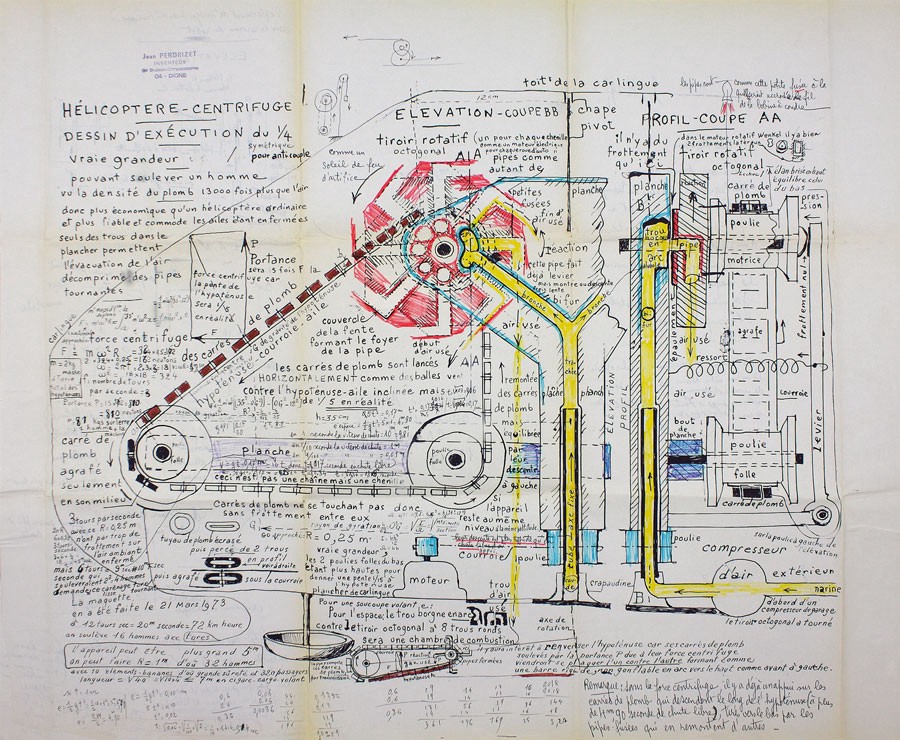
We are asked by physicists to accept that all sorts of energy fields are in fact underlying our material world. Blagdon however believed in these fields intuitively. In fact many non western cultures seem to have some sort of belief systems that contain ideas similar to energy fields, ideas that in Blagdon's world you might call techno/magical speculations. Jean Perdrizet, another outsider artist, was also a man interested in speculating about the universe and how it operated.
Jean Perdrizet: speculative engineering
Jean Perdrizet's diagrams are what you might call designs for symbolic devices or speculative engineering. Each drawing is in effect an invitation to reconsider the possibilities of physics and he embeds into his diagrams his self devised mathematical code as 'proof' that what he is revealing to us is based on some sort of reality. But are these 'Outsiders' really so far outside the norms of everyday reality? What if they were conceptually positioned alongside those scientists telling us that visible light can hold vast amounts of information and that data can be quantum entangled with photons from anywhere else in the Universe? Ideas such as those exploring how information can be exchanged between any two parties no matter how far apart in the universe they happen to be are emerging from a current understanding of quantum entanglement and possible future means of communication might be developed from this understanding. All this makes what were science fiction ideas, appear to be on the one hand more and more realistic and on the other hand more and more fantastic. It is in these frayed edges between science and intuition that myth may well emerge again, it may cloak itself in the magic of the mysterious and perhaps lead to a re-enchantment of the world we live in.
Paul Feyerabend, in his book 'Against Method' had this to say, 'For is it not possible that science as we know it today, or a "search for the truth" in the style of traditional philosophy, will create a monster? Is it not possible that an objective approach that frowns upon personal connections between the entities examined will harm people, turn them into miserable, unfriendly, self-righteous mechanisms without charm or humour? "Is it not possible," asks Kierkegaard, "that my activity as an objective observer of nature will weaken my strength as a human being?" I suspect the answer to many of these questions is affirmative and I believe that a reform of the sciences that makes them more anarchic and more subjective is urgently needed. (1993, p.154)
Feyerabend invented the term 'epistemological anarchism',which holds that there are no useful and exception-free methodological rules governing the progress of science or the growth of knowledge. Feyerabend states that the idea of the operation of science by fixed, universal rules is unrealistic, pernicious, and detrimental to science itself. He at one time described himself as a Dadaist and had a reliance on Dada as an approach to any form of pomposity or rigidity in thinking. Deep down I think he just thought if it wasn't in the end open to being funny, it wasn't worth bothering with. All of which helps when looking at that bigger problem of humans and the way they have brought to world to its knees.
I watched news footage last night of the Taliban riding through dust blown Afghanistan streets on long columns of motorbikes, and was reminded that religion can be even more fascist and doctrinaire than science and that although many atrocities were committed in the name of the 'scientific' principle of eugenics, there have been even more atrocities committed in the name of all the different religions of the world. Knowing what is right is perhaps the worst thing to know. It breeds intolerance and eradicates wonder and mystery. In my confused way, perhaps I'm arguing for a celebration of confusion, for an allowance of crazy ideas and for the cessation of constant measurement and data collecting, which seem to be at the centre of so much present day anxiety.
Trying not to take it all seriously is a serious issue. I'm in the middle of reading about Charles Henry and the formation of a psycho-physical aesthetic. This sounds serious stuff and it sort of is, but Henry in some ways also became the model for Alfred Jarry's 'Doctor Faustroll', who was in Jarry's terminology a 'pataphysician'. Jarry describes pataphysics as an examination of 'the laws governing exceptions, and will explain the universe supplementary to this one, since the laws that are supposed to have been discovered in the traditional universe are also correlations of exceptions, albeit more frequent ones, but in any case accidental data which, reduced to the status of unexceptional exceptions, possess no longer even the virtue or originality'. Henry in his own way was trying to describe the universe supplementary to this one. His systems of thinking about colour and symbolic form follow the rigour of mathematics and 'scientific' data assemblage and he did invent the aesthetic protractor which is a device all of us ought know how to use. If I could, I would use it myself to find the angle of naked pain, but I have in my dotage even forgotten how to use a slide rule, only remembering that paradoxically the slide rule was not meant to be used for measuring length or drawing straight lines, but was an sort of analogical computer. The aesthetic protractor allows for the systematic evaluation of colours and the forms they take, in order to clarify their aesthetic qualities. These qualities are themselves derived from Henry's self devised psychophysiological principles of dynamogeny and inhibition in relation to a theory of rhythm related to prime numbers or their reciprocal fractions. He also devised his own colour circle, so you could use the protractor to find out exactly where a particular colour might sit and its occurrence could then be related to amount and position. Somehow Seurat was able to use these theories to devise compositional structures for paintings. (Read all about this in Seurat and the Science of Painting, by William Innes. Homer)
Charles Henry's Aesthetic Protractor
I have for a while now been following artists and others who have been able to use diagrams to visualise their world view, and as I struggle to think through what it is I'm really trying to understand, here is another artist to look at who has used diagrams as some form of visionary architecture, Paul Laffoley.
Paul Laffoley
Paul Laffoley attempts to fuse science with Eastern religion and philosophy. He is also using info-graphic processes which help give his work more 'conviction' than those outsider artists that use hand drawn diagrams. However as he does so his work becomes not that dissimilar to the work produced by professional graphic designers who are employed to draw up visualisations to help physicists try and communicate their concepts to lay audiences.
A graphic representation of the Lie group E8
For example, mathematicians have mapped out perhaps the most complex abstract structure ever conceived, a 248-dimensional representation called the Lie group E8, which was first predicted in 1887 by the Norwegian Sophus Lie. In fact the result may hold the key to a unified theory of physics. Which as far as I can see is also a myth. The full E8 map includes almost 100 times as much data as the Human Genome Project. A “group” is a set of objects, together with an operation, that exhibit certain symmetries. Lie groups are fundamental to physics. All the particles and forces in the standard model, the dominant schema of modern physics, are represented by Lie groups, and their study has become an essential tool for understanding, and attempting to unify, the laws of nature.
Damián Ortega Cosmogonia domestica
Damián Ortega's 'Cosmogonia domestica' is a good example of what Paul Feyerabend would term 'epistemological anarchism'. His is an art that attempts to make the quotidian or everyday world mythic. He replaces models of the planets with objects found in our day to day life, thus elevating them into a cosmic dance. The engineering and structural mechanics that are needed to do this are both of course significant and the construction of the piece reveals a form that humans have turned to many times as they have contemplated that need for a bigger deeper understanding of what's out there.
Damián Ortega 'Cosmogonia domestica
According to the Hindu religion there is one ultimate reality—Brahman. That ultimate reality in relation to the world is Isvara. He has the three functions of creation, maintenance and destruction of the universe and then He is represented by Brahma, Vishnu and Siva.
Two types of symbology may be noticed in Hinduism. First, the sound symbols found in the mantras and secondly, the form symbols of different types of figures, revealed by conceptions of deities, the anthropomorphic forms which are often worshipped. The images are built according to the dhyana-slokas (meditation verses) of the particular deities. The images of the deities as well as the mantras referring to them are embodiments of consciousness itself. They are based upon the idea of the Mantra Sastra, which points out that every form has a corresponding sound at the back of it and every sound must have a form.
Tibetan mandala in the OM form
The sound Om is made up of three Sanskrit letters, aa, au and ma which, when combined, make the sound Aum or Om. This most important symbol in Hinduism, is chanted in every prayer and invocation to deities. Om is not a word it is an intonation, and is believed to be the primeval sound of the world and to contain all other sounds. It is a mantra or prayer by itself. If repeated with the correct intonation, it can resonate throughout the body so that the sound penetrates to the centre of one’s being, the atman or soul. When Om is chanted a vibration is created that synchronises with the cosmic vibration.
It is perhaps this idea that we are all looking for. An idea that is thousands of years old, but which still resonates.
Visualisation of OM
This particular 'OM' intonation is meant to be able to repair DNA sequences. Somewhere around here is one of the frayed edges I'm grasping at, a thread that I need to hold on to if I am to finally weave my own cloth.
We are yet to return to university and it is still unknown as to how we will be hosting the fine art course, online or back physically in the studios. However if you are reading this post as part of your preparation for next year, I would hope that it helps in that realisation that as an artist you will need to forge your own understanding of what is happening around you, and that any understanding can still root itself in meaning structures thousands of years old. The search for meaning is an ever present aspect of the human condition, perhaps an over rated one, but never the less it is a process that people from all cultures and times would recognise as being vital to finding your position within the universe. As a student you are also, like everyone else, a student of life.
Geometry has been central to the way human beings have visualised ideas for thousands of years. However most users of geometry don't understand the mathematical principles that lie behind its success, they operate, especially if they are artists like myself, somewhere between maths and instinct. Those that don't normally use geometry will of course still make images and often powerfully emotive ones, but it is when the two approaches combine, that I think unique and fascinating images can arise.
For instance, Gaussian probability field graph paper is manufactured for the use of visualising mathematical statistics and graphing the appearances of random variables, but it is also used by the artist Nikolaus Gansterer to draw on. Nikolaus Gansterer's work is typical of artists that sit in that field that sits between art and science, his working processes are informed by logic and an idea of experimental research, but his working process is also informed by instinct and an artist's logic.
He also uses various drawing devices which operate rather like a scientist's apparatus, (see an earlier post on this) and by doing this his work begins to take on a degree of authenticity that stems from the rigor of adherence to the processes that he has evolved. He talks about these drawings as 'interrogating the relationship between empiric and subjective truth', and uses both hands to draw them with. The 'right' hand being the one in control, the 'other' or less used hand being the one that expresses a degree of 'un-control' or expression. You can download probability field graph paper from here. You don't have to understand how it is used, but as soon as you print it off, it exudes an aura of mathematical and scientific 'knowing'.
These rough drawings of ideas (above) seemed to take on a certain 'reality' or 'conviction' as soon as they were done on graph paper.
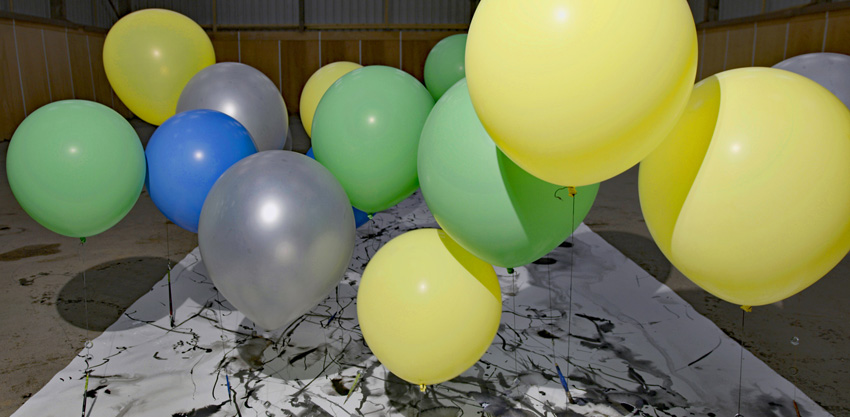
Kate Hammersley: Helium drawing
Kate Hammersley has a particular interest in materials and materiality, in particular in the way flow and flux is exhibited when materials come together. She was the first artist-in-residence at the University of Oxford Department of Engineering Science and in these drawings she is exploring both the material quality of helium and how balloons can be repurposed as drawing tools. Her apparatus in this case being the balloon environment she has constructed to enable the drawing. The final piece is usually shown as a video as the idea is durational rather than being about a fixed, static image.
Kate Hammersley: Helium drawing: detail
Karina Smigla-Bobinski: Ada
Interacting with other materials such as lighter than air gases can lead to some very interesting experimental situations. Karina Smigla-Bobinski's 'Ada' installation is a gradually developing drawing made by a sphere filled with helium and covered with precisely located and firmly attached charcoal sticks. She has taken on the idea implied by Hammersley and pushed it on much further. It is though at its core still a basic experiment using three dimensional geometry. What would happen if I made a plastic sphere, attached charcoal in a regular geometric pattern over its surface and filled it with helium?
Some artists sit in that gap between science and art, whereby an experimental approach is associated with the open ended 'I wonder what will happen if ?', attitude. An attitude that I believe should belong all scientist and the fine art practitioners. The geometric opposite of a sphere is a hyperbolic surface. A flat, or Euclidean, plane has zero curvature. A sphere has positive curvature. A hyperbolic plane has negative curvature; it may thus be understood as a geometric analogue of a negative number. Negative spaces have intrigued artists as much as scientists and mathematicians, therefore it is no surprise to find this area rich in possibilities for crossovers between disciplines.
Structures that have emerged from the Coral Reef Project
The Crochet Coral Reef project has its roots equally in handicraft, marine science, community art practice, feminism, environmental consciousness raising and mathematics. The crenellated forms of corals, kelps, sponges and nudibranchs are biological manifestations of hyperbolic surfaces. These structures are ideal for maximising nutrient intake in filter-feeding organisms and they are clear 'demonstrations' by nature of how mathematical principles can be used. The project emerged from the beautifully named, 'the Institute For Figuring'. TheInstitute For Figuringis an organisation dedicated to the poetic and aesthetic dimensions of science, mathematics and engineering. As it states on its website, 'the Institute’s interests are twofold: the manifestation of figures in the world around us and the figurative technologies that humans have developed through the ages. From the physics of snowflakes and the hyperbolic geometry of sea slugs, to the mathematics of paper folding, the tiling patterns of Islamic mosaics and graphical models of the human mind, the Institute takes as its purview a complex ecology of figuring'.
Folding paper is one of the institutes interests. The Hindu mathematician T. Sundara Row's 'Geometric exercises in paper folding' is the classic text on this and is another of those examples of someone devoting nearly all their energies to exploring a very particular field in order to extract new thinking.
The artist Dorothea Rockburne has said that, “I came to realise that a piece of paper is a metaphysical object. You write on it, you draw on it, you fold it.” She is interested in paper not just as the ground for a drawing but as an active material, its inherent qualities determining the form of the artwork. Rockburne studied with the mathematician, Max Dehn, in the early 1950s, and his teachings on the underlying geometries in nature and art affected her profoundly.
Dorothea Rockburne
What began as an investigation of geometrical possibility with T. Sundara Row, has gradually evolved into an art form. Rockburne gradually begins to develop free form inventions based on the principles developed by Row and passed on to her by Dehn. This is very like jazz improvisation and as Rockburne's work evolves it gradually opens out into a more lyrical space.
Dorothea Rockburne: Drawing that makes itself
The very formal investigations undertaken by artists such as Rockburne can be compared to more political work of artists, who nevertheless can also be influenced by concepts or images that derive from maths and science.
Ruth Cuthand: Bubonic plague
Ruth Cuthand: Typhoid
Ruth Cuthand is an American aboriginal Indian. She used the same type of beads traded by European settlers for furs, to make representations of the diseases brought to America by European settlers. These images of viruses which are based on electron microscope representations reflect a continuing power difference between the people of the Indian nations, and those people from more recent immigrant stock. Many Indians still make items for sale using these beads, beads which have over the years become associated with their culture because of their use in decorating both clothes and objects. However the immigrant WASP community is the one that possesses the powerful electronic microscopes, high levels of technological sophistication and more importantly a tradition of university education and connections that allow their children to aspire to lifestyles unavailable to poorly educated indigenous children. This white anglo saxon protestant community now regards its own people as owning these lands that once belonged to North American Indian tribes and tales of past atrocities are fast fading; Ruth's work being an attempt to remind everyone of how these two worlds are in fact still closely intertwined.
The 'myth' of science is a very powerful one and for those that sit outside it, uneducated in its concepts and structures it can take on an almost religious aura.
Daniel Martin Diaz
Daniel Martin Diaz is a fine artist based in Tucson, who represents the mysteries of life using geometry to construct scientific seeming diagrams. Immersed in scientific and philosophical concepts, Diaz has constructed a series of images that appear to come from another world, one that understands and uses both physical and metaphysical concepts in a similar manner to a science fiction novel such as 'Hyperion' by Dan Simmons. In his novels, Simmons fuses concepts of ancient religions with a future science that allows for travel between the stars. You could imagine Diaz's drawings as being used as illustrations for some of the chapters of Simmons' books.
Daniel Martin Diaz
Daniel Martin Diaz's work reminds me of Luboš Plný's drawings; drawings that combine his own very personal ideas about anatomy and psychology with actual anatomic structures taken from medical textbooks. His hybrid images deriving their conviction from both the intensity of the emotional engagement and the diagrammatic approach that he borrows from the science of medicine. Sometimes he gets so lost in his image making that it is hard to work out which way up these images should be. The bottom one of these three below being one of those drawings that record him working over a long period of time and from a variety of positions as he has worked his way around the image as it has developed.
Luboš Plný
Nikolaus Gansterer's probability fields don't seem too far away from Luboš Plný's anatomical diagrams, even though these artists are coming from totally different fields of art practice. Their images are neither one thing or another, and the slippage between logic and instinct gives them that indefinable 'edge' and keeps us thinking about whether or not we understand the world through the application of logic or through engaging with our emotions.
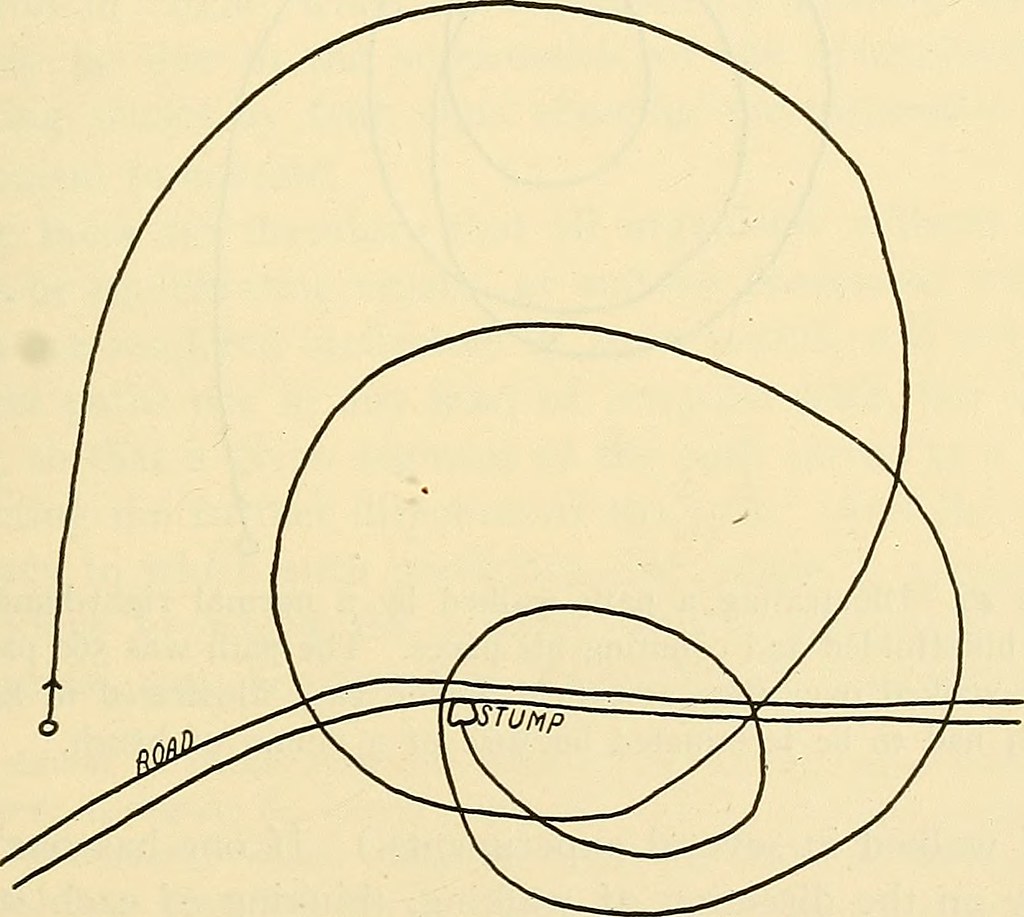
Asa Schaeffer: Spiral path of a blindfolded man
The drawing above by Asa Schaeffer was made in 1920 and shows the path of a blindfolded man walking through a field of wheat. Although done by a scientist to illustrate how we would walk in spirals if we couldn't use our eyes to locate ourselves spatially, the drawing also operates as an analogy for the human condition, we go on blindly until we are brought up short by an immovable object, in this case a tree stump.
In the field of data visualisation the Stamen company has begun to look at how to geometrically visualise emotions. This work overlaps some of the issues I have looked at before such as the relationship between music and visual forms, but it is interesting to see how they have progressed this area. Their 'Atlas of Emotions' icons go back to several older tropes of emotional geometry, finding the angle of perceived pain being a foundation course exercise from back in the 1970s, which itself was based in readings of Kandinsky's work.
From the 'Atlas of Emotions'
The interweaving of art and science is I do believe going to be very necessary if we are to embrace the full implications of living and being properly connected to this world. Without science we would have no hope for a future solution to the fast approaching climate crisis but without art we could be in a position of not being able to emotionally engage with a fast approaching future. Stories and beliefs, inner as well as outer worlds, will have to be harnessed and used to enable us to shape positive world views instead of the often found fatalism of those that have given up. As well as practical mechanical solutions to physical problems, we will need responses to our many and various emotional dilemmas. Hopefully we will eventually find ourselves woven back into the entangled fabric of everything, and as this happens we might finally realise that we belong.