Showing posts with label space. Show all posts

Tuesday, 2 September 2025

Drawing out from within

In 1945 farmers digging in the Upper Egyptian town of Nag Hammadi, discovered some long lost texts, that were found in unearthed ceramic jars. Amongst these texts were 114 supposedly secret sayings, that were attributed to Jesus. These short texts were about spiritual knowledge and they were understood to be from the Gospel of Thomas, a non-canonical text that is not in the Bible, but which scholars were aware of because of the existence of previously discovered fragments. However, this was a complete manuscript written in Coptic. Of these sayings perhaps the most well known is; "If you bring forth what is within you, what you bring forth will save you; if you do not bring forth what is within you, what you do not bring forth will destroy you".
For someone trying to visualise interoception, this phrase has often come to haunt me. Interoception is defined as the sense that allows us to perceive internal bodily sensations, such as emotional change, heart rate, respiration, hunger, and pain. It's often described as the body's "eighth sense," playing a crucial role in our moment-to-moment awareness of our physical state and influencing our emotions, self-regulation, and decision-making. 
Chen et al (2021) point out that definitions of interoception change and that they were initially to do with a creature's 'internal state', then by the mid 20th century it had become a way of referring to the dynamics of a body's homeostasis and only recently has it been seen as a communication process by which the nervous system both senses and integrates information about the inner state of the body.  They highlight 'the complex interplay between the brain and other organs necessary to monitor and regulate internal states'. (Ibid p. 4) 

The anatomical boundary that separates interoceptive from exteroceptive experiences has historically used the skin as a dividing border. Chen et al (2021) point out that interoception was focused on signals generated from within the body, sensations occurring below the skin, but as I have already become aware, it's not quite as simple as this, there being no clear division between internal and external realities. Even so, I like to feel that the images I make can 'get under your skin'.

Perhaps this is why that old Coptic text of St Thomas still strikes a chord in me. 

Although most of the current texts on introception rely on discoveries in neurology, as an artist, I'm still fascinated by psychology and its early acceptance of a subconscious/conscious dialogue. In fact the inner/outer duality of interoception/exteroception, stirs within me Surrealist yearnings and I'm prone to make responses to what I think I might be feeling, by relying more on instinct and chance than any sort of rational process.

The psychology of interoception works with body awareness and an ability or inability to use this awareness, can affect psychological issues related to mood and other emotional factors. The work I do in trying to help raise awareness of somatic feelings will hopefully help others enhance their ability to control emotional regulation and well-being, but I don't expect my art as such to change anything. The process of being involved and listening is probably the most important issue in relation to the fostering of wellbeing, the artworks themselves are stand alone entities, that emerge from a fusion of the process of listening and the process of image development. Part of the process therefore of an image's development, may well be therapeutic, but the final images are creatures in their own right, things that can carry whatever meanings they can, but they are not in themselves therapeutic images. 

I have been working with other artists to try and resolve some of these issues, as well as people who are not at all connected with the art world. Sometimes because of the close affinity I can feel with fellow practitioners, especially those that see drawing as fundamental to their practice, I can begin to see an almost epic dimension to the work. In conjunction with two artists that I have known for several years, I have recently been making much larger drawings, these are attempts to capture some of the essence of another person's life experience. We have spent some time preparing for the sessions, each artist making objects or drawings that can be shown alongside themselves, things that are used to animate the situation that we each draw from. The difficulty is we are all isolated from each other and we use the medium of the computer screen to communicate. We have though been doing this for a while now and we have tried a variety of ways to break through the barrier of the screen and try to 'touch' each other with our 'inner' as much as our 'outer' appearances. Above all we talk when it is our turn to be the subject. Conversation is such a wonderful thing, our sometimes awkward and at other times poetic attempt to put into words the things we are thinking and feeling, is right at the centre of what it is to be human. This alongside an eternal hope and expectation, that others will get some sort of awareness about our inner thoughts from a dialogic process. When you do this with people who are also practiced at another form of conversation, that of direct drawing from experience, the conversation is deepened. You are in the company of those that can feel the limitations of verbal conversation; as artists they of course value the poetry of communication, but they also, like myself, sense that so many things are unsaid, mainly because they can't be 'said' using words. We look at ourselves in the mirror and see a something that is as much the person inside as outside, our outward appearance a cypher that has to be decoded in order to engage with inner thought. A stance may indicate illness, mental state or environmental threat, the speed of a body's movement tells us so much about the physical and mental state that it encloses, the smoothness or erratic track of someone's hand gestures speaks silent volumes. 

Portrait of an Italian artist by an English artist: The inner and outer of an interoceputual experience

The three of us have recently been working on a particular project, focused on trying to extend previous ways of making portraits of each other and on my part, I have also been trying to re-define for myself what it is to make a portrait of another human being. This overlaps with the work I have been doing in the hospital, but in the protective bubble of artists communicating with other artists, I feel that I can begin to let go of my normal reserve and reveal aspects of myself that don't normally emerge in everyday life. I sense that that is also the case with my fellow artists. Perhaps this is art as a form of counselling, I don't know, but I do know that emotionally this is a very hard body of work to be engaged in and that it really stretches my ability to make emotionally resonant images.
 
Portrait of an English artist by an English artist: The inner and outer of an interoceputual experience

As I make the drawings, which are 5 feet (h) x 8 feet (w), I also photograph them and then make prints from the drawings, which are what I'm putting up for you to see on this blog. The prints are more screen friendly, I don't think the translation of large drawings into screen images works at all. The scale of the originals is such that you need to step up to them and then pull away, in order to get a sense of how they work. I'm also making all of the work done from the hospital available in digital print form, so that it is available to everyone concerned, patients and medical staff, and therefore I am becoming more attuned to the relative values of digital versus analogue imagery, seeing them both as capable of carrying feelings and emotional registers, but in very different ways.

An important issue is surface. The hand drawn initial images clearly show the traces of material changes and human interactions. There will be now dry water diluted coloured liquids, pen marks cut into the paper, areas of wiped away colour still holding a memory of the wiping in their stain, frozen brush strokes and fingerprints from when I have had to support myself as I have leaned over the drawing in order to make marks. The hand is remembered because the scale is one to one with the body, the paper size forming a flat theatre of possible re-enactment of every gesture made in the image's making. The digital version is very different, but as a print it carries a set of values compressed into a form that is equally powerful as a communicating surface. Paper and ink are fused together in a different way and if the right paper is chosen, (in this case Hahnemühle German Etching mould made paper and the inks all at maximum intensity, i.e. the printer is properly working and laying down colour as dictated by the digital colour files), the surface can be rich and seductive. Differences in handling in the original are now translated as changes in granular texture. The thickening and thinning of paint or ink as it moves across a surface can be captured by photography and tonal differences enhanced by using a digital filter that operates in the same way as now long discontinued lith film*. As this filter has only has black or white options it will produce a black and white granular texture as a translation of a smooth movement between light and dark. Therefore a brushstroke may now have a more three dimensional appearance or a new texture, due to the 'pushing' of the contrast. 

This way of working is a hangover from my time as a print technician. When I used to make silkscreen prints, I would often use what we called at that time, black and white 'lith' film', which came in rolls, so that it was large enough to make A1 size photographic exposures. Once made these positives of developed film were in effect 'burnt' by light into an emulsion that had been applied to the surface of the nylon screen, thus making a negative, through which ink would be squeegeed to make the positive on the paper that was to be printed on. 
High-contrast lithographic film was a specialised type of orthochromatic film designed for graphic arts to produce stark black-and-white images with maximum density and stark separation between tones, using a process that required careful control of developer strength. The film was specially produced for silkscreen printing, as any stencils; photographic, painted on or hand cut, had to allow for the printing of flat colours by pushing ink through a fine nylon screen. As technology moves on, it often carries memories of a previous technology embedded within it. For instance the first cars were at one point known as horseless carriages and their box like shape was a reflection of this. In a similar way the early filters designed for Photoshop, tended to reflect the types of photographic film and associated processes that existed before digital processing. 

I'll try and explain how I use this in the development of a digital print. In the detail taken from a hand made original below you can see the thickening and thinning of paint and inks, as well as tonal diversity. 

Detail of a large drawing

In the black and white image made from the detail above, a stark separation between tones has been achieved by using a 'stamp' filter on Photoshop. I have to decide the percentage of white to black, so I ask myself, do I need more black or more white in order to achieve the emotional effect I need? The most interesting textures are always those that evolve in the between areas, not clearly white or black and just as the old lith film did, this filter breaks down in-between areas in quite unpredictable ways. 

Image converted to black and white and using the 'stamp' filter in Photoshop

I can selectively highlight any area and make each selected component of the image darker or lighter, so may make four or five different black and white exposures and then collage them together to make a final textural layer. 

Once I have a surface similar to the one above, I can use this as a layer that can then be placed on top of coloured layers, often as in silkscreen printing, making the layers transparent, so that colours can both intensify each other and create often unexpected new colours as they overlay. I can then build the image up, layer on layer and as I do I can push some elements into the background, heighten others and remove anything that doesn't support the overall emotional tone. 

Detail of print

As you can see the final image made for print, is very different in surface feel to the original drawing. All the layers are compressed down before printing, their colour intensity when translated into ink, giving the image an impact that for myself, can be as powerful as the one made by the size and textual surface of the original drawing. Deciding dpi and output size is also of vital importance to the look of the final image. When printing these images, they are in effect squeezed out onto the paper surface and as they emerge back into daylight, this very compaction gives them a certain traction that allows them to stand up alongside images made in more traditional ways.

I have digressed I know into technical matters, but they are all a necessary part of the process of drawing out the interoceptual aspects of an experience. Technology is a vital aspect of drawing, a word that has ancient connections with the word 'drag', in the sense that you can drag a plow through the ground, thus scoring it, leaving a line of exposure as the earth is turned over to reveal the colour of the soil below. I am in effect trying to use drawing to drag out of myself and others, some sort of response to the feeling tone of interpersonal communication and whether this requires analogue or digital processes to do this, doesn't I feel matter, what does matter is whether or not some form of communication is made. 

Finally some thoughts about the drawing out from within that touch more upon the poetry of that inner/outer flow. In Philip K Dick's science fiction novel 'The Divine Invasion' he develops a wonderful description of what space and time is like for God like beings and I transcribed his description of a particular journey taken by one of God's prophets into my own words, in order to get some sort of traction on the poetic possibilities of a mind seeing both inside its own body and at the same time being able to escape the confines of a body and move out into the cosmos. This is what I wrote at the time when I attempted to imagine myself as one of Dick's characters:

My mind began to travel in an outside mode, my consciousness ceasing to be something, instead becoming a process, evolving into accretional layers, inhabiting a timescale of the outer world. From there or when, they are now both of one indivisible form, I could at last see the inside forms of my somatic body from another reality and as I rose above myself, I became a process of Hermetic transformation. I saw my body not as a mass but as transparent pictures permutating at an immense velocity, images made of forms outside of space, being fed into the body to become reality. As this image froze, time ceased. Slowly, by degrees a transformation began to take place, I saw outside of myself a pattern, the print of my own brain, I was within a world made up of my brain, with living information carried here and there like little rivers of shining red that were alive. I could reach out and touch my own thoughts in their original nature, before they became thoughts. Space filled with their fire, it stretched out, the volume of my own brain becoming external to myself. 
I now began to introject the outer world, so that it became contained within myself. Now having the universe inside me and my brain outside everywhere. My brain extended into vast spaces, far larger than the universe and I knew the extent of all things that were myself and because I had now incorporated this world I knew it and controlled it. 

What is within you, is also outside you; what you bring forth will both make you and disguise you.

References

Chen, W. G., Schloesser, D., Arensdorf, A. M., Simmons, J. M., Cui, C., Valentino, R., Gnadt, J. W., Nielsen, L., Hillaire-Clarke, C. S., Spruance, V., Horowitz, T. S., Vallejo, Y. F., & Langevin, H. M. (2021). The Emerging Science of Interoception: Sensing, Integrating, Interpreting, and Regulating Signals within the Self. Trends in neurosciences, 44(1), 3–16. https://doi.org/10.1016/j.tins.2020.10.007

Dick, P. K. (1981, 2008) The Divine Invasion London: HarperCollins

Wednesday, 1 June 2022

Drawing the void

David Edgar

David Edgar in his paper about encountering the void in drawing, reminds us that Alain Badiou regards drawing as a type of ‘seeming’ (Badiou 2014, p. 76). He suggests that Badiou believes that drawing transforms things by giving form to a particular type of understanding of the world, pointing to the relationship between imagining things in the mind, and the evolution of an image on a piece of paper. Badiou points to two ways of thinking about the sun; the real sun and the  sun as it is poetically manufactured within art. (An interesting way of saying making an image of something). I would however suggest that Edgar could have made more of the fact that between the two there is a space that you could call the perceived sun, the strange set of sense impressions that indicate to the brain that a controlled hallucination of sun-ness is occurring and which then stimulates a what to do action in response to this encounter. Today I will put on sun cream, yesterday I would have taken my shirt off and lay down to bask in its warmth. Fight or flight, is a product of the imagination and mine is now skewed by stories of global warming and ozone layer depletion. As Timothy Morton argues, global warming is a hyper-object, an almost impossible concept for one individual to conceive of, something beyond our everyday comprehension. However I am changing my behaviour in response to it, or in response to my imaginative interpretation of what I think it is. In the gap between the actuality of global warming and my inner feeling tone that has been constructed by myself in response to what I have understood of its existence, is a space, a void. These thoughts about a space between are called kū or sora in Japanese, and refer to those things beyond and yet also within our everyday comprehension, particularly those things composed of pure energy and the emptiness that the energy is made up of and which it comes from. Kū is an embodied term, in that it sits within us, and it represents spirit, thought and creative energy as well as the creation of phenomena. It can also be associated with the potential of creativity, spontaneity and inventiveness. Out of nothing, emerges something. If you are properly attuned to the void you can sense your surroundings and act without using your mind. However we are rarely attuned, because we think too much about the things of this world. Perhaps it is better to follow the example of a small bird when flying through a thick set hedge. Somehow it flies through the continuous space that sits between branches and twigs. Thought about the hedge would get in the way of its flight through the void. If it became self aware it would crash. This small bird one could imagine is a reincarnated Buddhist, it intuitively knows that in Buddhism the emptiness of the void is the ultimate reality. However the void is also a place of infinite potential. It is an “emptiness” related to the glass being half empty or half full, it is an idea, perhaps more than a thing.  The void is a space where ideas arise, which is similar to how the Zen concept of interbeing is described, which we might also think of as an aspect of non-attachment or the letting go of the self. Our western obsession with self is critiqued by the Buddhist concept of dependent originationEarly Buddhist texts associate dependent arising with emptiness and not-self. The Buddha (Choong, 2000) stated that we mistakenly depend on the dual notions of existence and non-existence, a binary reality, and that the right view was that, 'when you truly see the origin of the world with right understanding, you won’t have the notion of non-existence regarding the world. And when you truly see the cessation of the world with right understanding, you won’t have the notion of existence regarding the world.' (Sutta Central) Attraction, grasping, mental fixation, insistence, and other forms of self centred thinking are all just suffering arising, and what ceases in the emptiness is just suffering. 

Last year the UCCA Centre for Contemporary Art hosted the exhibition “Silent Thunder,” an examination of the links between Buddhism and contemporary art. The exhibition highlighted the influence of D.T. Suzuki and his teachings during the 1950s which did much to spread Zen ideas amongst post-war artists and intellectuals such as John Cage, Arthur Danto, and Robert Rauschenberg. In fact Zen visual aesthetics as reinterpreted by modern art; minimalism, austerity, and the acceptance of chance as a compositional tool, have since been re-imported into East Asia, this imposition of an aesthetic as to how Buddhism can engage with contemporary art and visual culture, being something that non western artists now have to deal with. 

Liao Fei: A straight line extended

Liao Fei's 'A straight line extended' is a classical Zen idea and as a physical drawing in space helps us to understand how the extended drawing canon has evolved to include sculptural practices. When you truly see the idea of drawing with a right understanding, you won’t have the notion of non-drawing regarding the world. And when you truly see the cessation of non- drawing with right understanding, you won’t have the notion of drawing regarding the world. 

Shao Yi

Shao’s sculpture series, Totem Producing, represents the interrelationship of his Buddhist beliefs and art practice. “Before someone studies Zen, mountains are mountains and waters are waters; after the person gets an insight into the truth of Zen through the instruction of a good master, mountains are not mountains and waters are not waters; but after this when the abode of rest is attained, mountains are once more mountains and waters are waters.” (Excerpt from Universal Lamp Records of the Jiatai Era, translated by D. T. Suzuki, Essays in Zen Buddhism, 1926) Shao's 'totems' are wooden industrial moulds, negatives involved in the forming of objects that we can only imagine. The emptiness of the mould providing the substance of the idea. These moulds are not moulds but are now totems, these totems are not totems but are now moulds. 

Of course the classical Zen drawing image is the ensō or circle form. An image that express a moment when the mind is free to let the body create. It is also an image of 'Mu', the void. Some artists draw ensō with an opening in the circle, while others close the circle. If the circle is incomplete, this allows for movement and development as well as representing the beauty of imperfection.  

Mugaku Sōen (1720-1791) 

When the circle is closed, it represents perfection, but also strength.

Ensō (c. 2000) by Kanjuro Shibata

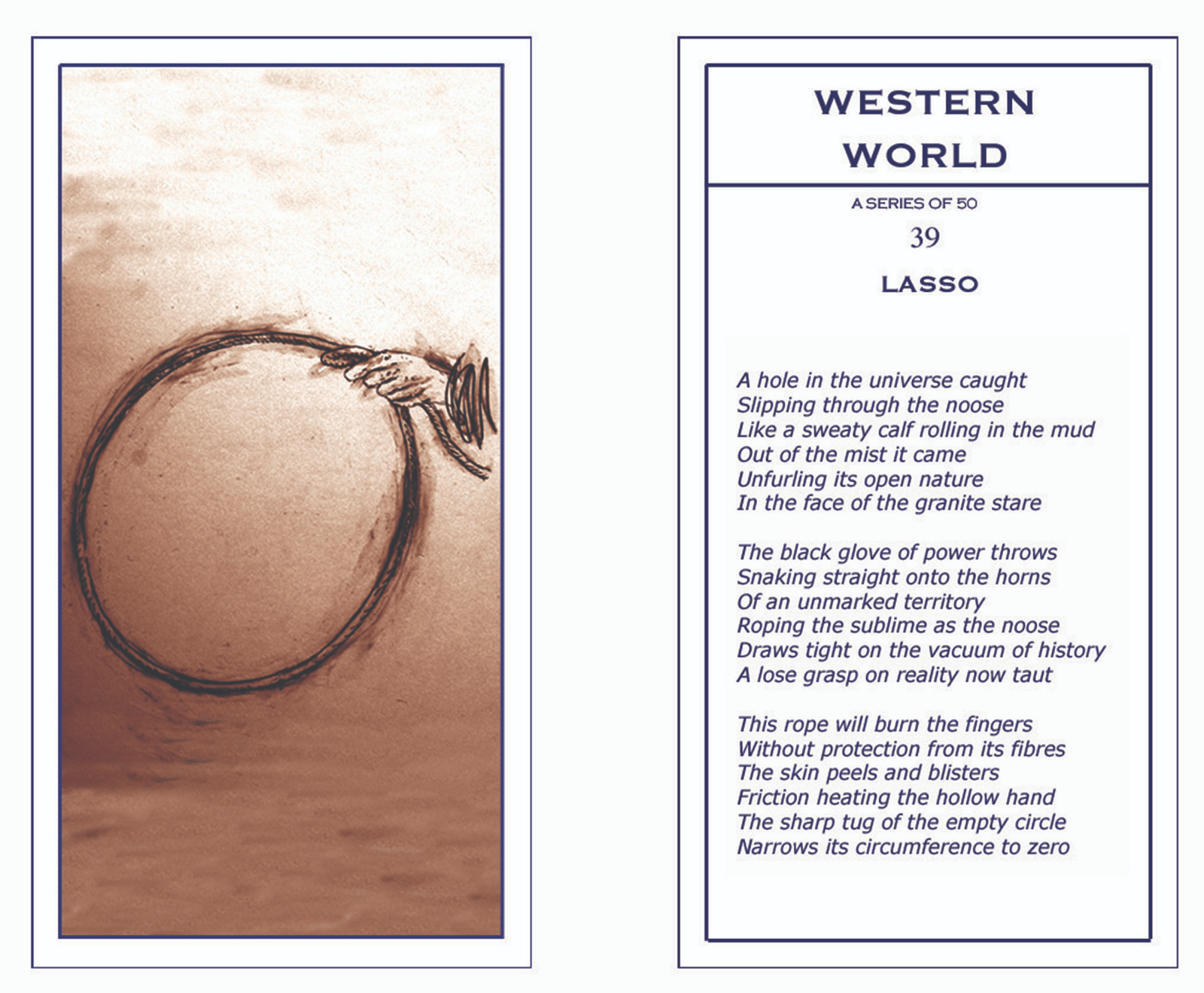
Some years ago I tried to build this idea into a series of images I was making about the myth of the cowboy. This is the only image I have left of the sequence, but I guess the idea is still there.


The void will have many interpretations and approaches, some of which I have touched upon before, but whether it is Rachael Whiteread's negative casts, or Robert Rauschenberg's erased De Kooning, these are all ideas of negation, emptiness and space. It is what is not there that defines what is there.
Miyamoto Musashi's book 'Go Rin No Sho', the Book of Five Rings, says of the void, “By knowing things that exist, you can know that which does not exist. That is the void.
Humanity has wiped out 60% of mammals, birds, fish and reptiles since 1970, that is the hyper-void.

References

Sunday, 5 January 2020

Mike Croft: Observation of Perception, Part 2

Observation of Perception, Part 2 

When writing this I’m thinking of drawing as a form of visual thinking. By such thinking, I mean considerations of mind, body and cognition variously channelled through the filter of vision. (Philosophically, this could take one in the direction of Embodiment theory.) What makes drawing as visual thinking particular in the context of art and design is intentionality, and it is the latter of which I try to be specific and that registers in and as the result. This said, a lot happens in drawing concerning the relatively autonomous behaviour of the medium that defies one’s intentions, and intentions are not necessarily always recognisable. However, on this occasion I’m trying to show through and as the drawing, ways in which one might observe perception. For this reason I’ve been recording the drawing process and my spoken thoughts while drawing as videos, specifically through an action camera attached to the front of clear plastic goggles worn over my glasses, Figure 1.


Figure 1: To show goggles, inside and outside, and action camera 
both separate from and attached to the goggles. 


This does also make the methodology more sharable, and anyone interested in it might take up the process and adapt it as needed. 
The action cam, however, appears as a thin blurred black rectangle imploded in front of and perpendicular to my vision, Figure 2.

Figure 2: Screenshots from Observation of Perception: Showing Part 1 of a 2-Part Drawing, video clip 26:52 min, 2019. 


This is therefore both a tool to record the drawing process and one of two objects or motifs to observe. While the action-cam itself picks up sound, I record my speech, what I term a voice-over, into a separate audio device. The second tool, also an object or motif, is the goggles. Both of these may be said to operate as tools because, being very close to my face, they’re almost an extension of my eyes. In this sense I’m observing perception, in other words looking at looking. This point is debatably another example of the medium’s defiance, but what I want is a situation where, as nearly as possible, there is nothing in front of my vision. 
The tools, neither of which you the viewer can see in the videos except in the terms that the drawing presents them, are each responsible for a pair of faculties of visual perception. One of the tools is the action cam, with its wide-angle lens, which records visual content both central and peripheral to my vision, without of course distinguishing between either. I provide such distinction through my speech. The other tool is the goggles that register eye and head movement in coordination with the head. (The camera won’t record eye movements made independently of head movements, of which there are two possibilities; eye movements while the head is still, and less often eye movements in different directions to movement of the head.) Both sets of faculties I register as drawn marks and shapes, which provide the accumulative visual/material interest that gradually makes the drawing, Figure 3.


Figure 3: The two stages of the drawing recorded as the video Observation of Perception: Showing Part 1 of a 2-Part Drawing and Observation… Part 2 of a 2-Part Drawing. Dermatograph pencils, black ink, attached filing cards on white laminated cardboard, 
109 x 79cm. 2019. 


In the first blog entry (link), through reference to the Russian psychologist Alfred L. Yarbus’s non-digital eye-scanning device circa 1960s’, and the Italian Renaissance theorist Leon-Battista Alberti’s net or gridded frame to enable the plotting of observed coordinates, I try to explain that to my mind the mediation between perception and observation falls somewhere between the observer and that which is observed. The eye-scanning device is useful in this respect because it shows how one’s eyes scan across space, and Alberti’s frame because it can represent a material mid-way for consideration of life questions; questions of being. By substituting minimal objects, better conceived as tools of perception, for more tangible three-dimensional objects at obviously more distant positions in front of one, then what gets presented on and in the drawing is the mid-way, the mediator of sources of reference that are before it, as nearly as possible extensions of perception itself.
In circumstances where I’m drawing only, without using the action-cam, I have only my glasses to which to refer. If, as in the following example, I still record my speech, it seems appropriate to write at least some of the observations onto and progressively into the drawing, Figure 4.

Figure 4: Drawing of reading glasses drawing viewed from inside the frames while being worn. Dermatograph pencils, coloured inks on white laminated cardboard, 
109 x 79cm. 2019. 

This might also be a key point in general about the experience of drawing: it’s an activity that starts on a surface and gradually, through its development, opens up the surface as space. My own drawing method however, which is mainly concerned with conveying information about its self-same process, does tend to prioritise the surface. 
Explained another way, I’m setting up an inversion of the circumstances whereby the observed object that’s usually positioned somewhere in the space beyond oneself and the drawing is immediately in front of one, in this case the glasses. There is no source of reference that’s logically in front the drawing, and in fact the drawing, that should be the mediator between perception and what’s observed, is further beyond the object in the positions drawer/agent – glasses – drawing, as suggested in Figure 5.


Figure 5: Drawing of reading glasses viewed from inside the frames while being worn + the actual glasses now suspended in front of the drawing to fit their drawn size 
according to distance when seen from behind. 


What’s now interesting about the circumstances so installed is that the actual space between the object, the glasses, and their mediator between perception and observation, the drawing, can be the space of a narrative, a story of whatever else could be taking place in and as a different criterion of perception, Figure 6.


Figure 6: Showing the photo of Figure 5, above, and a view of the actual space existing between glasses and drawing. 

Artists often use the medium of drawing to rehearse and research narratives, or use drawing as the sole medium for this purpose – to name but one example, the contemporary artist William Kentridge. 
This leads me towards another kind of theory, which is the psychoanalytical theory of Jacques Lacan (1901 - 1981). I’d thought of mentioning Lacan in the first blog entry in the context of the glance, but since I reference the glance specifically in the video, Observation of Perception: Showing Part 2 of a 2-Part Drawing (see Figure 3, above), and hadn’t completed that at the time of writing the first entry, it now seems a better moment for further explanation. Lacan’s theorisation of the glance occurs in his paper, ‘Logical Time and the Assertion of Anticipated Certainty’ (1945). This paper is particularly interesting from the point of view of inter-subjective use of time. While the scenario that provides the context for Lacan’s discussion concerns three human individuals, I’m adapting this to the kind of dialogue that can occur between a drawer/agent and a drawing.
Lacan explains that within the time frame of trying to make a decision or reach a conclusion about something, an initial hypothesis concerning that something is first put to the test of doubt. The period of doubt, which in decision-making need be no more than an instant, but an instant that can be of variable length, is in effect the glance. According to Lacan (2006: 168): ‘The time for comprehending can be reduced to the instant of the glance, but this glance can include in its instant all the time needed for comprehending’. What I like so much about this quote is the suggestion that the glance concerns uncertainty. The engagement with drawing, or more precisely the dis-engagement with other modes of thought during and as drawing, can be an extended time frame of the glance; the holding of decision-making in abeyance as uncertainty. In the following drawing of the action cam and goggles – from which I also made a video – I later superimposed the glasses, seen as before from the narrow space between my face and the glasses lodged on my nose, Figure 7.


Figure 7: Single-layer state of a drawing of an action-cam worn over goggles and the goggles viewed from the inside while being worn, and a second-layer state of the drawing showing the same drawing with orange glasses superimposed, viewed from inside the frames. Dermatograph pencils, black ink and coloured inks, attached filing cards on white laminated cardboard, 109 x 79cm. 2019.

What’s interesting here is that there’s conceptually a space between the two layers of mark making and cursory imagery that I leave alone. The several apparent positions of the glasses do seem to be increasingly in front of the placements of the narrow band of the action cam, but I mean a conceptual space that’s to do with my lack of conscious concern to integrate the two sets of imagery. However, the two sets waver in a kind of relationship that’s, in a sense, up to them.
While the word uncertainty often has a negative connotation, drawing and other forms of creative practice stand a good chance of manifesting uncertainty positively, no matter what one’s disposition. Debatably, if art works, it’s imbued with affirmation, even if its content and the invested feelings are opposite. Insofar as an uncertain disposition would be to hang back, and a decisive one would be to push onwards – hesitancy versus boldness – I personally like the idea of time conducting a kind of backwards rotation as part of its movement forward, where it picks up the past and draws it through. This also seems like drawing; where each decision is consequential on the next, and the next one is in acknowledgement of some previous decision. There are moments in the video-recordings of the drawing as shown in two states in Figure 3, above, however, where such consequential decisions break down, and in the video particularly of the second state I appear to be searching around for something to do next. While this often happens in drawing, I’d much prefer a drawing to roll on as a continuum of action, Figure 8.


Figure 8: Screenshots 40:42min and 41:27min, with 1st voice-over, and interventions of a 2nd voice-over between the timespan of the two screenshots, of the 44:35min video Observation of Perception: Showing Part 2 of a 2-Part Drawing, 2019.

What’s interesting with the strategy of intervening in the first voice-over that’s spoken spontaneously while drawing, is that the intervention is squeezed into available moments of silence where I’m drawing only, which seems like a textual equivalent of re-working and revising the drawing. I show this also, in Figure 8, to indicate how the drawing and the voice-over are mutually both cooperative and distractive.
A second point of Lacanian theory conveniently links the first blog entry’s reference to Alberti’s frame with the idea of a potential narrative space. Lacan adapted the idea of a mid-way in the optical pyramid to his own idea, in the psychical context, of an opaque screen, more like a ‘stain’ or ‘decoy’, that muddies vision, altering and affecting what we assume to be the objectivity of vision. (This is my simple interpretation of very complex theory. For more thorough explanation you might refer for instance to Harari, 2004: 119-40) Suffice it to say that the metaphor of muddied vision may relate to the more subjective aspect of perception: the fact that one often imposes personal interpretation on otherwise objective and sharable visual-material content.
I’m intending to offer this question to a small group of fine art students as a contribution to their seminar class on Embodiment. After a drawing exercise that follows closely in the method of the above-described work, I’ll ask them to define the space that their glasses frame, or the frame of sunglasses, in terms of a narrative of their own choosing. Whether physically in whatever medium in the space as shown in Figure 6, right-hand photo, above, or as further development of the drawing, the only stipulation will be that the drawing should be seen to physically morph into the story. A colleague wrote me a comment on the proposed idea: ‘I see action through big drawing (space), glasses in some way combining a self to a field, which could be expanded space of imagination and place of vision. Physically and symbolically this is interesting, with the use of interpretative words and objects and also the context of subject and thing. I think the content analyses time, space, place, and will involve the students naturally in self related content.’
The idea of framing in one way or another is always important in the more instructive level of creative teaching, and in the above-described project I’ve been doing this for myself. The intention of the drawings is to explore a hypothesis that one can observe perception and visualise it as an observation. As in some instances of drawing – though not all – one hopes that the result conveys a degree of clarity of intentions. However, in the process, things may happen that cause one to become involved in other areas of research. I’ve given some indication of my own interests, and of how things can occur by chance in the course of drawing. If research is an additional direction, then through one’s practice a third and more integral possibility can emerge that alters one’s perspective, but in a sense, because it’s within the work instead of clearly declaring itself, it waits to be discovered. This other integral possibility may shift and challenge one’s determination to achieve clarity.

References 

Harari, R. (2004) Lacan’s Four Fundamental Concepts of Psychoanalysis: An Introduction. New York, NY: Other Press 
Lacan, J. (2006) Écrits: The First Complete Edition in English. (First published 2002) New York, NY; London: W. W. Norton & Company

Thanks to Mike for a fascinating insight into the work he is doing. 

It might be interesting for you to contextualise Mike's post by reading my own thoughts on that 'uncertain certainty' an attitude that lies at the core of most ventures into trying to record perceptual activity. His glasses are another drawing device or apparatus and therefore it might also be useful for you to think about how these devices have become integral parts of other drawing processes. 

Mike has sent a sharable file for those interested in more detail. He has extracted a 'voice' from one of his videos and given an account of how his spoken interjections are woven into the narrative of drawing making. 

Wednesday, 8 May 2019

Drawing with wire: Picasso and Calder

Poster for the Exhibition

Wireframe drawings that are the result of CAD software have been with us for some time now and they have a history that goes back to the Renaissance. They have a particular aesthetic and are very useful when making ideas that require a very clear linear understanding of certain types of 3D space. 
However wire is itself a very interesting drawing material and it can be used to bridge that interesting gap between 2D and 3D thinking. 
I was in Paris recently and the Picasso museum was hosting an exhibition of Picasso and Calder. 

Picasso

Calder

This is how the museum introduced the aesthetic connections between the two artists.

'A key connection can be found specifically in their exploration of the void, or the absence of space, which both artists defined from the figure through to abstraction. Calder and Picasso wanted to present or represent non-space, whether by giving definition to a subtraction of mass, as in Calder’s sculpture, or by expressing contortions of time, as in Picasso’s portraits. Calder externalised the void through curiosity and intellectual expansion, engaging unseen forces in ways that challenge dimensional limitations or what he called 'grandeur-immense'. Picasso personalised the exploration, focusing on the emotional inner self. He brought himself inside each character and collapsed the interpersonal space between author and subject.'

These are fascinating issues and they extend some of the ideas I have touched on before in this drawing blog. In particular the way that an interior space, the space constructed by a mind deliberating on what it is to be, can be seen to be no different in essence to a cosmic space, one that looks to hold within itself all of creation. 

So don't forget the humble florist's wire and if at any time you feel that your drawing is becoming too flat, or does not begin to capture the spatial nature of an experience, remember that a wire construction may well help you both realise the experience and open a doorway into a new idea. 

Related earlier posts

Absence, emptiness and the void
This post includes comments on David Edgar's conference paper ‘Agitating the void: phenomenology and its practical application in drawing’ 
Cross contour drawing
3D Printing: solidified drawing
Some reflections on Sara Barker's wire drawings seen in a Glasgow exhibition


Saturday, 16 February 2019

The Pioneer Plaque

The Pioneer Plaque

An understanding of scientific concepts has allowed us as a species to begin to think beyond our world and to imagine what it might be like to meet an extra-terrestrial being. When we as a species decide that we want to communicate with Aliens, what do we do? We send them a drawing, and in this case it is a drawing of which we know quite a lot about the decisions made as to why the images on it are what they are. 

Pioneer 10


In 1972, an attempt to contact extra-terrestrial life began with the launch of the Pioneer 10 spacecraft, a vehicle designed to attain enough velocity to escape the solar system and therefore the possibility of reaching an extra-terrestrial civilisation. The idea of including a specially crafted message that was designed to be read by any extra-terrestrials it might bump into, was a late addition and was overseen by Dr. Carl Sagan, Professor Frank Drake  and artist Linda Salzman.

The problem these three had to solve was whether they could come up with any universally understood concepts that could be communicable to intelligent extra-terrestrial life. The first principle that was decided upon when this question was being debated was that the only similarity between Earth bound humans and any extra-terrestrial civilisation would be that we belong to the same universe. Because it is science and mathematics that we use to understand that universe, it was further reasoned that this would be the same for any other species. Hence the Pioneer Plaque was initiated, which would operate as a symbolic message to any 
extra-terrestrials the Pioneer 10 might encounter. This plaque was designed to be attached to the exterior of Pioneer 10 and had its visual language developed by directly linking the drawing on the plaque to clear, fundamental scientific concepts.
The first issue decided upon was to set out a standard for the measurement of distance and time, a standard that could then be used throughout the plaque to ensure consistency. In order to do this it was decided that hydrogen, the most abundant element in the cosmos, would be the element around which a communication system would be evolved. Therefore it was decided to draw a symbolic representation of two hydrogen atoms at the top left of the plaque, each in a different energy state.


Image of hydrogen atoms as inscribed on the Pioneer plaque

The text immediately below is how the image is described in a scientific journal, the hyper-links were also in the description, so I have left them in because they give an idea of how complex this idea is. 

'The image above is of a schematic representation of the hyperfine transition of hydrogen, the most abundant element in the universe. The spin-flip transition of a hydrogen atom’s electron has a frequency of about 1420.405 MHz, which corresponds to a period of 0.704 ns. Light at this frequency has a vacuum wavelength of 21.106 cm (which is also the distance the light travels in that time period). Below the symbol, the small vertical line—representing the binary digit 1—specifies a unit of length (21 cm) as well as a unit of time (0.7 ns). Both units are also used as measurements in the other symbols'.

I presume the scientists behind this thinking thought that the creatures that would meet Pioneer would also be scientists. Not just that but that as scientists they would also think like earth scientists. 


Fundamental concepts such as the hydrogen atom can however be described in several ways and the concept of a schematic representation is itself a very complex one, one that would have first of all been introduced to people like Sagan in school science classrooms. Below are a few other representations of Hydrogen and its electron. There are several problems with the decision to use the symbol chosen. For instance ionised hydrogen, i.e. a hydrogen atom stripped of its electron and existing as a free proton, is pretty common in the interstellar medium, and solar wind. So the format of one proton surrounded by one electron doesn't always describe the state of hydrogen. It has also been established that the electron  moves in a wave pattern around an elliptical orbit. This orbit is often referred to as a cloud, because the electron operates in three dimensional space and moves so fast it is in effect occupying a cloud of possible positions. The idea of a static symbol like a dot or spot, would be hard for anyone outside of a small sub-group to understand. 


Words can be put together in different ways to say the same thing. For instance we can rewrite the paragraph above like this: 


'When atoms of hydrogen change from one energy state to another—a process called the hyperfine transition—electromagnetic radiation is released. It is this wave that harbours the standard of measure used throughout the illustrations on the plaque. The wavelength (approximately 21 centimeters) serves as a spatial measurement, and the period (approximately .7 nanoseconds) serves as a measurement of time. The final detail of this schematic is a small tick between the atoms of hydrogen, assigning these values of distance and time to the binary number 1'.

As you can see from both the written and drawn illustrations above, there are several ways to visualise or verbalise the idea of a hydrogen atom, in particular how do you visualise an idea that is in many places at once and is always in movement? Does a fast moving electron appear to be more like a pixelated cloud, or does it look more like a series of linked wave forms, or would an external observer be more likely to be aware of the presence of antimatter and would expect this to be represented too?

Bees draw by flying dancing patterns through the air, what would a life form that had a similar evolutionary history to that of a bee make of this plaque? 

The most prominent figures on the plaque are those of two adult humans: a man and woman. The man bends his arm and displays an open palm. At the time it was believed that this was an internationally agreed greeting on the Earth, but it would be meaningless to an extraterrestrial civilisation and even on some parts of the Earth a naked man with his arm raised could be seen as a threat. The drawing could just as well have been done upside down and from the back for all the sense someone who wasn't trained in the conventions of reading a drawing would make of it. When photographs were first shown to Amazonian Indians they apparently couldn't recognise what they were, so even it would appear indexical systems such as photography are culturally learnt. We are so immersed in a photographically centred culture that we have forgotten, or never noticed that we had to learn what photographs represented. The woman hangs her arms by her sides and stands with her weight shifted rearward apparently to dispel any misunderstandings regarding a fixed body and limb position; it was drawn this way to show that we are mobile and flexible. There was little thought going into the relative positions between the representation of the man and the woman. The man is active, raising his arm in salute, the woman passive, her body less confrontational. Another totally accepted cultural norm of the 1970s is in place. As well of course of the stylised haircuts that might as well be hats or strange growths 
and the fact that both figures have no facial or body hair, factors that speak so much about cultural norms of the time. The man's haircut and woman's hair style single them out as young mature white western caucasians, their hair, facial features and body types set out according to a particular norm or measure, (no one is too old, disabled, fat or too thin) that other people, races and cultures were at the time measured against. 
Beside the illustrations of the humans is the binary number 8, inscribed between two ticks, indicating the height the woman. The extra-terrestrial being is supposed to conclude that the woman is 8 units tall, the unit being the wavelength (21 centimeters) described by the hyperfine transition key; thus, the woman is 8 times 21 centimeters, or about 5.5 feet tall.
At the heart of the plaque is an exploding star shape of lines and dashes. In the centre of this star format is meant to be our home star, the sun; the radial spokes signify the relative distances and directions to pulsars, (rapidly rotating neutron stars that emit electromagnetic radiation at regular intervals). Accompanying each line is the period of the respective pulsar, once again, in binary. Not only does this map communicate position, but time as well. The rate of electromagnetic bursts from pulsars changes over time; thus, the period of the pulsars denoted on the plaque serves as a timestamp. It was presumed that a civilisation that has developed radio astronomy would have the capability to comprehend the nature of pulsars. Which they may well have, but far more complex a problem for them to solve would be the interpretation of this plaque. As a further confirmation of where the Earth is, our solar system’s planets are depicted along the bottom edge of the plaque with their respective distances to the sun in binary. A line with an arrowhead leaves from the third circle from the large circle on the left and a small drawing of what looks like a falling sailing boat is next to it. This represents Pioneer 10 leaving the Earth, the third planet from the sun. The problem being that the relative sizes of the spacecraft, sun and planets and distances between them can't be represented in such a small drawing. The Earth is about the size of one of the Sun's average sunspots, and if you were to link sizes to relative distances between planets you would have to have a drawing with long extensions that would make the spacecraft unworkable. The drawing of the sailing boat on its side reappears in the background behind the drawing of the man and woman. It is meant to show relative sizes and explain that the size of Pioneer 10 could be used to help visualise the size of grown humans. However the convention of overlapping forms in a drawing to represent one thing being in front of another is a very sophisticated one, one not learnt by humans until quite a late stage in their educational development. The idea that you can leave gaps in a form to suggest it sits behind other forms is usually only learnt if you go to schools that teach drawing from a Western European perspective. The fact that the Pioneer spacecraft is visualised from one specific point of view is also something only understandable if you follow engineering drawing conventions of plans and elevations. So lets hope the drawing is first seen by an extra-terrestrial engineer. 


A photograph of Pioneer 10, showing the plaque in place

It may well be that an advanced extra-terrestrial being would be able to visualise whole cultures and species types by analysing patterns of making revealed in the making of any object and that by looking at the way the Pioneer was engineered would be able to deduce the evolution of the creatures that built it. If so it could also be important to this creature to provide for itself an aesthetic framework within which to view this new knowledge. Because of its own evolutionary history it might well take a deep interest in insect or crustacea evolution and accompanying structural and aesthetic possibilities and decide that all terrestrial evolution is based on the structure of a flea or shrimp.

Robert Hooke: Drawing of a flea: 1665

Diagram of Evolutionary links that suggests that evolution from a distance is very shrimp like

It is most likely that this alien creature will have evolved in such a way that it understands itself as part of an always changing set of relationships. It will be aware of beginnings, middles and ends of these relationships and that all beginnings and ends are simply moments between changing patterns. The idea that we could communicate with this creature was one you would expect a well known scientist like Sagan to have thought through a little more. In some ways it could be seen as quite funny, but in others it is indicative of the reason why we have managed to get the world into the state it is. As we have come to understand some of the complexities of the physical world, to the extent that we can send a spaceship out into the void, we have at the same time not been able to understand how blinkered our view of ourselves and others is. We designed those figures on that plaque with a certain presumption, one that is beginning 45 years later to unpick itself.  At the same time that many humans are shaving themselves everyday to become hairless like the drawings on the plaque, other humans are being persecuted because they appear to be neither of the two genders represented. The images of the people represented represent a view of humankind that was in fact not very kind, or was somewhat thoughtless.

In the book 'Sum: Tales from the Afterlives', David Eagleman recounts forty stories, each one describing a different afterlife. In his short story 'Microbe'  he gives an account whereby God is discovered to be the God of microbes.


"There is no afterlife for us. Our bodies decompose upon death, and then the teeming floods of microbes living inside us move on to better places. This may lead you to assume that God doesn't exist—but you'd be wrong. It's simply that He doesn't know we exist. He is unaware of us because we're at the wrong spatial scale. God is the size of a bacterium. He is not something outside and above us, but on the surface and in the cells of us.

God created life in His own image; His congregations are the microbes.
The chronic warfare over host territory, the politics of symbiosis and infection, the ascendancy of strains: this is the chessboard of God, where good clashes with evil on the battleground of surface proteins and immunity and resistance".
From 'Sum' by David Eagleman

It is useful to remind ourselves every now and again that there is far more chance that alien life would be more like bacteria than humans. Artificial intelligences are being taught to learn in laboratories all over the world and the more we work with the associated software programming the more we become aware of how blinkered learning actually is. Whatever is taught to an AI becomes the world that the AI exists in and it 'sees' everything else from the point of view from whereby it was fed the initial information. But more on that in the next post.


Sum is available to download here