My last post on the Venice Biennale ended with a reflection on presentation and possibly the most immediately arresting formal approach to this never ending issue was seen in the Romanian pavilion.
Șerban Savu: The Polyptych of Work and Leisure.
The wall had been extended in thickness, so that all his paintings could be inserted into shallow niches, making them sit flat, with their painted surfaces congruent with the grey painted plaster wall. 45 paintings of various sizes made between 2006 and 2024, were set out in a format that echoed those used in Christian churches and cathedrals. Indeed sometimes the images directly evoked that situation, as in the painting directly above, entitled 'Saint Christopher'. Serban Savu belongs to the Cluj school of Romanian artists, who focus on depicting the banality and uncertainty of life after the fall of Communism and whose work is characterised by a loose application of paint, often with dark, subdued palettes. This subdued tonal range reminded me of the Renaissance use of 'unione' techniques, by which you achieve emotional delicacy by tonal control. One way that controlled colour gradation can be achieved is by toning down colours by reducing their saturation, a method often used by Raphael.
Raphael: Saint Catherine of Alexandria
Raphael used this to achieve a certain monumentality of affect, suggesting that the Christian idea was a solid permanent thing and Savu by also restricting his palette suggests that work is somehow eternal. However as you get closer you become aware of the more impressionist application of paint and this begins to undermine the first impression. You then become more aware of the fact that Savu's paintings are populated by disorientated protagonists and lethargic extras, caught in the lull between work and rest and as you begin to grasp this, you realise his world is one where people are just as confused as we all are.The embedding of the canvases into the huge wall (2215 x 566 cm) and the formal layout, did though really impress me and it reminded me to spend more thought on presentation issues the next time I come to show work.
I have been aware of Madge Gill's work for many years, her drawings have a hallucinatory quality, checkerboard patterns tie her images of women into shallow spaces that suggest giddy, quasi-architectural constructions. Pale faces of nameless women, with ambiguous expressions people her images, crowds of them swirl about and push their way through a compositional thicket, which is in reality the organic shape of an energetic pen and ink drawing. When asked about her drawings she stated that she was working under the control of 'Myrninerest', her spirit guide, and that her drawings were some sort of magical outpouring similar to ghost writing.
Madge Gill
Gill's mediumistic communications from another world, proliferate in a dense web of repetitive mark making and the immense scale of the work presented at Venice, 'Crucifixion of the Soul' from 1936, is a monumental version of her characteristic approach. It reminded me of a stained glass window both in its luminous intricacy and the way it was made; she developed the composition by drawing on sections of her calico fabric as it was unrolled. I have not made any large drawings for a while, trying to focus on developing a wider range of imagery and looking for ways to open out the subject matter for my ceramic work, but this image reminded me that I need to finish the stained glass panel I have been working on and more importantly, that I have now developed sketchbooks full of imagery that needs to be activated by being brought together within both remembered and mythic landscapes as narratives. Some of my best work, (or what I regard as my most effective), has been done when I have set myself the task of creating large scale drawings that can hold within them complex narratives. They do though take a lot of mental as well as physical effort, but without that, the work can stay on a sort of 'OK' or satisfactory level, so I really do need to get back to making more ambitious images.
Outsider art, or art made outside of western art traditions, was central to this biennale's idea of 'Foreigners Everywhere'. Anna Zemánková’s images of invented plants and alien like organisms were another approach to what I think of as finding an internal affinity with an external reality. In her own words, she was “growing flowers that are not grown anywhere else”. The exhibition catalogue states that her 'forms seem to metastasise with a vital force of their own, laden with fruit-like appendages and delicate arabesques. The imagery of the pieces on display straddle both microcosmic and macroscopic orders, evoking a cartography of unknown astronomical formations as well as the reproductive structures of imagined plant life.' I couldn't put it better.
Anna Zemánková
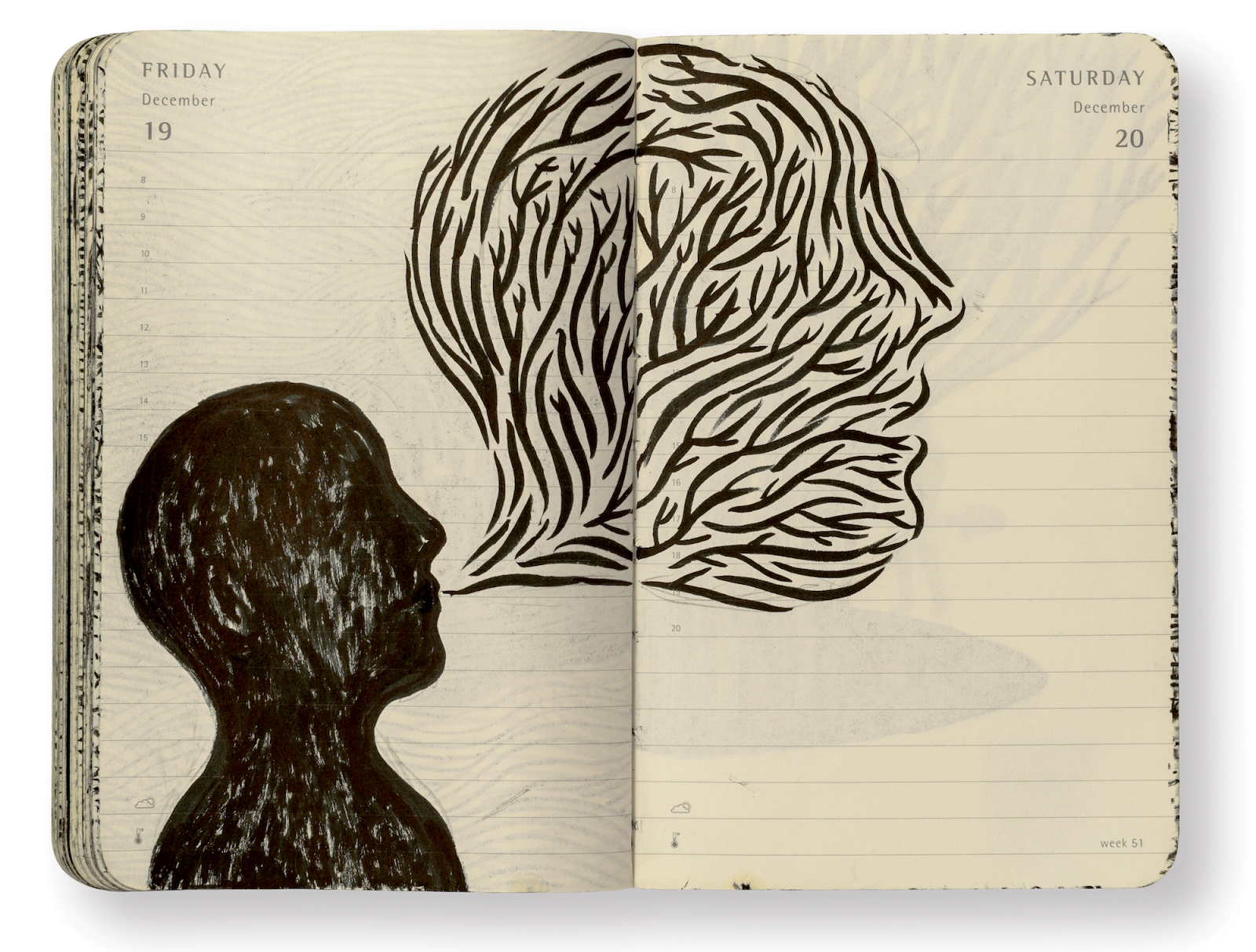
Artists such as Madge Gill and Anna Zemánková who are considered as outsiders within a rationally focused western culture, can be seen, because of their mediumistic type communications, as being very similar to artists who in other cultures tap into the spiritual world, as a way to interpret the day to day realities of existence. Joseca Mokahesi, a Brazilian artist who lives in the Yanomami Indigenous lands. draws characters, scenes, and landscapes from his people’s universe, presenting myths and shamanistic chants, as well as moments from the everyday. Many of his characters are 'xapiri', spirits left by Omama, the Yanomami creation deity, to aid shamans in their tasks, who when summoned, descend and manifest in shamans’ bodies. The image directly below is of the spirit 'Hawahiri', drawn as a chestnut tree emerging from a mouth.
Joseca Mokahesi: A bee spirit
I could really empathise with this approach and have for a while been thinking that an animist way of thinking is essential to a reconciliation with a world that we have tended to mine for its resources, rather than find ways to communicate and commingle with it. Thinking about communication with things very different to ourselves might also mean that we need to see things differently and an artist/shaman such as Joseca Mokahesi, might help show us a way to do this.
Next to the space devoted to Joseca Mokahesi's images, was another Yanomami artist. André Taniki is a shaman who's artistic output is directly linked to his association with artist and photographer Claudia Andujar and anthropologist Bruce Albert. The drawings exhibited by Taniki were done in the late 1970s, and were made in conversation with Bruce Albert, when together they were searching for ways to depict shamanic visions. The structures of the drawings made represent the organisation of the cosmos from the point of view of the Yanomamis’ sense-universe. They are a sort of cartography which is visible only to the 'xapiri', the Yanomami shaman’s auxiliary spirits, and to the shamans themselves. The drawings, made using felt tip pens provided by Bruce Albert, made me think about the possibilities of translation and communication between different cultures and systems of knowledge.
André Taniki
This work also made me think about cultural tourism and what might be happening to these people once they had been exposed to the western art world. Nothing seems straightforward any more, but I hope both Joseca Mokahesi and André Taniki found something of benefit by taking the time to put their shamanic visions on paper and using them to explain to others some aspects of the nature of their lives.
Naminapu Maymuru-White: paintings on bark
Naminapu Maymuru-White, presented a series of bark paintings that show animal and celestial motifs, and which were based on centuries-old stories. These images are meant to invoke old wisdom, connecting the earthly sphere with heaven and linking ancestors to people living now. The paintings are of the Milŋiyawuy an indigenous name for the Milky Way. It is also the name of a river that flows into the north of Blue Mud Bay, where Maymuru-White lives, and the paintings are also about the river. Their restricted palette gave these images a certain gravitas, and the themes of landscapes, stars and other elemental forms, still seemed to ring true, even if these images had been lifted out of the Australian territories that they were meant to be set within. I do understand that many of these indigenous artists have been locked into a western art world structure and that they have begun to rely on money coming from purchases made from outside their community, but even so, it seemed to me that some of the old magic of landscape embedded storylines was still there; these images were effecting me deeply enough to want to have one of them on my own walls at home.
Archie Moore 'Kith and kin'
The First Nations people of Australia have a considerable presence in this biennale, the Australia Pavilion itself showcasing a powerful piece made by the artist Archie Moore, who’s kith and kin is both evidence and a reminder of how these first inhabitants of the continent have been treated since the British occupation.A huge chalk on blackboard mural traces Archie Moore's Kamilaroi and Bigambul relations back 65,000+ years, therefore including the common ancestors of all humans. Handwritten across the walls and ceiling, this huge family tree engulfs the audience. As the catalogue states, the central black ink made pool 'works like a void; a memorial to First Nations deaths in state custody attended by piles of coroners’ reports. Archie adds archival records referencing kin to demonstrate how colonial laws and government policies have long been imposed upon First Nations peoples. These bureaucratic papers documenting tragedies are cradled by the reflection of the family tree in the surrounding water. The artist uses his family history to make systemic issues uncomfortably tangible to audiences while providing a prescient reminder that we are all kin.'
Archie Moore 'Kith and kin'
The video gives a much better idea of how immersive Archie Moore's work was.
I began to wonder if things had actually changed at all. Primitivism as an aesthetic was often used by Europeans borrowing from non-Western cultures. The Art historian Kobena Mercer when writing about Picasso'sDemoiselles d'Avignonin his book on black diasporic art, 'Travel and See',argued that Picasso's stylistic change in response to an African inspired aesthetic was individualistic and modern, but the artists he took ideas from received little to no recognition for their work. Picasso himself said about his painting "It's not an aesthetic process; it's a form of magic that interposes itself between us and the hostile universe, a means of seizing power by imposing a form on our terrors as well as on our desires." I think he intuitively as an artist recognised the magical intent of the work he was responding to, the issue being that the culture these works emerged from had no concept of the celebrated individual artist, the work emerging from a common cultural language of magical effect that many artists had used over long periods of time. If we can get beyond the idea of Picasso as a genius and simply see his work as a celebration of the human spirit, then we might be able to accept his appropriations as an acknowledgement of the inventive power of all human beings.
I'm still very much in awe of Picasso, he has taught me so much over the years and I still return to his work as a very deep reservoir of both formal invention and simple joyful, playful fun. So I will give him the final words for today's post. On entering the museum he found it damp and dusty and nearly left, but he didn't. He stated, "But I forced myself to stay, to examine these masks, all these objects that people had created with a sacred, magical purpose, to serve as intermediaries between them and the unknown, hostile forces surrounding them, attempting in that way to overcome their fears by giving them colour and form. And then I understood what painting really meant. It's not an aesthetic process; it's a form of magic that interposes itself between us and the hostile universe, a means of seizing power by imposing a form on our terrors as well as on our desires. The day I understood that, I had found my path."
To be able to look at the work of artists from other cultures and see within that art something to inspire and change yourself, demonstrates great insight and empathy, qualities that many people have decided are not ones with which to associate Picasso. Like many Spanish men of his time he believed in the myth of the bull male, something that now seems totally unacceptable, but I don't believe he can be blamed for something his entire generation accepted as being the way things were.
On the subject of the loss of innocence and its rediscovery, Picasso is quoted as saying "Every child is an artist. The problem is how to remain an artist once he grows up" and he is also quoted as stating, "It took me four years to paint like Raphael, but a lifetime to paint like a child".
I was reminded of these quotes when I was listening to Kirsty Young's podcast 'Young Again' that was focused on an interview with the writer Phillip Pullman. He was he said at one time a middle school teacher and during the years 9 to 13 he saw children change their behaviours as they became self aware. He referenced in relation to this, 'On the Marionette Theatre' by Heinrich von Kleist, and this extract below is what I think he was referring to.
"About three years ago", I said, "I was at the baths with a young man who was then remarkably graceful. He was about fifteen, and only faintly could one see the first traces of vanity, a product of the favours shown him by women. It happened that we had recently seen in Paris the figure of the boy pulling a thorn out of his foot. The cast of the statue is well known; you see it in most German collections. My friend looked into a tall mirror just as he was lifting his foot to a stool to dry it, and he was reminded of the statue. He smiled and told me of his discovery. As a matter of fact, I'd noticed it too, at the same moment, but... I don't know if it was to test the quality of his apparent grace or to provide a salutary counter to his vanity... I laughed and said he must be imagining things. He blushed. He lifted his foot a second time, to show me, but the effort was a failure, as anybody could have foreseen. He tried it again a third time, a fourth time, he must have lifted his foot ten times, but it was in vain. He was quite unable to reproduce the same movement. What am I saying? The movements he made were so comical that I was hard put to it not to laugh.
From that day, from that very moment, an extraordinary change came over this boy. He began to spend whole days before the mirror. His attractions slipped away from him, one after the other. An invisible and incomprehensible power seemed to settle like a steel net over the free play of his gestures. A year later nothing remained of the lovely grace which had given pleasure to all who looked at him. I can tell you of a man, still alive, who was a witness to this strange and unfortunate event. He can confirm it, word for word, just as I've described it."
A key moment in Jewish and Christian religious terms was of course the fall of mankind. By eating from the tree of knowledge of good and evil, we were no longer innocent and knowledge brought with it the difficulties and vicissitudes of too much awareness; suddenly we realised we were naked. As knowledge is gained innocence is lost and we become more self-conscious. We have hopefully when children all at some point in our lives inhabited those states of unselfconsciousness; experiences that were often pure and joyful. As adults though we have to attain those types of experiences in other ways. The poet Lorca suggested that we could regain the poetry of unselfconsciousness via what he called 'el duende'; that quality of human 'lost in the moment' action that he found in the best flamenco dancers; who could attain an almost trance like state that made the experience of their dance unforgettable. Lorca believed duende could be found in all the arts, not just in dance, and that it could only come into existence when someone is totally possessed by the experience, one where subject and object are conjoined, where the physical world and the artist merge with the spirit world; and when this happens forms arrive as if “shaped like wind on sand”. (Lorca, in Berger, 2016, p.99) But to achieve that state, we need to practice and practice and practice, until our body/minds meld into one and we know what to do without thinking. As we get older, what we loose in spontaneity we can regain through hard work. Through practice, a new type of grace can be attained that is even better than the one we had as an unselfconscious child. Hard work and long effort can lead eventually to an apparent child like simplicity, which is the state I'm sure Picasso was referring to when he said it takes a lifetime to paint like a child.
Philip Pullman then went on to say that you don't make art because you are inspired, inspiration he stated is a reward for hard work. I have spent endless hours drawing, years and years of making artwork, and gradually I think I'm beginning to make some things that look easy, but which on second looking it hopefully becomes apparent that they have a deep complex conviction behind them.
Childhood is though always with us. I remember at the age of 10 looking out of the window of my bedroom in our house in Himley Road, Dudley. We were about to move house and I wanted to remember the landscape that I had spent so many hours playing in. My bedroom was at the back of the house, it looked out over the scarred wasteland that had been the space within which I had grown into my own self awareness. There was the slag heap down whose sides I used to run or ride my battered old scooter, bomb craters that I had in the past lined their edges with hedge clippings in order to make dens and hide away from everyone else. I looked at the walls that formed the backs of yards where the pigs were kept, animals that would inhabit my imagination throughout my life, a slag mound hillock on which I once stood holding a roof slate in my hand for an older boy to shoot at with his air rifle, the pain as the pellet went into my hand still remembered, the rusty remains of old factory equipment still left broken after wartime bombing, but which were now entangled in weeds; all a backdrop for vivid imaginary play.
That landscape is still with me now, the cradle of my innocence. I have tried to rediscover it time and time again, each time looking for a way of capturing something of that feeling of total immersion that comes from being lost in play. Part of an artist's role it would seem to me is to try to maintain some sort of naivety and to try and hold off the sophistication of adulthood for as long as you can, or at least to fold into the knowledge that comes with age, a memory of the innocence that came first.
Landscape of the past
The drawing 'Landscape of the Past' is based on my memories of the time when I looked out of that bedroom window. I made the drawing about 5 or 6 years ago, so roughly 60 years after the actual experience. Has enough work been done to regain an innocent eye? I suppose that is up to others to decide, but within my own aesthetic process, the loss of innocence and its rediscovery are key components that need to be added into a mix of animist practices and a need to be entwined into the world and not to stand outside of it. I still struggle to accept the subjective insides that have become enfolded into me from a previous outside, but in that very struggle, perhaps my most interesting work is done.
Running with low cloud and pig
The drawing 'Running with low cloud and pig' melds together several stories. Clouds were wonderful things to watch as a boy, I would lie on my back for what seemed hours just gazing at them and imagining worlds and creatures they contained. Then one day as a teenager I saw the film based on Michelangelo's life, 'The Agony and the Ecstasy' and saw Charlton Heston doing the same thing, but this time seeing in his clouds the Sistine Chapel Ceiling. This very romantic take on an artist's life effected me deeply and it was one of those 'moments of epiphany', whereby I realised that I wanted to be an artist. The clouds are tadpoles waiting to metamorphose into whatever they needed to. I run down the hill towards home, arms outstretched as I did as a boy, always about to take off, always about to fly. The pig, my nemesis, waits in ambush, all tales from a younger self, but now re-seen with an older eye.
Wireframe drawings that are the result of CAD software have been with us for some time now and they have a history that goes back to the Renaissance. They have a particular aesthetic and are very useful when making ideas that require a very clear linear understanding of certain types of 3D space. However wire is itself a very interesting drawing material and it can be used to bridge that interesting gap between 2D and 3D thinking. I was in Paris recently and the Picasso museum was hosting an exhibition of Picasso and Calder.
Picasso
Calder
This is how the museum introduced the aesthetic connections between the two artists. 'A key connection can be found specifically in their exploration of the void, or the absence of space, which both artists defined from the figure through to abstraction. Calder and Picasso wanted to present or represent non-space, whether by giving definition to a subtraction of mass, as in Calder’s sculpture, or by expressing contortions of time, as in Picasso’s portraits. Calder externalised the void through curiosity and intellectual expansion, engaging unseen forces in ways that challenge dimensional limitations or what he called 'grandeur-immense'. Picasso personalised the exploration, focusing on the emotional inner self. He brought himself inside each character and collapsed the interpersonal space between author and subject.' These are fascinating issues and they extend some of the ideas I have touched on before in this drawing blog. In particular the way that an interior space, the space constructed by a mind deliberating on what it is to be, can be seen to be no different in essence to a cosmic space, one that looks to hold within itself all of creation. So don't forget the humble florist's wire and if at any time you feel that your drawing is becoming too flat, or does not begin to capture the spatial nature of an experience, remember that a wire construction may well help you both realise the experience and open a doorway into a new idea. Related earlier posts Absence, emptiness and the void This post includes comments on David Edgar's conference paper ‘Agitating the void: phenomenology and its practical application in drawing’ Cross contour drawing 3D Printing: solidified drawing Some reflections on Sara Barker's wire drawings seen in a Glasgow exhibition
I've just bought an old copy of the 'Picasso's Sketchbooks' exhibition catalogue. The book has facsimiles of six complete sketchbooks and fragments of 36 others. I used to have one which I bought back in the 1980s, lent it to someone and it never returned. What I thought was interesting when returning to go through these images was how little writing he did. All his thinking is visual, each page represents a search for an alternative resolution to a visual problem, and I think there is a strong lesson to be learnt here. Sometimes students feel they have to annotate everything in their sketchbooks in order to justify their decision making. However if the mind is thinking visually, stopping to write can often hold back the visual invention as the brain is having to switch between different modes of thinking. This doesn't mean that artists should not write, Picasso and many others have written wonderful poetry, but that artists have to be careful to not compromise one way of thinking by muddling it up with another.
Picasso
Ex LCA student Henry Moore's sketchbooks are not as wide ranging in approach as Picasso's but are similar in that they concentrate on solving visual ideas. However some sketchbooks are about finding ideas from direct observation and others about free form invention. The famous shelter or sheep sketchbooks are reflections on 3D form as much as they are records of observed events, once again we have an artist looking at the world and selecting out of it the information that supports their aesthetic vision.
Henry Moore
However many of Moore's sketchbooks are more like Picasso's, he is looking for a range of visual solutions to a problem and works images through as variations on a theme.
Henry Moore
As always there are alternative arguments and at first sight Edward Hopper's notebooks seem to suggest that he is writing to support his visual thinking, but when you read the text you realise these drawings are done after the event so to speak, they are documents of work done. The notebook as document of practice is something that has become more prevalent recently, as several artists have begun to use the document of practice as their actual practice. It is in Hopper's work I see the initial germ of this idea emerging.
Hopper
Pep Carrió
Pep Carrió
Pep Carrió’s sketchbooks are stream of consciousness records of every day of his life. He never misses a day and his sketchbooks become the artwork itself, gradually building up a mass of images that have an impact simply because of the sustained invention that has now continued for years.
An alternative approach is that of Dieter Roth. He used the diary format to reflect on his life, interweaving selections from these diaries into his work, making almost direct translations from them and creating copybooks from them using Xerox. Each page becomes an intense interaction between word and image, he often used water soluble ink as he wrote so that when the paper was dampened ink would bleed and spread, the writing then becoming more visually akin to other types of mark making. At the same time as he made these diaries, alongside them he was collecting every piece of waste less than 1cm thick that he encountered every day in the studio, preserving it in a plastic folder and compiling these into ring binders. His everyday thoughts are collected alongside everyday detritus. A concept that I think is very interesting, artists' jottings being valued as much as the dirt and rubbish on the studio floor. This is almost in direct opposition to Picasso who values every page, signing and dating his work as he proceeds, as he obviously believed that at some point in time researchers would value his work so highly that they would want to be able to follow his thinking in sequential detail.
Roth diary pages
Roth daily collection file pages
Dieter Roth: vitrine of notebooks
Roth often used both sides of his paper, so this has given exhibitors a problem, and of course there is an interesting solution.
Dieter Roth
Double sided frames can be really useful and encourage a very different audience engagement with the work. Professional framers, such as John Jones in London, also make double sided hinged frames. However framing and how this can change an audience's engagement with the work is something else and I shall open this out a little more in the next post. Sketchbook links of interest:
Drawing and printmaking have always been very closely related. Besides the fact that printmaking techniques were usually developed because they allowed the reproduction of several copies, the main interest for image makers has always been that printmaking brought into the field of drawing new ways of making images, and because of the issue of reproduction these new methods were often much more direct, often leading therefore to a simplification of images. Compare the woodcut below by Nolde with a drawing done at a similar time.
Nolde: The Prophet 1912
Nolde: Head 1913
In both images Nolde is
searching for some sort of primitive simplicity, however the woodcut allows him
to be so much more direct and the qualities of the wood itself become part of
the image, the frame/edge of the wood directly impacting on the power of the
image. Several contemporary artists
have turned to printmaking when they have needed to refresh their approaches to
image making, some such as Rauschenberg
and Jasper
Johns I have highlighted before, but there are many more artists to
explore, historical heavyweights such as Rembrandt and Goya as well as those
closer to our own time. Ken Kiff is an artist I have already introduced
as someone who 'drew in colour'. He often turned to printmaking as a way of
combating artist's block. In the late 1980s Kiff made woodcuts, monotypes,
lithographs and etchings. Each set of techniques gave him new materials to work
with, and to think with, in the case of the images below, it's the wood grain that coheres the surface and direct cutting into the wood that simplifies and gives a quality to the images that makes them feel as if they have emerged from a folk tale.
Ken Kiff: woodcut
The other area to look at in relation to Kiff is his collaboration with master printmakers, such as Dorothea Wight, Mark Balakjian, Erik Hollgersson and Garner Tullis. This is also of great importance when considering the work of Johns and Rauschenberg who used the master printers Ken Tyler and Bill Goldston. When I first worked in Leeds because of my background in printmaking, (print was my DipAD craft option), I was employed as an editioner by the Spike Print workshop, at one time working to edition Terry Frost etchings, as well as working alongside him to develop the plates. It was a symbiotic relationship, he would know what he wanted and we would be expected to allow him to achieve the effects needed. I went on to set up the printmaking area at the College of Art, and spent many years working alongside students in the familiar capacity of mentor, trying to empathise with the student needs and not direct or censor an approach, attributes all learnt as a printer working with established artists.
Picasso: From the Vollard Suite
The one modern artist
above all who demonstrated how printmaking could be used as a powerful and
independent medium in its own right was Picasso. As a fellow Spaniard he was
very aware of Goya's use of print, and is perhaps best known for the Vollard
Suite of etchings (above). He creates a wide range of images including the
Battle of Love, The Sculptor’s Studio, Rembrandt, the Minotaur, the Blind
Minotaur and of course, portraits of Vollard, the man who commissioned him. The images show Picasso exploring a full range of etching techniques; sugar lift, dry point, soft and hard ground, aquatint, burnishing as well as variations in plate wiping techniques designed to make full use of the ink quality when printing. As well as etching he also took to the humble lino cut and produced some very powerful images.
Picasso: Lino cut
If you want to look at the full
power of formal invention that Picasso has, the best place to look at this is
by exploring his sketchbooks. He had already developed a drawing language
before he took to print, this meant that he could concentrate on the
possibilities each medium offered, without having to worry about 'what to do'. Sketchbooks is yet another area
I have yet to cover in this rambling blog but I will get there at some point. I have used printmaking as an extension of drawing myself
at various times, using silkscreen, lithography, monoprint, collographs and
wood engraving, but probably my most successful ventures have been in etching.
I have always found that the aquatint process in particular has helped me deal
with tonal values. You have to be very clear and direct about the range
and depth of values you need before putting plates in the acid, you can’t
fiddle and mess around, which I like so many people have a tendency to do. Here's one I did a few years ago.
Etching with aquatint
So if you are feeling stuck, or simply want to open out your range of approaches to image making why not go into print? We have two print workshop areas, the one in Vernon Street is always under used and they have fantastic etching and silkscreen facilities there, together with very user friendly technicians.