Showing posts with label Eco art. Show all posts

Wednesday, 1 November 2023

Contemporary landscape part two

Ian McKeever 1977

Ian McKeever has been working with images of landscape for a long time. However his work as a painter gradually grew out of a conceptual interest in landscape that used drawing as a vehicle to reveal time and place as moments of photographic capture. Back in the 1970s conceptualism was a powerful driver of art practice and there was a focus on the methodologies that lay behind representation. In particular photography was often used as a measure of time. For instance; focusing on a snow-laden bush of spiky branches, Douglas Huebler photographed it twelve times from a fixed position at fifteen minute intervals. He was also interested in the idea of a photograph also undergoing a material transformation, the silver gelatin printing process allowing for a very beautifully controlled set of tonal variations that reveal the role of light in relation to the underling negative-positive process of the medium in which he is working. He regarded this type of work as sculpture and had this to say about that; "The existence of each sculpture is documented by its documentation". 

Douglas Huebler: Duration Piece #11: 1969

This type of gridded documentation was very influential when I was studying sculpture in the early 1970s and you can see how 
McKeever was using it to present his own take on the documentation of the coastline. 

Ian McKeever: 1972: 'Tree painting' for grassy lowland-scape: Photography and drawing

As you can see in the image above, McKeever had been bringing together photography and drawing for a while and in the painting and construction below, he was trying to show several elements of his landscape experience.  He wants to show us the sky, the beach and the rocks all at once, but some experiences are more tactile than others so he has made textured ceramic balls to present us with the more tactile experience. 

Ian McKeever: 1971: Withernsea, Yorkshire Painting with extensions: Oil on canvases in 2 wooden boxes, with textured ceramic balls

However as McKeever progressed he became more and more interested in the relationship between photographic documentation and drawn or painted realisation. Often a photographic element was juxtaposed with a drawing or overpainted.

Ian McKeever: Studio set up

As you can see from the studio shot above, he began bringing the landscape back into the studio. Painting, drawing and photography are enmeshed together. 

Ian McKeever: Seascape with photograph

Gradually the painterly recreation begins to escape the photographic documentation. 

Ian McKeever: Assumption 

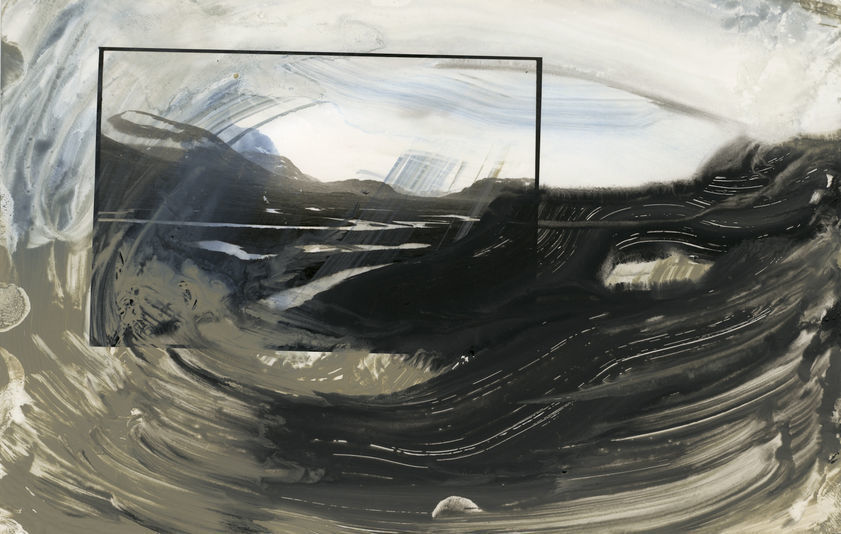
In painting such as Assumption, it is the quality of light that interests McKeever, rather than a documentation of the landscape. The manipulation of paint on canvas makes a landscape in its own right. As the paint is moved around, it is as if he is re-creating the forces of light, wind and rain and how they interact with a geologic substrata. 

Ian McKeever: Waterfall 3 1979

You can see the split between photographic documentation and painterly recreation beginning to come about if you look at McKeever's 'Waterfall' series of images from the late 1970s. He juxtaposes the photographic document with a drawn recreation of the same place. The drawings begin to 'escape' the dictates of the photograph, they make their own reality, just as the landscape does. 

Lucas Arruda

Lucas Arruda is a Brazilian painter known for the atmospheric luminosity of his landscapes. It is interesting to compare his work to McKeever's, as in a way they have both left representation behind and both are far more concerned with re-creation. Arruda states, “It’s the idea of landscape as a structure, rather than a real place.” He paints from memory, and avoids specific reference points, recalling atmospheric conditions, different types of weather or times of the day. 

These paintings are a type of abstraction, the use of a horizon line gives a sense of a landscape of distance and atmospheric space. When seen in the flesh, the materiality of the paint, combines with the brain's tendency to see landscapes, and the art historical references point to the romantic sublime. I like them because they waver between things, sitting on an edge between genres, whilst being very enjoyable paintings, that are very much about paint.

Lucas Arruda

Lucas Arruda

Christopher Prout is an artist working with the English landscape that I have often looked at as someone operating in a very interesting space between an abstract expressionist sensibility, one of making paintings that achieve their impact and expression through the way they are painted, and an observational practice, that attempts to capture the images of particular places and atmospheric conditions. While looking at his work your mind can switch between an awareness of the painting as object and the painting as a window. 

Christopher Prout

Christopher Prout

However when it comes to the drawn image, a current favourite of mine are the drawings of Sue Bryan. She works in charcoal on either handmade paper or primed wooden panel. 

Sue Bryan

Sue Bryan's drawings are always about dry materials such as charcoal and graphite, but also about certain atmospheric conditions. You feel that she really does have a deep empathy with the trees that she is depicting, these images are suffused with love. Her process of image making is one of building up tones and textures using a combination of charcoal, carbon and graphite combined, in order to achieve a beautiful range of blacks and greys, that as she puts it "vary in density and transparency as much as in tonality".  

 
In a time of global warming and an awareness of how we as a species have made such an impact on the landscape of the planet, how art can be used to raise awareness of the wonderful landscapes that we still have left, is becoming a more and more vital question. 

Nils-Udo: Beech and Rowen Berries

Artists such as Nils-Udo and Andy Goldsworthy have used the materials of nature to make their drawings and site specific installations, whilst collaborative ventures such as Red Earth have undertaken performances and have become much more directly involved in the preservation of landscapes. 

Red Earth

Whether you are trying to make people aware of the beauty and wonder of landscape by making images of it or are being much more environmentally politically active, (as in the work of Agnes Denes), doesn't matter, what is important is that you become more aware of how our future is inextricably linked to the fate of the landscapes that surround us; not just the ones we can see out of the window, or as we travel through the countryside, but also the landscapes that we cant see, but which are still effecting us everyday, such as the Amazon and the Antarctic, huge areas of land that have both been severely effected by climate change and human intervention. 

Saturday, 18 March 2023

In Praise of the Dandelion

Early illustration of a dandelion 

The other day I was trying to get everyone excited about the various ways that research could help deepen an understanding of both the world and possible connections we could make between it and the artworks we make. Because one student's site chosen for developing ideas for artwork, was a small patch of waste ground, I have decided to put together some secondary research relating to that ubiquitous wasteland plant, the common dandelion, a plant that is sometimes regarded as a weed, but which historically has often been a vital source of both food and medicine. However research alone can make for a somewhat sterile approach to the subject and we are of course those muzzy headed things called artists, so I have blended into the secondary (book and Internet) research, the things that are personal to myself; my individual idiosyncratic bits of connection with the world that make my life interesting. In order to create unexpected images we often need a hard to grasp something, that grit in the oyster that triggers the growth of a pearl or hopefully in this case causes a poetic image to come into being.

Dandelions have historically often been used to represent celestial bodies, each one coming into prominence during the 3 different phases of the dandelion's life. The plant’s yellow flower representing the sun; the dispersed floating seeds the stars and the puffed out fluffy dandelion ball the moon. We have records of dandelion use going back over 4,000 years and fossil evidence of them from 50 million years ago. They are therefore much older as a species than humans and have had much more time to adapt to various environmental conditions. However like humans they are generalists and as such have been able to survive over a wide range of environments. The early 17th century herbalist, Nicholas Culpeper, found it to be a ‘virtuous herb’, and when consumed in the spring he states, "you may look a farther, you may see plainly without a pair of spectacles”. Its supposed ability to sharpen our eyes could be a clear metaphor and alongside its cleansing quality in the treatment of obstructions of the liver, gall bladder and spleen, you have a restorative concept that could also lead to images of healing. 

In folklore the dandelion got its nickname, the ‘shepherd’s clock’, because the flower opens after sunrise and closes at dusk. They are of course very easy to grow, Dandelion seeds germinate quickly, generally taking from three to six weeks to sprout, and are able to survive a light frost. It is an aid in activating compost as well, making Dandelions useful agents for getting a wasteland's transformative energies moving quickly and keeping those energies moving. It is an essential component in a natural healing process, whereby if we leave a plot of wasteland long enough it will become a vital, thriving community of interrelated species. Therefore dandelions are an aid to their surrounding environmental community, helping to transform environments so that more delicate plants can grow; also providing a wealth of nutrients to a wide range of animal herbivores and omnivores and providing bees and other insects with nectar during times when other plants are not in flower. You could think of the dandelion as a catalyst for other garden reactions, its presence signalling that a healthy plant community was being built. 


The dandelion 'sun' flowerhead

The dandelion’s bright yellow flowers open when touched with the sun’s first light and close again in the evening as the sun dips over the horizon. Because of this mimicry of the sun's actions and its appearance as a radiating yellow disk, it has long had strong associations in people's minds with the sun. This has led to certain folkloric metaphors, such as the dandelion’s yellow flower being able to shed light upon that which would otherwise be hidden. In herbal remedies, it can, because of this association with the life giving energies of the sun and therefore light, be used to help give the confused clarity and to rejuvenate the tired and enervate us after illness. It does indeed help clear the blood and has been used as a medicine for thousands of years. The dandelion is classified as a herb, and was used by Native Americans for eradicating kidney disease, reducing swelling, alleviating skin problems, stopping heartburn and curing upset stomachs. The Chinese used it for curing stomach problems, appendicitis, breast inflammations and lack of milk flow. In Europe, it has been used to relieve fever, boils, eye problems, diabetes and diarrhoea. As a child when you blew its seeds out into the air, you often made a wish or sought to foretell the future, but little did we think at the time, that our childish ‘seed-thoughts’ were helping the dandelion to plant its own seeds in far away places.
The distinction between weeds and non-weeds is a fascinating issue to examine. The definition of the dandelion as a weed shines a light on how human concerns shape the way we think about non-human things as well as how they fashion the types of spaces we develop. For instance, there is an old hierarchical organisation of inorganic and organic matter, that is measured against the position of human beings within the cosmic order of things. It is interesting to look at that and compare it to more recent ways of exploring relationships within current socio-economic practices, especially ones that define what plants are allowed to exist and where. 

Raymond Lull and his staircase of hierarchies

In Raymond Lull's diagrams of hierarchies, notice how each element sits one above the other in importance, people are above animals, that are above plants, that are above moving forces such as fire and water and which are above inert things such as rocks. People are though below more spiritual beings such as angels, God of course occupying the top step.  

From 'Book the ascent and decent of the intellect' 1305

Back in the 13th and 14th century Raymond Lull developed a way of categorising the hierarchy of relationships that existed between God and all of his creation. Lull used the metaphor of a ladder or stairway to do this. The mind 'ascends the analogy of being' and as it does so it contemplates the relationships that God has set up between himself and all of his creations. This contemplation would have been centred on passages from the Bible, such as this from Genesis: 1:26–28.

'God blessed them, and God said to them, “Be fruitful and multiply, and fill the earth and subdue it; and have dominion over the fish of the sea and over the birds of the air and over every living thing that moves upon the earth'

In this passage from Genesis, God is giving human beings the authority to have dominion over every other living thing and that means that Jews and Christians have for over 2,000 years been taught that plants like the dandelion are a step or two below ourselves on the ladder of being. 
 
The fact that certain plants have been historically understood as food, textile material, money, religious objects, ornaments or weeds speaks to the many socio-economic variables at play in their categorisation; their names sometimes preserving traces of their various social lives. With this in mind, along with a very particular personal reason, the story of dandelions, and their ambiguous existence on the border between weeds and food, becomes something that begins to open out for myself several avenues within which to develop visual inventions. 

Perhaps I ought to explain my personal association with dandelions. It is twofold and complex but all the more rich therefore in its potential. My father was an obsessive lawn maintainer. He was one of those people that liked to see an immaculate lawn in front of the house, as if it was a sign of the ordered house behind it. I was taught to mow the lawn in straight lines, so that the grass was at exactly the right length and bent over at a particular angle so that the lawn's stripes, lined up with the house's axis. 

It was a time when boys up until the age of 12 still had to wear short trousers

A nice striped lawn

As well as to mow the lawn, my job was to weed it. Dandelions were for my father a particular threat and they were easy to spot, a tiny spot of yellow was for my father an eyesore and to keep him happy, I learnt to keep an eye out for them. I was taught to use Weedol and would pour it onto any foreign plant that threatened to disturb the lawn's homogeneity and as these were two of the most resented tasks my father forced on me, both mowing and weeding became inextricable from my idea of what he represented. (Yes I am aware of Freud's Oedipus complex) Many years later I was to get a phone call to tell me he had died, he had had a heart attack when mowing the lawn. My mother's mother, my grandmother, lived in a village and was deeply attuned to the natural world and every year we would go walking in the local fields and would pick dandelion heads, so that she could make dandelion wine. This was a joyous experience, instead of a chore it was lots of fun and was a time of immersing myself in the world of tall grasses that tickled your legs and felt warm as you rolled down banks covered in what my dad would have thought of as weeds, but which my gran knew as plants with stories. These two alternate visions have stayed with me throughout my life and still influence my view of the world and our relationship with it. The dandelion for myself, representing a focus around which these two opposing realities moved. What I'm suggesting here is that when looking to develop work around something, it is often useful to find a personal relationship to the subject. This may of course allow others to accuse you of making your approach too subjective, but for myself, it has always been an essential aspect of why I'm bothered to make work about the things I do. 

In my father's mind the human / plant relationship was one of signals about property and ownership. He did not want any 'weeds' to dilute his signs to neighbours that he was in total control of his domestic life. He owned the house and controlled what was allowed within its boundaries. But my father was not alone in his thinking. A quick search of the Internet will reveal a host of ways to eradicate weeds from lawns, millions of home owners still wanting to ensure their immaculately kept lawns are free from foreign invaders. There is a very good article on lawns by Krystal D'Costa that was published in Scientific American, 'The American Obsession with Lawns', in it she states;

"Lawns are viewed as an indicator of socio-economic character, which translates into property- and resale values. Lawns are indicative of success; they are a physical manifestation of the American Dream of home ownership. To have a well maintained lawn is a sign to others that you have the time and/or the money to support this attraction. It signifies that you care about belonging and want others to see that you are like them." (D'Costa, 2017) 

The dandelion becomes, not just a couple of steps down the ladder of being, as in Lull's medieval hierarchy of relationships, but an economic threat to property and resale value. A reflection of the gradual erosion of the Christian religion and its value systems and replacement by capitalism and its value systems.

There are dandelion stories that have been told over and over again and in many different languages, common tales that belong to everyone and these stories contain within them other sets of values, in the case of the following story a more communal idea is fostered, could it perhaps suggest that the dandelion be celebrated for its socialist ideals? 

This story has been told many times, sometimes it is an angel that does the judging and at other times fairies, but whichever version of the story you will hear, it is always one that celebrates the virtues of a flower that seems to be able to grow almost anywhere and that has edible, roots, leaves and a flower that makes for tasty wine.

Long, long ago, the flowers and their fairies had been having long ongoing talks and discussions as to which was the most beautiful, the most special and therefore the most loved flower. The talks went on for many weeks and eventually an argument started; each and every flower at some point claiming to be the most beautiful and the most special. Finally, after much distress and shedding of petals all of the flowers agreed to let the Flower Fairies decide. The Queen of the Flower Fairies was a fair, gentle and kind spirit and so the fairies turned to her and asked her to settle the issue and to give one plant her blessing and the title of the "most perfect" flower. At first she refused the task, she told the flowers that they were all wonderful and said to the other fairies, "They are all beautiful in their own way." But the bickering began again and she could see that there was not going to be a solution until they all had an answer.
The Fairy Queen had ideas of her own about beauty and what was special and she therefore decided to test each flower by asking them one question. She had always understood that it was only by considering the needs of others and the relationships between everything that we could become aware of how delicate and wonderful the fragile nature of existence was and her question was designed to find out if the flowers had ever themselves thought about these things. Although she loved them dearly, she had always had a suspicion that they loved themselves a little too much and that they rarely thought about how much their beauty relied on the efforts of others.
The first flower the Fairy talked to was the rose. "What is your ambition?" she asked. "I would like to climb the castle wall." said the rose. "And then kings and queens and nobles would pass by everyday and exclaim over my beauty, my scent and my delicate nature." The Flower Fairy Queen nodded her head and thanked the rose, and then moved on.

Next she came to a tulip, standing tall and proud. "What is your ambition?" she asked the tulip. "I want to live in a public garden" said the tulip. "Where everyday people would come and admire my wonderful colours and see how straight and tall I stand." Once again, the Flower Fairy Queen nodded her head and after thanking the tulip, she moved on.

She walked until she came to a forest. There she found some violets. She asked them "What is your ambition little violets?" "Oh" said the violets quietly "We like it here hidden in the woods where no one can see us and where the trees keep the sun from dulling our beautiful colour." Once again, the Flower Fairy Queen nodded her head and after thanking the violets, she moved on. She then talked to the tiger lily who told her how wild and fierce it was, of how it wanted to be the strongest and bravest of all the flowers. She talked to the sunflower who barely answered her because all she wanted to do was be warmed by the sun. The Queen talked to the orchids who only wanted to dance and she tried to talk to the narcissus but it was too busy looking at it's reflection in the water to speak to her.

The queen walked on speaking to flower after flower, each one full of self regard but of little awareness of the needs of others or of how and why they had themselves become such beautiful things.

After many months of wondering the Earth she was becoming worried, was there no flower that understood the world in a similar way to herself? She was ready to give up and go home when she came to a field with bright fluffy yellow flowers on long thin stalks. The leaves were long and jagged and very close to the ground and the flowers looked happy and cheerful. "What are you called?" she asked? "I am a dandelion" said the little flower. "What is your ambition little dandelion?", she asked, just as she had all the other flowers that she had come across. "I'd like to live wherever there are others. I want to live beside the road, and in the meadows, and push up between the sidewalks in the cities, and make friends with snails and flies and beetles and worms and other plants and mushrooms and algae and birds. I want all things to feel happier when they see my bright colours, when they feel the thin fingers of my roots tickle them, when they see my juicy leaves and taste how delicious I am." The dandelion chattered on happily saying, "I want to be the first flower that children pick in the spring and take to their mothers. I want to carry wishes on the wind and become part of everyone's life."

At last the Flower Fairy Queen began to smile again, she nodded her head and said "Little dandelion, you are the most perfect and special flower of all and you shall have your wish! You will blossom everywhere from spring until autumn and be known as everyone's flower." This is why the dandelion comes so early and pushes its head up everywhere with such strength and determination; and why it is so loved by other plants and soils, who offer it hospitality throughout the year.

So when you see a dandelion peeping out between the cracks in paving stones, sitting in alongside the too neat grasses of a manicured lawn, or simply holding on to what would be a bare patch of waste ground if it wasn't around, remember that it is the most special of flowers and blessed by the Flower Fairy Queen and if you don't treat it with the utmost respect she will know this and will remember you and that is something you really don't want to happen.

Dandelion stars

Seed head structure

The dandelion stars are of course its method of seed distribution. In the mass of seeds known as a dandelion clock, each seed is suspended from a parachute-like stalk. We have all as children released these seeds with a puff of our breath, but as we did so we were never really aware of the complex science that lay beneath this seductive process. The dandelion's seed parachute is a bunch of bristles called a pappus. Each pappus carries around 100 filaments, each attached to a central point, rather like the head of a chimney sweep’s brush. Just like a parachute, it increases aerodynamic drag, slowing the descent of each seed and allowing it, once aloft, to stay in the air for much longer. 

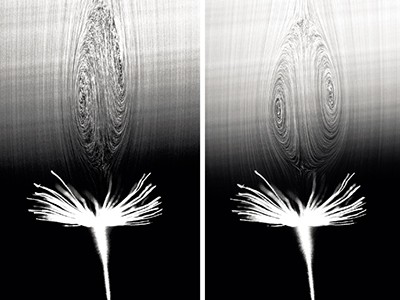
Images of the low pressure vortex created as a dandelion seed-head floats downward

The dandelion's parachute of bristles is arranged so that when the pappus falls, air flows between the bristles and creates a low-pressure vortex. When captured using special imaging technology, this vortex is rather like a tiny ghost that travels above the pappus and yet is not attached to it, an invisible familiar that generates lift and prolongs the seed’s time in the air. An article in 'Nature' by Cummins, et al. (2018) explains that the key to this lies not in the bristles of the pappus, but in the spaces between them. 

       'If projected on to a disc, the bristles together occupy just under 10% of the pappus’s area, and yet create four times the drag that would be generated by a solid disc of the same radius. The study shows that air currents entrained by each bristle interact with pockets of air held by its neighbours, creating maximum drag for minimum expenditure of mass. The pappus’s porosity — a measure of the proportion of air that it lets pass — determines the shape and nature of the low-pressure vortex'. (Cummins, et al. 2018 p. 417)

What interested me most about this however was the fact that the dandelion had evolved to respond to the thickness of the air, something that I had only thought animals could do. Like the dandelion's parachutes, tiny insects, such as the featherwing beetle have evolved to swim through thick air. Featherwing beetles do not fly using traditional wing shapes, they swim through the what is to them, thick viscous air, using ‘paddles’ made of bristles. The difference between plants and animals is perhaps less than we would like to think. If we think of a dandelion more as a series of interacting processes, then its seeds floating away are just one of several aspects, all of which are equally important to its life cycle, and one aspect of this life cycle is that its seeds need to fly. 

The featherwing beetle

The dandelion's 'stars' are not just mythically attuned, they are reminders of how narrow our particular frame of reference can be. The very air that we breathe is of course a fluid substance and one that for some creatures is like a sea within which they swim. The dandelion being one of those living things that is uniquely poised between earth and air. 

When botanical illustrators are asked to show the dandelion, they often concentrate on its above ground features, but sometimes an illustrator will acknowledge that there is as much going on under the ground as above it. Durer gives us the underlying sod of earth that he cut out of the ground with his plants, as an integral part of his subject and in doing so he also gives us a glimpse of the complex interrelated life of these plants, rather than dissecting them, atomising them and cutting them up as if they were 'dead' things.  

Durer


Various artists' approaches to illustrating dandelions

The Japanese approach to dandelion illustration is less 'scientific' but more poetic. The interrelationship between things is more important than the dissection of its parts. 

Hare and Dandelion: Kubo Shunman: 1820

Dandelions are deeply respected within Japanese culture, but perhaps a poem serves us better than prose. 

Stars and Dandelions by Kaneko Misuzu

Deep in the blue sky,
like pebbles at the bottom of the sea,
lie the stars unseen in daylight
 until night comes.
You can’t see them, but they are there.
Unseen things are still there.

The withered, seedless dandelions
hidden in the cracks of the roof tile
wait silently for spring, 
their strong roots unseen.
You can’t see them, but they are there.
Unseen things are still there.


The Little Weed puppet between Bill and Ben the Flowerpot Men

In the 1950s the BBC used to have a series of children's programs most of them involving string puppets. The Flower Pot Men was the story of Bill and Ben, two little men made of flower pots who lived at the bottom of an English suburban garden. Julia Williams was the voice of Little Weed, a dandelion with a smiling face, who was always shown growing between the two large flowerpots that were the homes for Bill and Ben. The program was for myself as a child a powerful visual influence and as I got older became one of those personal image banks on which I could draw upon, the further back in my personal timeline they emerge from, the stranger they seem but somehow also more comforting. The talking weed in particular would sometimes come to inhabit my dreams, eventually of course I would need to draw it, a process that at times can be vital to the construction of what I see as an externalised mind. I'm afraid this is another very personal account, but by thinking of artworks as externalised minds, I am able to think about how they work for myself and why I need them. 


Various drawn manifestations of the dandelion/Little Weed in my own work

Other artists have found their own ways to use the dandelion within their art. The American art collective 'the art department', gathered bags of dandelion seed heads in order to construct their 'wish processing centre'. 

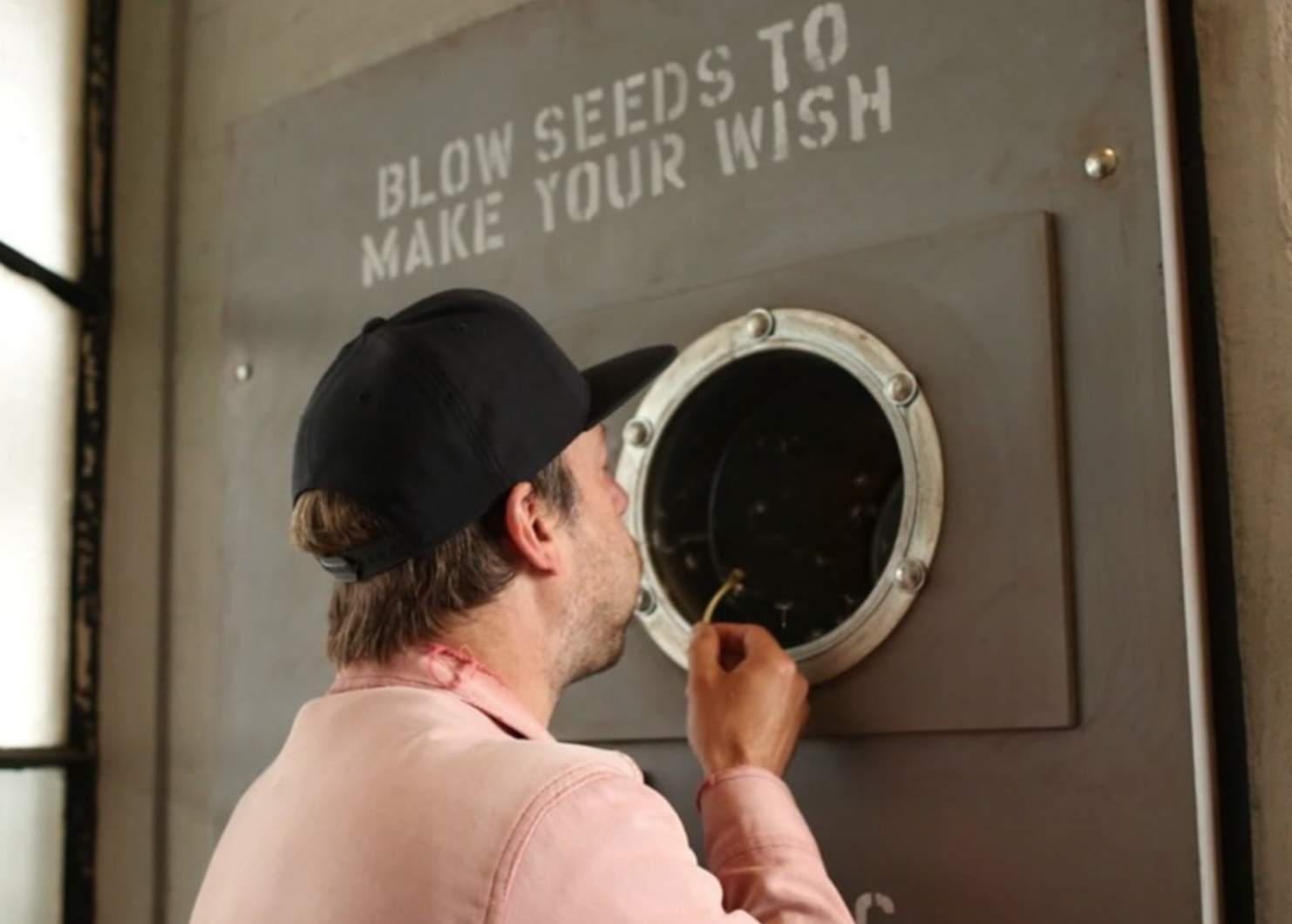
The art department: wish-processing centre

A participant makes a wish

In a working industrial site southeast of downtown Los Angeles, the LA-based group 'The art department' created a wish-processing centre. This ephemeral installation, lasted for just one weekend. It incorporated large piles of dandelion seed heads, which have long been associated with the granting of wishes when their seeds are blown off into the air. People were expected to gather seed heads and make their way to the wishing stations and make wishes. 

I have only touched upon the many and diverse stories associated with dandelions, from their current use as a substitute latex in the manufacture of rubber, to particular recipes for salads and the myths associated with bed wetting; as soon as you begin researching, more and more avenues to follow will open out. 

Dandelions remind us of our childhood and those times when we really believed in make-believe and that wishes could come true and as such as far as I am concerned, they ought to be celebrated as wonderful things and never, ever regarded as weeds. 

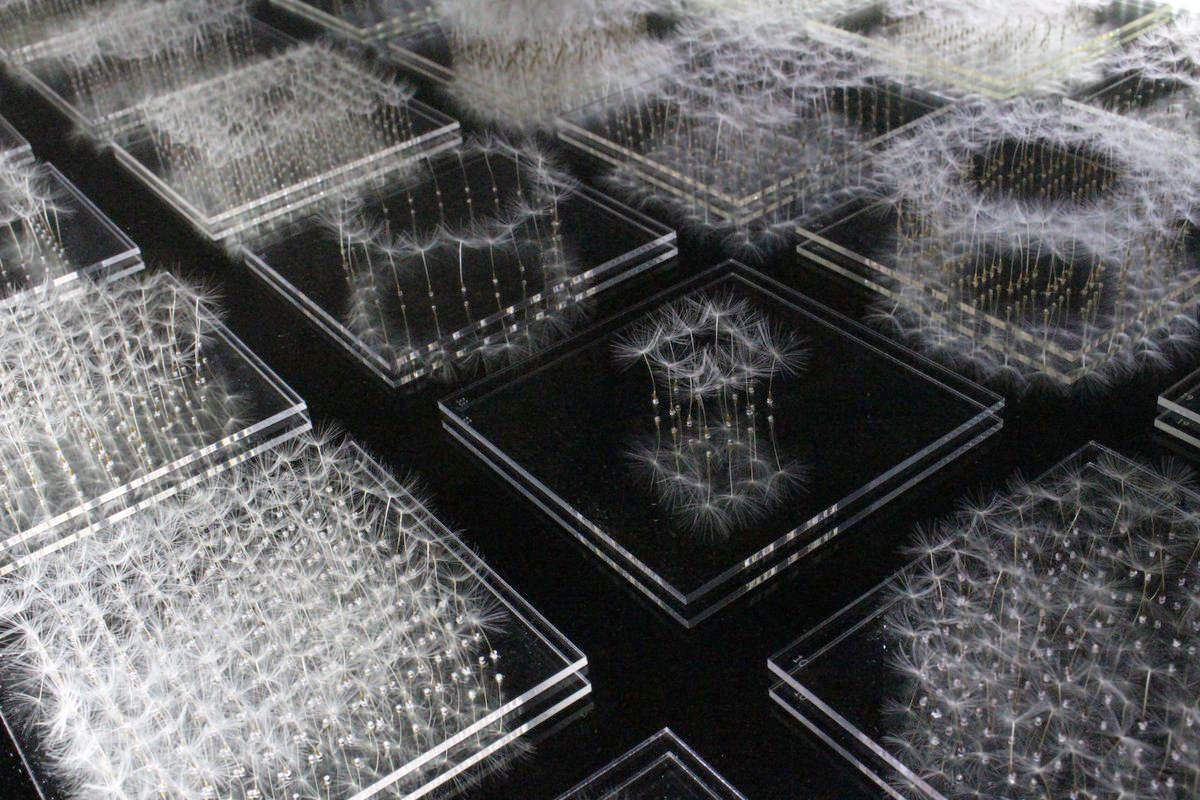
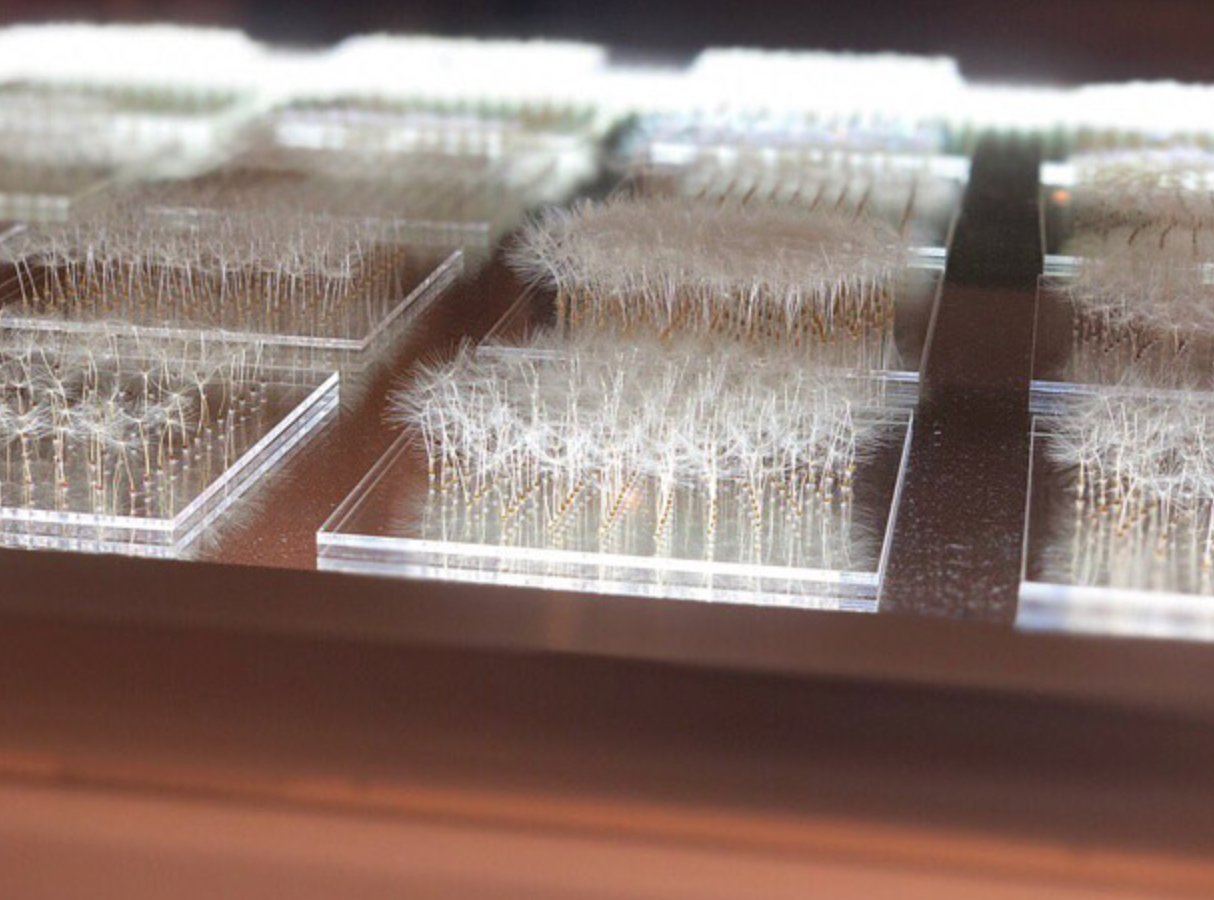
I'll leave you with the work of the Japanese artist Yusuke Aonuma, dandelion seeds form the building blocks of very carefully arranged architectural artworks preserved on rafts of perspex.


Coda

My old friend Terry Hammill sent the cartoon below as his favourite response to the dandelion. 

Stephen Collins

Coda 2


In the spring of 2026 I was in Graz installing an exhibition of my work and whilst there was visiting museums. One exhibition I went to at the Kunsthaus was entitled 30% Dandelion, the accompanying explanatory text I thought chimed beautifully with my own thoughts. This is the text copied directly from the Graz Kunsthaus website:

'The dandelion—as a flower, botanical plant, cultural symbol, and aesthetic phenomenon—possesses strength and quiet courage. Unobtrusive yet persistent, it adapts radically, returns, and resists. Titled " 30% Dandelion" the exhibition at the Kunsthaus unites more than 35 works dedicated to the flower and its direct connection with humankind—humans share approximately 30% of their genetic material with the dandelion—along with selected loans from the collections of the Universalmuseum Joanneum. In these works, we encounter the melancholy of a crumbling present. At the same time, they take us on a journey into the familiar, beautiful, and intoxicating aesthetics of the dandelion and its expression of joie de vivre. The exhibition explores themes of recurring arrival, symbiotic cooperation, and farewell: poetic, political, and ecological.

The dandelion serves as both a model for adaptive strength and for a language spoken by all. In the spirit of floriography—the historical language of flowers—it becomes a transcultural gesture of recognition and communication: overlooked, yet persistent and beautiful. As a flower of margins, meadows, and gardens, it offers a symbolic vocabulary that resists normalizing constraints, speaks in everyday language, possesses healing powers, and, with its radiant sunlight, attracts the insects that pollinate it. The exhibition draws on the concept of "entanglement" as well as on philosophical and ecological frameworks of "aesthetic offering" (Elaine Scarry) and "critical hybridity"—thus connecting to the exhibition Hybrid Pleasures. Helen Chadwick supported by Liesl Raff on the upper floor, which explores productive and provocative forms of polyphonic hybridity. These “entanglements,” or interconnections, are understood, as thinkers like Donna Haraway, Karen Barad, and Timothy Morton have formulated, as being politically and colonially charged, as well as transcending species or gender. When Haraway writes, “We will be together or not at all,” it is crucial to trace these connections and use the insights gained to create a just future.

Amidst ecological crises, the aftereffects of colonialism, and digital acceleration, 30% Dandelion calls for new forms of attention – attuned to what grows slowly, demands time, and quietly returns. The flower itself, but also the dandelion with its spreading seeds, its natural healing power, and its communal flourishing, embodies this principle of an ethical way of living in coexistence.

Featuring works by Iris Andraschek, Suzanne Anker, Karl Blossfeldt, Andrea Bowers, Viltė Bražiūnaitė & Tomas Sinkevičius, Claude Cahun, Regula Dettwiler, Spencer Finch, Barbara Frischmuth, Anita Fuchs, Yevhen Holubentsev, Sanja Iveković, Anna Jermolaewa, Markus Jeschaunig, Claudia Larcher, Jonas Mekas, Joiri Minaya, Ryts Monet, Alois Neuhold, Agnieszka Polska, Anna Ridler, Ugo Rondinone, Martha Rosler, Sonya Schönberger, Nina Schuiki, Elfie Semotan, Petr Štembera, Alexander Stern, Thomas Stimm, Michael Stusser, Neja Tomšič, Dirck van Rijswijk, Anna Zemánková and other loans from collections of cultural history, natural history or literature, the exhibition unfolds as a multifaceted exploration of the flower, its attribution and The power of attraction.'

See also:

Drawing and the diggers: including more thoughts on using the dandelion in an image


Sunday, 16 October 2022

Drawing and The Diggers

Diggers getting nowhere

Sometimes ideas come full circle and when they do you either have to celebrate that their time has come, or despair that there will never be a right time for them and that human nature is such that we are doomed to make the same mistakes over and over again. The animated gif above was one of my responses to that feeling of 'stuckness' I had when thinking about the promise of The Diggers. It seems that for every shovelful of earth they removed, someone would have a spadeful of dirt to throw right back onto the pile. 

To dig the earth is a powerful idea, one that is celebrated by the name 'The Diggers'. They were a group of people who way back in the middle of the 17th century envisioned the tight ecological interrelationship between humans and the rest of the world. They had the idea that connections between people and the land were deep and inseparable and they advocated for social and agrarian reforms including the common ownership of land. The Diggers was a name given to 'The True Levellers' because of their insistence on digging as a way of signalling that any plot of earth could be made into a productive garden. One of their leaders was Gerrard Winstanley, who declared that "true freedom lies where a man receives his nourishment and preservation, and that is in the use of the earth". They were one of the first political groups to write down ideas that we now associate with socialism or communism but more importantly they understood that humans were in an interrelationship with the land and that it should not be owned by anyone. As they started to cultivate common land, they began to be called the Diggers, but their aims were much wider than that, they were developing their manifesto at the same time as the English Civil War. King Charles the First had been executed and therefore the unquestioned concept that the country and its land had to be owned and ruled by an elite class of people had been broken. For the first time the idea was mooted that no one individual should own land; as Winstanley stated, "The Earth was made a common treasury for all." These words now ring truer than ever; but when we look at the statistics of present day land ownership what do we see? 


In the book 'Who Owns England?' by Guy Shrubsole, we find that around 25,000 people, most of them still members of the aristocracy or owners of large companies, own approximately 48% of the nation’s land. The aristocracy and gentry accounting for around 30%, with the next 18% coming from corporations. However even the land technically owned by corporations, after looking at that in more detail, and exploring the labyrinthine legal ownership bureaucracy that covers up real ownership, he finds that much of the land that corporations hold is also essentially in the hands of the gentry. As Shrubsole puts it, “Land ownership in England is astonishingly unequal, heavily concentrated in the hands of a tiny elite.”

Almost a hundred years after The Diggers made their mark, in 1755 Jean-Jacques Rousseau in his 'Discourse on the Origin of Equality' had this to say, “The first man who, having enclosed a piece of ground, bethought himself of saying "This is mine", and found people simple enough to believe him, was the real founder of civil society. From how many crimes, wars and murders, from how many horrors and misfortunes might not any one have saved mankind, by pulling up the stakes, or filling up the ditch, and crying to his fellows, "Beware of listening to this impostor; you are undone if you once forget that the fruits of the earth belong to us all, and the earth itself to nobody.” If only someone had pulled up those stakes or filled up that ditch.

Perhaps now you can see what I mean by my concern that we are doomed to make the same mistakes over and over again.

But if we don't continue trying to raise the flag of alternative possibilities, we become ethically compromised and we easily forget those artists who have for many years nailed their socialist credentials to their left leaning ship's mast, because by virtue of the questions they ask and the causes they celebrate, it is unlikely that their work will become widely known in the mainly right wing media or bought and sold within the capitalist dominated current art market.
Gerrard Winstanley by Clifford Harper

As I write about Gerrard Winstanley I am reminded of the work of Clifford Harper. I first came across his work when visiting the anarchist bookshop just behind the Whitechapel Gallery in London. As an artist he is firmly embedded into a tradition that stretches back to expressionist woodcuts, a style he echoes with his mainly pen and ink drawings. Clifford Harper is described as an anarchist underground artist, and of course is regarded by many people more as an illustrator than fine artist. As he puts it very clearly in his own words, “I don’t regard myself as an artist. I am a craftsman. Fuck art.” For myself he fits into a tradition of socialist protest art, which other artists such as Sue Coe also inhabit, a tradition that is a world wide one and that continues to have relevance as a visual voice of dissent. 

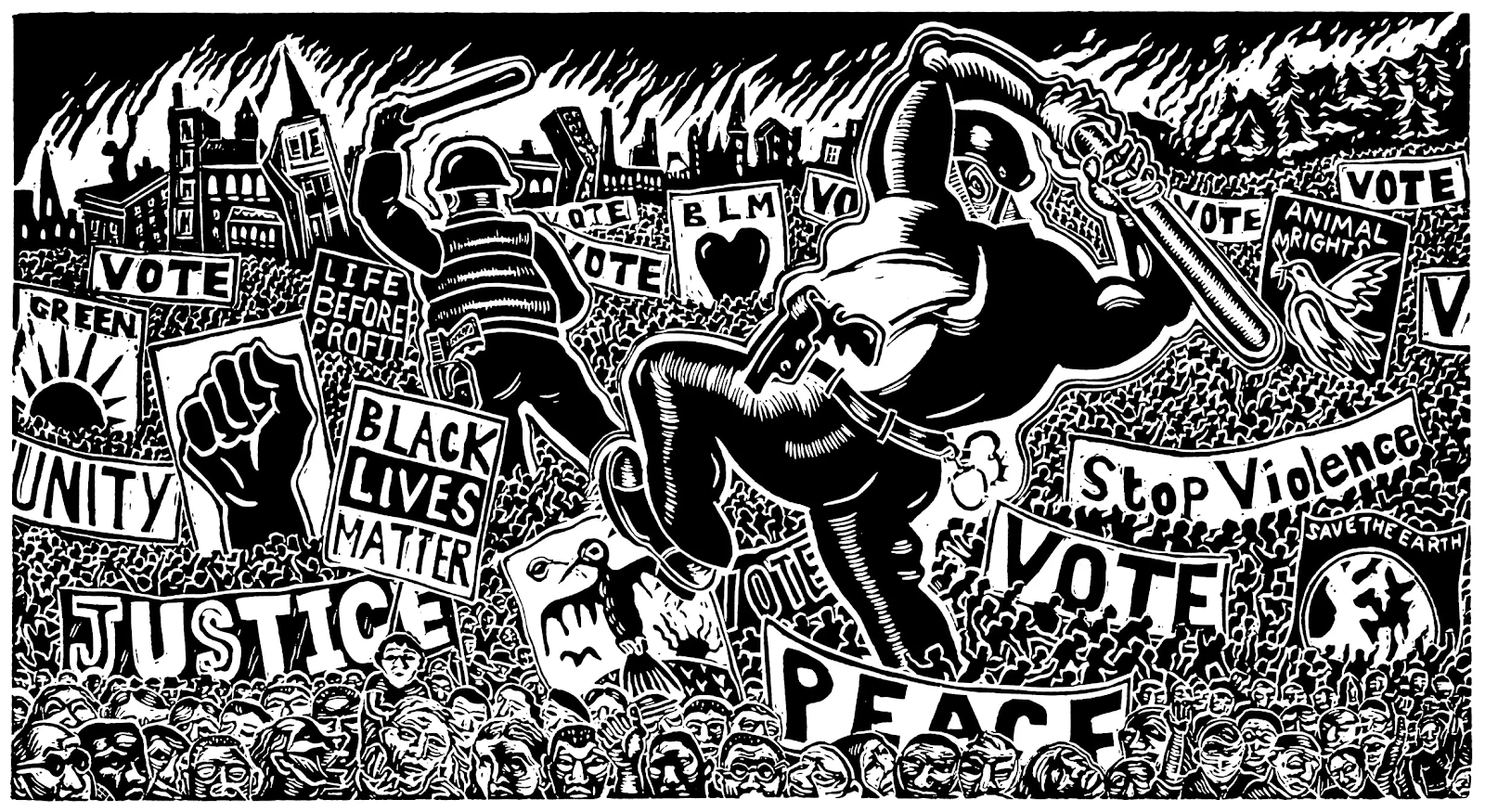
What is unique about this visual 'voice', is that it is designed to be a communal voice rather than the voice of an individual, you can see this very clearly by comparing a few artists from this tradition. 

Sue Coe: We are many they are few 2020

Clifford Harper: Anarchy Now 2019

Charles Nkosi: Submission to Death 1976

John Muafangejo: Rorke's Drift 1981

Maurice Merlin: Black Legion Widow 1936

Zheng Yefu: Fight 1933 

Đorđe Andrejević-Kun

Käthe Kollwitz: The People 1922

Frans Masereel: The City 1925

Safo Marko, untitled linocut

Ken Sprague: Happiness 

Neil Doloricon: Tribute to frontliners 2020

Black and white is of course a powerful visual idea. The world is full of colour and therefore not only does a black and white image stand out because of its internal high contrast, it stands out because it is so different to the coloured world that surrounds it. Simple print making methods such as woodcut, lend themselves to stark imagery, and community groups who want to promote their ideas are often strapped for cash, therefore basic print technology is vital to their ability to communicate. However not all these artists use wood or linocut, Clifford Harper mainly uses black ink on white paper, the reality now being that reproduction methods are so cheap that in contrast large woodblocks or rolls of linoleum are prohibitively expensive. It is though the visual language that is most important, the long association of socialist left wing ideas with clear high contrast black and white imagery, means that an audience 'gets it' very quickly. The emotional language of socialist expression has become universal, whether we are in China, Belgium, the USA, Albania, the Philippines or England, and  because of this it is a language that all of us can use.

Clifford Harper like most artists that use the visual language of socialist expression, also has a personal language of visual expression, one that I find at its best when he makes images such as the one below of the humble dandelion. Using pen and ink to simplify what is often regarded as a weed, together with a symmetrical composition and a reframing of the seed head as a halo, he reminds us that this so called weed, used to be part of our staple diet in England and that far from being a weed, it is a plant that has saved many of society's poor from starvation. Dandelions are a rich source of vitamins, minerals and antioxidants. They have powerful healing properties as they can be eaten to improve the immune system, detoxify the liver or gallbladder, as well as help kidney function. Its long taproot brings up nutrients so that nearby shallow-rooting plants can benefit from the minerals and nitrogen it extracts as well as its beautiful yellow flowers attracting pollinating insects such as bees.  

Dandelion: Clifford Harper

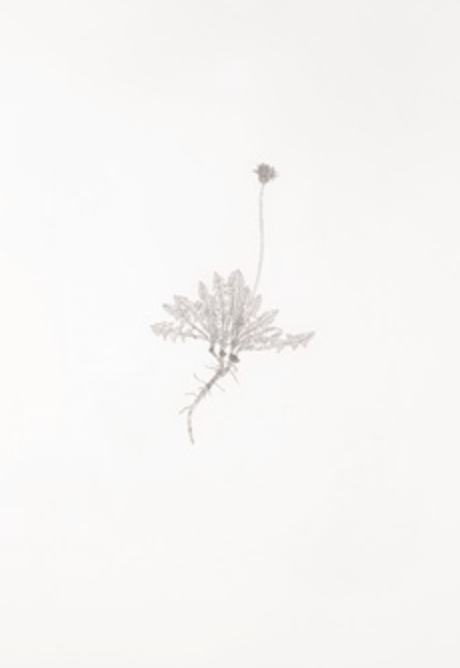
It is interesting to compare Harper's image with the much more well known and celebrated artist Michael Landy's weed drawings. Landy was lauded for etchings that critics said celebrated what was often overlooked and thought of as weeds. Yes they are sensitive drawings of the dandelion and that is a good thing. However Harper goes further and constructs the image of the dandelion in relation to his own socialist agenda and he gives it an almost religious conviction. Landy is properly humble in front of the dandelion, its pale grey image forcing us to peer into the image to discover its beauty, but Harper is sensitive to the wider ecological issues involved, ones that just as the Diggers intimated, we need to heed and to act upon, to respond as if all nature is sacred. In this case the weed is portrayed as if it is a saint with a halo. The concept of a surrounding aura, glow or irradiation was used in Christian and other religions to single out figures that had God like status and Harper uses this idea to give honorific value to a common plant, in a similar way that he might try to give value to the often overlooked 'common man or woman'. 

Michael Landy: Common dandelion , 2002

In San Francisco in the 1960s another Digger community action group emerged. This was a group of activists and street theatre actors operating out of San Francisco's Haight-Ashbury district. Contributors included Peter Berg, Neal Cassady, Richard Brautigan, Allen Ginsberg, Emmett Grogan, Paul Krassner, and Gary Snyder. The group put out a magazine between 1965-8 and printed leaflets known as 'Digger Papers'. 


Digger Dollar 

The Digger Dollar was a vital image as it highlighted the central role that money now had in society and in particular the dollar was now the value system that all the rest of the world's currencies measured themselves against. 
The issues brought to the fore by the Diggers continue. A continuing ownership of the land by a few powerful individuals and corporations as well as their wasteful use of the resources they own, has brought about a climate crisis and a growing awareness of the consequences of global warming. Ecological art forms are therefore proliferating; in particular this means an art that could involve functional ecological systems-restoration, as well as socially engaged, activist and community-based interventions. Ecological art addresses politics, culture, economics, ethics and aesthetics as they impact on our collective awareness of the threats to ecosystems that the dominant capitalist system perpetrates. Its practitioners are often found working cooperatively and as well as artists, may include scientists, philosophers and other activists all working together to restore or heal what has been broken by unthinking economic growth and also raising public awareness by developing very visible projects. You will find many links to artists working in this way if you use the sustainability resources link below, but my point for today's post is that at various times in the past groups have collected together to raise the public's awareness of what happens if we lose sight of our responsibility to the planet. My fear is that the power of the existing Earth's owners will once again win out and that those who many years ago conquered the various lands by force of might, will hold on to that power forever. The new King Charles inherits what the old King Charles bequeathed to the royal family, and I realise how so many of us feel safer if traditions are maintained, however it was a salutary reminder that when a conservative chancellor wrecked the economy, that the people that it really affected were as always the working poor. When tackled as to how they would support poor people through this crisis the government's safeguarding minister Rachel Maclean, stated that people could 'take on more hours' at work or move to a 'better paid job' to protect themselves from this new cost of living surge. This is not just about conservative ministers being disconnected from the realities of people's lives, as the Labour party put it, it is a reflection of the deep divisions between those that own the land and those that work on it. Until we have true equality not just between people, but between humans and the rest of the world, we will be getting nowhere again. 

In the meantime perhaps it is worth looking at how one artist in Ireland is responding to the situation:

'The Distant is Imminent' is a work by Camille Seaman, depicting her still and moving images from Antarctica and the Arctic. 

Meant to be projected on the walls of cities most threatened by rising sea waters, a line in Seaman's video depicts where the water level would be in that particular location in 2050, if no action is taken to curb climate change – viscerally showing that while icebergs melting away might feel distant and abstract, climate change is indeed imminent and personal. 

A living artwork, the piece initially covers four locations (more to be added in the coming months) – New York City, Tokyo, Amsterdam and Limerick, where the artist resides.

You can download the video files from here, and project the video on the walls of your city, to raise awareness about the climate crisis.


See also:


Wikipedia links 


NB
Wikipedia is a free online encyclopaedia, created and edited by volunteers around the world and hosted by the Wikimedia Foundation. It is another example of how human beings can collectively work together for mutual benefit.