Whenever you have to deal with mass in a drawing, cross contour lines
are a potential approach. Sculptors in particular have to deal with mass and
therefore have often developed a cross contour approach to drawing. Working in
this way, is not about developing a cross contour style, (always beware of stylisation) it’s about
recognising when and where to place marks so that they indicate the mass that
they relate to. Time spent making this sort
of drawing helps to develop the eye’s ability to recognize change in surface
direction and aids your hand’s ability to respond to these changes by both developing control and getting used to inventing
marks to suggest surface texture and mass at the same time
Moore: Shelter
Moore: Study for sculpture: Family Group
Moore: Etching: Elephant Skull
Henry Moore used cross contours throughout his life and was very
sensitive to their use in a variety of ways. In the etched drawing of an
elephant skull above, you can see how his lines trace over the surface of the
bone and in doing so pull your vision in and out of areas of light and dark. In
this case Moore is allowing the lines he makes to do two things at once. He
masses lines together to create dark holes and then allows cross contour lines
to ‘escape’ from the dark and travel over surfaces. Compare this drawing with
his earlier ‘shelter’ drawing. Again we see the use of cross contour lines,
this time combined with wax resist and ink lines that trace over the form. His
studies for sculptural groups of figures are particularly sensitive to the use
of contours, the heavy mass of stone being suggested by crayon and the changing
of direction of surfaces suggested by the contour lines as they make their way
over three dimensional forms. The 'stone' texture is suggested by the use of a grey wash, this also being used to describe the play of light over the mass, however in this case the contour lines are still clearly seen, as the wax rejects the wash and the lines stand out in white.
Cross contour lines are drawn lines that travel across the form. They
may be horizontal or vertical, or both, often when describing more complex
forms, cross-contours are drawn at varying angles, sometimes changing direction
as they develop to suggested planar change. When I was a student a classic
exercise was to imagine an ant making its way over an object you were looking
at. You then had to draw the traces of its imaginary movement as if its feet
left a line of marks. The trick to this was not only hard looking and thinking,
but to imagine an unpredictability of movement, as if the ant had a mind of its
own and kept changing direction. This exercise made you ‘feel’ across a surface
and you got used to adjusting the direction of marks so that they ‘sat’ in the
space convincingly.
Map contours work in a similar way, (see above) as they gather
together they suggest a sharp drop or steep incline, as they spread out they
suggest a tilting plane or gentle slope.
In mathematics geometric contour lines are often used
to visually describe complex three-dimensional forms, such as rotating
surfaces. See above. This type of geometric thinking having a history that goes back to the
Renaissance and Uccello’s wonderful drawing of a vase.
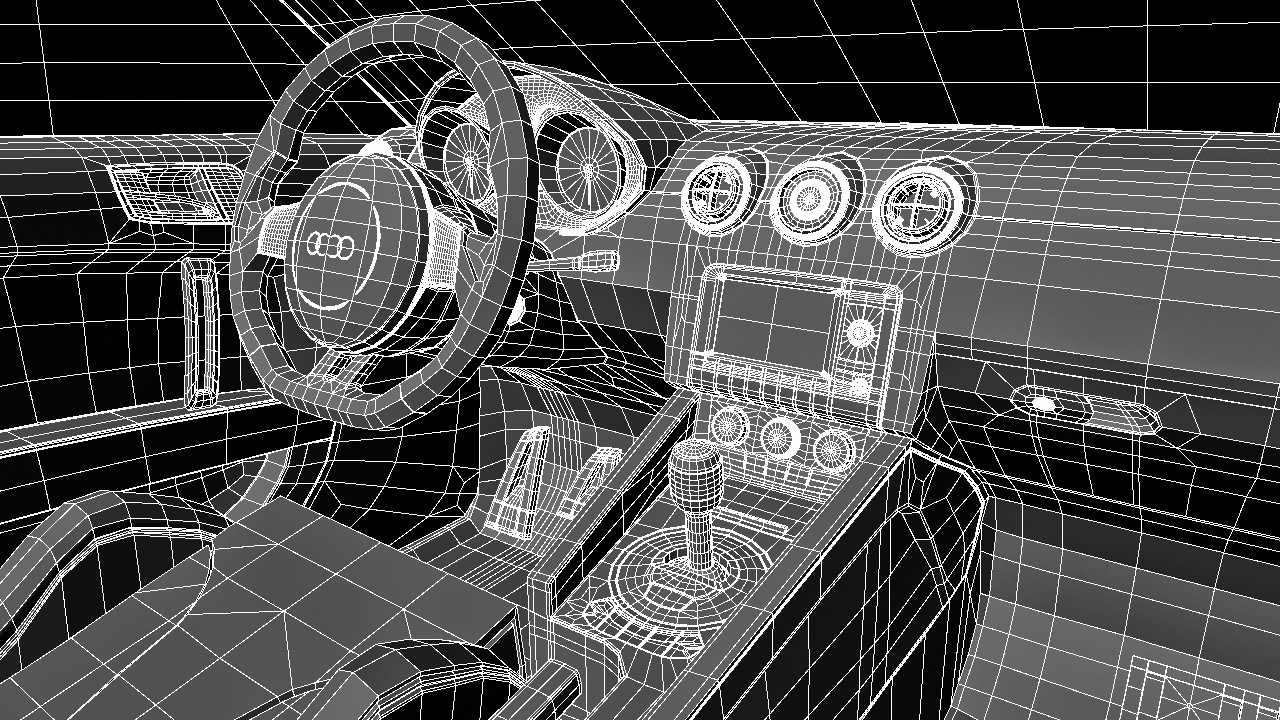
Present day computer realisations that use wire frame
modelling continue this long tradition.
You can find examples of cross contour lines in the work of many artists
both historical and contemporary.
Durer
In this drawing of a man’s head by Durer, you can see
a particularly subtle use of lines following the surface of the skull. Lines
are drawn in white as well as black, this allows the artist to suggest
two things at once. A line can follow the direction of the surface, thus indicating
the physical mass or ‘haptic’ nature of the subject and at the same time can
indicate the way light plays over the form. This allows the artist to place the
subject in a convincing space. Mass and space are therefore synergistically
combined in this sort of drawing.

Victor Newsome’s drawing ‘four views of a figure’ uses
cross contour lines within a very technical approach. His figures look like they have emerged from an engineering drawing, suggesting that as humans we are at the end of the
day simply living machines. This woman in a bath is one of a series of drawings that Newsome made, the study of a head (below) gives a clear idea of how he used perspective contour lines to simplify form. (He is also another former ex-student of LCA)
Victor Newsome
Victor Newsome
The study of ears by Newsome above is currently on display in the Ferens Art Gallery in Hull.
I've used cross contour drawing myself many times and usually to give weight to an idea. For instance this idea of a head like form with a hole through it would not be convincing if it hadn't been drawn using a method that gave it formal weight.
Hans Bellmer
Hans Bellmer's, Bastille Corset, uses brick-like structures to suggest both the soft shapes of a corset and the structural presence of a brick wall. Bridget Riley uses the same visual effect to create spatial movement in her early black and white canvases.
Bridget Riley
Although always spoken about as if being entirely about 'optical' effect, Riley's early work, I would suggest, relies upon a strong awareness of the relationship between touch and sight. In some ways the disorientation you feel in front of her 'Op-art" paintings is a very physical one, that derives from our brain's search for a solid on which to pin the illusion.
Perhaps the most important issue about cross contour drawing is that it brings together sight and touch. You are drawing as if you are feeling over a surface and it is well known that children need to feel objects in order to begin to picture what they might be, touch reinforcing what is seen. It has therefore been argued that touch comes before sight in our world of organised perceptions.
As Margaret Atwood wrote: “Touch comes before sight, before speech. It is the first language and the last, and it always tells the truth.”
Atwood points to a key element of meaning, authenticity is vital to our awareness. There is something about 'trust' here. Touch is more 'honest', we believe in it, therefore by working in a way that brings us back to an awareness of touch, we can build a feeling of 'truth' into the image. The solidity we perceive in front of a Henry Moore drawing also means that we 'trust' that these forms are 'authentic', the lines that trace their mass telling us that these images have weight and therefore a certain 'gravity'.
Related Posts
Solidified drawing: 3D printing