Showing posts with label Tape. Show all posts

Friday, 10 December 2021

Drawing with Tape: Part two

Colour coded electrical tape

I was interested to hear this week that an artist in Sheffield who is working with LEDs has had some research done on how to give the strings of LEDs in her work more resilience as the work has to be publicly sited. The answer was to embed the LEDS in a heat shrinking transparent electrical tape. Tape seems to be going through a technical revolution, some of its more industrial uses now looking to replace older methods such as welding and riveting, thus making much cleaner finishes and in many cases a much better waterproof bond. 

I have put up a post on drawing with tape before, but that was a few years ago and its use is perhaps even more popular as a drawing medium, so it is perhaps timely to remind you of how useful it can be, as well as how powerful and very particular the aesthetic language of tape drawing can be. 


Mark Khaisman

I've been working with brown translucent packaging tape myself recently and it is a very sensitive medium if you want to control tonal variation. It has other benefits too, such as if you cut it neatly into rectangles, eventually all the small pieces of tape begin to create a grid like structure that gives stability to images that could be rather formless.  Mark 
Khaisman's tape drawings are a useful indicator of the types of possible surfaces you can achieve and it is also useful to follow his career and look at how he has progressed his work from an aesthetic dependent on tape, to one now using more sculptural conventions. 


Aakash Nihalani

Aakash Nihalani uses tape to create optical illusions and in particular he makes use of tape's easy to use and remove quality. His work reminds me of Felice Varini and Georges Rousse; artists I looked at when discussing illusion

Joy Walker has used tape to create tightly controlled rhythmic geometric structures. Walker is an artist living and working in Toronto. Her work reflects her interest in pattern, repetition, geometry and the ephemeral, using a variety of methods including printing, photography, drawing, stitching and cutting. In the image below you see her attaching a small, very informal tape drawing to a wall. Her approach to using tape is to reveal its delicate, more sensual properties. 


Joy Walker

Maurizio Cattelan: Comedian 2019

Probably the most sensational recent use of tape was by Maurizio Cattelan. His banana taped to a wall, 'Comedian', provoked debate and discussion among audiences around the world. 
Cattelan's work initially thought of as a witty stunt, then as a self portrait, eventually morphed into an unlikely symbol of a labour movement, initiated a discussion about art and financial securities, as well as becoming a symbol for the end of conceptual art. All this with a banana and some duct tape.  ArtNet news has collected articles about the debate and made them available here.

Perhaps the Guerrilla Girls had the most succinct repost.

Guerrilla Girls: 2019

Find below a few more tapes that can be bought on line. The fact that tape can be thought of as very long drawings means that certain types of associations gravitate around this common commercial product, from miniature roads to playful games about measurement. The idea I really like, which is the screw head tape; a tape designed to stick two surfaces together but to make the join look as if it was a screw fixed joint, is a simple illusion, but in its very uselessness it becomes poetic. The same designers (Richard Shed and Sam Johnson) came up with Dovetail tape which is conceptually witty but not quite as poetic. 


Centre Tape

Tape measure tape

Screw head tape

Dovetail tape

It's not just designers that have used tape in interesting ways, the architect Bijoy Jain of Studio Mumbai, has had to use tape to draw with because of trying to make drawings in a very wet climate.

Studio Mumbai: Saat Rasta: Mahindra Unit Tape drawing, 2013. Pencil and tape on wood

Bijoy Jain explains that tape drawing is for him about ‘adapting to place’. The idea of drawing with tape on a plywood sheet originating from a response to constant, heavy rainfall and the need to find an alternative to drawings printed on paper, which could not withstand the conditions on site. The tape drawing contains information about the fabrication and workings of the unit’s roof edge, building components, layering of materials, and their proportion. The contrast in colours and grain of both the tape and wood also lends a tactile quality to the drawn section. In this modest architectural drawing, practicality and visual expression are conjoined, as line is activated by the seams between each piece of tape, in such a way that it suggests the material properties of the final building materials. Bijoy Jain goes on to state that the Saatrasta-Mahindra tape drawing also conveys a narrative of place and process and that building design needs to be rooted in a context that also includes the way in which architects design and draw.

Bijoy Jain has this to say about his design process; 'The way I practice, architecture works both on a personal as well as universal level. If we think that what fundamentally makes me, also fundamentally makes everyone else, then it means that we are all deeply connected'. 

Tape as a connecting material is something that is not too far away from the material that wrapped mummies in ancient Egypt, and of course before we forget, was also the stuff that Maurizio Cattelan used for his piece, 'A Perfect Day', the 1999 work in which he duct-taped his gallerist Massimo De Carlo to a wall.

'A Perfect Day'

See also: 


Tuesday, 24 May 2016

Up close and far away. The macro and the micro.

Hand made drawings are when looked at from a very close up position, just a field of marks. But the nature of this markfield is essential to an understanding of the drawing as a whole. Not only does the mark quality and handling tell a story, but the concept of a mark field being something that comes together as an identifiable entity when you see it from a distance, is itself fascinating. You can think of this situation as being rather like what happens when you begin to examine something with various powers of magnification. Look at the video 'Powers of ten' and it clearly articulates how levels of magnitude allow us to think about how scale and 'look' are relative concepts that depend on moving our conceptual framework beyond our 'normal' ideas of size, a normality that is based on a particular understanding of ourselves and our relationship to our immediate environment.

From 'Powers of 10'

Powers of Ten

In this video the figure lying on the grass represents our 'normal' scale, but when the camera focuses on the hand, then looks at the skin and then goes into the structure of the molecules and eventually individual atoms, you realise that 'reality' is all of these things and that the superficial surface is deeply dependent on what lies beneath.

Rembrandt self portrait: Etching

Rembrandt detail

Van Gogh

Look at the close up of Rembrandt's etched drawing. The lines are both a sign for hair and a tonal value that begins to give shadow to the face. Different weights of mark are brought together to fuse the two aspects of hair texture and shadow into one. Now in your mind's eye stand back and look at a Van Gogh drawing, dots and lines operate freely as themselves and as textural equivalents for foliage. Both drawings can be seen as fields of marks, but Van Gogh's 'signature' or hand gesture is different to Rembrandt's. With both however the further away you are from the drawing the more it will 'look' like an image of a face or a landscape. You can think of this as a coming in and out of focus, or as drawing as a particular physical type of encounter. As you step towards and away from a drawing you are getting very different perceived sensations from it.
The difficulty in exploring magnification on a computer screen is closely related to these issues. If you look closely at the screen it pixilates out. The Rembrandt detail in particular is beginning to disintegrate because the resolution is only 72dpi.  
The concept behind Debra Weisberg’s tape drawings relies on this effect.


Debra Weisberg: Tape Drawing

As it states on her website, 'On a macro level one can read the explosion of the cosmos; on a micro level it looks like a magnification of neurons transmitting impulses of energy'. She is making an explicit reference to the way we can read marks in relation to changes in scale. As we step back from her tape made drawings gradually we lose sense of the fact they are made of tape and begin to read them as something else.

However we can think about 'what lies beneath' in different ways. Scientists have reasoned that what everything actually consists of is energy vibration and this can be visualised in a mathematical or geometric format.


These harmonics are not only beautiful but relate to the way other things such as DNA structures are organised.

The close up below of the surface of a drawing is fascinating. We don't know what it is a representation of, but we already begin to think about what it could be. Could it represent the surface skin of an animal, or is it a landscape?  So the other issue is about image potential, as an image comes into being, the drawer sees the surface both close to and as they place the image away from them to see it clearly as a whole, at a distance. This working between distances is something students are always advised to do. "Step back away from it and see what is actually happening", is something you will hear over and over again during the course of an average life drawing class. But you could be missing a trick, what if the closeness to the surface was allowing your invention to unfold? 

Detail of a graphite drawing on watercolour paper

When you look at the molecular level close ups in 'Powers of 10' you cant tell these come from a hand, they could be of any organic or inorganic object, it's only when you get to the skin level that you can sort of guess it's from a human. At this level of magnitude it's as much about the paper surface as it is the graphite hardness or softness. Things are brought down to their material essence rather than their ability to represent something. Once again we have a change in focus, not only literally but metaphorically.

The artist Tim Head had explored this close-up world in relation to digital and print technology. He refers to 'the digital medium's elusive material substance'. He strips back the screen image, or digital print to the pixel or dot and uses these basic elements to make works that reveal the illusory nature of the digital.

Tim Head

Tim Head

Keith Peters

Keith Peters is an artist that uses code to deal with these issues. The code can be seen as the micro and the resultant images as the macro. You can explore these types of ideas by following artists that deal with generative art, i.e. artists that often by using computer software, begin to build large worlds from tiny units. This area of thinking was introduced to the mainstream by the popularity of fractal mathematics. You can see how the process works by looking at the diagram and animation below of Koch Curve generation.


Think of looking at a coastline. If you try to measure it from a map you will get one result, but as you increase the size of the map you will see more and more indentations, as you measure these the coastline measurements get longer and longer, as you get to a one to one correspondence with the actual coastline, the closer you look the more complex it gets, you begin to have to measure around every single pebble, and as you get ever closer around every crystal that makes up the stone and every molecule, atom, quark etc. A fractal is a natural phenomenon or a mathematical set that exhibits a repeating pattern that displays at every scale. The important issue here being that it allows us to think about the macro and the micro as having an indexical relationship. (Charles Peirce developed the concept of indexicality as a way of describing the direct relationship between one thing and another, such as a photograph and the thing that was photographed)
An example of these issues are the very large scale Nazca drawings in South America.

Nazca lines photographed from an aircraft

Nazca lines ground view

It is only possible to get an idea of what Nazca lines look like from an aircraft, at ground level they are still very effective but your experience of them is totally different. Once again this opens out possibilities for thinking about things made to be seen from one point of view, in this case I presume it would have to have been the viewpoint of a God. This begins to remind me of anamorphic projections and similar illusions, and as this is a slightly separate issue more to do with position in space than closeness and distance , I'll reserve my thoughts on this for the next post.

see also:


Sunday, 13 December 2015

Drawing using tape

As it's getting close to Christmas, I thought it perhaps time to think about drawings made with adhesive tape. You will no doubt use a lot of it over the next few weeks, but as always we need to ask the question what are its possibilities as a drawing material for artists? 
Tape as a medium appears amongst a variety of artists' practices and can serve a wide range of functions.  

Jim Lambie

Jim Lambie uses tape for its decorative qualities, as well as its ability to stretch across large areas of floor space. Tape is often used to traverse architectural space, its a lot easier to work with than paint, there are no drying times and when worked with carefully the thin lines can have an almost mesmeric effect. The hallucinatory quality of the zig zag pattern has been recognised by many cultures, Lambie's use being not that dissimilar to the way Australian Aboriginal peoples used this pattern. Dance cultures can range from hip-hop to the 10,000 year old dances performed at the Laura Aboriginal Dance Festival, the zig zag often accompanying these dances as their visual cousin.

Aboriginal Wunda Shield

The Polish artist Monika Grzymala uses tape to explore architectural space in a variety of ways. Sometimes she is using tape to create barriers, at other times to wrap surfaces or to join elements, then at other times she is using it to make a more decorative surface and at others to create a narrative. Look at the way she cuts tiny shards out of the tape to create an explosive effect.


Monika Grzymala 

The Korean artist Sun K. Kwak, uses a scalpel to cut more organic shapes and lines through her taped wall surfaces. She will have researched different tapes and produced several trials and tests before deciding on the tape used. Tape comes in a wide variety of thicknesses and in particular some industrial tapes are worth researching for their colour and surface qualities alongside their availability in large amounts and wide formats.


Sun K. Kwak

Edward A Burke

Edward A Burke uses tape more like a traditional painting medium, each piece of tape operating as if it is a brush stroke of paint, whilst Alex Menocal creates wall drawings in a similar way to Michael Craig-Martin. His half taken down image below is of particular interest because of the way it reveals the process of its making. The hanging tape becomes the drawing, so we switch our reading from tape as something to help us paint straight edges to something that can be used much more directly to make the artwork.


Alex Menocal 


Bernardino Rakos

Bernardino Rakos creates domestic interiors out of tape.  All the furniture reduced to flat signs. 
However making wall drawings with masking tape only touches the surface of how we can think about tape as a medium to work with. If we begin to think about the material properties of tape we can begin to tap into ideas that could be developed in relation to its 'ur' history (using the Benjamin term) as well as open out ideas associated with each tape's actual use and the ways in which these uses could be subverted or revealed as part of the way we could ‘read’ or ‘engage’ with drawings made from tape.

Below is a list of tapes, some I have simply defined by their physical makeup, others by their function. As you will quickly see a rich contextual playing field opens out as soon as you do some basic research. . 

Barbed tape: Barbed tape is characterized by the shape of the barbs: typically short barb barbed tape has barbs from 10 mm to 15 mm long, medium barb tape has barbs 20 mm to 25 mm long, and long barb tape has barbs from 60 to 66 mm long. It was first of all used to keep people in places such as mental asylums, now often used by gated communities to keep people out. 
Barricade tape: Brightly coloured tape (often incorporating a two-tone pattern of alternating yellow-black or red-white stripes or the words "Caution" or "Danger" in prominent lettering) that is used to warn or catch the attention of passersby of an area or situation containing a possible hazard.
Binding tape: Linen binding tape for handmade book manufacture. 
Bondage tape: A strip of thin plastic material, often made of latex,  that adheres only to itself, without any adhesive; it is typically intended to be used in erotic bondage as it does not stick to the hair or skin.
Book repair tape: A linen tape, using a natural adhesive with low PH designed for archival purposes.
Cable path tape: This has adhesive that runs only along its edges, similar to gaffer tape, it's designed to route cables across rooms, its adhesive-free center sits over the cables, so they can move whilst still being safely attached to the floor.
Copper tape: Some copper tapes are used as slug or snail barriers, because their mucus has an adverse reaction to copper. Copper foil tape is used in stained glass manufacture.
Double sided tape: This tape has adhesive on both sides, and is used to stick two surfaces together.
Duct tape: a composite make-up of woven cotton cloth that's been backed with polyethylene, and then coated with a high-tack adhesive.
Elastic therapeutic tape: A sports injury tape that now comes in a wide variety of colours. 
Electrical tape: Made of PVC vinyl, and is backed with a pressure sensitive rubber-type adhesive. Comes in a variety of colours (black, red, green, yellow, green, and white) that can be used for colour-coding.
Fibreglass tape: Made up of a fiberglass mesh/aluminum foil composite, and backed with a strong, durable adhesive. Usually has a shiny silver surface.
Filament tape: A pressure sensitive adhesive, coated onto a backing material of polypropylene or polyester film with fibreglass filaments embedded within it for high tensile strength.
Fire tape: Used to close the seams between drywall panels with a fire-stopping joint; Fire Tape is rated for 1 and 2 hours of fire protection.
Floor marking tape: PVC film-based tape contains a solvent or acrylic adhesive, used for marking of areas on a floor.
Friction tape: Made to wrap around things such as tennis racquet handles. A tape made of cloth which has been impregnated with a rubber-based adhesive.
Gaffer tape: Originally developed for the entertainment industry, this flexible matte-finish tape is ideal for holding down cables and marking positions, and its matte finish won't create an annoying glare by reflecting stage or set lighting.
Gecko tape: A tape surface covered with nanoscopic hairs intended to maximize surface area.
Gorilla tape: A heavy duty duct tape.
Gum tape: Brown paper gum strip is used by artists to stretch watercolour paper. Water activated tapes are also used for closing and sealing boxes.
Heat shrink tape: Heat shrink is a polyolefin sleeving that contracts when heated, conforming to whatever surface it's wrapped around.
Hockey tape: You can get both stick tape and shin tape. These come in a wide variety of colours, shin tape being elasticated and new stick tapes are now rubberised.
Lingerie tape: Used to secure bra straps and stop them from slipping, similar to wig tape which is used to stop toupees slipping.
Magic tape: It appears frosty on the roll, yet is invisible on paper. Easy to write on and therefore often used for wrapping presents.
Masking tape: The adhesive is the key element to its usefulness, as it allows the tape to be easily removed without leaving residue or damaging the surface to which it is applied. The tape is available in several strengths, rated on a 1–100 scale based on the strength of the adhesive. Most painting operations will require a tape in the 50 range. Household masking tape is made of an even weaker paper and lower-grade adhesive.
Paper repair tape: Comes as a very thin tissue, this is almost invisible when burnished.
Parcel tape: Also called box sealing tape: This usually brown tape has also been used by artists as a way to create molds of objects as well as to create a brand.  See Mark Jenkins’ and Thomas Hirschhorn’s work. (It's interesting to note that the article on Hirschorn mentions his signature style as using 'duct-tape' but its actually 'parcel tape', poor research on the part of the writer.
Police tape: Used by police forces to mark out a crime or accident area. 
Road marking tape: Preformed polymer tapes that can be applied permanently or temporary to the pavements to create road markings.
Sellotape: A British brand name, a general-purpose clear home and office tape. The name is often used as a generic term for this type of tape in the UK.
Spike tape:  Specifically for placing spikes. I.e. places where actors need to be when acting on stage or for a film. When used to indicate locations under dark conditions florescent spike tapes are used.
Silicone tape: Made out of a single self-fusing compound that bonds to itself. Used to provide waterproof seals and electrical insulation in wrap-style applications on cables, hoses, and electrical components. During application, it's simply stretched and wrapped (with slight overlapping) to create a seal, and after a curing period (usually 24 hours), the silicone forms an unbreakable bond.
Steri-strip medical tape:  These tapes used to be called butterfly stitches. A butterfly closure is one that can be done without stitches. Usually used to close small cuts in sensitive areas of the body.
Velcro tape: Consists of two components: a lineal fabric strip with tiny hooks that can "mate" with another fabric strip with smaller loops, attaching temporarily, until pulled apart.
Washi tape: Japanese self adhesive decorative tapes now widely available in card shops and other commercial outlets. Historically ‘Washi’ is the term used for hand made Japanese papers, these tapes are semi-transparent and I think it’s this quality that leads them to be called ‘washi’.

You could now go on to research who made the ingredients that make up the adhesives for these tapes, what are their working conditions like? How is PVC vinyl made? Who extracts the raw materials for these products out of the ground? Does their manufacture cause environmental damage? There will be environmental, political and sociological factors involved in adhesive tape production and above all individual human beings have been involved in every stage of their production and distribution.

However as an artist you don’t have to take these things into account, you might begin by simply turning a tape around in your hands and thinking about what you could do with it. Even the fact that tape creates layers as it is wound around the central spool can be used. 

Topographical maps carved from electrical tapeTakahiro Iwasaki.

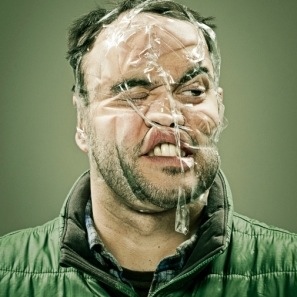
Wes Naman and Douglas Gordon have both used sellotape to distort faces. You might want to look at how different tapes could be used to create a dialogue with the body, think of how many scenes from films involve people and tape. 

Douglas Gordon: Monster

Wes Naman


Sports injury tape

These body parts with applied sports injury tape begin to open out a fascinating dialogue between the diagram, abstraction and fashion. The important issue is as always looking for the potential in any medium to carry ideas. In this case the humble tape has become something wonderful, a material that has a powerful signifying power and one that is woven deeply into our contemporary life. 

What is the relationship between the black bar of censorship and the black tape of the terrorist who tapes his victim’s mouths shut? To tape your mouth shut is to stop you acting as a human with any agency. We use tape both physically and metaphorically and as you tear open your Xmas presents this year perhaps you might give some thought to how as an artist you could take that tape and give it a new life within an extended drawing practice.


See also: