Tauba Auerbach (pronoun 'they') reminds us of how important craft is to an understanding of how the world works. At one point, when they were younger, they worked as a sign writer and this experience highlighted for them the importance of hand skills and how the body builds up knowledge about how materials work and how to be sensitive to them. Auerbach also has a long commitment to unravelling a parallel scientific understanding of the world and questions how we really understand the world we live in. Is it through an activity such as science, or is it through the way we encounter the world through the materials we use? Auerbach suggests that in shaping materials as craftspeople, we understand the world in a deeply embodied way, they then use this embodied understanding of craft, to revisit certain scientific principles and to rethink them as material structures. The craft of drawing is central to this process and they remind us of how vital an awareness of body control is to the making of any image.
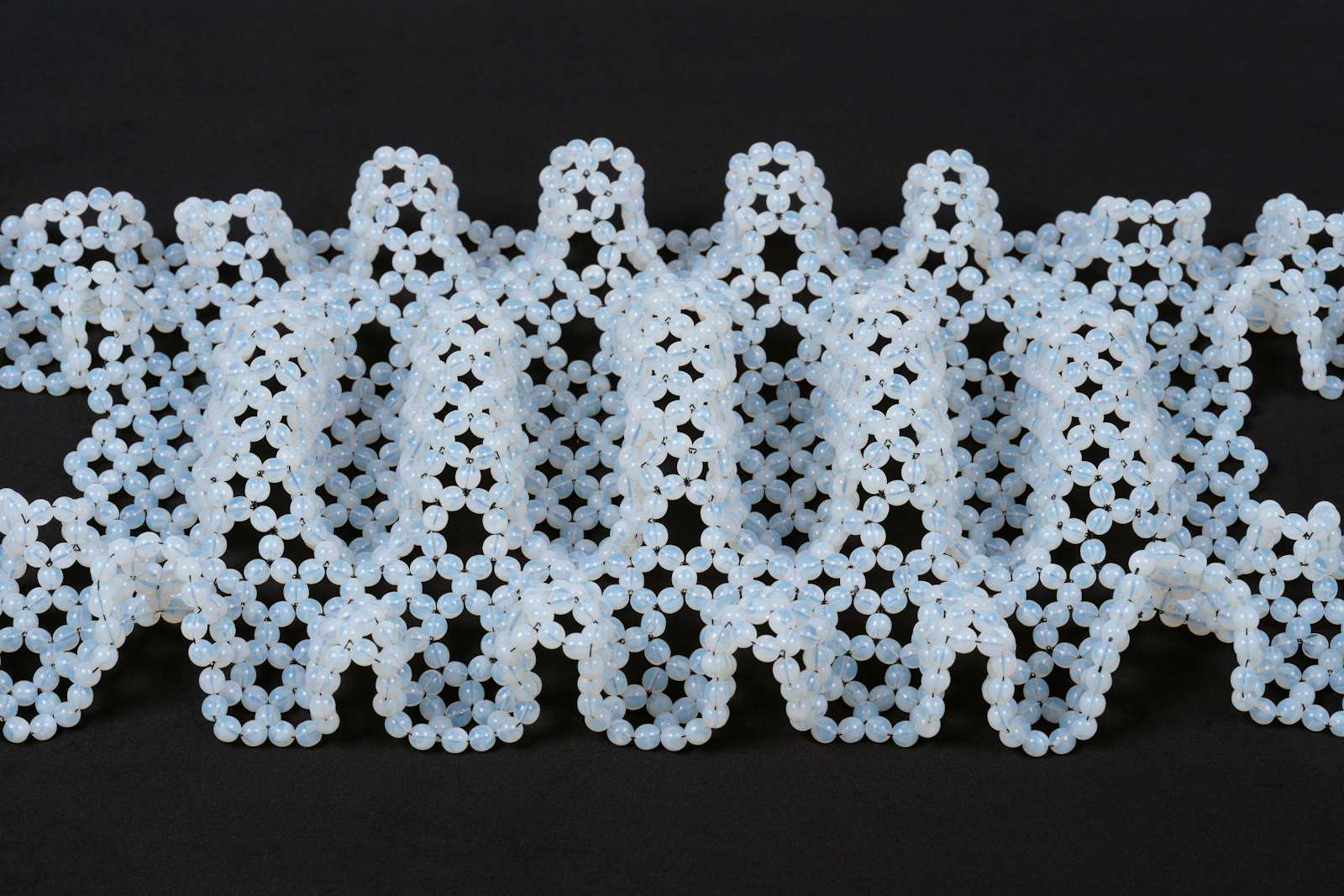
There is a particular set of crafts associated with bead construction and this is associated with religious objects, such as prayer beads and also, the visualisation of atomic forms, whereby atoms are grouped into certain configurations which can be modelled by using beads. Auerbach has learnt the skills of bead construction from someone who had been making these scientific models for some time and has then gone on to create her own models using the skills learnt. We have looked at these issues before; Daina Taimina for instance used crochet as a way of modelling hyperbolic space. She taught herself crochet and in doing so her levels of understanding geometry were raised, as it was much easier to see how a line, generated by a fold, could operate in hyperbolic space; especially when you saw these structures develop as a result of a series of hand movements.
Tauba Auerbach: Ligature: 2019
Ligature is a drawing done with a large chisel tip felt pen. It is a type of meditative drawing controlled by an underlying grid. This is something anyone can try. Simply use some graph paper or draw out a grid and then after practicing hand movements and how to hold the felt tip pen, you should be able to eventually control your hand / arm movement to make an image not unlike the one Auerbach has produced. This is about smooth, continuous movement and keeping the same pressure and consistent angle as you move the pen. It relates to the sort of hand movements you need when undertaking the writing out of calligraphic script. This is another craft and one usually associated with the Islamic religion, but on a more quotidian level, signwriters have to be able to achieve a similar consistency of application in their everyday work. The grid helps a pattern form and patterns are often found in nature to underpin the way that forms are structured. These images remind me of the work of Marian Zazeela an artist who worked in the 1960s and onwards, but who was always in the shadow of the composer La Monte Young, a link that reminds me of the entangled interconnections between musical notation and the representation of vibration and other rhythmic constructions such as lines of force.
Marian Zazeela
Lines of force illustrating electromagnetic action
Auerbach's revisiting craft techniques includes marbling. You might have done this yourself because people often do this to make endpapers for books. A very basic way to do this is to float oily inks onto water and to develop patterns by touching the ink drops with a stick or a broken comb. Auerbach makes marbled surfaces on a much larger scale than the normal amateur would, (see this video link) and makes a connection back to scientific principles in relation to the material interactions involved.
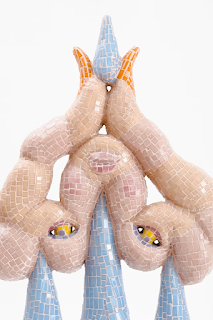
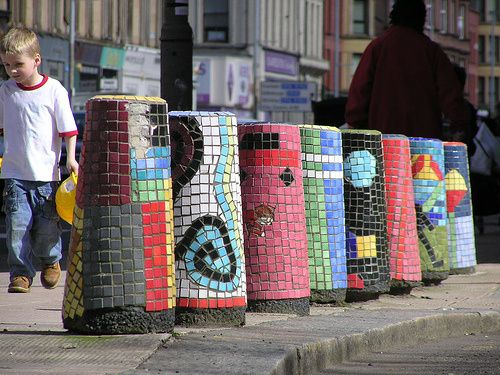
What is interesting here is that some of the crafts Auerbach is using have a history of association with amateur crafts and outsider art making. They remind us that everything is up for grabs when it comes to developing ideas, especially areas of endeavour that are usually dismissed as being naff or not very creative. Perhaps browse through the crafts section of your local bookstore and look at that wide range of activities that includes everything from crochet to knitting, via marbling to mosaic, and papier-mâche to decoupage. Look at how Zsófia Keresztes takes the idea of using mosaic to cover an object and elevates it from a craft into art. Keresztes had an impressive exhibition of her sculptures at the last Venice Biennale, all of which had a surface finish using the same type of mosaic techniques that we might find forming some sort of street decoration.
Zsófia Keresztes
Mosaic bollards Glasgow
Kathy Prescott Parker
Finally perhaps relook at those objects we have ignored in the past as being non-art or kitsch and then after reconsidering, might they actually be much more interesting than we initially thought. I have been making some hybrid objects myself lately and now when I look at them they don't seem that far away aesthetically from the work of artist's such as Kathy Prescott Parker, who on her online profile says she deals with, 'All things colorful, smile-inducing and inspirational'.
Over the weekend I went to see the 'Material Environments' exhibition at the Leeds Tetley for the final time. This is an exhibition I have visited several times because it both demonstrates how to build an exhibition around very particular spaces and how to embed a theme across a variety of artists working in quite diverse ways. As someone focused on drawing and with an interest in ceramics I was fascinated by the work of Phoebe Cummings. She makes organic ceramic environments using unfired clay. In order to preserve the work she was doing, the whole area had been encased in a temporary polythene structure, which meant that you had to enter the space as you would a field hospital operation area or temporary on site police forensic lab via a pull aside transparent plastic doorway. Her title 'A ripening surveillance' suggesting perhaps poly-tunnels for forced plant growth, conjoined with a paranoid need for constant vigilance. Cummings draws with clay, linking one botanical idea to another as she combines both hand made and shallow relief cast forms into imagined landscapes of 3D drawings of seemingly alien flora. The fact that you had to enter her space in the way you did, emphasised its alien nature, reminding me of the way in the film ET the government operatives sealed off the domestic middle class home environment, thus signifying that it was now potentially toxic. The alien is always seen as dangerous. We have this week been reminded of how potent the nerve agent novichok is, and images of makeshift plastic environments have again been dominating the media, as police seek to find the source of novichok contamination. Cummings in making her triffid like constructions reminds us of the continuing unsettling presence of things we don't really understand. Clay, that primeval substance, the basic building material out of which according to the Bible God created man, still has a deep resonance as something that comes up from the bottom of river beds and allows us to think about a chthonic inception of forms. As it states in Job 10.8-12, 'Remember that you have made me like clay,' but so is a golem also a clay made creature. As a material clay holds within itself infinite possibilities, like all forms of drawing, the maker needs to first of all attune themselves to the nature of the interrelationship between a material and the way it can be shaped.
Phoebe Cummings: A Ripening Surveillance (2018)
Richard Long encounters clay on his walks through the natural world. He collects the clay from river beds and uses it to form hand drawn images on the walls of galleries, thus reminding us of the tension that exists between the geometric structures erected by people and the constant grinding of materials down into mud, which will eventually be the fate of all earthly materials both human and non human made. Location is very important to him and his works remind us that what is in the earth has had a powerful impact on how human beings have survived.
Richard Long
Richard Long: detail
Richard Long: Cornish china clay on wall
In the image directly above, the fact that Long is using Cornish china clay is a very important aspect of the meaning of the drawing. China clay is called 'China Clay' because porcelain was for hundreds of years only available from China, and kaolin, (China Clay) is a fine grained white clay found in Cornwall, a fact that was responsible for the development of Cornish clay mining. The drawing suggests the map of an underground labyrinth, its simplicity however suggesting a symbol for a labyrinth, rather than a reflection of the complexity of real underground mining tunnels, such as those set out in the map below.
US Geological survey: Shafts and tunnels of
the Comstock mines
A coin from Knossos depicting the labyrinth
If you compare the image on the coin above to Long's work, you can see that they are part of the same image family. The coin depicts a symbol for the labyrinth, again all complexity and asymmetry is removed in order to facilitate the clarity of the design.
The
artist Yusuke Asai uses locally sourced clays and dirt to construct his complex
mythological images, which he develops into immersive environments by drawing across floors and walls. He is
interested in the fact that,“Seeds grow in it and it is
home to many insects and microorganisms”. It is, he states “A ‘living'
medium.”
Yusuke Asai
"I accepted the ephemeral nature of dirt as a medium from the moment I started painting with it. Once dry, paint cannot be wiped away, but with the addition of water dirt can be removed from a surface. I have been doing this type of earth painting since 2008 and most of these works have already disappeared! There is a desire for artwork to be permanent, but to try and keep it forever would mean that my painting would become unnatural. When I erase the painting it is sad, but within the context of the natural world, everything is temporary". Yusuke Asai
Asai taps into his own subconscious when creating these drawings, drawings that sit somewhere between a sort of imagined folk art and the images of a previously undiscovered culture. This is world creation at a vey high level. By using mud, clay and dirt, (dirt when wet is mud) Asai is able to feel much more connected to nature and he accepts the fact that his work will only be temporary. When I went to see the work of Phoebe Cummings this weekend it was already cracking and falling apart, all of these artists embrace entropy. As soon as any drawing or other artwork is made it is beginning to slowly fall apart, but this process is usually so slow that we don't notice it. However by embracing this as part of the artwork the artist can open out the connections that the work makes into the natural life path of those who experience it.
Rudolf Arnheim wrote a classic essay on these issues; 'Entropy and Art: An essay on Disorder and Order', which was an attempt to reconcile the contradiction between our need for order and the fact that everything is in reality in a state of entropy or chaos. Clay it would seem to me embodies within itself all of the issues that Arnheim unpicks. It comes from the soil, or from river beds, in many ways it is sourced by removing it from the chaos of nature. It has an ability to be formed when wet into a variety of forms because of its plasticity, and is hard and brittle on drying. The processes of creative formation are flexible and malleable, but once the forming stops, the clay begins to dry and become brittle, in its rigidity it becomes fragile and suspect to entropy.
So finally what am I getting at here? Bergson used the concept ‘élan vital’ to describe a force inside all living beings that motivated them to continue, what we might call 'the life force'. Bergson was suggesting that life itself was a creative process, something that Prigogine calls a self-organizing dissipative structure, driven by non-equilibrium flows of energy. I.e. the active forming process is a self-organising one, one that reflects the possibilities in the organisational structures of life itself. This ‘élan vital’ it could then be argued is something that runs through everything, not just living things and that all materials have the potential to be formed into others, they just need to be in interaction with whatever they find themselves in contact with.
Brie Ruals is an artist that digs holes, piles up earth, sits in the surf and generally embeds herself into the earth from which she sources her clay. Her whole body is involved in clay drawing, and anyone interested in this type of work should research her.
I often use water-based ink on paper as my drawing
material. I sometimes categorise my drawing materials into those that flow in
water as if in a primordial sea and those that are scraped off on hard surfaces
like some form of geological attrition. There is for myself a rightness about
the flow of ink, it feels as if I am tapped into working with something akin to my
own life blood.
But in order to explain this I need to explore some
very basic things about drawing with water based inks, to look at the underlying processes that allow
drawings to ‘stick’ to the paper they are made on.
I usually choose to use water based or hydrophilic inks, which are in chemical terms called polar inks, i.e. their molecules have a high attraction for certain papers, that causes them to absorb and/or be receptive to water.
I use paper that is made of cellulose fibres, and cellulose is a polymer
of the simple sugar, glucose.
The key point about cellulose is that the polymer chains that bind cellulose together have -OH or hydroxyl groups sticking out all around them; they look as if they are wanting to bond with something. Hydroxyl groups are often found in organic or ‘life’
chemistry and are vital to the formation of sugars and alcohols. A hydroxyl group consists of one hydrogen and one oxygen
atom, which is of course closely related to the structure of water,
which consists of two hydrogen atoms bonded with one oxygen atom. Hydroxyl
groups are polar, and the oxygen side is always negative, while the hydrogen side is always positive. All
a hydroxyl molecule needs to become a water molecule is another hydrogen
molecule, therefore it has a high capacity to form a hydrogen bond. The
capacity of a hydroxy group to form hydrogen bonds imparts water solubility and
internal structural stability to proteins, including amino acids and hydroxy
groups also participate in the dehydration reactions that link simple
biological molecules into long chains. I.e. they allow some of the fundamental
life processes to be maintained.
So when my inks do attach happily to their paper surface, they will
attach initially using a hydrogen bond, which is “the electrostatic attraction
between two polar groups that occurs when a hydrogen (H) atom
covalently bound to a highly electronegative atom such as oxygen (O)
experiences the electrostatic field of another highly electronegative atom
nearby.”
As I use my water based or hydrophilic inks, they will create molecular
bonds within the thin layer of water that I have created around the cellulose
fibres as I drag my ink laden pen or brush across the surface of the paper. Put
into very basic terms, my water based ink sticks to paper because it has a high affinity for
the medium it's being applied to.
On the other hand there are hydrophobic
surfaces. When water based ink is drawn onto a surface that it doesn't like, it aggregates,
it sort of clumps together, as if it is trying to avoid any interaction with
the surface. Just rub some butter or lard on a sheet of paper and try and draw
on it, you will see what I mean.
This is not about repulsion between individual
water molecules and lipids, it is because of the strong attraction of water
molecules for one another in comparison with the slight lipid attraction.
When water soluble ink begins to interact with
lipids, (organic compounds that are insoluble in water, such as
fatty acids or grease), the water forms ordered cages around the hydrophobic
elements, (the lipids), because of the way the water molecules are more attracted to
each other than the lipids. These cages cause a decrease in entropy, and by the 2nd law of
thermodynamics, this is unfavourable. I.e. the system cannot pass from one stage
of thermodynamic equilibrium to another, therefore the internal structural
stability that hydroxyl groups give to proteins, would not be possible.
In the diagram above you can think of the ink as the
water, and the hydrocarbon chain of the lipid as the greasy surface.
For me this is a deep metaphor, the difficulty of
trying to draw with water based inks on a greasy surface, is reflected in the
fact that the molecules cannot interact positively and the ease in which my
ink flows and bonds with paper, reflects the way that water operates as a life
enhancing medium, the complex molecular bonds that are needed to create amino
acids being not that dissimilar to the way that ink sticks to paper via intermolecular
attraction.
The fact that I can think of my ink as being like blood is not too far fetched, in fact T S Elliot stated that the purpose of literature was to turn blood into ink. An ink very like blood in appearance is oak or iron gall ink. Iron gall ink is a
purple-black or brown-black ink made from iron salts and vegetable sourced
tannic acids (usually oak galls), and was the standard drawing ink used in Europe from the 5th century to the
19th century, remaining in use well into the 20th century.
The ink stuck so well because iron sulphate, (FeSO4)
added to tannic acid (C6H2(OH3COOH) had a
very strong affinity with the cellulose fibres of vellum and paper. In
fact the bond was so strong the only way to erase a mark was to sand the whole surface down.
The other area of intermolecular attraction that is also helping to hold the ink on paper, (London forces), also operates as one of the main forces when holding marks on paper when drawing with chalks, charcoal and graphite, so I will look at this in a future post, when I will try and open out some of the more geological aspects to leaving a mark on paper. There is also capillary action to consider. If you pour mercury over your paper it will not wet it, mercury's surface tension is so great it adheres to itself. But if you pour water onto paper it will wet it, even if the paper is sized, because the surface tension of water is much less. If however you clean the surface of a metal, such as aluminium, mercury will 'wet' that. At a level below all this is the behaviour of sub-atomic forces and the fact that these are shaping everything we do is sometimes forgotten. If you want to explore these in more detail go to my posts of drawing and quantum theory. Drawing and quantum theory one Drawing and quantum theory two
I did refer to London Forces briefly at the end of an earlier post and you can find that here.