It is now over 50 years since the smiley face image was introduced into our culture. There are two aspects to it that really fascinate me, one is how we use the same image over and over again but in different ways according to our needs and the other is how as a society we have set up legal structures surrounding ownership that are strange and bizarre, (well they are if you are someone who dislikes the capitalist system) and yet as artists you have to be aware of legal precedent in copyright law and its use if you are to safeguard your intellectual property rights. (My personal belief is that I find the phrase 'Intellectual Property Rights' quite difficult, and the transfer of the right to own property to ideas, as something that goes totally against my vision of society as a cooperative effort.) This is however another post that is designed to raise awareness of legal issues, something which is a mandatory requirement of the course here at LAU, so whether I support the copyright law system or not, I do have to acknowledge its existence and communicate something of its implications to those of you that may need to use copyright law at some point in your careers.
In 1963 the graphic artist and ad man Harvey Ross Ball was commissioned to create a graphic image to raise the spirits of the workers of the State Mutual Life Assurance Company. He was paid $45.
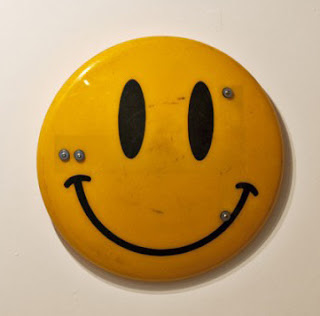
Harvey Ross Ball's original smiley badge.
When you look at the image there are certain distinguishing features, the eyes are not perfect circles, one is an oval and the other more like a short dash. The mouth is off centre and slightly thicker on one side, the image basically says it was drawn using tools that reflected the hand made nature of their application. The original smily face still carried within it the traces of the maker, the hand skills of Harvey Ross Ball. You can still 'see' him drawing that smile, the slight wavering of his hand as he used a pen and black ink to thicken it, until the smile had enough visual weight to work within a circle of that size and colour. A simple drawing, but one that reflects the fact that Harvey Ross Ball was a professional graphic artist, who used the tools of a trade that in 1963 had yet to encounter a computer.
The image was very successful and the company used it extensively, but never thought to copyright it.
In the early 1970s, brothers Bernard and Murray Spain, from Philadelphia came across the image, saw it was popular and after adding a slogan “Have a Happy Day”, in 1971 copyrighted the revised design. In my earlier post on copyright law I cited the fact that in the logic of “transformation” any creation of a derivative work which under the law should require a license, needs to prove a “transformative use” and if so, this can be seen as “fair use.” In transformative use, alterations must result in an aesthetic and character different from the original; therefore if applied, in this case the Spain brothers could have argued that adding the slogan was transformative and therefore a 'fair' use of the idea. However because neither Harvey Ross Ball or the State Mutual Life Assurance Company copyrighted the idea there were no impediments to the Spain brothers' application. The fact that courts are more likely to consider artwork commercial if it is sold as decoration or merchandise, such as mugs or t-shirts and that people are using the artwork to sell consumer merchandise, rather than selling the artwork itself, didn't really come into the situation, but it would have been interesting to see how the courts would have dealt with a counterclaim for copyright by Harvey Ross Ball, if he had been aware of what was happening at the time, as the smiley face was clearly being sold as merchandise.
The Spain Brothers 'Have a Happy Day!' smiley face
The Spain brothers' smiley face is a more centralised image, the two eyes are the same, both elongated ovoids, a black circle of a particular weight now contains the face and the mouth has a much smoother curve, suggestive of drawing implements being used to sharpen the design. Soon after their copyrighting of the image they were asked to go on the TV program 'What's my line?' and they were introduced as the people who had invented the smiley face, an image that was now selling huge amounts of associated merchandise and making a very handsome profit.
However over in Europe in 1972 Franklin Loufrani registered the smiley face for commercial use, using it to highlight the rare instances of good news in the newspaper France Soir.
He trademarked the “Smiley,” as he called it in over 100 countries and launched the Smiley Company by selling T-shirt transfers. By 1996 the Smiley Company had developed a formalized style guide, had set up international licensing agreements and had started to develop the first graphic emoticons for computer use in association with word processing software.
The Smiley Company states, 'an emoticon is a typographic display of a facial expression, used to convey emotion in a text-only medium'. The present owner of the company argues that the design of the smiley is so basic it can’t be credited to anyone. It is so well known that it is appropriated by people all over the world and law suits are constantly being taken out to try and quash the various appropriations that are constantly emerging. It's current manifestation is slightly different again, two oval eyes, often now moved as part of a change of expression and a mouth that has a clearly vector graphic supported curve. Harvey Ross Ball's hand drawn version now long gone, the contemporary smiley's oval eyes surely the product of a vectored graphic package. 'Have a happy day!', eventually morphed into 'Have a nice day' and more and more creative uses of the smiley face were seen out there in the image-sphere, from Kurt Cobain's anti smiley to Jimmy Cauty's Riot Shields.
The Nirvana smiley
Jimmy Cauty: Riot Shield
Over the years meaning and use has changed alongside social and cultural values; the optimistic message of a 1960s insurance company became a commercialized logo, in 1970s Vietnam, for American soldiers it became an ironic fashion statement, in the 1980s a symbol of rave culture imprinted on ecstasy pills, and now it is central to our wordless expression of emotions in text messages.
A collection of sew on badges from a Vietnam veteran's collection
Ecstasy pill
Dave Gibbons used the smiley face with a trickle of blood running down it as a symbol for the deceit and lies of a dystopian world of depressed and traumatized superheroes in the classic graphic novel he created with Alan Moore, 'Watchman', Gibbons stated “It’s just a yellow field with three marks on it. It couldn’t be more simple. And so to that degree, it’s empty. It’s ready for meaning. If you put it in a nursery setting…It fits in well. If you take it and put it on a riot policeman’s gas mask, then it becomes something completely different.”

The smiley face is now an icon of contemporary visual culture, and as such it becomes subject to fine art's attention. Antonio Brasko an Iranian/American artist has developed a practice that fuses together graffiti, pop culture, various fine art tropes and fashion, his version of the smiley perhaps breaking the mould by now placing it in a rectangle; the rectangle of the fine art canvas meeting the spray language of the streets.
Antonio Brasko
Tala Madani
Tala Madani has highjacked the smiley face, giving it a personality that envies real faces with noses and thus the anonymous icon begins to slowly merge back into the emotional faces from which it emerged, it's smile now being one of happy vengeance, of the smiling retribution of the noseless smiley, as it scissors away the noses of its distant relatives.
See also:
Another post on copyright law
More information on Jimmy Cauty's riot shields
Abstraction and meaning
Drawing can be funny
Dots and spots
Authenticity and Blockchain
The circle