Showing posts with label joints. Show all posts

Sunday, 3 August 2025

The Join

I occasionally focus my attention on basic formal or material attributes that can become part and parcel of the physical structure of a drawing or any other artwork. Partly to emphasise the materiality of art and how its media specificity leads to material thinking and partly to show how any physical property can lead to a material metaphor. 

In our visual language, "joins" can refer to the way elements like lines, shapes, colours or textures are connected and interact to create meaning, but they can also be actual 'joins', lines along which one thing is joined to another. For instance the line of a weld, the line of a stitch or a hinge. These connections are both visual relationships between things that are brought together and symbolic relationships, representing ideas that emerge from the way we can think about how things can be connected with each other. 

Sometimes we use a specific material's property to join things together, such as the various glues and tapes that are available and there is a huge industry out there devoted exclusively to pursuing research in this area and at other times we try to join things without this third party and investigate the inherent properties of the materials we wish to join together to see what possibilities emerge. There is both a structural and philosophical difference between glueing two pieces of wood together and cutting and shaping two pieces of wood, so that they can be joined without any additional fixing. 

Japanese wood joinery

A combination of craftsmanship and a deep understanding of the material used leads to a particular mindset and philosophy that places great value on both awareness and respect for a material. There arises a calmness from the contemplation of a 'dance' of joining, that you can get as you follow in your mind the intricacies of Japanese wood joints. 

Japanese culture has a long history of philosophically considering the join. For instance the concept of Kintsugi, "joining with gold", that involves repairing broken ceramics with lacquer and highlighting the joins made with gold, a concept that validates and honours the idea of repair, as something that adds value. This is very different to the concept of built in obsolescence, that leads to a throwing away and replacement with new, of things that are regarded as broken. 

Joining two different materials together can be done in different ways and the appearance after joining can be very different. 
Adhesive Bonding uses a substance that undergoes a chemical or physical reaction to form intermolecular bonds between itself and the surfaces being joined. You need to ensure that the two surfaces meet each other firmly along a clean overlapping area and you may need to allow time for the chemical reaction to take place. In drawing the main use of adhesive bonding is in assembling collages, but as has been highlighted in past blog posts, various tapes, such as duct tape and masking tape, can be used to both make joins and draw out forms at the same time. Glues also have different properties, 'Mod Podge' for instance is often used by artists because of its different possible surface 'finishes'. If you want to look at an artist that uses adhesives creatively, Mark Bradford is an excellent person to follow, his collages join together all sorts of papers and found surfaces and he uses industrial materials similar to silicone-based sealants, which give flexibility to his surfaces as well as a type of painterly presence. The joining together of various elements taken from his environment has ensured that his work is socially grounded, even though at first sight the work may look as if it is an abstract image. 

Mark Bradford: The devil is beating his wife: Collage

Mechanical fastening can be an area that leads to all sorts of visual invention. For instance clamping methods can be used to join any two paper surfaces, and to do this you might end up drilling holes or creating bent wire or using rivets, staples or paper clips. The nature of mechanical fastening means that the materials often need a considerable overlap in order to be joined, and this overlap can be a visually exciting edge. 


A visual field of a particular quality can be evolved using any mechanical fastening

Stitched joins rolled up in ink and printed off as monoprints

Once a joint has been made using mechanical means it will be much more physically visual, therefore its visual properties can be further investigated, as in the case above, where stitched together papers were then used to make monoprinted surfaces. 

The joint made by a spiralling wire that forms the spine of a sketchbook

The most common physical and visual paper joint we see everyday in the studio is the spiral binding of sketchbooks. It feels like a backbone to me and when I'm making drawings of how back pain might feel, I will often show someone the sketchbook spine, to see if they too feel this way. 

Various paper fasteners

Every one of these fasteners if used as a form of repeated unit to make a joint, will produce a very particular visual line. A simple change in pin type for instance, such as a plastic headed as opposed to a steel headed one, changes the visual rhythm.

The line of pins develops a particular visual quality as fabric and thin paper are joined

We use the joins in clothing to tell interesting stories about the garments we wear and to highlight parts of the body that the clothes relate to. For instance, as a material nears an edge, when there is the need to 'finish' off or end a section of fabric, we often see a change in direction of the material's granular sub-structure. For instance a shirt cuff. 

Shirt cuff

In order to both stop the material fraying and to imply 'this visual movement stops here', the cuff is made with a change in the direction of the fabric, placing the stripes in this case at right angles to each other. Visually we feel there is a rightness, the direction of our gaze doesn't slip off the end of the sleeve and the hand is visually put on a plinth, or presented by the cuff. One piece of fabric is joined to another and this fact is highlighted by the change of stripe direction. The most startling use of this idea being of course the ruff, a formal element that presents the head and creates a visual full stop to the garments below it. 

Van Dyke: Man wearing a wheel ruff

Another way that joins are highlighted in garment manufacture, is by seam placement. By strategically placing seams, both structural form and aesthetic function are controlled by fashion designers. Buttons are another way of joining two surfaces together, and visually they slow the read down, providing a series of linked full stops.

Cloth edges, stitched and with buttons

When we see these joins in our clothing, we recognise their importance, the edging being vital to our perceptual understanding of the situation. Not long ago there was a fashion for having open seams that ran around the edges of knitted garments, therefore highlighting rather then hiding the structural form of the clothes. This felt as if the wearer was trying to say something about truthfulness and that they were not trying to hide anything. 

This visual recognition also operates when we look at a sheet of paper. The deckle signifies that there is an edge to the material and it also operates as a reminder of the paper's manufacturing process. 

Deckle edge

However we rarely develop the possibilities that the joint offers us, both physically and metaphorically. The term "line of join" might also be used in a more figurative sense, perhaps referring to a line of demarcation, a dividing line, or a point where two things come together. On a map the line along which two countries touch is usually seen as a dividing line or line of demarcation, but is it too much of a conceptual leap to think of that line as the place where people join together?

When I used to teach on the Foundation course at Leeds, one exercise we used to do was to divide a sheet of A1 paper into four equal parts and then to make one image that was made of four different visual languages, that butted against each other at the lines of division. For instance the first section might be drawn using a pointillist technique, the second expressive charcoal, the third flat colour and the fourth watercolour washes. The final images if done well, seemed to slip in and out of different time zones, the overall image gave them coherence, but the visual fractures that happened as languages changed, caused some sort of temporal confusion.  

Joining different visual languages

The bringing together of different visual languages to create an image that they can all be part of, can also be used to suggest that there might be something that underlies our differences and that beneath our first perception, something more fundamental is in place.  

One way this sort of join has been used to stimulate the imagination is in exquisite corpse drawings. 

Man Ray, André Breton, Yves Tanguy and Max Morise: Exquisite corpse

It's great to see several different minds united in one image, the joins linking the ideas together, as well as the line of join making sure each personality has its own space within which to operate. 
The formal change in direction we see when a cuff is made for a shirt, is now a conceptual change in direction as one artist's viewpoint butts up against another's. 

But these joins are also folds. 


A fold can be seen as a type of breaking into two parts, what was formally one pure, unblemished surface, such as when you fold a sheet of paper in half. But like the join, it too has many physical properties and metaphorical associations. The line of the join and the line of the fold are closely linked, but the one implies two different things being linked and the other implies one continuous surface being divided into two contiguous surfaces, so I will reserve thoughts about the fold for another post. 

The join and the fold are closely related to the split and the tear, issues I have dealt with in the past and that are integral threads to an unfolding of my thoughts around these things, so do if interested follow the links at the end of this post.

Thursday, 22 December 2022

Thinking with articulated body parts


William Kentridge

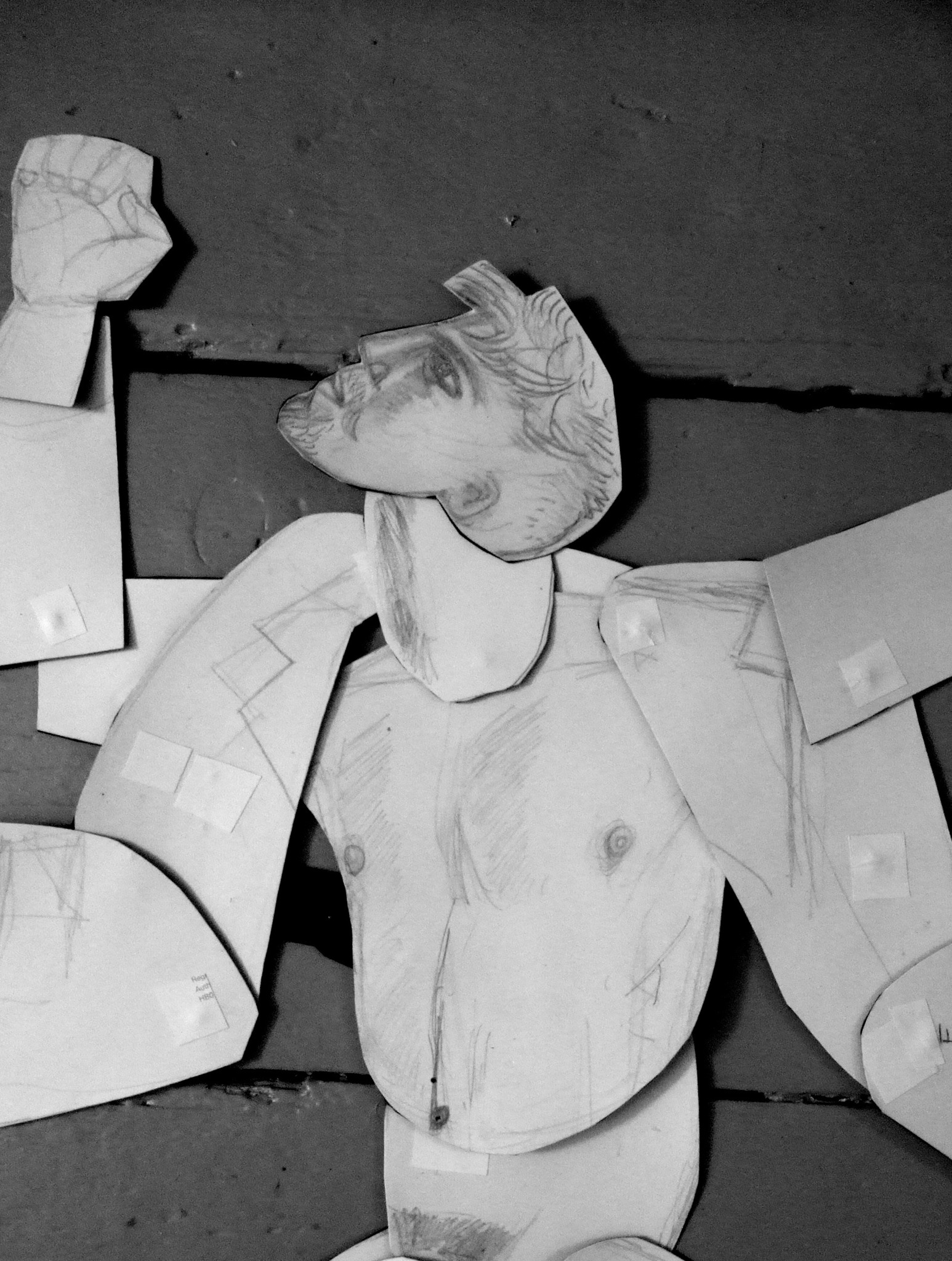
The William Kentridge exhibition that has just finished at the Royal Academy provided us with a wonderful example of an artist working across genres and being inventive in a wide variety of ways. One of the tools he uses when inventing compositions and movements for both human and animal subjects is to make cut out forms that can then be fixed to each other using simple joints. I love this articulated thinking, and have used it myself, both as something totally two dimensional and as a way to think about linking more three dimensional forms together. 

Making articulated figures is a very old way of working and Kentridge isn't the only artist who still uses this technique, Clive Hicks-Jenkins also uses it productively. 


In the image above you can see the various cut out body parts and their associated clothing being assembled. This is not about cutting out complicated forms, in fact the simpler the better, you do though need to have an idea of how joints will be made and where to place them. I use split pin butterfly clips to make my own jointed figures, but have also used paper clips, wire and string. 

Split pin butterfly clips

You can of course simply stitch a joint using thread, use a small piece of twisted wire, anything that allows you to make a joint. Once you begin working like this you can be very playful, perhaps you might make a short animated film of the movement possibilities. 
Don't forget overall image effect. Because you are cutting out shapes you tend to be much simpler or bolder in your thinking; the forms that make up a figure therefore become much clearer. We all have an unfortunate tendency to get trapped into details and this really does help to avoid this. When you begin to make any drawing or textural indications within these shapes it is therefore useful to maintain a simple but clear way of visual thinking. Look at the trousers in the figure below.


The movement of cloth and associated folds in the trousers has been reduced to a few bold marks, this allows for the trouser forms to sit comfortably within the dynamic of the overall composition of arms and legs and body parts; i. e. they are integrated into the gestalt of the whole image. 


You can see this process developing as the image evolves. The simple forms of a cut out coat are integrated into the totality by another set of marks that suggest both the edges of the coat's collar and the play of shadow across creased fabric. The problem would be if you tried to give the fabric a realistic finish, it would not sit well within the simple forms of a cut out. 

Simplified drawing on head and hands and torso, kept visually separate by simply changing colour

Clive Hicks-Jenkins 

Clive states that he begins with a maquette, starting with a paper template and working his way to a fully rendered figure. Once he has the figure made he can play and try out compositional experimentation. He takes photographs and makes sketches as he makes these changes, something that as students you all need to do, so that you can visually explain the processes that lie behind your decision making. Finally for Clive a drawing takes shape, and then in his case often a painting begins. The result will often be quite different to what he had in mind when he started out, as he points out, these things take their own directions. They are what they are. However, as they begin as flat, articulated figures, something of that origin has to remain in the final work.

Clive Hicks-Jenkins 

If you look closely at Clive's articulated cut out wolf, the language of animal hair comes from the same visual language set as folds in clothing. It is simple and bold enough to sit against the cut out shapes that make up the creature. 

This way of working was sometimes used by early animators, my own favourite being Lotte Reiniger.

Lotte Reiniger.

You can see 
Lotte Reiniger's influence on William Kentridge, his own animations owing much to her sophisticated shadow play and of course all of these artists owe a debt to historical folk traditions such as Chinese and Indonesian shadow puppetry. 

Indonesian shadow puppetry

I'm very aware that several students have asked me about portraiture and this approach can be a very interesting way to break out of old habits in terms of facial depiction and composition. 
Tim Hawkinson. Emoter

I have posted on Tim Hawkinson's Emoter  a while ago and I think it is still worthwhile looking at his approach but this time in terms of portraiture. He breaks a face down into units, just as the body can itself be broken down. He uses blown up photographs of his own face to do this, so the type of simplification that drawing can produce isn't available to him, but the implications are still there. You could build a face in the same way that a body is constructed. 


Muscle structure of the face

Face mask with articulated jaw "elu" ("spirit") Nigeria, Ogoni

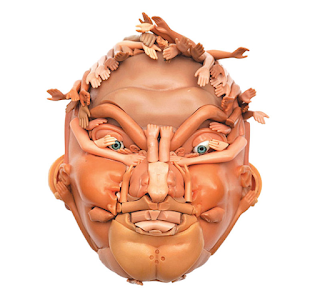
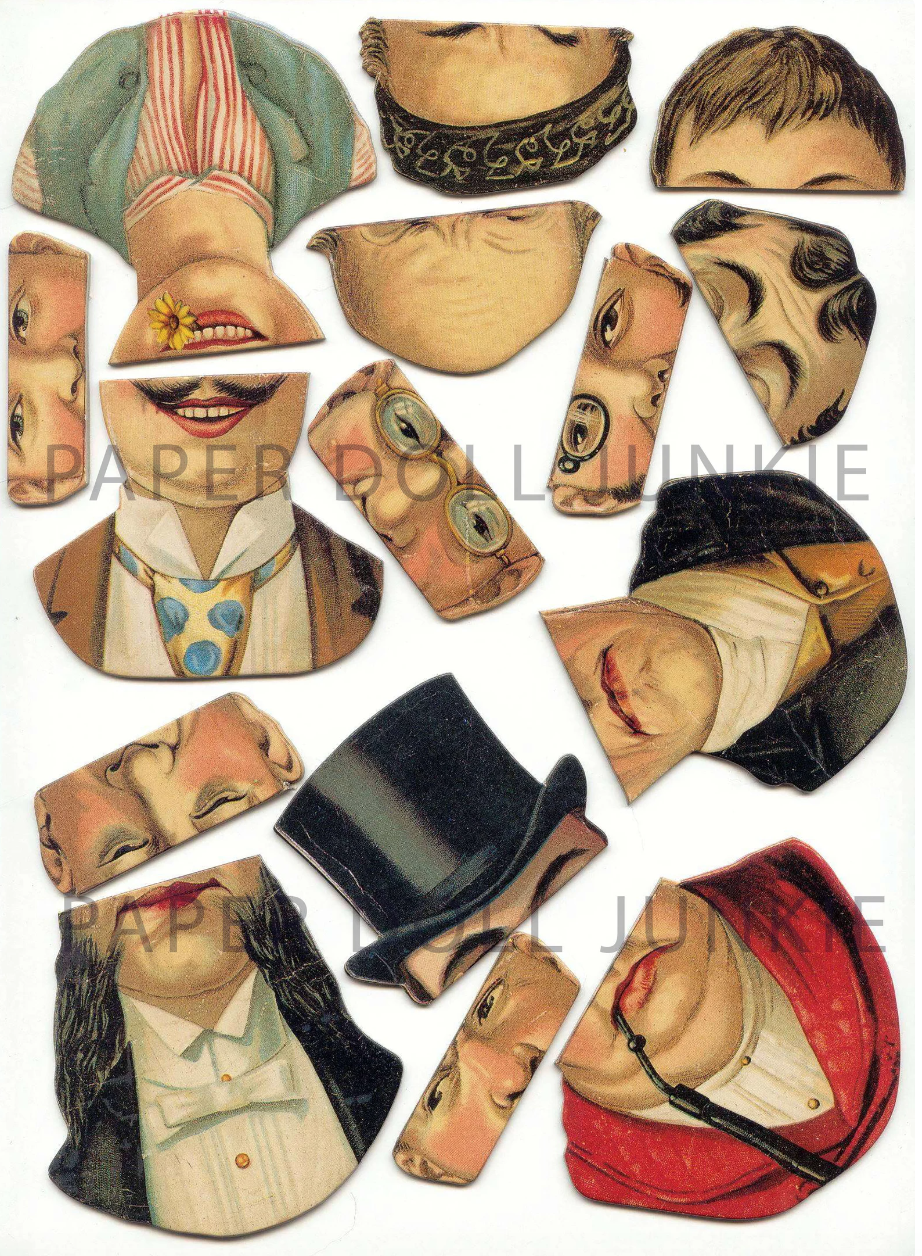
The degree of simplification you bring to this process will determine the visual look or feel of the images made. Compare the Nigerian face mask with an articulated jaw above, with a face made by Freya Jobbins from recycled dolls and the early 20th century paper toy face further below. 

Freya Jobbins

Paper toy face

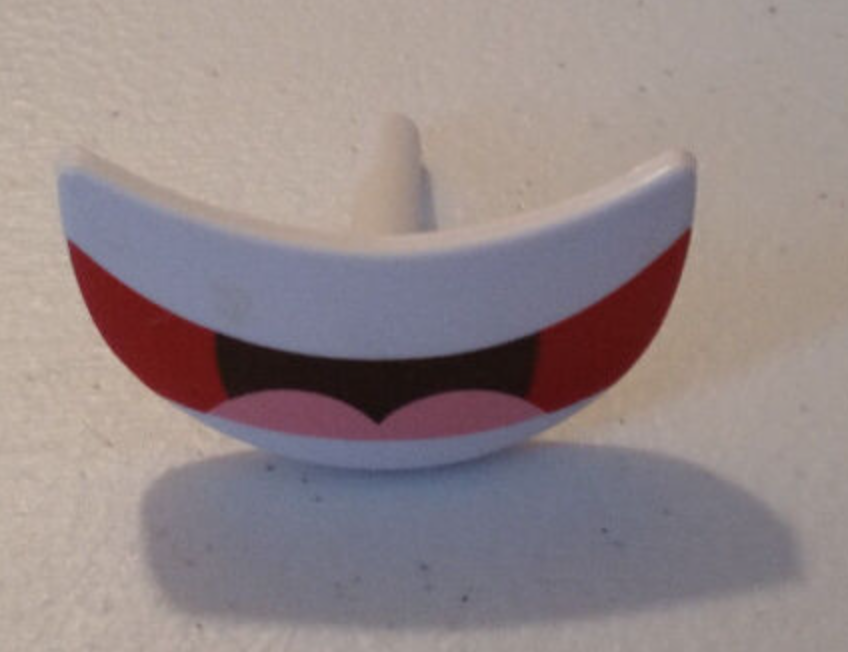
The world of toys is another area of endless fascination in relation to these issues. Mr Potato Man has a wide variety of body and face parts now available to buy as extras that mean you can extend your Potato Man ideas even further. 

Mr Potato Man mouths

A Mr Potato Man mouth

When you look closely at the mouth forms that the plastic additions come in you may well find that they are very strange abstractions. The mouth above could be a design for an abstract painting. The more we separate a whole into parts, the more each part can become loosened from its original function. This process of atomisation is one that we are very good at, but which has also led us as a species to be able to cut up interconnected eco systems and divide the world into dis-functioning units. Every way of thinking has its effects on reality, and hopefully before we apply these conceptual models we think through their consequences. 

However it is in shadow puppetry that the most deeply mystical and spiritual of articulated images emerge. Like the cave wall that acted as a membrane between the world of the spirit and the world of the everyday, the thin sheet upon which the shadows move is another delicate membrane that sits between the world of the imagination and of reality. 

A figure from the Javanese shadow-puppet tradition of Wayang Kulit

Clive Hicks Jenkins has an excellent blog and he has given a far better explanation of the history of shadow puppets than I could ever manage, so do click on the link and read what he has to say about this wonderful art. 

Christian Boltanski 

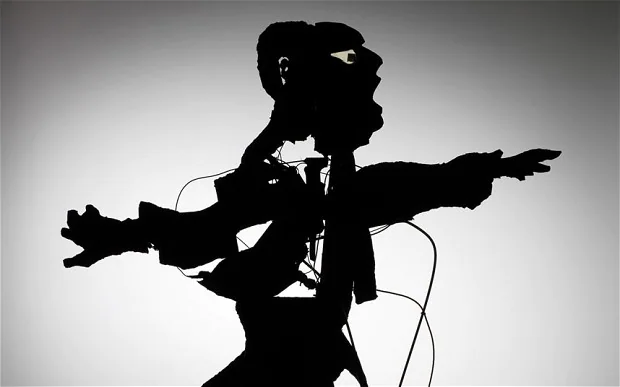
Various contemporary artists have returned to articulated shadow puppetry, and as well as William Kentridge, Christian Boltanski and Kara Walker have made extensive use of the technique. 

Kara Walker

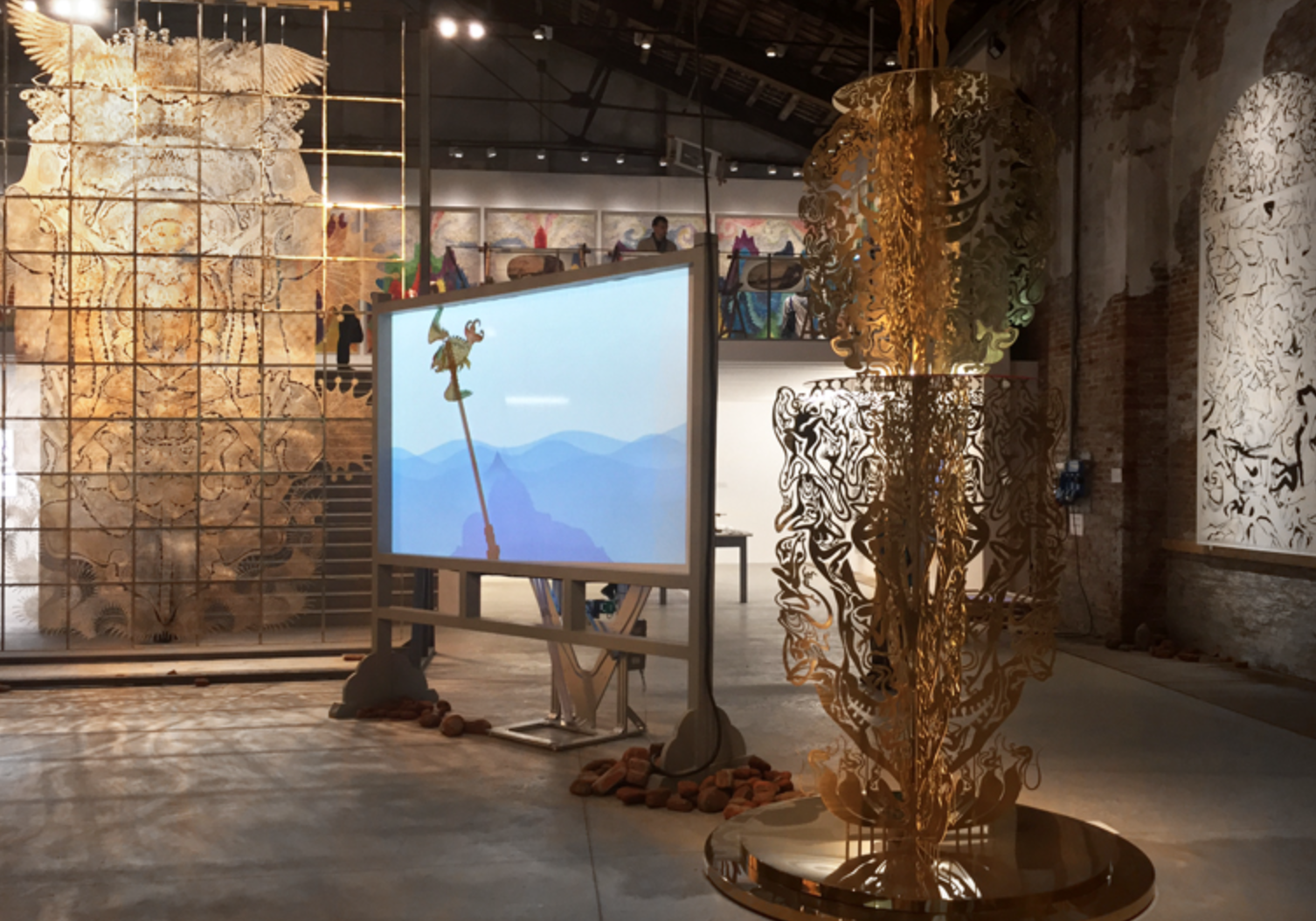
The Chinese pavilion at the 57th Venice Biennale saw the artists Wang Tianwen, Tang Nannan, and Yao Huifen working together to present ‘Removing the mountains from and filling the sea’, a shadow theatre performance. 


Wang Tianwen, Tang Nannan, Yao Huifen: Removing the mountains from and filling the sea

Wang Tianwen, Tang Nannan and Yao Huifen combined new and old technologies to make the work. Traditional skills in making the shadow puppets were combined with computer driven armatures, whilst some components were still fixed to bamboo sticks, such as the waves you can see in the image above. Their work reminds us that old and new technologies are in reality the norm. We keep using what works, whilst we invent new forms, and the one sits alongside the other. We forget that painting is an art form thousands of years old and happily go to exhibitions where it sits side by side with video projections and we have kitchens full of modern gadgets that sit alongside utensils that have changed little since Medieval times. 
It is not just artists that have thought of breaking forms down in this way. Detecting people in images is a key problem for video indexing, browsing and retrieval. The main difficulties are the large appearance variations caused by action, clothing, illumination, viewpoint and scale. Therefore the people that break down images for indexing, represent people use a 2D articulated appearance model composed of 15 part-aligned image rectangles surrounding the projections of body parts: the complete body, the head, the torso, and the left and right upper arms, forearms, hands, thighs, calves and feet. Each body part is numbered so that a numerical filing system can be applied to the images. 

From: Learning to Parse Pictures of People: Remi Ronfard: 2002

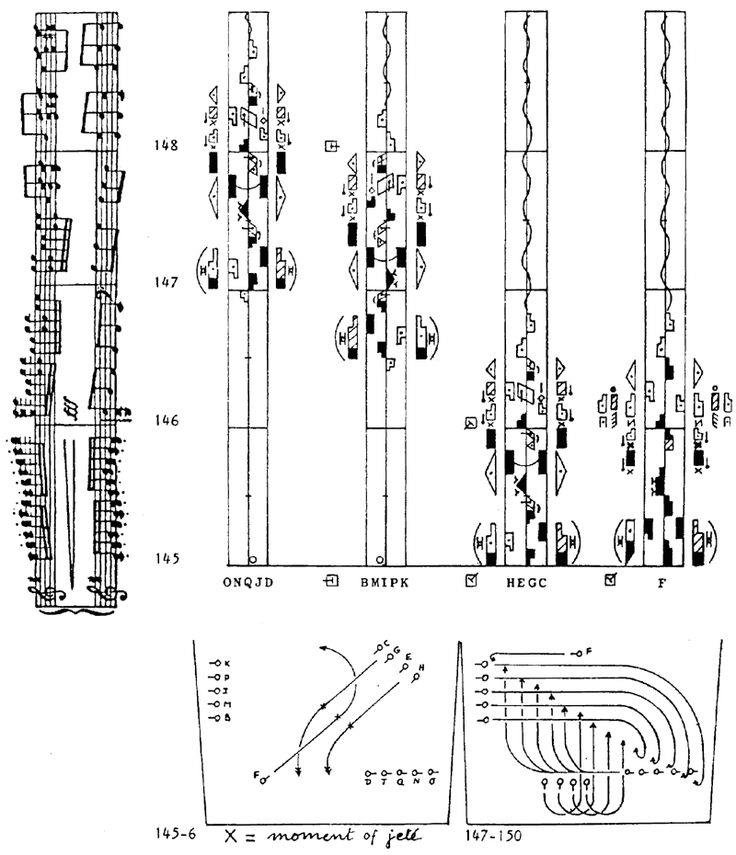
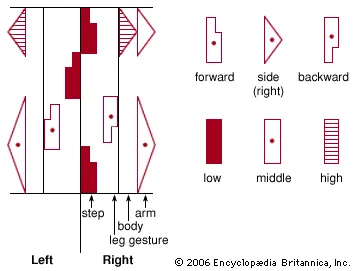
This way of visualising computer images of the body is now 20 years old and is no doubt in the scientific world of computing redundant, but it might be interesting to combine it with Laban notation. 


Laban notation

Of course once you begin looking at how to move a real body in terms of articulating it in sections you could take the idea out into performance and that could be a wonderful new beginning for the idea. What if we could extend or join certain parts?


Rebecca Horn: Finger gloves

All of these thoughts have led me towards my own attempts to work with articulated body parts in an animation.

One of several articulated figures that are going to eventually feature in an animation. 

See also: