Showing posts with label sculptor's drawings. Show all posts

Wednesday, 27 March 2019

Hanging large drawings: Peter Randall-Page Leeds City Art Gallery

Peter Randall-Page: 6 charcoal drawings


Every now and again I put up a post about presentation. Especially when you are making large drawings, exhibition presentation makes all the difference to how the drawings are received.  
I popped into the Leeds City Art Gallery the other day and they had put up a display of Peter Randall-Page's large charcoal drawings of organic forms. Randall-Page is a sculptor so as you might expect his drawings have all the hallmarks of a sculptural sensibility, from the use of cross contour lines to help the eyes 'feel' over the surface of these forms, to the use of the drawn black edges that cut right into the forms, to suggest that the drawn forms are bursting through the black charcoal drawing space and out into the gallery. 
Above all these drawings are big and they require an observer to walk about in order to see them properly, as you can see in the image above, they are collectively quite a physical presence. 
What I thought was very interesting about the presentation was that it reflected the way that Randall-Page would have had to begin the drawings by rolling out his paper. 
Large paper usually comes in rolls and for an artist this has advantages and problems. The advantages are all to do with size and scale, the size of the paper can be decided on because you have to cut the paper into chosen lengths and in doing this you begin the process of measuring the size of the paper in relation to your own 'human' scale. 
The disadvantages are to do with the roll. The curl of the paper is hard to work with and you are always fighting this, sometime reverse rolling the paper in order to flatten it and at other times putting weights on the corners to hold it down. 
In this case Randall-Page has used the fact that the paper will always try to return to its rolled state, and uses a presentation method that reflects this. 


He has used what look like broom handles to roll the ends of his drawings onto. Stapling the paper right into the wooden rod and then inserting a metal screw eye into each end, he is able to roll the drawings up when not on display and simply determine how pulled open they need to be when exhibition time comes. 


This presentation method makes the drawings feel more like objects. This is a long way from the window mounted drawing behind glass, he is making a point about the physicality of these drawings and that we as observers need to be just as aware of rolled paper and how it physically operates as we do of the nature of the organic forms that he is drawing. 


By presenting these drawings as a block, the overall effect is very powerful and the wooden supports create a secondary visual grid like structure that by contrast enhances the organic bulging of these forms as they push out into our space. 

See also:

Cross contour drawing 
Framing a large drawing
Edges

Saturday, 14 April 2018

Drawings on show in Leeds City Art Gallery

Anne Hardy: Installation view 'Falling and Walking'

It’s nearly always worthwhile checking out your local art gallery at least once a month. Exhibitions change and a new arrangement of their existing collection can reveal new things about often seen work that you might have become overly familiar with. So as you return to university after the Easter break why not pop in to see whats on?
Leeds City Art Gallery has two drawing themed exhibitions on at the moment. The focus on the drawings used to develop the installation Falling and Walking’ by Anne Hardy is really useful to look at if you are thinking about how drawing can be used as a way of thinking about large scale ideas and how they might be realised. Anne Hardy uses a combination of model making and drawing in order to both work her ideas out and to communicate them to other people. Most of the drawings are quick sketches of ideas, you get the sense that drawings are very much ‘what ifs’ for Hardy and that the models are where she gets t grips with the nuts and bolts of how things might actually work. She often uses watercolour wash to establish a feeling for a space and what might activate it and ballpoint pen to scribble out a fast idea or to hold on to a thought before it disappears.


Ann Hardy: Thinking drawings and a model of installation ideas

Adjacent to the display of Anne Hardy’s drawings and models is a very interesting display of the gallery’s collection of two-dimensional work by artists that we usually think of as sculptors. This was very informative and once again highlighted the role that drawing plays in so many artists’ working methodologies. It was personally interesting for myself because one of the first drawings on display was ‘Crossed Beds’ by Jenny West, a fellow colleague at the Leeds Arts University and one that I worked alongside for many years when I worked on the foundation course. Jenny is well known for her very technical approach to drawing,  using tightly controlled perspective drawing projections. In the drawing on display she uses a variety of surface qualities to soften and sharpen different areas of the drawing in order to emphasise the planar movement of her spatial grids and to humanise the technical approach she uses to nail down the image. It was impossible to photograph the image through the glass it was framed behind, so all I can do is give you a ghost image of the drawing, one that has my own body standing within the centre of its crossed grids. 


Jenny West (Crossed Beds: Image behind glass)

Jenny’s drawing is positioned right next to two Claes Oldenburg images. Both of his drawings rely on a very strong sense of how scale can be manipulated in order to give drama and power to an image. The first larger drawing is of a faucet or as we would put it in England a tap. The tap is on and water pours from it in a vertical column. The image is designed to look as if the tap is huge and an architectural insert into a park or garden.  Here perspective is used very technically in order to give authenticity to Oldenburg’s vision of what an everyday item might be like if it was elevated to the scale of a huge landscape feature.


Oldenburg: Proposal for a cathedral in the form of a sink faucet for lake Union, Seattle

A small much looser drawing of cigarette ends is also in show, it is also designed to get an audience to see how these throwaway items could become monumental. These two drawings give you a snapshot into Oldenburg’s mind and you quickly realise how good a draftsman he is. The images are drawn with a consummate command of the materials he is using, whether he is making a swift sketch or a more detailed technical drawing, he is in total command of the process.

Phyllida Barlow: exhibition installation of coloured drawings

Phyllida Barlow

On the opposite wall is a collection of A1 size coloured drawings by Phyllida Barlow. Her drawings are made independently of her three dimensional work, and unlike the Oldenburg drawings are not preparatory sketches or visualisations of ideas but works in their own right. You could think of them as compositions, or freeform arrangements of colour and surface materials, as thin coloured sculpture or flat environments. This distinction between sculptors that use drawing to visualise what might be and those that use it to explore other possibilities runs throughout the display and highlights a key distinction between those using drawing in the old sense of 'disegno' and those who see drawing as a discipline that has its own autonomy, those that in effect treat drawing as an object in its own right.

Alison Wilding

Alison Wilding is an interesting case in point, she uses drawing to explore concepts that she has also realised in 3D, not to visualise more 3D versions, but to create some alternative 2D possibilities that exist as images in their own right. Rose Leverton’s ‘Dinner table beneath the floor proposal’ is of course in the other camp, the drawing is showing us a possibility.


Rose Leverton

The person that perhaps opens out the most conceptually interesting approach to drawing is Cornelia Parker. Her ‘Dead match exposed by a live one’ uses simple photographic technology (literally drawing with light) to produce a photogram of a burnt-out match, brought back to life again by the light of a newly stricken one, in the form of a glowing white silhouette. Parker is conceptually playing with us, getting us to see a beautiful connection between how an image is made and what the image is of.


Cornelia Parker: From ‘Dead match exposed by a live one’ 

The Cornelia Parker image was impossible to photograph because like most of the drawings on display it was behind glass. However it does give me a chance to show you a view of the exhibition as reflected in her photogram and it offers a timely reminder that all of the drawings shown in these blog posts are digital images rendered from photographic exposures. I am always having to write about a topic that is never actually seen, but only referred to. In many ways this demonstrates the power of photography, it is so embedded into digital technology that I often forget how it is shaping and processing everything that I refer to, so perhaps for a while I might turn my attention to 'drawing with light' and see how as a way of thinking it re-conceptualises what I have been trying to articulate in relation to drawing as an extended practice. 
In the meantime do try whenever possible to go and see original artwork, drawings are so much more like objects when you see them in the flesh, the camera lens flattens and de-textures everything, as well as resizing images to fit screen world formats. 


Sunday, 10 December 2017

Austin Wright: Emerging Forms

Austin Wright

The exhibition, 'Austin Wright: Emerging Forms' is on at the moment at the Stanley and Audrey Burton Gallery. For those of you interested in sculptor's drawings this is a very interesting exhibition as it includes several of his working drawings as well as a selection of his early drawings that point to his emerging interest in the depiction of three dimensional form. 


Early drawings

I must apologise for the poor quality of the images but all the drawings were under glass and I couldn't find a position where either myself or the gallery spotlights weren't reflected in the glass. Even so do go and look at the original drawings. I was particularly taken with the drawings of everyday life just after the war. His figures have a monumentality and grandeur about them, all reduced to essentials and seen as emerging sculptural forms even before he was working as a sculptor. His more linear later sculptures may be of interest to those of you thinking about making three dimensional linear drawings, as in a post David Smith context, but all of you should be interested in his drawings that attempt to sum up groups of figures as simple masses. 


Drawings for hanging sculptures


Details of drawings dealing with groups of figures

The working drawings of sculptors are always interesting as they reveal how the process of thinking about form progresses. In Wright's case he is always interested in human beings as a communal animal. Very rarely do you see a single figure, what he is searching for is that composite form that suggests the interaction of small groups of people, either of family or friends, people that know each other well and who are prepared to invade each other's space. The quick sketches that I have tried to photograph (sorry about the reflections folks) were for myself really moving. He was trying to visualise something very important about the human condition, our need for supportive touching and feeling and being around others; suggesting that an isolated figure is in some ways less human. 
These small exhibitions tracing the history of recent Modernist art practices are nearly always rewarding, you just have to be receptive and open to ideas that sometimes feel old fashioned or not contemporary and in doing this I think you become able to appreciate a much wider range of art works and above all educate your eyes to see. 

When I was young it never occurred to me that I would at some time in the future be writing a sentence that suggested that Modernism was old fashioned. However in 7 years time it will be 100 years since the original publication of Paul Klee's Pedagogical Sketchbook. It was a central text in relation to my own art education, but already nearly 40 years old when I first encountered it as a teenager at school in Dudley. Wright was born in 1911 and Modernism would have been the dominant mode of expression throughout Western Europe for most of his working life. But times have changed and yet in some ways they haven't. I'm reading the Rev. J. G. Wood's 'Insects at Home' a comprehensively illustrated book published in 1871. The preface states this; "The reader may probably notice that these figures of insects are but slightly shaded, and in many cases are little but outline. This is intentional, and the shading is omitted in order that the reader may supply its place by colour." The text goes on to recommend mixing ox-gall in with the colours so as to neutralise the oily lines of the printer's ink. There is something of the Modernist in this, a democracy of engagement, that suggested the reader become engaged in a process that would lead to the fixing of the insects firmly in the mind of the reader. Klee encouraged the reader to take a line for a walk, the Rev. Wood encourages us to colour in the wood engravings in his book. Art becomes something that we can all do, and Modernism released us from the need for academic training, in France the Salon de Refusés had allowed non trained artists to feel as if they could produce work of equal significance to their Academy trained peers. But strangely the art schools that were set up as models of the Bauhaus, eventually became as academic as the old academies. Klee's teachings becoming central to the idea of a Modernist art education, but now perhaps we need a new Salon de Refusés, another new start, a fresh Modernism or even a new academy if that's not a contradiction in terms. If so what would we teach? Maybe the arts of bioengineering, robotics, and nano-technology?


Monday, 16 May 2016

Drawing and Mona Hatoum

This weekend I managed to get to see the Mona Hatoum exhibition at Tate Modern. This is a wonderful show and is central to how contemporary artists use drawing. In particular Hatoum uses a wide variety of approaches to drawing to visualise her ideas, from sketches for ideas all the way through to the physical actualisation of her concepts. These are a few of her approaches but once again remember it's best to go and see these things in the flesh, so if you can get down to London it's on until the 21st of August 2016.
 
Impenetrable 2009 


'Impenetrable' consists of hanging metal rods that have had the twists of barbed wire added, so it looks as if this is straightened barbed wire. Once again the grid format is used to give coherence to the form, this time by floating the 'cube' of verticals you get the sense of a space that is on the one hand 'Impenetrable' but on the other hand it is very ephemeral, hovering ghost like in space. This is essentially a 3D visualisation of vertical lines in space and reads as a 3D drawing, rather than as a sculpture dealing with mass.

Light Sentence


'Light Sentence' again reads as a 3D drawing this time using shadows to give kinetic excitement and mood to the space. She has a dangling light bulb at the centre of this piece, (again the wire mesh lockers gain coherence because of the grid format), the bulb is attached to a live wire that is itself raised and lowered very slowly, ensuring that the shadows are constantly changing and therefore as a viewer you are always slightly off balance, unsettled by never being able to establish a fixed point of reference. This is a very powerful piece, but in essence it is again a 3D visualisation of a drawn grid. Of course the actual material associations make for a far more complex read than a pencil drawing and the inescapable references to wire cages are vital to its reception. Again though I would argue that this is someone who thinks through drawing, even though her final pieces are material led.

Undercurrent (red) 2008


'Undercurrent' continues Hatoum's obsession with live electric cables. Electric wires are fascinating as they hold a vital current, an invisible energy that is powerful enough to kill if handled. She uses the cables as if using threads in a weaving, (again a metaphor that has been mentioned a lot in this blog), and shows us the effect of the hidden electrical current by attaching light bulbs that dim and fade as the current oscillates. The red covering of the cabling is also vital to the read as well as the way the cables open out from a very formal central weave as they stretch out towards the light bulbs that form an edge around the piece.

Homebound (2000)


'Homebound' is an earlier example of Hatoum's fascination with electric currents. This time everything was placed behind a tautly strung wire fence, this itself being another metaphor, the wires acting as a boundary beyond which the audience can’t pass. Homebound links a wide range of domestic objects together with electrical cabling and we can see that they are live because light bulbs are inserted into objects that glow as the current throbs through the installation. The wires linking things together are lines of connection, again this is a drawing concept.

Present Tense 1996


Another obsession of Hatoum's is the map. She revisited maps several times in this show, and once again I have often pointed out how maps are central to the way that drawing can be used to visualise our world. 'Present Tense' uses soap made out of olive oil and the map itself is drawn by pushing into the soap thousands of tiny glass beads that are often worn by Palestinian women. The soap is again a carefully chosen material, it being one of the products manufactured only by Palestinian workers in this heavily contested, politically charged area of the world.

Handmade paper map


Her handmade paper maps are very subtle. We have looked at papermaking before as an area much underused. In this case she has used a stencil to give form to the shape of the continents. This is hard to control but quite straightforward once you are set up to make your paper. The end product leaves a gap or space where in this case the continents would be, therefore asking a question as to how solidly each landmass can be associated with a particular idea of territory.

Neon Globe

The neon globe carries the idea on further, the fact that you can see through the globe again undermining the idea of fixed territories, the neon lines merging and mixing to create new continents as you walk past the work. Once again though, this is about line, line as a boundary, line as an edge and line as a mapping device. 

+ and -


'Plus and Minus' is all about erasure. As the work is drawn it erases itself. A wonderful metaphor for creation in destruction and of course related to the idea of how we draw by marking surfaces and erasing these marks as we proceed to develop new images.

Rubbing on stiff tracing paper
 
Hatoum's rubbings on stiff easily crinkled tracing appear to leave ghosts of images without actually having to use any applied rubbing materials. The image is revealed as the paper is broken and 'whitened' by the way light is reflected off the broken paper surface. She also pricks holes into areas where there is a hole in the object beneath. The grey is made by the light coming through the untreated areas of the paper's surface. This is all about investigating the properties of paper and then finding an appropriate use for it.

Sketchbook page
Finally there is Hatoum's use of sketchbooks and scraps of paper on which she tries out ideas. Her performances and projection pieces are first of all realised as sketchbook drawings, these are not at all 'finished' but clear enough to give an idea of what can be done. If you look at the page above it is crammed with information as to how this piece will work, she used drawing as a vital thinking tool, and I would suggest that without drawing she would find it very difficult to do the things she does.
Hopefully this is a reminder of how important it is to think of drawing as an extended practice, it is both something that can be practiced in a traditional way and a discipline that is now capable of standing alongside any other practice. As I mentioned at the beginning of this post, go and see the exhibition yourself and make your own mind up, but as a drawing student try and think about how her approach could both ask you questions about how you yourself are responding to the events you are living through and whether or not you can open your ideas up to a much wider range of approaches to drawing both conceptually and materially.

See also:


Saturday, 19 March 2016

A Sculptor's Drawings

Michael Lyons surrounded by his own drawings

Michael Lyons the sculptor has an exhibition of drawings on over at the Leeds University's Stanley and Audrey Burton Art Gallery. It's aways interesting to look at sculptor's drawings because no matter how gestural you might think they are, there is always an underlying sense of form, whether from a sense of mass or volume. 
These drawings of trees below are very interesting in terms of how observational drawings reveal the interests of the artist. 


Michael Lyons Tree Drawings

The first of these tree drawings looks at the tree as a solid mass, the one below begins to break the mass down into planes and the third drawing is more an investigation of the spaces between both shadows and tree trunks. 

Michael Lyons: Tree

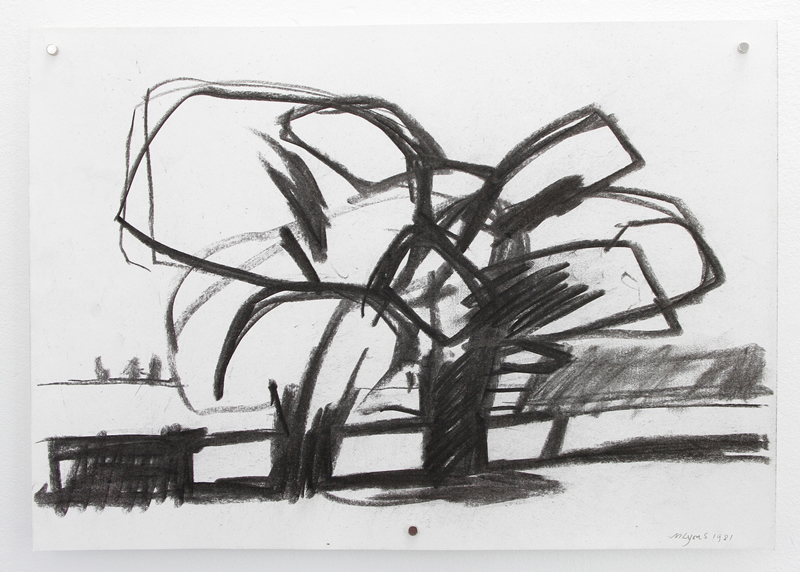
This charcoal drawing is almost becoming a drawing for a piece of sculpture, the linear nature of each plane now being picked out and traced for its rhythmic potential. Compare the tree drawings above with the tree in landscape drawing below. 
Michael Lyons: Trees in a landscape

Lyons is much more interested this time in the way that landscape can be simplified into blocks of space, a more tectonic approach to drawing, you can almost feel how his experience of working with plates of metal have informed his thinking. These observational drawings can be compared with his drawings for sculpture, such as these below. 

Michael Lyons: Drawings for sculpture

The 'tectonic' plates that make up his sculptures are being thought about by using a combination of black cut paper shapes and charcoal, cutting into the paper and adding to the blackness, in effect 'carving' the forms into realisation, together with developing a linear rhythm within which they can have a presence. You might not be a sculptor, but I think you can appreciate these drawings as a forceful exploration of form and a reminder of how important this type of work was during the 1960s and 70s.
The Leeds University's Stanley and Audrey Burton Art Gallery is straight over the road from the Art College, just walk up the steps of the Parkinson Building and it's on the left once you enter the great hall. Go and see the original drawings, the tree drawings are not on show, but there is a wonderful display of his drawings for sculpture, they still hold their own and are a really good example of how to find a form by adjustment and searching for that 'rightness' of relationships. 

The exhibition co-incides with the installation of Lyons' sculpture 'Lenten Cover' in the grounds of the university. 

Michael Lyons: 'Lenten Cover' 

Compare Michael Lyons' drawings with the sculptor Kabir Hussain's see: