Showing posts with label tradition. Show all posts

Saturday, 17 August 2024

Venice Biennale 2024 Part three

As an artist that works between 2D and 3D, I'm always fascinated by those that have managed to develop processes that allow them to do this seamlessly. In the USA pavilion Jeffrey Gibson, in his exhibition, 'The space in which to place me', demonstrated how a strong sense of formal design could be used to hold together wide ranges of materials as well as very strong colour combinations. His North American Indian heritage is mined for these formal principles, therefore both signalling his heritage and pointing to the fact that many cultures have in the past relied on abstraction and geometry as frameworks on which they have developed very specific cultural identities; Modernism was not the 'owner' or inventor of abstraction. 


Embroidered inserts were locked into compositions that used a symmetry derived from the art of the indigenous people


Navaho carpet designs


Jeffrey Gibson has developed a hybrid visual language that draws from American pop art, minimalism, the art of indigenous people and which also references particular subcultures that he taps into. He is a Choctaw Indian of Cherokee descent, and has lived in urban centres of the United States, Germany, and Korea. In his work, intertribal aesthetics, beadwork, textiles, and found objects from the past two centuries commingle with the visual languages of global modernism. His use of pattern and abstract geometries is a form of cultural critique, that engages with these complex histories rather than erasing them. Gibson develops a space in which Indigenous art, together with a broad spectrum of other cultural expressions and identities are shown to be central to the American experience.


I was particularly taken with these thread and beadwork portrait busts. They had a powerful presence, and the use of a simple symmetry, helped to give formal coherence to the masses of small coloured beads and other items that were used to construct them. The embedded badge states, "If we settle for what they're giving us we deserve what we get". A reminder that so many indigenous people lost their lands and had their ways of making a living taken away, and therefore had to rely on state handouts to survive. They were then labeled as work shy by the very culture that had stolen their livelihoods. 


I wasn't as convinced by the heavily textured 'ducks' but liked the fact that they were an attempt to make animal forms with a similar conviction to the human ones. 


When you make a ceramic pot or vessel, it is a 3D realisation of your own body's dexterity, a frozen form that captures the movements of its making. Therefore pots have often been used as substitutes for human heads or bodies. Ceramics is of course one of the oldest art forms, and by using pottery within his sculptures, Gibson reminds us again that there are other powerful visual traditions, that can still have relevance, including his own Cherokee culture. 

Cherokee artist Davy Arch, "Gumby Pot", 2005

Ceramic and textiles

Large freestanding figures using structures taken from indigenous peoples' tribal costumes

I wasn't sure Gibson had achieved a proper synthesis in these figures, but I could see the intention. Sometimes you just want to do too much; for instance the glaze of the pot/head was bright, but not quite right in terms of overall design. I didn't think the dripped glaze was right and there is such a long history of Cherokee pottery, that I'm sure some of the forms developed historically would have fitted much better. 

I was still thinking about how interesting peoples costumes could be as we moved on to the Nordic pavilion. This was devoted to the Altersea Opera, written as a hymn to diversity, displacement and belonging and the costumes that had been designed for the performers had all been based on Japanese kimonos and had been decorated with scenes meant to illustrate various narratives developed within the opera. 
The project was conceived and conceptualised by artist Lap-See Lam (Sweden) and realised in collaboration with experimental composer Tze Yeung Ho (Norway) and textile artist Kholod Hawash (Finland). At the centre of the story, lies the Cantonese mythological figure Lo Ting, (half fish, half man) and his longing to return to his former life in Fragrant Harbour; a narrative that is meant to suggest many of the stories told by migrant peoples, of their forced displacement and their thoughts of 'home'. Perhaps because of the fact I was already thinking about the power of clothing as symbolic form, my attention was mainly focused on Kholod Hawash’s textiles that took the form of a sculptural installation using kimonos stretched over bamboo frames. The Altersea Opera merges both real and imaginary stories all related to the diasporic experience, and it leaves us with a recognition of the need to move on and at some point leave behind but not forget previous experiences.

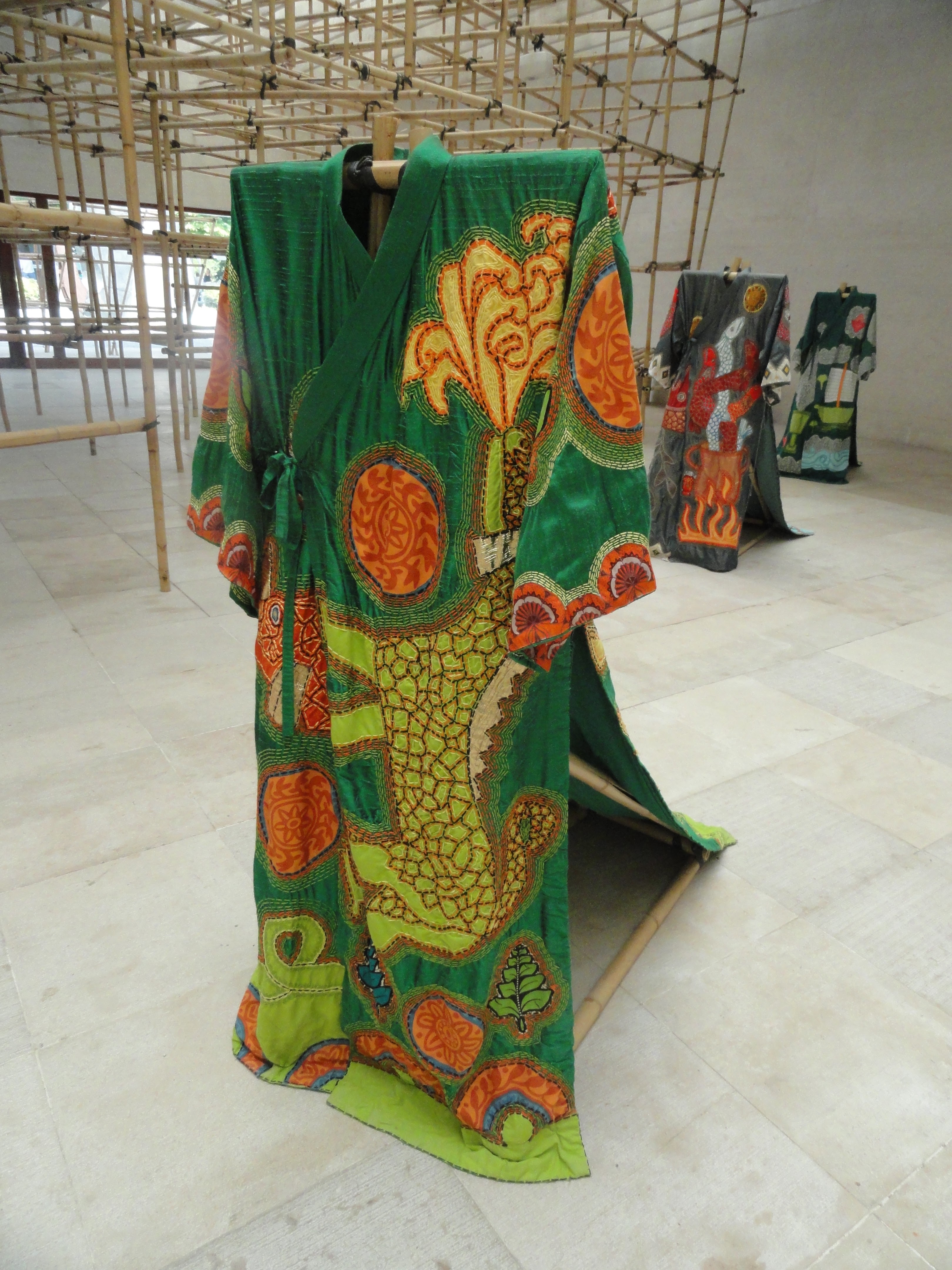


Kholod Hawash: embroidered kimonos

However I also felt that the operatic form was too steeped in western history and its overblown structures made it hard to express genuine emotional engagement with the story; or at least it prevented me from getting this. I wanted something more simple and direct.

Daniel Otero Torres

Because of the nature of the biennale theme there were many reminders of the dangers faced by migrants, such as Daniel Otero Torres's presentation of a simple terracotta relief of a raft with people's belongings on it; a very unobtrusive piece that could easily be overlooked. I think it may have emerged from a community project he was working on, so it may not even have been made by him, but even so, a small image picked out in clay, sometimes can mean more to me than a full opera. 

A full sized cart carrying carved wooden eels reflected how memories of home can morph and grow, becoming something strange within whatever stage becomes the new normal. 

Brett Graham, Wastelands

Brett Graham uses a distinct Māori visual language to construct a contemporary narrative. Graham’s sculpture Wastelands (2024) is a carved pātaka (storehouse) on wheels, implying mobility, transience, and separation from homeland. The pātaka was traditionally used by the Māori as a storehouse for food and treasures, often bearing particularly ornate carving across the lintel, indicative of the wealth and prestige of the community. Instead of using traditional carved patterns, Graham covers his pātaka in carved forms representing eels, a traditional Māori food source. In 1858, as part of the colonial project, the New Zealand government passed the Waste Lands Act, which shifted the designation of the large swamp lands within which the Māori used to catch eels to “waste”. The act transferred the understanding of swamps as they were now thought of as unoccupiable land, so they could be drained and turned towards western agriculture. Graham reminds us that for the Māori eels were once as valuable as gold and that you don't have to be a migrant to be displaced from your own land.

But probably the most poignant work for myself was that of Bouchra Khalili, who in 'The Mapping Journey Project' (2008–11) used a simple format of videoing a hand holding a marker pen as it followed the narrative of various people who had left their homes and had since been travelling the world looking for another one. 

Bouchra Khalili 'The Mapping Journey Project' (2008–11)

To view this work you sat on a seat directly in front of each projection, so that you could listen to a migration the story being told by the person who had experienced it, whilst at the same time watching a pen mark a map. The people recorded were very matter of fact about their experiences. "I saved up money so that I could get someone to help me get away from where I was. They took me to .... and then they disappeared with my papers. Then after working for two years in... I was able to get some false papers made and used them to go to...The police there realised my papers were false and I was deported to...." etc. etc. All were stories to break your heart and yet they were told as if these were recountings of everyday experiences; which I suppose they were for the people involved. 

I have tried as an artist to reflect on similar experiences myself, making work that attempted to visualise the stories told to me by migrants who had arrived in Leeds. The work I made at the time made me very aware that I was just one of countless artists all over the world who had been trying to make some sort of sense of an ongoing situation that art cant change. But perhaps by transforming experiences into an art form, we can make sure that the situation isn't forgotten. For myself the work was a realisation that every single person that has had to face leaving their homeland and travelling into the unknown, has had to face a trauma that those of us like myself who live settled lives in stable countries, have so far never had to experience. Hopefully this means that I will have more empathy with those people who after such traumatic journeys, finally end up in the vicinity of Leeds and try to help them with the process of settling in. Our recent experiences when trying to support someone threatened with deportation to the Gambia, have been a reminder that Kafka was indeed prescient as to the role of bureaucracy and the due process of law, when situations such as people's rights to stay in a country arise. This is undoubtedly so that people don't have to deal with people. It's so much easier to let systems make decisions as to people's fates, rather than to look across the room at someone and make a decision as to their future, then and there in front of them. Suddenly people become real and as they do, moral anxiety kicks in, because you know what is going to happen will affect real people in real ways. 

See also


Monday, 11 March 2024

Old and new traditions

Tenmyouya Hisashi: RX-78-2 Kabuki-mono 2005 Version

I've posted a few times on other cultures and traditions, and the posts have tended to concentrate on the past and the historical legacy that comes with being part of a different culture. However there are other stories and one of the most common is how tradition and contemporaneity coincide. The Japanese artist Tenmyouya Hisashi for instance uses tradition to reflect on contemporary life and at the same time question the notion of tradition itself. His work questions what traditional culture is, not just in relation to Japan but everywhere.

When my son was a young boy he was fascinated by Transformer toys. The Transformers toy line was created by the Japanese company Takara and was initially marketed in Japan under the names of '
Micro Change' and 'Diaclone'. In 1984, the US company Hasbro bought the distribution rights to these toys and re-branded them as 'The Transformers' for a North American audience. The designs for the original figures, all of which could transform from one thing such as a car, aircraft, gun or even a cassette into robots, were made by Japanese artists such as Shōji Kawamori, (who was probably the most well known), but also designers such as Kouzin Ohno, (Ironhide, Jazz, Starscream) and Takayoshi Doi, who designed the Dinobots. I was at the time fascinated by the Insecticons who were designed by Takashi Matsuda. I thought I could see traces of Egyptian scarab beetle sculptures in their design; a design that was constructed so that these toys could transform from insects into robots. 

Egyptian scarab 

Bombshell Insecticon 

Takashi Matsuda also came up with the form of Megatron, a robot that could also transform into a gun. All of these toys had one thing in common, they could take on more than one identity. A tiny insect could morph into a giant robot, size constancy didn't seem to be a problem for a child's imagination. 

The cultural tradition young boys were growing up with in the 1980s and 90s was definably Japanese, especially as Nintendo released their Gameboy in 1990 hot on the heels of the Transformers coming to the UK. Culture within the commercial world of capitalism is global. Hasbro needed English names and associated back stories for the characters, so that they could be marketed to English speaking customers with a narrative that was understandable in relation to Western young boys and their interests and so they approached Marvel Comics and Bob Budiansky was given the job. He conceived the names of many of the original Transformers that would be then released onto the American and European markets, such as Megatron, Ratchet, Starscream, Sideswipe and Ravage. He also wrote the vast majority of the descriptive "tech spec" biographies printed on the Transformers' toy packages, giving each figure unique personality traits in the same way that Marvel superheroes such as Spiderman were constructed. In this way two cultures were blended, the world of Japanese toy design and the superhero world of American comics. The fusion would of course result in Marvel releasing another comic title, The Transformers'.

From Transformers the comic

You can easily spot the historical references in the design of the robot forms.

Traditional samurai armour

Tenmyouya Hisashi

Tenmyouya Hisashi's images illustrate the 'mash up' of traditions that occur as hybrid global cultures emerge. In 2006 the Japanese football team had qualified for the football world cup which was held in Germany. A game originally invented in England, now belonging to a world wide culture, a game that now represented serious international money and that also wanted to celebrate the inclusion of specifically recognisable 'other' cultures as proof that the game was now global. Tenmyouya Hisashi's images were perfect illustrations of this and his work was chosen as one of the posters that celebrated the event. The use of traditional gold leaf backgrounds to his images, now also signifying the background of wealth that at the time surrounded world football. His 'RX-78-2 Kabuki-mono' image of a Transformer toy, constructed again on a gold leaf background and this time with a traditional dragon wrapping itself around the robot, fuses the old and new traditions together in such as way that we are reminded that the robot's design is based on ancient Japanese warrior costumes. 

The robot within Japanese culture is particularly fascinating. It is an object that generates meaning for its Japanese observers and participants within a tradition that is specifically Japanese. Shintoism has been followed in Japan for over a thousand years and it is a religious tradition that embraces animism. Spirits or kami, can be seen to inhabit animals, natural features like mountains and many other non-human things. Therefore the idea of a robot being able to be animated by human like attributes was more easily assimilable by Japanese culture. There had also been a long tradition of automata using clockwork mechanisms. The term 'karakuri ningyō' refers to a variety of clockwork automats created in Japan during the 17th century.
Karakuri = ‘mechanism’ or ‘trick’ / ningyō = a puppet.

Chahakobi ningyō

A chahakobi ningyō or miniature tea server, was made in the 19th century by Hisashige Tanaka, founder of the Toshiba Corporation which would eventually become a diversified enterprise involved in electronics, electrical equipment and information technology and which is still based in Minato-ku, Tokyo and they of course now make robots for industrial use. 
The Toshiba Corporation website includes video demonstrations as to how its latest robots can do the work that used to be done by humans. 

Current Toshiba Corporation video of robot use

The next step up in technology to be used to make automata after clockwork was inflatable rubber tube hydraulics. Gakutensoku, a humanoid robot built in 1928 by Nishimura Makoto, used this technology to tilt its head, move its eyes, smile, and puff up its cheeks and chest. It was also programmed to use calligraphy skills. It has recently been reconstructed and a new computer-controlled pneumatic servo system has been designed to keep it going over 90 years after it was first put into operation. What was fascinating about 
Gakutensoku, was that this was a very early attempt to give human expressions to a robot and cemented the idea into modern culture of robots often being humanoid in form. For myself, I have tended to see this as a continuing form of animism and often think of these forms as being similar to pre-historic shamanistic figures, such as the one illustrated below of a bee faced Algerian shaman figure, that has mushrooms growing all the way around it. This might of course be an indication of early drug use, something that might have helped the shaman get deeper into character. The final form is another hybrid one, an image that suggests that the sharp differences between humans and other creatures is not as sharp as we think it is. 

Gakutensoku’s head could express human affect

An ancient Algerian shaman figure

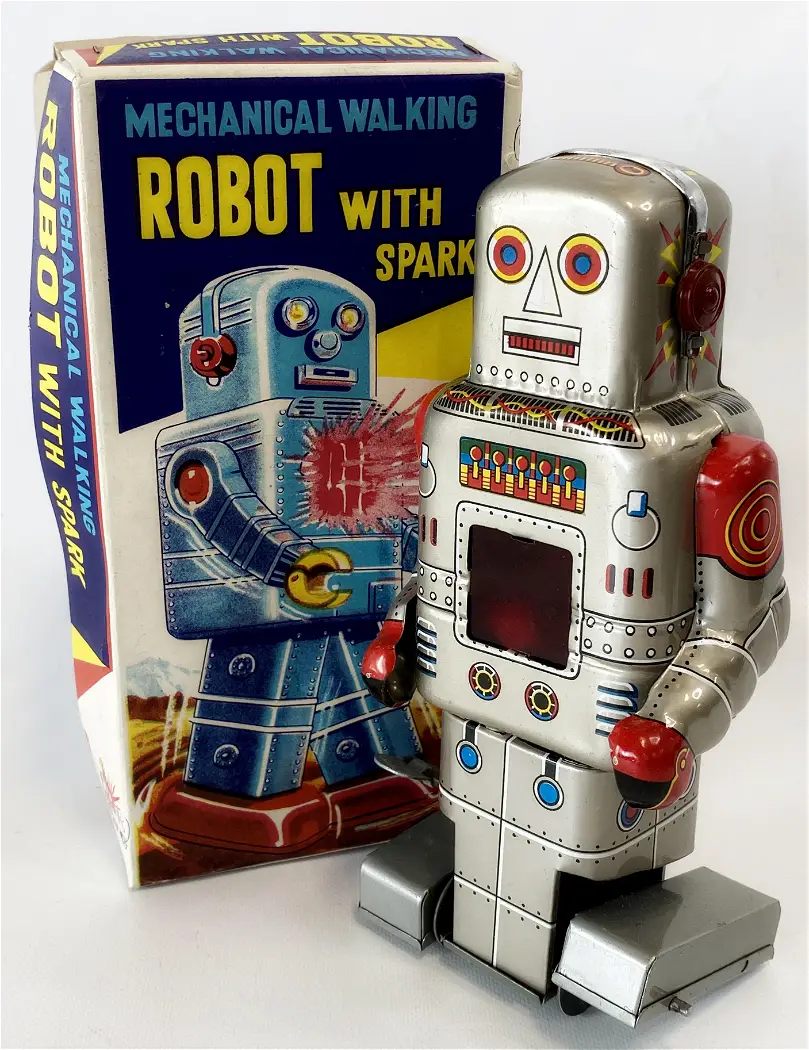
Robots had gradually entered Japanese culture, and there was less of a worry in their society about how their introduction might effect our human lives in the future. Perhaps because they had had to deal with the aftermath of the atomic age of science fiction becoming atomic bomb science fact, the society was much more open to future casting, whatever the reason, the first mass-produced mechanical toy robots were built in Japan following World War II. These wind-up robots, typically made from tin and brightly coloured, captured the world's imagination and were the first step in the development of a new hybrid culture, whereby robots took on humanoid forms. 


Samurai armour the traditional form behind the modern icon

By the time that films such as Pacific Rim came out in the 21st century, the visual idea of what a robot should be like had been fixed, its Japanese lineage now locked fast into a global idea. 

Design for a giant robot for the film Pacific Rim 

Another culture has been mixed into the hybridity in the image above, that of the engineering 'blueprint'. This is used to give 'scientific veracity' to the design. A design which itself relies heavily on the ideas that came out of Japan in the 1980s, the forms and shapes of which were rooted in traditional samurai armour. The following my nose 'logic' of this post seems to be outlining a post-modernist idea of culture, but I didn't set out to imply that this was what I thought contemporary society was about. I was simply trying to unpack a few thoughts set into motion by looking at some Tenmyouya Hisashi images. As students sometimes it is worthwhile doing the same thing and what it often reveals is the importance of children's culture on what will become an adult world. When I asked the highly regarded contemporary sculptor Thomas Houseago where he thought his main sculptural ideas came out of, he told me that Sesame Street was right up there as one of his main influences. 

Oscar the Grouch in Sesame Street 

Thomas Houseago

For myself it was perhaps Sooty and The Flowerpot Men that have stayed with me all these years, which were, it could be argued, deeply animist ideas as well. In fact at one point I tried to bring images from the two worlds of puppets and humanoid robots together, fused around a memory of when my mother worked as an usherette in the Gaumont Cinema in Dudley during the late 1950s. I found the film so frightening, I had to get my Sooty puppet to watch it instead. 

Sooty watches 'The Day the Earth Stood Still'

I'm now living in an age that recycles the remains of the culture of my youth. Little Weed from the 1950s TV series 'The Flowerpot Men' seemingly a much more threatening thing now than she was at the time; she is no longer the polite weed of yesterday. In a time of global warming and ecological disaster, the taking seriously the life of a weed, seems so much more important and her sagacious advice to the flowerpot men, now seems more like a metaphor and a parable for about how we should have been listening much more closely to nature in the past, and that if we don't in the future, all of us will find ourselves redundant not just 1950s children's puppet shows. 

Little Weed from the Flowerpot Men

Capitalism is driven by a constant need for new forms, so what is current for one generation is totally outdated by the time the next generation comes through. This is something most of human society historically would have found very strange. In the distant past change was very slow and your grandparents' culture would have been virtually the same as the one you would experience. However our propensity for an animist relationship with non human things still remains a powerful force, so I am hopeful that we might eventually begin to treat the world as a living, complex entity, rather than a resource to buy and sell. We still have to deal with our existentialist angst and buying new things never did bring happiness, but reflecting on these issues can at least bring us some sort of awareness and in awareness lies knowledge and in knowledge lies wisdom and in wisdom lies the overcoming of the sadness caused by desire.

Tuesday, 29 August 2017

Venice Biennale part 4 Continuing traditions

Although I'm reviewing the 2017 Venice biennale, the themes and technologies I'm looking at often reach far back into history. For instance abstraction has a long history, Tantric art in particular having an ancient abstract lineage and research into abstract entoptic forms can take us all the way back to pre-history.
Abstraction in this year's biennale was represented by several artists, it obviously still has an important place within contemporary fine art practice. The two artists I have chosen to represent abstract practices however come from opposite ends of the aesthetic spectrum. Dan Miller is autistic and drawing is his main means of communication. He draws words and images over and over again. Each drawing is gradually lost under a surface of marks as new drawings replace it. Superficially these drawings look like Abstract Expressionist works, but they are not, they are records of someone's life, a life that is perhaps hard for us to understand, but by the sheer perseverance of Miller trying to communicate, we are presented with powerful images that seem to have been 'abstracted' out of his various attempts to communicate, each surface becoming a palimpsest of seismic energy, which itself is more powerful than words. 

Dan Miller: detail


Close-up of the framing of one of Dan Miller's drawings

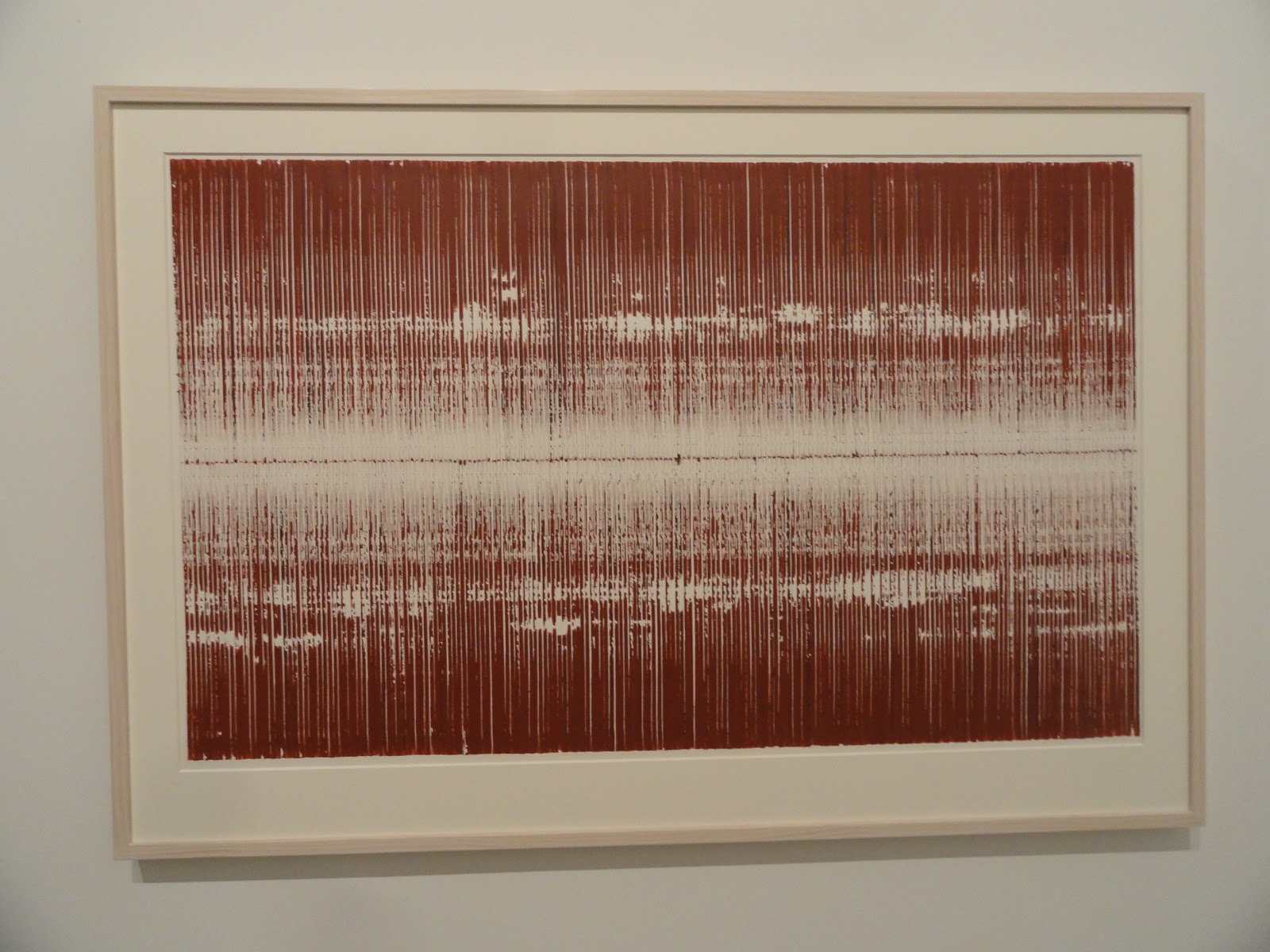
Sopheap Pich sits at the other end of the abstraction spectrum. His drawings are meditative responses to particular processes that he has set up. The drawings on exhibition were made by systematically pressing a stick of pigmented bamboo onto a sheet of watercolour paper. As each print is made more or less pigment is deposited, the process always being done to ensure a bi-lateral symmetry is maintained, carefully and systematically working a way out from the centre to the edges. 

Sopheap Pich

Sopheap Pich: Window mounted drawing 

It is interesting to compare how Miller's work is framed to Pich's. Miller's drawings float off their backing board behind a shallow box frame. The edges of the paper can be clearly seen and you get a sense that Miller works around his paper in such as way that the edge is very important. The paper in this case is presented as a physical object. In contrast Pich's work is window mounted, this heightens a sense of separation from the world, we are given a space within which to meditate on the process. 

Several artists were using textile materials and I have posted before on the stitched line and the relationship between drawing, grids and weaving. Of the artists using textiles I was particularly drawn to Maria Lai's work. 

Maria Lai


Maria Lai: detail of stitched writing


Maria Lai 

Maria Lai was given a posthumous retrospective, her stitched maps and books coming across as still being relevant and aesthetically potent when viewed at a time of international disruption, when there is a great need for empathy, but little coming from our world leaders. Sewing gathers threads together and her books which at first sight appear readable, dissolve back into a language of fits and starts, black blobs of caught cotton, standing for the words on a page, becoming the texts of forgotten languages of appeasement; as people babble and misinterpret each other’s languages as possible threats or aggressive sounds. Her books are soft; their unspoken words soft whispers for weary minds worried about world events, and a welcome distraction from the newspapers. 

Compared to Lai's work I found Achraf Touloub's textile hangings overly mannered and portentous, and although I could get the chain references, I wasn't really convinced. However as a way of furthering ideas in relation to the stitched line the work occupies that territory between 2D and 3D, the stitched lines incised into the surrounding padding, making these pieces into relief sculptures. 


Achraf Touloub

His small drawings, that were sort of Futurist in feel, were much more convincing and when I  looked at some of his other earlier work, decided that his drawings were nearly always more sensitive and concise. 


Achraf Touloub


Sparse and sensuous drawings by Huguette Caland were presented alongside three costume and mannequin works the artist made during the 1970s and 80s. The drawings were of particular interest as they demonstrated how minimal you can be and yet still be very sensual. 


Huguette Caland
Huguette Caland: Mannequin

I spent quite a long time in the Chinese pavilion, one of the reasons being the juxtaposition between old and new technologies. 


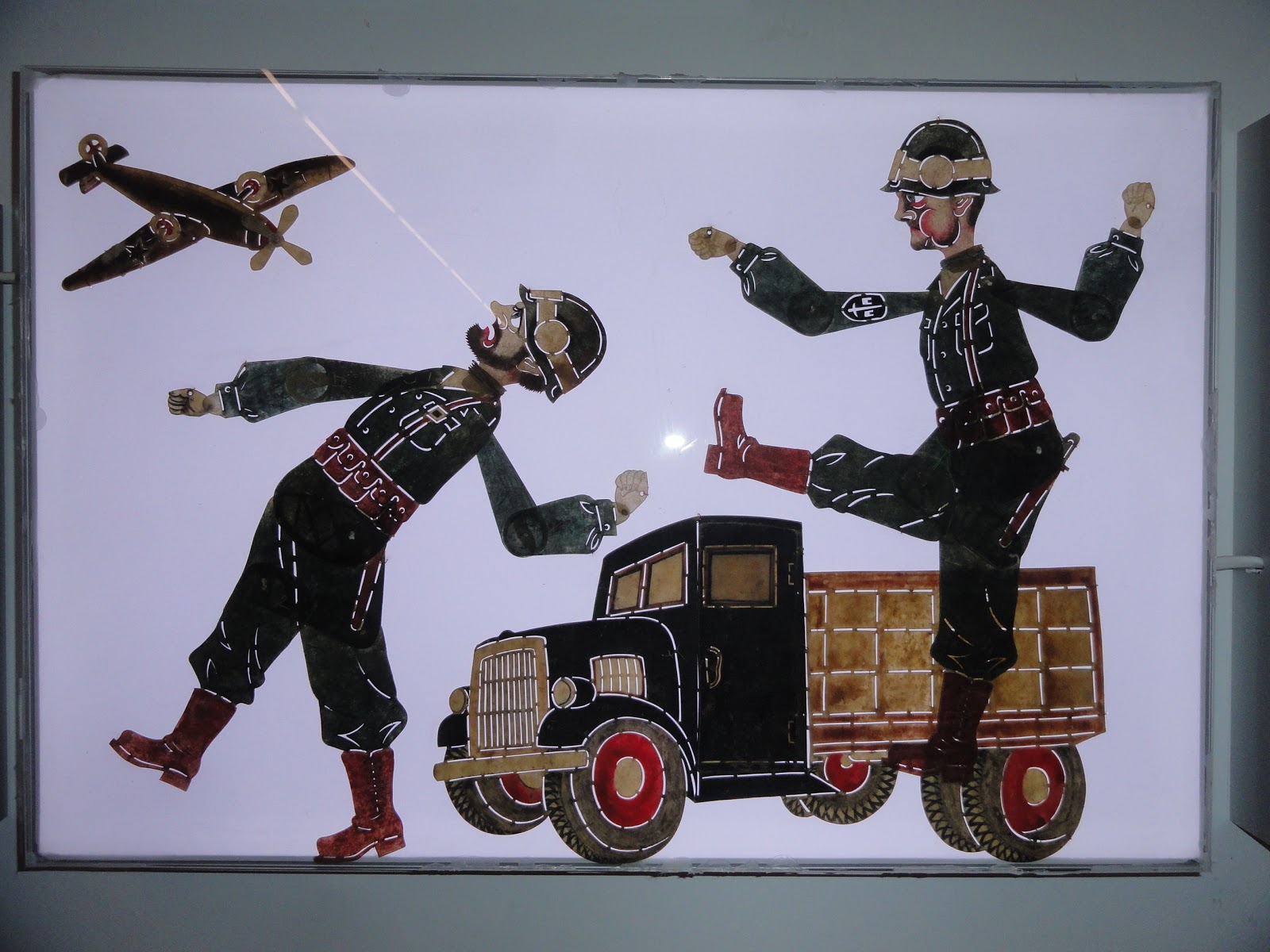
Wang Tianwen, Wu Jian’an and  Tang Nanan, Continuum – Removing the Mountains and Filling the Sea, shadow theatre performance, front and back views


Wang Tianwen, Wu Jian’an and Tang Nanan's 'Continuum' was a fascinating mix of technologies, using old shadow play techniques with contemporary animatronics. You could watch both sides of the installation with equal interest, the animatronics were easy to see and all the workings were 'open', so that as the bird flew across the sky, you could watch the mechanical arm and joints moving in order to activate the bird. You were of course reminded of how sophisticated we are as humans, and how hard it is to duplicate our actions with robots. By mixing the telling of an old story and an old shadow technology with contemporary robotics, 'Continuum' asked questions about the nature of our future relationship with technologies. 

A collaborative work had been developed by Tang Nannan, ‘what’s the sea’ with school children. This began with stories about the sea and workshops whereby the artist supported the children in making images about the sea. These images were then collected together and storyboarded so than an animation could be made, children sometimes then asked to return to their images so that they could draw the in-between frames. I should perhaps have put this post in with the one about relational practices, but because of the nature of the Chinese pavilion, this felt more about passing on a continuing cultural tradition than an artist acting as a catalyst for the development of a relational practice.


Tang Nannan, ‘what’s the sea’ workshop


The whole point of the Chinese pavilion was the interconnection between the past and the present. Old craft techniques and ancient stories, combining with new technologies and people both from inside and outside what could be called the 'fine art' bubble. Crafts people were working using traditional materials alongside fine artists, both equally valued. This attempt to demonstrate a continuing aesthetic tradition was I presume also a political statement about the coherence of Chinese culture, even so I thought it a powerful statement and one that had a lot of resonance for myself. I have often thought that if my own work is to have any traction, I need to make sure it sits within a tradition that makes it accessible and understandable to a wider public than the 'art cognoscente'. But what that is, is difficult to define. Because I'm interested in narrative, I tend to look at a tradition that goes via William Blake and Hogarth, via Rowlandson, 'folk' prints, comic book art and Steve Bell, and has its roots in Pieter Bruegel.  


Qiu Zhijie, The Map of Continuum.


I'm always drawn to maps as images and Qiu Zhijie's map of “Mountain/Sea” and “Ancient/New” representing “Yin/Yang” was presented as the framework around which the exhibition was built. Two well-known Chinese fables, The Foolish Old Man Removes the Mountains and Jingwei Filling the Sea, provide the imagery for the exhibition and the concept of “Bu Xi” (continuing tradition) is used to give coherence to the idea of bringing together two folk artists and two contemporary artists to convey the meaning of the narrative. 
I really enjoyed the presentation of traditional 'light box' images, these worked in a very similar way to stained glass and relied on the simplification of images and their articulation in a similar way to shadow puppetry. You could make very similar figures out of stained acrylic sheet.


A traditional animated story, presented as a video with English text overlaid


This complex cutout was used in exactly the same way as a stained glass window


Detail from the window above


Another detail from the window above


The point I am trying to get across is that as an artist you can use both old and new technologies, the one will often refresh the other and in their juxtaposition or combination you can often find a new way of pushing forward those perennial ideas that will always surface, ideas that each generation of artists will have to redefine in their own terms, but will be about life and how it is experienced. 


Nevin Aladağ: Traces


Finally I would like to recommend Nevin Aladağ's playful sound video, 'Traces'. She had edited together a series of short takes of various ways of getting things to play their own sounds. See this a how it was made documentary.  You might wonder what this has to do with drawing, but I would argue that the editing process is itself a type of drawing. Aladağ would have had to storyboard the idea and organise each shoot so that eventually all would fit together and in doing this I believe she would have had some sort of overall plan or map to work to.  You can see how Traces worked as a three screen installation here


Nevin Aladağ: Traces


In 'Traces' the city of Stuttgart plays itself. This review of Aladağ's work by Andreas Schlaegel in Frieze explains the work much better than I could.
"The action unfolds in public playgrounds and urban pedestrian areas: in one sequence, a cello rotates on a toy carousel; with each turn, it hits a stationary bow fixed to the ground, producing a note that elongates as the carousel slows. Aladağ has skilfully edited the scenes to create an ambitious musical and visual composition, at turns operatic and slapstick. As soon as a musical thread establishes itself, however, it is quickly interrupted or concluded, as when an accordion hanging from a lamppost slowly submits to gravity, emitting a final, fading moan. Traces, ultimately, is a composition of continuities and ruptures that resists readily identifiable melodies and harmonies, as well as all-too-easy politically correct readings. Aladağ’s ambivalence toward a finite meaning is tangible in the deceptively simple musical devices she creates. Traces is not only a theatre of animated matter, but of cultural references in motion – dynamic and quirky, but more often idling, aimless and melancholic. If the town plays itself, it is moody".
Andreas Schlaegel 

Nevin Aladağ talks about her work, she talks about one aspect being 'a drawing of the sounds'. 
See also: