Thursday, 13 June 2024

The visualisation of embodied thinking

An infection is surrounded by epithelial cells that produce an antimicrobial peptide

Both mental and physical experiences are imprinted into our bodies. This is partly why I have recently posted on the tattoo, which I was thinking about as a sort of analogous process, suggesting that tattooing can be thought of as a metaphor for how the body's internal cells are imprinted by external events. External experiences are held in the body/mind as imprints and memories, and because they are now inside the body, they effect physiological change. 

Our nervous systems are layered, and we have inherited older parts that still work because they were effective during the early part of our evolution as an animal and they helped us to survive.  These primitive reflexes still mobilise our fight-or-flight decisions and they are integral to our inner emotional feeling tone. This feeling tone is an embodied awareness as experiences are encoded in this system non-verbally and non-consciously. This is why I have decided that drawing and other material processes such as making things in clay, are so essential to the awareness raising needed if we are to engage with how our body/minds are working to keep us well. 

I have been looking at my own history and there were times when my experiences of life were traumatic. I feel sometimes as if I still carry these events within myself, even though they are events that took place a long time ago. It is as if these past experiences are somehow still 'fixed' in the body, the problem then being that some of my actions and reactions to new experiences, can be still in some ways, responses to situations that are no longer the case. 

I recently undertook an awareness exercise to help myself identify whether or not my body might be working harder than it needed to when operating automatic self defence mechanisms. After going through the symptoms, it did seem to be the case. I sometimes get cold hands or feet, a common sign of blood being diverted away from the periphery towards the core muscles that help us flee or fight, when we are stressed. I am very sensitive to bright lights and loud noises. I sometimes lose spatial awareness and become dissociated, and I often have that feeling of having my head in the clouds. I have also in the past had panic attacks, but thank goodness I have had none during the last few years.  All of these are signs that my mind/body is over compensating and that it goes into survival mode much too quickly, because it has not been able to 'forget' past experiences that are no longer threats.

Drawing and making things are activities that enable me to feel safe, they are my main health resources, or at least it feels that way to me. Those inner body feelings of an anxious stomach and tight chest, disappear when I am engaged in drawing or making ceramics. I have been for a while now exploring images associated with interoception, perhaps an awareness of how these images came to be, can help others overcome their own embodied anxieties. 

One of the books I have been reading about embodied stress suggests that if you are to move on past your self defence mechanism triggers, an extremely useful skill is to learn to check whether you can inwardly visualise the size, shape and weight of your body. the book suggests that an awareness of the boundary of the skin, helps differentiate who we are; the skin being a transition place between me and not me. The book explains that a layer of our nerve rich skin grew from embryonic ectoderm, which also forms the brain; therefore the skin it is argued, is another outpost of the nervous system, as is the stomach. However, when you try and envisage the body, there can be bits missing. Some people on trying to visualise the body realise that in their body/mind they are missing legs, or limbs are far too small, images of their bodies may be diffuse, abdomens absent, one side of a lung absent, or bones far too soft. In fact it is in the spaces between what feels known and what feels unknown, that some sort of visual understanding is being forged and the unknownness of these elements, is what makes the images made from these feelings so interesting. They are sort of the opposite of photographic realism, they are glimpses of things that are felt and then in order to catch the glimpse, you need to re-invent the form that it is coming in. Even with all this ambiguity and missing elements, there is something about this process that feels much more 'realistic' than copying photographs, because at least I am directly being in touch with myself or others feelings, no matter how tenuously. 

The short condensed text, 'Finding Safety via Embodiment' by Steve Haines (The Body College, 2019), sets out questions that are designed to help you visualise your body...This is the verbatim text...  "Initially it can be useful to go through them as a sequence, using the mnemonic WOSI; Weight, Outline, Skin, Inside. with more experience you can be much more flexible. Often the simple question ‘how does x compare to y’ can open up a realisation of an incomplete mapping of the body. Weight ‘How does the weight of your body feel on the table?’ ‘Do your shoulder blades, hips, knees and ankles feel even on the table?’ Outline ‘Can you feel the outline of your body, the silhouette it makes?’ ‘Does the outline feel the same from the inside with your eyes closed as it would if you were looking at your body or touching it?’ ‘How close or far away are your hands and feet. They are not too big too small or too close or too far away?’ Skin ‘Can you feel your skin as a clear boundary between the inside and the outside?’ ‘Does your skin feel sharply defined and easy to contact or is it a bit blurry or amorphous?’ Inside ‘How does the inside of your body feel?’ ‘Does the inside of your body feel full, flowing, alive or are there bits that feel empty, fixed, numb or hard to contact?’ " (Haines, 2019)

However, I had a few questions myself about the questions asked. Haines presumes that the inner body map in some way resembles the way we see or feel our bodies from the outside. The work I have already done in relation to interoception and how to visualise inner or somatic experiences, has pointed to a wide variety of ways for people to visualise inner body feelings. Drawings that have been done in workshops, as well as images I have made myself, point to a wide range of possible approaches to visualising feelings.


Images made during a workshop

The issue for myself is that by attempting to visualise a somatic experience, the person involved begins to 'own' the experience and to actively engage in building up a relationship with feelings and inner body sensations that they would normally ignore. 

A visualisation of stomach pain

Identification of pains within a crude body map

I have been undergoing pilates sessions, in order to come to a better understanding/awareness of my own body and at the same time attending therapy sessions to get a better grasp of how my mind is working. Hopefully by undertaking the two approaches at the same time, I can gain a better grasp on my own mind/body relationship. I am of course still drawing and having conversations with other people about their own feelings/understandings of these issues. 
Somewhere in the mix, whether it is in the workshops with other people whereby they make interoceptual images, or in my own self reflections, at some point images will hopefully emerge that can help with some sort of communication of what is an eternal conundrum; the fact that we cant see inside anyone else's head.  We do however need to have empathy for others and we need to operate in ways that enable cooperative actions, these things are central to our collective human condition. The making of art, is I feel, something that illuminates our experience of life, that it enriches it and gives it more depth. The mind/body relationship is something humans have had to consider over and over again, each society and time, coming to different conclusions as to how to make sense of consciousness. 

Above all, I'm trying to find answers to the development of a practice that ties together all the various parts of my life experience, a way of working that acknowledges that environments will effect both our bodies and our minds. I also believe that we are inseparable from nature and an integral part of it, which means that you cant step outside of it, a situation that leads me to also believe that everything is interconnected and that this reflects a powerful quantum interconnectedness, which is based on an argument that subatomic particles are in some form of intimate connection with one another, no matter how far apart they may be.

Because these beliefs are not scientifically verifiable and don't fit any one religion, I'm forced to tiptoe around the frayed edges of science and this is why I often post on esoteric ideas such as Mesmerism or Rayonism or am looking to non western traditions, such as a belief in chakra points. I sense that there is some other way to tap into the energies that surround us, and that art can be helpful, as it gives legitimacy to practitioners such as myself, as metaphor inventors and makers. There is a word, 'grok' which means to understand profoundly through intuition or empathy, which was coined by Robert A. Heinlein in his 1961 book 'Stranger in a Strange Land', which is a good word to use in these circumstances, as it suggests a grasp of a something, that you know is there, but you cant put your finger on it. 'Grokking' can be used in a sentence as you would a word like running; to grok being to empathise so deeply with others that you merge or blend with them, even though you might not agree with the way they set out their beliefs. For instance I can empathise deeply with a religious person, even though I don't believe in their religion. 
This deep empathy is often associated with the times when we are in love. In the book, 'Kama Muta: Discovering the Connecting Emotion' Alan Fiske goes into great detail about how we feel when we are moved by feelings of love. He uses phrases such as 'being moved', 'feeling connected', 'feeling warm and fuzzy' and 'being at one with someone else', all of which suggests that we are at our best when our interoceptual feelings chime with those of someone else and that embodied feeling is at its most wonderful and beautiful best, when it is a shared experience. 

References:

Barrett, L. F. (2018) How Emotions are made London: Pan

Biernoff S, Johnstone F. (2024) 
What can art history offer medical humanities? 
Available at: https://mh.bmj.com/content/early/2024/05/30/medhum-2023-012763

Briggs, S. (2023) How to change your body London: Synergetic Press

Crawford, D. H. (2009) The Invisible enemy: A natural history of Viruses Oxford: OUP

Fiske, A. (2019) Kama Muta: Discovering the Connecting Emotion London: Routledge

Menzam-Sills, C. (2018) The Breath Of Life: An Introduction to Craniosacral Biodynamics New York: North Atlantic Books

Pert, C. B. (1999) Molecules of Emotion London: Pocket Books

See also:

Drawing and quantum theory

Why do we draw?

Object orientated ontology and drawing

Lines as symbols of invisible forces

Visualising energy flow

Drawings as aesthetic transducers 


Thursday, 6 June 2024

The fine art of the tattoo

Tattooing is now featured in major museum exhibitions. In the tradition of the tattoo artist, the Romantic outsider artist as a lone genius stereotype disappears and an even older tradition based on a more communal art form re-emerges. In particular the tattooist works very closely with the client, because they will be 'wearing' the images created on their body for the rest of their lives. The client is in effect, curating their skin as a developing image and the tattoo artist is working with them to do this. This is a symbiotic relationship, but of course the tattoo artist still has to have all the skills necessary, to ensure that once agreed upon, the design can be created. Skills in the use of the equipment, whether traditional or new approaches, need to be combined with excellent design skills and good hand eye co-ordination. The conceptual skills needed to create images that make us think about the human condition or that tap into deep mythic traditions, are also just as much in evidence in the world of tattoo design as they are in other art forms. 

There are some overlaps with the art world. For instance Coco Loberg is an Australian artist who develops tattoo ideas by taking images from a wide range of contemporary sources. For example the sardine tattoo below, is based on one of Kate Jarvik Birch's paintings, who is an artist that lives in Salt Lake City, USA. The internet now eliminates distances and artists can tap into influences or copy images from virtually anywhere. 

Sardines: Kate Jarvik Birch

Coco Loberg

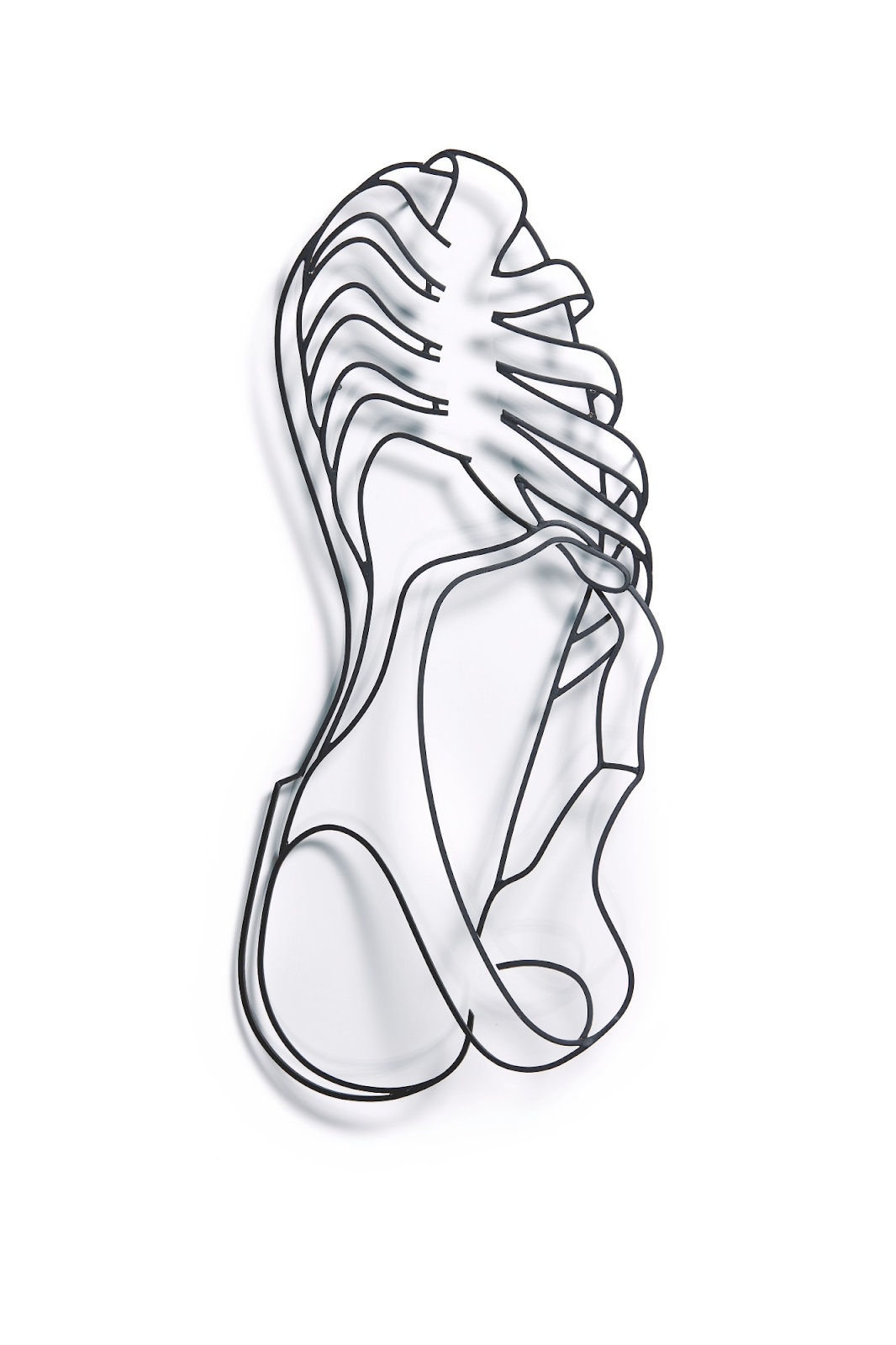
Loberg's images are not too far away in style from the line drawings of Michael Craig-Martin. In order to arrive at an essence, they both strip down their subject matter to a few clear lines. Michael Craig-Martin is of course a world renowned fine artist and Coco Loberg is a tattooist. It would of course normally be argued that Craig-Martin was there first and that as a fine artist he laid the ground for the public's appreciation of such stripped down line imagery. 

Michael Craig-Martin: Sandle

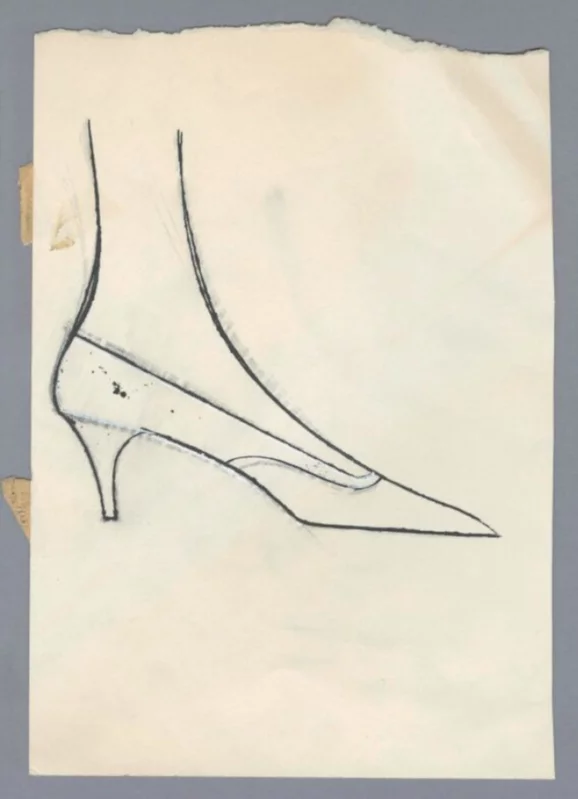
Craig-Martin's 'Sandle' is one of several images he developed that were regarded as a type of conceptual commentary on the nature of imagery, rather than a depiction of a type of shoe. However, the 1950s designer drawn images of food, (below) were done so that they would reproduce well on paper as printed images, using what were still in those days mainly black and white printing processes. It could be argued therefore that the graphic designer/illustrators of the 1950s were preparing the public for the Pop-Art imagery of the 1960s.  Indeed Warhol's experience as an illustrator in many ways prepared him for his fine art career.

1950s objects line drawing

Warhol: Shoe drawings: 1956

All these types of line drawings need to go through a process of visual simplification. Formalist thinking is therefore central to all three outputs. Hokusai would have understood this process, as it is clearly central to the production of his own stripped down drawings of everything from plants and animals to people and objects. 

Hokusai

Because of the nature of Japanese art, it lends itself very easily to tattoo designs and you can find traditional Japanese images, adjusted for tattoo use in tattoo studios all over the world.

Foo dog / Fu Dog / Shi Shi / Chinese Guardian Lion by @wootattoo_1

Koi Dragon by @horisumi

Heikegani / Samurai Crab by @sootattoo_1

The tattoo designs above are recreations that exploit hybridity as a powerful inventive force. All of the studios cited above also do highly complex body and sleeve designs and as these have to wrap around arms or backs or chests, an excellent knowledge of how two dimensional forms will work when following a spatially curved surface is needed. In the tattooists' jargon this means that designs need to consider 'wrap'. An inner forearm design must consider the visual drop off at either side of the area. A wide design will appear narrower as it curves around the arm, therefore when for instance, designing for the inner forearm, it is thought of as having a flat surface from the ditch, (in tattoo jargon, the indentation behind your elbow) to the wrist, an area around 3 to 4 inches wide. Then as the surface area curves around and becomes the outer forearm, any design that is wider than 3 to 4 inches, will start to distort, the more it extends out on either side. In order to visually work with this, good tattooists locate key visual elements on a centre vertical line, well inside the 3-4 inch flat plane, locating less important details in the areas that fall away on either side. Body maps are sometimes used to help think about these issues. 

Tattooist's body map: From https://www.tattoospace.com/

Tattoos are now seen as a major art form, and art galleries are beginning to think about how they can be displayed. 

Tattoo. Art Under the Skin: CaixaForum: Barcelona 

The ‘Tattoo. Art Under the Skin’ exhibition held at the CaixaForum art centre in Barcelona, documented tattoos past and present and explored the development of the art form as a global artistic expression.

I was as interested in how tattoos were presented as much as the various different approaches to the medium. It is a very strange thing to see a disembodied leg, standing alone in a clear perspex vitrine. Once you get past the dismembered body feeling, you then have the secondary experience of the tattoos themselves and how they combine to form a three dimensional surface. In this case the Spanish tattooist Laura Juan, shows how to combine colour and realism, in an emotively hot blend.  

Laura Juan

Laura Juan's work is 'painterly' in its application, her use of colour is a result of the way she lays in the early layers of her work, which allows her to simplify form and yet at the same time suggest a very lively and accurate understanding of light reflecting off her various surfaces. I suspect she has looked at a lot of Impressionist paintings.


Kari Barba

Kari Barba has made it her mission to highlight the role that women can play both as tattooists and as skins. (A skin or canvas is the tattoo jargon for someone who has been tattooed) Her scenes are dramatic, and they feel as if they could come directly out of illustrations from adventure fantasy novels. Her work was exhibited in “Tattoo: An Exhibition,” at The Natural History Museum in Los Angles, which provided a historical overview of the social and religious significance of tattoos worldwide. The museum text describing tattoo art as “a process [whose] results can be a sign of identity, a rite of passage, a type of protection, a form of medicine, a memory made visible, or a piece of art to be collected and worn on the most intimate of canvases, the human skin.”

Colin Dale

I personally really like the work of Colin Dale. For instance when working with a beekeeper, he developed a "Honey Hunter" pictograph image that could be put onto the calf of the leg. The designs come from European cave paintings from about 10 thousand years ago and they depict people climbing vines to harvest honey from hives in the upper branches of trees. 

Jee Sayalero

Jee Sayalero in contrast is a 
post-modern artist, in the image above he combines the contemporary Japanese Nintendo game figures of Super Mario and Yoshi with a traditional Japanese tattoo design. 

The Quai Branly Museum in Paris held a large exhibition of tattoo work a few years ago and this exhibition toured both the USA and Canada and in doing so raised the profile of the tattoo as an art form. This was the exhibition on which was based the “Tattoo: An Exhibition,” selection at The Natural History Museum in Los Angles, and the echoes that have been resonating out from such a prestigious series of exhibitions are yet to fade away and tattoo artists are beginning to be seen as the keepers of very important world wide folk art traditions. 

An introduction to the Quai Branly Museum tattoo exhibition

My interest in tattoos has resurfaced because I have been thinking about them as a way to hold images as they pass between the inner world of the body and the exterior experiences of the world. For instance, some tattoos depict the inner body on the outer body, thus sort of making the skin invisible.


Other tattoos make you aware of the skin, but then create an illusion of the skin being opened out or pulled away to reveal what is inside the body. 


I first encountered this particular aspect of the tattooist's art in Barcelona. We had been for a swim in the olympic pool on Montjuïc hill; from the hill you can look out over a magnificent view of the city and on this particular day we needed to cool off after going to the Miró Museum. At one point we were inside the building, looking down on one of the pools, it was empty except for one lone swimmer. The man was swimming lengths, very powerfully, and smoothly, using a good front crawl stroke, but what fascinated me was the fact that he had a full-sized body tattoo of the inside anatomy of his body and as he swam, his back activated illusionary muscles and bones. 

Back Tattoo: Matt Doherty: Empire Tattoo Studio 

'Biomech' tattoo: Never Say Die: Croydon

I can still see the man's body in my mind as it swims, and in my chemical memory it becomes a deep metaphor for myself, the body cleaving its way through the water, cutting into the pool's blue skin, whilst the body is revealing its own inner reality as it stretches itself to its physical limit. 

On the other hand some tattoos bring the outer world into the body. 

Paul Owen: Naughty Needles Studio

Jolly Octopus: Christchurch

I still remember back in the mid 1960s reading Ray Bradbury's short story "The Illustrated Man", it had a deep affect on me at the time, A creepy, overweight carnival worker is given tattoos by a  witch who creates images with magic needles. She tells him that they will show the future. One of his tattoos is of the man strangling his own wife, something that does come to pass and another is of the man being attacked and beaten by the other carnival workers when they realise what he has done. There is something very disturbing about the idea of the body being able to tell a story about its future life. There was also a film made based on the story, with a slightly different plot, whereby a man sees his own fate on his murderer's body. 

The Illustrated Man: 1969 Director: Jack Smight: staring Rod Steiger

The body can be a surface on which to place images that remind us of our encounters with the world. My grandfather had served in India during the time of the First World War and he had tattoos from his time of travelling out there; he had had one done at each port that he had docked at and so he then had a mnemonic of his experiences, which, over 30 years later, he was still able to use to help tell his grandson some amazing stories. 
However, the body also tells stories about its life, without any outside interventions. The skin ages and as it does it communicates the facts of its own mortality. Certain illnesses, infections and diseases communicate their existence through the skin; eczema, psoriasis, acne, shingles, moles and fungal infections all have unique visual properties. Sometimes the skin displays pigment distribution abnormalities such as in the case of people with vitiligo and this reminds us that skin colour is simply a result of the distribution of different amounts of melanin. When someone has an irregular distribution of melanin they can in effect be more than one colour, a state that asks many questions as to why humans attach so much importance to skin colour. 

Old human skin

Guttate psoriasis

Acne

Shingles

Vitiligo

The skin has its own memory, which we call 'scarring' and different cultures use this process to decorate bodies using various scarification techniques.

Operation scars


Scarification

Recent images of sunburn tattoos have been circulating on Instagram, Playboy magazine even markets its own “sun tattoo” bunny stencils, however the fine artist Dennis Oppenheim had the idea way back in 1970, when he decided to make a before and after image of himself 
lying in the sun. 

Reading position for second degree burn: 1970 Dennis Oppenheim

My thoughts are still coming together about this, I have yet to decide how to use these various ramblings, but I have an intuition about how inside and outside experiences, can combine to make us what we are. Somewhere in my making process I'm attuned to this instinctively, but have yet to clarify exactly what this means to me. These types of posts are a sort of edging around the subject, precursors to the main event, which is about me finally deciding what to do.  


Notebook thoughts on possible use as tattoo 

See also:


Thursday, 30 May 2024

Klara Kristalova: Ceramics and drawings

Exhibition display of Klara Kristalova's 2D work

I first came across Klara Kristalova's work in Copenhagen at the Gammel Strand gallery. Sue and I had decided to have a short break back in I think 2017 and entering the gallery was an unexpected pleasure, in particular in relation to how Kristalova's work was displayed. Her 2D ideas were shown alongside her ceramics, in such as way that the drawings didn't seem secondary to the 3D making, they both held their own space and the narrative impact was very strong, as there were a lot of ideas all being shown at once. The gallery space in effect became Kristalova's world. I liked that and I felt an immediate affinity with her way of working. 

Portrait of a young girl

Horse girl at night


Summer breeze

I like the way that an image of hair being blown over a face, as in 'Summer breeze' can be made to feel as if the head is suffering an attack from some alien creature. By simply thickening the strands of hair, they become octopus like tentacles. 

Exhibition display of Klara Kristalova's ceramic work

The black painted wooden structure above which she used to show a range of ceramic figures in the Gammel Strand gallery, was just one of several approaches she has taken to presenting her work.

Strange Clay

Her work in 'Strange Clay' inhabited an artificial landscape, as if creatures from a fairy tale were becoming 'real', whilst in another exhibitions she has used a cabinet to house her work and tables and chairs as surfaces for both display and interaction with her ceramic figures.

Cabinet display 

Each approach suggests a slightly different reading of her work and this is something I realise I need to explore myself. In particular I want to be able to exhibit my ceramics alongside my drawings, in such a way that they support each other. Lighting is also very important and by putting lighting into the cabinet above, her work is intensified and given a relic like aura. 

The sleep of dreams: A response to Goya

Woman / Bat hybrid

I'm drawn to hybrid forms, so the woman / bat image above, like so many of Kristalova's images, intrigues me. The clay holds the image, but in its very malleability, it also suggests that this is but one moment in a series of changes that the figure is making. You may feel that the days of the fairy tale are over, but I beg to differ, and would suggest that the more we head into uncertain times, the more we will need new tales and fables, both as an escape from reality and as a way to develop new stories, designed to tell allegories and parables, that might at some point, help us to find ourselves again. 

See also: