Showing posts with label Paul Klee. Show all posts

Monday, 5 July 2021

Paul Klee and Markov blankets

The mind in the body in the world (study for stained glass)

Biological systems are autonomous, or self regulating. We tend to think of the things inside a biological system, such as a forest as being lots of separate things, but they are all interdependent, however when each of the elements is looked at it can appear as if it has boundaries. For example an individual tree can be thought of as just that, a tree. But it cant exist as that, its roots tap down deeply into the soil and its leaves are breathing in carbon dioxide. I.e. although for the sake of identification it might be useful for us to be able to nominate a tree as a separate thing, in reality it is an event or aspect of a process. But we can also think of a collection of atoms we call a tree being nested within another set of atoms we call a forest. The boundaries of biological systems, from individual cells to trees (or indeed people) can be thought of as the supporters of free energy, or places where that energy meets other forms of energy and where interactions take place that help to stabilise the entity. If so, something called a Markov blanket can be used to define its boundaries in a statistical sense, i.e. instead of a solid wall you have a series of probabilities whereby something is and isn't at the same time, called in this instance, the active inference scheme. You can infer something is in existence but when you look at it directly it hardens up and becomes a fixed probability. If this sounds like something from quantum mechanics, well it sort of is. For a long time physicists have realised that things are only fixed as they are if you look for them. On a larger scale a collective of Markov blankets can self-assemble into a global system that itself has a Markov blanket that links it to the larger universe; these linked autonomous systems can therefore be understood as having layers of nested and self-sustaining but permeable boundaries. It has been proven mathematically that any living system can be described as a Markov blanketed system and, this is the interesting thing, that the boundaries of such systems need not be co-extensive, or extending over the same area as the biophysical boundaries of a living organism that exists within it. I.e. there is a certain amount of give and take. If you look at the diagram below try to think of the dark spots as a tree, or at least the tree event or fluctuating core of what we tend to think of as a tree. However as part of a Markov blanketed system the edges of 'tree-ness' are not that clear and the tree extends out into the surrounding system, lets say the air or the soil, whereby it is hard to differentiate tree-ness from soil-ness or air-ness. Moving the light grey dots about will eventually disturb the pattern of the dark dots, but on a good day the pattern is pretty predictable statistically and on the whole the dark dots are stable enough for long enough to be at times seen as a tree or whatever else words try to isolate from the situation. Everything is though never static, hence the animated gif version. 


Object/space folding into Markov blankets

If you randomly generate a mess of dots, apparently after a time these dots begin to form patterns, i.e. free energy systems eventually appear to become self regulating. As I'm into diagrams at the moment perhaps another diagram might help. If I place a ball on top of a smooth curved hill as in the diagram below, it is unstable and will seek stability by rolling down until it reaches the ground and a state of stable equilibrium.
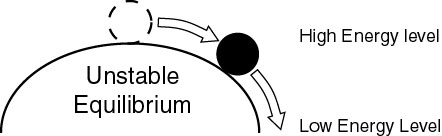


But as a human being you tend to take your ball, (your head) and have it kept in a vertical position. If it was up to physics we would be always be lying flat on the ground (lowest energy level), i.e. we tend to spend most of our lives in a state of unstable equilibrium. This is because we are part of a system. If you look at things as separate entities they work as separate entities. We know a lot about parts but very little in comparison about wholes. But a tree is as we have seen, a part of a system. This situation is called an open systems exchange. Energy, matter and information all enter and leave the system, forms can change, interactions occur and energy can be stored and released. These systems are regulated by feedback loops, which can be either positive or negative. Earth as a whole is warming up and cooling because of these systems, and we have seen this as part of our awareness of how global warming works. If the ice caps are large they form bright, reflective surfaces and they will reflect more of the sun's energy back into space, therefore less heat remains on the Earth's surface; thus cold conditions lead to more cold. However, when air cools, it holds less moisture and relative humidity goes up and condensation will occur. Condensation is water changing from its gas to its liquid state. In a gas there is a lot of energy being used to keep all those atoms flying around at a distance from each other, but as the situation cools down the gas becomes a liquid which needs less energy to maintain its form and the energy has to go somewhere. This energy is known as the latent heat of condensation. The latent heat of condensation then starts to heat up the surrounding air and leads to subsequent temperature increases. Our bodies operate very like this, interconnected feedback loops allow us to regulate our body temperature, blood sugar levels etc.


The diagram immediately above is a different way of representing a Markov blanketed system, but the one made of dots is more like the real situation. The boundary between one thing and another is never a nice sharp line, it is a permeable membrane that is constantly in movement as it adjusts to an ever changing world, so perhaps its better to think of the line of curvature more like the curved line in the image below, something rhythmically punctuated and permeable. 
Representation of an outer edge of a Markov blanket

The image above is an image whereby I was trying to visualise a body immersed into its environment with a permeable boundary allowing information to pass from one part of the system to another. The image at the top of this post was a different attempt at making an image whereby the figure and ground distinction was removed by thinking about the image as a design for stained glass. The floor, the bodies and the surrounding room space, interpenetrate each other as flat planar structures. I have also been thinking about scale and our bodies can be scaled in a variety of ways. For an ant climbing up my leg it is a huge landscape, and when I look out over my chest and down to my legs and my toes, I find another landscape type experience. But as I step away from myself, (an interesting idea in itself) I can see myself as a body, and I'm in portrait mode or human scale. However as you move out and away from the situation my body becomes a mere speck on the horizon. I am in relation to much larger visions, such as world, solar system or galaxy totally insignificant. (See this earlier post for details as to how this works)

This ability to think about scale changes is helpful because it allows us think about different types of boundaries. For instance at a molecular scale our bodies are composed of elements such as sodium, potassium, calcium, and magnesium, and each has a specific electrical charge. Our cells use these charged elements, called ions, to generate electricity. The contents of a cell are protected from the outside environment by a cell membrane. This cell membrane is made up of lipids that create a barrier that only certain substances can cross to reach the cell interior. (I have looked at lipids before in a post about why ink sticks to paper and I thought then that there were deep metaphors that could be constructed from the way they operate) Not only does the cell membrane function as a barrier to molecules, it also acts as a way for the cell to generate electrical currents. Resting cells are negatively charged on the inside, while the outside environment is more positively charged. This is due to a slight imbalance between positive and negative ions inside and outside the cell. Cells can achieve this charge separation by allowing charged ions to flow in and out through the membrane. The flow of charges across the cell membrane is what generates electrical currents. Cells then control the flow of specific charged elements across the membrane with proteins that sit on the cell surface and create an opening for certain ions to pass through. These proteins are called ion channels. When a cell is stimulated, it allows positive charges to enter the cell through open ion channels. The inside of the cell then becomes more positively charged, which triggers further electrical currents that can turn into electrical pulses, called action potentials. These action potentials are what we think of when we become aware of ourselves doing things. Our bodies use certain patterns of action potentials to initiate movements, thoughts and behaviours. Which is great, but when it goes wrong we have a disruption in our network of electrical currents, which we usually call illness. This is something I'm particularly aware of because I have a heart condition, for my heart to pump, cells must generate electrical currents that allow the heart muscle to contract at the right time. Irregular electrical currents can prevent heart muscles from contracting correctly, and this is why I have an irregular heartbeat.

 
Memory of a feeling tone

As we become aware of interroception a fusion occurs between the memory of exterior perception and an interior somatic awareness. The image above was constructed as part of a series of responses to remembering how it felt to have a painful bunion. This was then contrasted (below) with an image made when actually in pain.

Image of a pain

Paul Klee suffered from scleroderma an autoimmune condition that happens when the body’s immune system starts to attack itself. Damage by the immune system causes excessive inflammation and increased production of collagen, leading to scarring or fibrosis of the body’s tissues and organs, hence the name, 'scleroderma'. His own artwork you could think of as a way of visualising the internal working and structures of art itself. His 'Pedagogic Sketchbook' being a sort of Gray's Anatomy of the visual world. It was as if he wanted to reveal what lay under the skin of all that Victorian figurative painting.  

I have been returning to Klee's work as a loadstone or check-in to help me with my next steps in trying to visualise the invisible. How to translate the feeling tones that emerge from the inner body into visual images and it has been a back to basics experience, and has forced me to get rid of a lot of visual baggage.

Klee: Äliup, 1931. Watercolor and pencil on paper on cardboard, 47.9 x 31.4 cm

Klee's world begins with the potential of a dot. More than one dot creates energy, either a balance or an in-balance is created and as these two situations are created and uncreated 'life' begins to emerge from the surface of the paper. As the surface becomes animated moments of more concentrated energy occur, in the case above forms emerge picked out in dark lines, and in the image below shapes become intimated, they drift one into the other and occasionally pop into being, such as the archway or the circle. 

Klee: Ad Parnassum 100 x 126 cm

I found that by returning to Klee's work after many years, that it seemed as fresh and as inspiring as it did all those years ago when I first encountered it. In the image below we find lines now taking over the image making load, they gradually become signs, but are still also just lines, nothing is fixed but at the same time we can see forms emerging. These images feel very like music, they touch us with their rhythmic pulse, like small creatures, we can feel their heartbeat as we hold them.  

Klee: untitled. 

Last week I was able to visit the Pallant House Gallery in Chichester and they had a Paul Klee image on exhibition. Titled 'Clouds' it was stunning. A delicate line image was constantly emerging from the centre of a floating cloud of darkness. The tonality was handled so subtly, that it was hard to see how it was achieved, until you realised that he must have used layer after layer of thin washes to achieve an effect as if the darkness was an integral part of the paper rather than something applied to it. The thin ink lines that drifted in and out of the dark, were like so many of Klee's lines 'going for a walk', lines that were looking for an idea to become, a form to make, always in a moment of becoming rather than an idée fixe. The image was far too delicate to photograph, so you will have to imagine it, and perhaps that's a good thing, we are looking at too many images on line at the moment and we can tend to think that's how they are, but only certain things look good on a screen and it's important that we don't forget that. 


From a series of drawings of the body as a self-aware entity

See also:

A growing series of posts that follow the evolution of an idea


Sunday, 2 September 2018

Signs of life in flowing line drawings

Paul Klee introduced us to the idea of taking a line for a walk and more recently Francis Alys walked the boundaries of Israel leaving a continuous green line of paint, both artists realised how powerful the idea of a continuous free flowing line is and how any breaks in a line can be used to signify a wide range of possible interpretations. The line was so important to Klee that the active line is figure one in the definitive edition of his 'Pedagogical Sketchbook'.

This is how Klee introduced us to his idea of a freely moving line:
'An active line on a walk, moving freely, without goal. A walk for a walk's sake. The mobility agent, is a point, shifting its position forward'.

Klee's line is reminiscent of another artist's attempt to explore a particular way of thinking about the formal qualities of line when trying to define beauty. Hogarth's 'Line of Beauty' also has a certain sinuous quality and is one not too far away from Klee's.


From Hogarth's Analysis of Beauty

Hogarth was concerned to direct our attention to the fact that nature, (e.g. the flower drawings 43 and 44 above) exhibits a powerful sinuous line in its various forms and that artists can extract this and use its qualities in their own compositions. If used appropriately this compositional device would therefore have the same curvilinear energy as found in natural growth and would therefore give 'life' to an artist's composition. As a compositional device it can be used with both large and small curvatures, therefore it can link overall compositional ideas into the way that details are dealt with. (See also)


A moving line as some sort of representation of life links Klee and Hogarth's ideas together. 


When you compare what Klee describes as; 'An active line, limited in its movement by fixed points', as in fig 6, you can see that a line moving freely, can be seen as a sort of line as dérive, literally a line 'drifting' along, as in fig 4. 


(Debord defined the dérive as "a mode of experimental behaviour linked to the conditions of urban society: a technique of rapid passage through varied ambiances".
Klee's line that is limited in its movement by fixed points (fig 6) suggests a line controlled by other forces, perhaps the constraints of a powerful governmental structure that a drifting line would in effect question because it suggests an unconstrained movement, perhaps even a way of living outside of the normal constraints of society. This reminds me of the 1960s and the fact that I was a hippy once. I can vaguely remember a Dutch artist (I think he was from Holland) who used to make continuous chalk line drawings that meandered over roads and up the sides of buildings, simply lines curving about and crossing themselves without any form of restraint. At the time these drawing/performances seemed just right and reflected the ideas that were floating around of ways to find new approaches to things, ways that were not constrained by a generation that had experienced the discipline of war, ways that were about peace and love.

Shantell Martin

That free flowing street line was a chalk one, but the spray can as a free flowing drawing tool is perhaps the main reason a certain 'anti-authoritarian' graffiti style has evolved over the last 40 years or so. You have to move the spray can nozzle very smoothly and quickly if you are to maintain that flowing movement that is indicated by Hogarth, his line of beauty now conflated with another idea that of urban style and freedom. Graffiti has its own history and you can find an in-depth article that looks at the history and media specificity of the spray-can here. What I'm trying to get to is that a certain idea of line and life has been around for a while now and that it takes various forms and is as much a product of media specificity as conceptual reasoning. Shantell Martin is one of those artists that seem to have been able to carry their urban style into the world of gallery art, her lines on walls still curved and sinuous with echoes of Picasso, Matisse and Keith Haring.

Matisse

Picasso

Keith Haring

When you get to a certain size of drawing the line comes more from the shoulder and as it does it becomes more 'open' and 'embodied'. As with all hand done drawings, the energy flow moves directly from the relationship between the body's jointing systems and their smooth or otherwise articulation.

Tim Knowles takes another approach to continuous line drawing. His windwalk drawings use a GPS messenger system to plot his journeys which have been directed by wind direction. His strange helmets with attached weather vanes are an essential and publicly very evident aspect of this work, which is performative as well as being an aspect of documentary practice.

Tim Knowles

The image above shows "how as the meandering route of the windwalker [guided solely by the wind] collides with buildings, walls, railings, ventilation shafts, parked vehicles.... glimpses of the city's structure are revealed". Taken from: Tim Knowles' website.
In this case the meandering line literally reflects a sort of derive or wandering through the city. The fact that our mobile phones are constantly sending out information as to where we are at any given moment makes this type of technology much more central to our lives and I would suspect that computer drawings that follow changing GPS coordinates will be used more and more as ways to record our lives. If you are interested in this area you will need to begin exploring how to visualise GPS data and there is help and software around to do this.
A lot of work has already been done in this area; I am very fond of the series of GPS maps drawn by Jeremy Wood who has recorded the movements of a lawn mower each time it has been used to mow a lawn. It both reveals the shape of the lawn and the different patterns taken over time as the mower confronts the same task but goes about it in different ways.


Jeremy Wood 

Those of you that are much more digital natives, (i.e. not myself) may well find that a GPS tracking system could be your sketching charcoal. I think it can be used in as subtle a manner as any other drawing medium, it just takes time and adjustment to bring out the best from this form of continuous line drawing technology. Even though these lines are made by a computer and printed off using a machine driven plotter, I still see a clear connection with Klee's "active line on a walk" and part of the fascination these drawings have is that although they are computer aided, at their core is a human being driving a lawn mower.

It is useful to compare this idea about flowing lines with earlier posts on the description of water. The artist Sonja Hinrichsen perhaps sitting between the two, her snow drawings are done both to reveal the meandering tracks of herself and volunteers and to represent the water in flow as it would be after the thaw.  


Sonja Hinrichsen: drawing in snow

The flowing lines of Hinrichsen's huge drawings also remind me of images of microscopic life in sea water, viruses and human tears. When I see photographs of these things taken with electron microscopes, somehow they feel more like drawings than photographs, perhaps because they are captured slices of a world that feels as if it is coming into being. Life inside me is perhaps like this, I am made up of millions of tiny worlds like this, each one contributing to some tiny aspect of my vast lumbering whole. 

Sea Water

A Virus

Tears

These traces of lines of life that Hogarth could never have had access to appear to exist at all levels of magnitude including the sub-atomic. These bubble tracks below are a beautiful example of the spiralling line at it most elegant.

Bubble tracks of atomic particles

But Hogarth was always predisposed to find lines of energy and grace in life itself, as he reminisces; "I never can forget my frequent strong attention to it, (the spiral) when I was very young, and that its beguiling movement gave me the same kind of sensation then, which I since have felt at seeing a country-dance; tho’ perhaps the latter might be somewhat more engaging; particularly when my eye eagerly pursued a favourite dancer, through all the windings of the figure, who then was bewitching to the sight, as the imaginary ray, we were speaking of, was dancing with her all the time". Lines and the dance, rhythm and movement, usually linked together with sound. 
Dance movements

Flowing lines suggest flowing movements, flowing movements suggest a healthy body in action and here it is that we have life. Each drawing a frozen choreography of actions, each line open to be swallowed by ourselves as we endeavour to ingest the life force it holds, looking hard, we are moved to touch and once touched, we need to taste a thing to fully grasp its reality...


from ice skating

to


eating lines

Our experiences of being in the world can be very linear. 

Visualisation of water movement

Heather Hanson

Most of these things can be brought together in performance practices, for instance Heather Hanson brings together dance and drawing as she choreographs and transfers her movements onto large sheets of paper. Whether this is contemporary dance or drawing doesn't matter, it does though remind us that all drawing is in some ways a bodily performance. What a mathematical addition to a computer drawing program such as the use of Bézier Curves can do is add to the smoothness. No jerkiness is to be found in a Bézier Curve, see this earlier post, but perhaps the maths can be 'questioned' if the program can be blended into a performance. This 'performance' is for instance driven by code, but as code is written this itself is a type of performance. 
Casey Reas: image derived from computer code

The breaking of lines of code can become similar to the breaking of smooth lines of movement. When lines of movement are broken in a drawing they can suggest accident or rupture. 

Avis Newman

The drawings of Avis Newman suggest a moment of rupture or traumatic event, simply by breaking the smooth continuity of lines. She herself refers to drawing's ability to create 'fractured' space. These drawings can also be read as the script from a finished performance and perhaps at some future date as a map for coding. As I begin to think about how breaks and discontinuities in lines create narratives about themselves and at the same time metaphors for our experiences of the world itself, I'm reminded once again of those dialogues with other non human things that seem to be becoming more and more important to me. 

Scuffed vinyl floor

The scuffed vinyl floor above, is another trace of a performance, one that has many actors involved in its performance. If I try and remove the egotistical nature of art practice from any ideas about 'intention' then the drawing seems to comfortably take its place as the record of a series of encounters, an idea that I have tried to deal with earlier. 

See also 


Tuesday, 5 June 2018

Tim Ingold’s Keynote Speech for the Art, Materiality and Representation Conference

Tim Ingold in action


I’ve pointed out before that Tim Ingold has become an important theorist in relation to how drawing can be thought of within a wider academic context. In particular because he is an anthropologist he makes several links between how artists think and how anthropologists think. Ingold was this year’s keynote speaker at the Royal Anthropological Society’s annual conference, the theme of which was, ‘Art, Materiality and Representation’, this of course fitted perfectly with Ingold’s interests. I had submitted and had had accepted a paper and I was also a panel convener therefore was able to find out what he was now saying.

My notes are a very crude snapshot of what he had to say and I’m very subjective in my listening and do sometimes go off on thought tangents, but even so some of you might find my version of what he had to say interesting.

Ingold began the lecture by taking Paul Klee’s dictum from his Creative Confession (1920), “Art does not reproduce the visible, it makes visible”, as the touchstone for the presentation.

The central issue seemed to me that he saw art as not about reproduction or observation, (a very contentious beginning when you think about some art such as certain types of realism) but was more a process of revealing to us what is there. This revelatory process is one I do find I have great sympathy for but one that I also acknowledge can slip if we are not careful into a sort of spiritual or religious territory, but hopefully he does not go too far in that direction.

He set out 4 initial points that he wanted to make.

  1. That anthropology was to be seen as a speculative discipline.
  2. That research needs to move beyond its present situation as a discipline dominated by science and scientific methodology.
  3. That he wanted to see anthropology develop as a discipline that was opening out a view of the world that would have a place for everything. (A catch all discipline)
  4. That he wanted to finally bring together the disciplines of art and anthropology to create a way of thinking that could lead to true citizenship.

Ingold set out a definition of anthropology as ‘life as we find it’ and contrasted this with an idea that art was concerned with ‘forms that are new’. Both beginning with observations of the ‘real’ world. He believes that they share a common task; that of shaping a future and that both in their own ways are asking a question, ‘How ought we to live? Big claims and one’s that I found hard to swallow but an interesting declaration and a sort of ‘call to arms’. He suggested that every way of life was a communal experiment and it was in negotiating and finding shapes for the outcomes of these experiments that made disciplines like art and anthropology important. In particular the one thing that anthropology brought to this endeavor was the fact that it was a discipline that was concerned with all the peoples of the world. But what he asked would happen if art and anthropology combined as a new hybrid discipline?

This new discipline would have 4 key attributes:

1 It would be centred on acts of generosity; it would have an ontological commitment to give back. (By this I presumed that he was suggesting that the bedrock or solid nature of being of this new discipline would be to be generous, something that I would like to think would be the case but from what I have seen of both disciplines I would suggest this would involve a lot of wishful thinking) I was warming to his optimism though.

2. It would be concerned with open ended enquiry. It would in doing this reveal the various ways that what was going on was going on.

3. It would be comparative, i.e. that it would allow alternative approaches to be taken. (Considering his critique of ethnology for instance, I wondered how widely the alternative approaches would in reality go. In my own mind I was debating a ‘what if’ scenario such as how generous I might be when faced with someone telling me how a particular religion explains the world.)

4. It would be critical and in particular he reminded us of how important it was to continue to critique the society we live in today.

In effect a merging of art and anthropology as disciplines would forge a new discipline that would be concerned with ‘making a conversation of human life itself’. Art would help anthropology become less concerned with giving answers and make sure that it was inquisitive. The art process would benefit because it would be more experimental and less transgressive, and would be able to conceive without being conceptual. (Big statements, which I would like to question but perhaps at another time, as what I’m trying to do is give a flavour of his talk).

What he believes is special about art is that what it takes in it gives back out by making it sensible. In particular the areas of art that use various craft skills of making come closest to his vision of a new anthropology. (I presumed he was in this case referring to ‘material thinking’.

Ingold then turned his attention to the difference between anthropology and ethnography. However because I’m not an anthropologist I was little unclear as to the difference, so I’m going to presume that as art students you may be too, so here is a definition of the difference as far as I have understood it

Ethnography is a method of study and data collection involving a trained observer documenting the life of an extant people or group using a participant/observe strategy. The products of such research are the outcomes of organising, describing, and analysing the data collected. Ethnography is the method most commonly used by social and cultural anthropologists to collect qualitative data.

Anthropology is the scientific discipline that focuses on the human species, its origins, its evolution, distribution, commonalities and diversity in the way humans organise and adapt over time and space. It is self-reflective since humans are both the subject of the study and the instigators of the study. It is at times contentious because anthropology took on the study of the non-European and non-literate (no written history) peoples that Europeans encountered in their commercial and imperial expansion, therefore it has at times been seen as a discipline that reflects colonial power.

Anthropology can be thought of as a discipline and ethnography is a scientific method.

Ingold likes diagrams and used these two below to explain the difference.

The diagrams represent the fact that anthropology is woven into life and inseparable from it, whilst ethnography touches life at a tangent and never actually gets embedded into what life actually is. He is referring to the fact that ethnography relies on scientific method and he again warms to his argument that scientific method is not just wrong but harmful. Data collection turns life into numbers, and the problem with ethnography is that it makes an account of life. What anthropological study can do however is to join in with the forces and flows of life, (it was hard at times though to see how, because I would presume that any discipline by its very nature stands outside of life in order to establish the boundaries that enable us to see that it is a discipline. Once it dissolves into life it would I would argue cease to be a discipline, and in effect be part of life. Of course all disciplines are part of life, it’s just that by having an idea of a discipline we can use different lenses to reflect on life). Ingold further reflects that in an art of correspondence sometimes however art and anthropology are ill matched. This he believes is due to the continuing influence of ethnographic practices. Because ethnography fulfills the high standards of academic measurement it has led to an obsession with alterity (it is much easier to measure difference) and this has led some art theorists (like Hal Foster: see Artist as Ethnographer) into what Ingold calls, ethnographic envy. This can lead to the idea of radical alterity as a type of philosophy for art practice. However, Ingold further argues, some people are more ‘other’ than others. This ‘ours’ and ‘theirs’ difference is a problem and binary differences lead to conflict and are unrealistic. Otherness is always an emergent thing. Ontogenesis is a coming into being and worlds of becoming are rather like conversations. Art and anthropology should therefore be dialogic, or conversational in their approach. As Karan Barad has put it, ‘Cutting together apart’. Ethnography’s coding of difference can if we are not careful lead eventually into a type of fascism.

Another problem Ingold has with disciplines is that they are always putting things into context. Context puts things into frames and in doing so disarms them. For instance Alfred Gell wanted to reveal chains of causal connections in order to develop an interpretive context for both anthropology and art history. (I have mentioned Gell before: see) However Ingold believes that the practice of art should be about unwrapping and peeling away the interpretive context, so that we can feel the force of the original again.

The real problem is that the default mode of research is led by science. It determines what will be carried out as research and how. But how can we know in advance what we will find? Because of the power of science we dress up most of our research enquiry in scientific garb. We fake it. What kind of knowledge do we look for? Perhaps the onus should be on scientists to show how science is research. Research means ‘going along with it’. There is no holding nature still and looking at it. It is an experience. Both the thing being looked at and whatever is doing the looking are moving on, therefore things change and in that change there is a sense of there always being a new a second search. (Re-search).

Nb. The word research has a history, so as an idea it has evolved. Research entered the English language in the late 16th century and was taken from the French word recercher, from Old French recercher "to seek out, or search closely," from re-, intensive prefix, + cercher "to seek for," from Latin circare "go about, wander, traverse," in Late Latin "to wander hither and thither," from circus"circle". Therefore circus and research are as words closely related.  For some other reflections on research: see.


Ingold pointed out that every step is a new beginning and not an iteration (repetition), it was more like an itineration, (journeying from place to place). At the centre of this attention to the passage through life should be curiosity and care, in the sense that we have a duty of care to look after the world, to develop a way of living curiously with due care and attention. The ‘slippery’ quality in relation to all this is ‘truth’, or the search for it. We were reminded not to blame truth for the wrongs committed in its name, (the post truth society, Trump’s ‘fake news’). Truth is inexhaustible, and all we can have are clues to which direction to go in if we are to seek it. True research is therefore always hopeful. It suggests that life will carry on, which is why there must be more to research than the collection of data. In fact the interesting thing about ‘blockages’ and difficulties that are put in the way of looking for truth, are often openings that let us in to new understandings. By thinking about research in this way, we can see it as being about new beginnings. We don’t use research to break through to a new understanding, we use it to join with other things and peoples and as we do the surfaces and boundaries between things disappear and this is our new understanding. We are in it, (life/reality) and being in it we know it. We cannot Ingold argues be objective, objectivity is a lie and you therefore can’t confirm the validity of your research by citing its objectivity. “Observation goes beyond objectivity”. We were reminded that the things we study will eventually guide our attention. Research is therefore more like correspondence as a form of experience. This calls into question the relationship between fact and fantasy. “Let us learn to dream” says Ingold. Then we may find the truth, but only after testing it against the fact of life. Research and science must unite experience and imagination.


Ingold then moves on to the final part of his thesis which was how the bringing together of art and anthropology could create a way of thinking that could lead to true citizenship. Citizenship is only attainable if people take responsibility for it. Responsibility and due care of the world should be centered on an awareness of sustainability. Ingold then states that research as correspondence is a condition for sustainability. Real sustainability begins when limits open up and when they do new possibilities open out. I.e. by joining into the flow with other things and peoples and by doing this removing the surfaces and boundaries between things, we will be able to see how the totality works and how our actions may be damaging parts of that totality and how by changing our actions we might create less damage. The point being that by standing outside of the world (being objective) we allow ourselves to damage the world because we don’t feel the effects of the things we do. Either we are part of everything or we are part of nothing. The problem is that we have been bamboozled by numbers. But, numbers have always been broken off from the ebb and flow of life. You can’t count the waves or clouds, they are constantly folding and merging as they flow from one form into another, they have no separate identities. Life is a holistic process not a series of discrete things. To count trees is to cut them out from the soil, from the mycelium that surrounds their roots. My reading of this was that a group of people can only be reduced to numbers in concentration camps, they are much more than a set of individuals, their intermingling with others and their environment is their reality and numbering them can only diminish them. (This reading I must admit is due to my own subjective response, my grandmother was of Polish Jewish extraction, so I have a particular awareness of history).


Ingold states, in the correspondence of voices we are an intermingling. We are part of an ever forming plenum, which is the world we live in, the cosmos, the universe. (Plenum: an assembly of all members, or a space filled with matter). Research is supposed to clear the ground, but to clear the ground is not to make a space, it simply smooths it out. The kinks, twists and knots of reality, as everything is enfolded into everything else is the true order of the plenum. The convolutions of material folding in on itself as it goes along doing its doing is limitless, because it is a process of always carrying on. The plenum is therefore perhaps time itself. We therefore live in a ‘con-crescent’ world. (Concrescent: in biology, a growing together of initially separate parts or organs). In the plenum nothing is final. The world is therefore a ‘pluriverse’, consisting of endless multiples of kinks and folds and it is this situation that we should be responding to. We should not be trying to transform this pluriverse into goods and services, not be looking to have ends in mind, not be designing for future consumers, because all predictions are wrong and all designs are predictions. Form is in the end death. Ingold reminds us again of Klee’s dictum, “Art does not reproduce the visible, it makes visible”. The aim to fill the gaps in knowledge is therefore wrong. There are no gaps to fill, we simply join in with emergent phenomena. As educationalists we are hopefully all concerned to educate and as Dewey states education is about the continuity of life. Our job is to help every student begin anew. When seeking the truth that emerges from the real a conversation will be everything. Therefore the process is fundamentally democratic and is concerned with conjoint actions. These bodies in correspondence are engaged in democratic conversations, they are communities of open-endedness. ‘Commoning’ or the joining with others will be the key drivers behind sustainability. Big science and big corporations are not interested in how we ought to live and their view that they are in control is often mistaken. Ingold was now drawing to a close and gave us the analogy of the mouse and the CERN Hadron Collider as final thing to think about. He was I think mistaken about the mouse but the point is the same. In April 2016 a stone martin entered the grounds of the CERN facility, it was electrocuted but in doing so it short-circuited a transformer and shut down the centre for two weeks. This has happened again since and this time a weasel was the cause of the problem. Nature will always remind humans of the hubris of thinking that they have any form of separation from or dominance over it.

Patterning, ties, entanglements and knots

Listen to a Tim Ingold podcast in order to get a much better idea of how he puts his ideas over.