Showing posts with label Markov Blankets. Show all posts

Saturday, 18 October 2025

Speculative grace

The plane journey to Gothenburg and back to Leeds was broken by having to change planes at Amsterdam, therefore I had a lot of time to fill and so decided to re-read Adam S. Miller's 'Speculative Grace: Bruno Latour and Object-Orientated Theology'. I had read it initially some time ago and happened to spot it on my bookshelves just as I was thinking about what to take with me to read. It's a strange book, as it tries to tease out the religious concept of 'grace' from the writings of someone that developed a body of writing focused on how science makes meaning. 

Latour was though a life long Catholic and therefore as a Christian his thinking would have been coloured by his Bible readings. He was not trying to argue the importance of Christian beliefs but his arguments do suggest that certain Christian ideas, helped him shape his thoughts. For instance, Matthew 5:5; "Blessed are the meek, for they will inherit the earth," and 2 Corinthians 12:9 that states, "He said to me, 'My grace is sufficient for you, for my power is made perfect in weakness'". After looking at the way that science actually operated in real life situations, Latour had decided that you can never actually be objective, he had then developed the idea that you cannot separate opposites out from each other and that reductionism, or the focusing down on one direction or way of understanding the world was not just wrong, but that it was actually an impossibility. An idea therefore, of power residing in weakness, could have helped him to think about dissolving distinctions between culture and nature or subject and object. By stating that the world is actually an amazing network of interconnections and that everything relies on everything else, Latour suggests that if any one thing pulls itself out of the matrix and acts as if it has power over other things, it will in effect eventually undermine itself, as it would cut the very ties that enable it to be what it is.
He also argues that nothing is ever actually a thing, there are simply nodes or centres that are connected to everything else. Although at times there could be a suggestion of an object's separate identity, this could only be a constantly shifting one, one that was in itself determined by all the various connections that thing might have from moment to moment. This is a type of strength through harmony; something that could easily have emerged out of Latour's Christian beliefs, for instance many Christians believe that the unity of believers is built on humility, forgiveness and mutual respect. A unity that is achieved not through uniformity, but by valuing diversity within a common faith. I was also reminded of the Markov blanket concept, whereby, although for the sake of the way they use communication systems it might be useful for humans to be able to nominate a tree as a separate thing, in reality it is an event or aspect of a process. The boundaries of biological systems, from individual cells to trees (or indeed people) can be thought of as the supporters of free energy, or places where that energy meets other forms of energy and where interactions take place that both help to stabilise the entity and to ensure it is in constant communication with all the surrounding energy fields that it depends on for survival. If so, something called a Markov blanket can be used to define its boundaries in a statistical sense, i.e. instead of a solid wall you have a series of probabilities whereby something is and isn't at the same time, called in this instance, the active inference scheme. But Latour goes much further than this, he believes that all things operate in the same way, both organic and non organic and that some things might be processes. I was then reminded of Timothy Morton's 'hyperobjects', which could also be things such as global warming. 

Latour looked at the complexity of the everyday and in doing so, he helps us value what is going on right in front of us and Adam S. Miller opens out an argument that 'grace' can be found in Latour's writings by this very fact. 
I wrote the note below in a very shaky biro hand whilst flying between Gothenburg and Amsterdam. 

"Votives and the Pluriverse"
If we take a point of view that everything is interconnected and that everything is always becoming, in flux, never quite establishing fixed boundaries, then a votive practice that is multi faceted would seem to make sense. The need to create a flow, to establish the conditions of constant fermentation, can be met as a practice evolves out of parallel views. Grace emerges from the fermentation of the multitude. It is embedded in the bustling give and take of objects. A votive always emerges from a complexity. Ceramics allows us to make forms that are collapsing and emerging at the same time and as they do, at some point we can come to a temporary stop and see how this evolving object can now talk to the situation that it emerged from.

My votive making emerges from a complex something that comes out of a conversation. The conversation may well be far too hard to simplify or clarify what is needed, so there has to be a process of finding a line through what is being said. I push back against someone to see what will come out of the dialogue. They then push back at me, often with a statement such as, "It's not like that, its more like..." In this way forms arrive out of the flow, rather than an object being made from a pattern. 


Votive forms made of psychic animal body parts
I.e. what your organs might look like if you were inhabiting the soul of an animal

In Gothenburg I had been giving short presentations to medical professionals about the work I had been doing at Pinderfields Hospital. When not having to be doing that, I was free to follow anything else that was happening, and the other much more comprehensive presentations were being given by scientists that were very interesting. I had been reading Craig's book on interoception just before leaving, therefore I could see how important neuroplasticity was to the way our nerves operate and how our body parts are connected through our backbones. I saw two presentations in particular that looked at ways to use stem cell growth to foster the development of new neurons that could reach over divides made during traumatic injury, when a backbone is broken. It was hoped that these new discoveries would lead to a way to repair broken spinal networks and in doing so get limbs moving again.  

The patients who were involved were very similar to the group I had met in Wakefield, all had suffered traumatic spinal injuries. However the 'actants' as in Latour's use of the term, also included several non-human creatures, including mice and monkeys and machinery. The images of the injuries were made using powerful electron microscopes, giant sections of backbones were projected on several screens as presenters pointed to newly grown dendritic shaped fibres beginning to spread out into bone substrates. Craig had made me aware of an evolutionary history of the different types of nerve fibres running through the spine and therefore I was not surprised when for instance one presenter pointed to the existence of nerves carrying visual information through adjacent channels. No one mentioned that nerves carrying more emotional information would also have to pass through the backbone's super highway. I was though now beginning to see these presentations as entries into a type of micro world, one that I entered guided by science, that was re-shaping my visual spinal image bank. This caused some sort of oscillation of my being, that also included the mice and monkeys that had given their lives to the research conducted in the many medical laboratories that had been working on these issues. I was being connected via a series of networks that were previously unavailable to myself, but which had already been invisibly shaping my experiences. 

Bruno Latour's ideas level the playing field between things. He used the image of a constant fermentation that arises as a physical/chemical/quantum/emotional/psychological and economic mix that is achieved by the constant swelling and current mixing of energy seas. It's an idea that for many would be too disconcerting, people often want some form of certainty and the rise of rightwing philosophies points to this need. You need a certain confidence to ride the waves of uncertainty. An idea of time as a relative thing that operates in different ways as it interacts with small and large scale events, can for some people be very disconcerting, as people are in many ways already dead, as well as not yet born. As an artist I can see how objects effect me, they shape my mind, they penetrate me and I am worked on by them from within. I need to accept this, if not I could have no real belief in the power of the objects I make to effect other people. As you read this post, another non-organic thing enters your mind and as it does it begins to reshape your body. This may only be for a moment, you may well decide that this text is boring and stop reading, but in the short time you were reading, you were being re-shaped. Any perception of rightness is just a temporary "momentary truth", that sits within a larger, ever-changing process of constant becoming. It is a fascinating thing, one that can either be embraced or rejected, and as it is embraced there are wonderful opportunities for becoming immersed in the flow of possibilities.

Grace is normally defined as an acknowledgment that one's well-being is a result of God's undeserved kindness, benevolence, or blessing. Grace is something that reminds us that luck or good fortune is not a product of one's own actions, it is a game of chance. However in a world where there is no God, there can still, it has been speculated, be a form of 'grace'.
This is a way of thinking about the implications of a world where the idea of a deity, sits within or on the same playing field as a game of marbles or a TV set. The wonder is in the everydayness of it all and the fact that you are indeed special. No matter how insignificant you might feel you are, you have existed and still exist as a something. That existence is a complex amalgam of events and physical happenings that has during all the time it has been with us, been rubbing up against other things and in doing this it has in turn, shaped them. You might not be able to see this, you might be too close to the happening that is you to see it, but it is still happening and in that happening you are bathed in the speculative grace of now.

See also:

Monday, 2 August 2021

Hybridity and permeability

Two related ideas have become central to my own art practice and they are both formal and political in their implications. They are 'Hybridity' and 'Permeability'. Both these concepts suggest that a clearly defined, sharp edged, entity with boundaries is a problem and that rather than looking at the world as a collection of things, or atomising experience so that you can break it down into smaller components, you instead look at interrelationships, entanglements and processes that show how systems depend on their different parts working together. This means that for instance an image of a human being is something that needs to acknowledge the fact that it is in reality a hybrid form that is over 50% bacteria and that it is always in a process of becoming, which is an event rather than a thing and that it can never in reality separate itself out from its entanglements with everything else. 

Hybridity has in contemporary theory several readings, and I have also had to take on board the fact that certain writers claim 'hybridity' as being of a particular importance to themselves too. I would therefore like to acknowledge all their contributions to various readings of the term as further evidence of 'hybridity' as a fertile term, out of which a more sensitive understanding of life emerges.

Hybridity can be seen as a cross between things, as a formal mixture of elements.  This could be biological, for example a cross between a male lion and a female tiger is a 'liger', a hybrid plant emerges from the seed that is the result of a cross pollination between different plant varieties, in order to achieve this the female (pistil) of one plant variety receives pollen taken from the male (stamen) of a different plant variety. Hybridity can also be about human cultures. A hybrid is simply something that is a mixture between one thing and another. Hybridity has been a feature of virtually all civilizations and is created by trade, conquest and the fact that at certain times different people rub up against each other.  Cultures borrow ideas that they find useful, this includes religions, philosophies, and science, but also art and languages. Our word 'hybrid' is derived from the Latin 'hybrida' or 'ibrida', which meant the offspring of a tame sow and a wild boar. In music Edward II is a wonderful example of a hybrid fusion between English folk music and Jamaican reggae.  

Edward II 'Miles away'

In cultural theory hybridity has been re-appropriated by social and cultural critics as a challenge to fixed or essentialist accounts of identity and culture. Radicalised claims of purity of origins, such as those advocated by nazi theorists are refuted by ideas of hybridity that understand the breaking down of racial and cultural boundaries is a normative feature of societal development. Hybridity as a sociological concept recognises that identity is formed through encounters with difference. In particular, the condition of cultural hybridity has been explored by examining the post-colonial cultures of migrants which are based on fusions and translations between and of different peoples, cultures and places. If you are interested in reading more about this idea, one of the most developed theorisations of hybridity is by Homi K. Bhabha (See: The Location of Culture, Routledge, 1994) which does not consider it as merely the fusing of existing cultural elements. For Bhabha, hybridity refers to the process of the emergence of a culture, in which its elements are being continually transformed or translated through continuous encounters. 

My own interest in the term also embraces how it was thought about by Mikhail Bakhtin, who used notions of hybridity to celebrate the idea of multi-vocal stories. This polyphony of voices was part of his idea of the 'carnivalesque' as (Clark and Holquist in Mikhail Bakhtin,1984: p. 4) put it, ‘a boundless world of humorous forms and manifestations opposed the official and serious tone of medieval ecclesiastical and feudal culture’. So yes, a hybrid can also be transgressive and funny and in being funny it helps to break down the rigid boundaries between things. Bhabha's ‘Third Space of enunciation’ (1994:37), is also a space for jokes, for freudian slips and a bit of daftness. 

Permeability has traditionally been a term more related to science than art. It is defined as the ability of a substance to allow another substance to pass through it, especially the ability of a porous rock, sediment, or soil to transmit fluid through pores and cracks. However I have been rethinking it as a term that is essential to all life and its ability to maintain independence whilst at the same time acknowledging that interdependence is the only possible condition if that life form is to survive. If I look at myself, I am very permeable. I have a skin that surrounds me that is permeable, I intake solids, liquids and gases through the various mechanisms that my body has evolved to ensure that I am being constantly interpenetrated by the environment around me. I am designed to be very permeable. The science of Markov blankets suggests that all life forms or self-organising systems rely on an ability to interact with their surroundings in order to survive. It is argued that this ability to self organise is in fact an emergent property of random dynamical systems, which means that at some point order will not just emerge, but a type of order that likes to keep itself in that very order, as well as being able to interact with all the other chaos around it, will come into being. It has been argued that in order to maintain themselves, these orderly systems need to possess Markov Blankets, permeable surrounding areas that allow for interchange between various states of order and disorder. Therefore a human being's Markov blanket touches and interacts with the Markov blankets of other things and becomes part of a system that both includes it and these other things, in order to help itself self-regulate, whilst also forming necessary parts of other regulation systems that in turn help in the process of maintaining a state of homeostasis. 

The formal consequence of this for my own thinking is that hard sharp edges between and around things are suggestive of organisms that are cut off from each other and therefore liable to die off and softer more open or vibrating edges that allow for things to pass through them are more likely to suggest permeability and states of entanglement with other systems and events. 

Amoeba

The amoeba has a flexible permeable membrane, this allows it to exchange and interact with its surrounding environment, sometimes extending itself to surround 'food' whilst at the same time being able to allow waste products to pass back out into the surrounding waters. In order to visualise this it is better to use a dotted or dashed line to represent its edge or boundary rather than a hard continuous line. 

Body as flux and spatial movement

One way of thinking about larger organic forms is to treat them in a similar way to how you might draw an amoeba, however very quickly the independence of the body begins to dissolve into its interdependence with the surrounding environment. This has created for myself a conundrum, and this is how far do I take the visual implications of my thinking? Hybridity might mean that I bring together different ways of visually representing an idea and this is where I am at the moment, making a series of images whereby I explore how hybrid visual methodologies can be used to create what I see as perceived images, or perceptions of the imagination. My current project is an attempt to set out an idea that suggests that images that arrive from or come from imaginative play, have exactly the same status for our decision making processes as images that arrive as direct perceptions. 

An amoeba human hybrid

Hybrids meet

Our skin is not only porous it is a surface with embedded hair follicles and these are organised in such a way that the hairs take patterns or directions over the body. These patterns have evolved over millions of years as the best way to quickly direct rain water off a moving mammal's body. 

Hair direction, front and back

We rarely think of this pattern when making representations of humans, but it is a reminder of our animal nature as well as visually a way of thinking about the dynamics of movement over and around a body. As an image it is both an imaginative interpretation of empirical research and a representation of perceived experience. I was very interested in how by keeping the two halves apart, this allowed the space surrounding the body to dramatically enter it from above and below as both invisible penis/anal hole and extension of the head's crown chakra down into the body. The previous idea I had of the body as a form of Klein Bottle would only work in four dimensional space but I still like the idea of it, perhaps though it needs to be animated so that time is more clearly present. 


From worm to human Klein bottle to walking amoeba

As thoughts about forms evolve, so do thoughts about life itself, the one allowing the other to become what it becomes. This is a sort of evolutionary philosophy, a way of developing a reason for formal invention that is also a way of developing an attitude towards the world. It is not though a fixed idea, more a process that perhaps we all go through at some point, some people going through similar thought processes at a very early stage in their life and others much later on. In this case I'm reflecting on my own process at quite a late stage in life, and I am aware that it is a way of working that is idiosyncratic and which is no more 'right' than the millions of other similar processes other humans are also engaged with at this very moment. Perhaps by comparing and contrasting with your own approaches to these things it may help you become more aware of your own working methods, what it is unlikely to do is advance your analytical thinking and be useful as a 'proper' research methodology; this is art and not science and one of my personal guides in this process is whether or not it could also be funny. 

See also:


Monday, 5 July 2021

Paul Klee and Markov blankets

The mind in the body in the world (study for stained glass)

Biological systems are autonomous, or self regulating. We tend to think of the things inside a biological system, such as a forest as being lots of separate things, but they are all interdependent, however when each of the elements is looked at it can appear as if it has boundaries. For example an individual tree can be thought of as just that, a tree. But it cant exist as that, its roots tap down deeply into the soil and its leaves are breathing in carbon dioxide. I.e. although for the sake of identification it might be useful for us to be able to nominate a tree as a separate thing, in reality it is an event or aspect of a process. But we can also think of a collection of atoms we call a tree being nested within another set of atoms we call a forest. The boundaries of biological systems, from individual cells to trees (or indeed people) can be thought of as the supporters of free energy, or places where that energy meets other forms of energy and where interactions take place that help to stabilise the entity. If so, something called a Markov blanket can be used to define its boundaries in a statistical sense, i.e. instead of a solid wall you have a series of probabilities whereby something is and isn't at the same time, called in this instance, the active inference scheme. You can infer something is in existence but when you look at it directly it hardens up and becomes a fixed probability. If this sounds like something from quantum mechanics, well it sort of is. For a long time physicists have realised that things are only fixed as they are if you look for them. On a larger scale a collective of Markov blankets can self-assemble into a global system that itself has a Markov blanket that links it to the larger universe; these linked autonomous systems can therefore be understood as having layers of nested and self-sustaining but permeable boundaries. It has been proven mathematically that any living system can be described as a Markov blanketed system and, this is the interesting thing, that the boundaries of such systems need not be co-extensive, or extending over the same area as the biophysical boundaries of a living organism that exists within it. I.e. there is a certain amount of give and take. If you look at the diagram below try to think of the dark spots as a tree, or at least the tree event or fluctuating core of what we tend to think of as a tree. However as part of a Markov blanketed system the edges of 'tree-ness' are not that clear and the tree extends out into the surrounding system, lets say the air or the soil, whereby it is hard to differentiate tree-ness from soil-ness or air-ness. Moving the light grey dots about will eventually disturb the pattern of the dark dots, but on a good day the pattern is pretty predictable statistically and on the whole the dark dots are stable enough for long enough to be at times seen as a tree or whatever else words try to isolate from the situation. Everything is though never static, hence the animated gif version. 


Object/space folding into Markov blankets

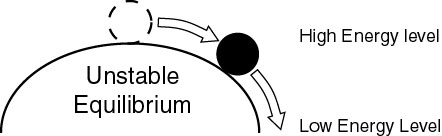
If you randomly generate a mess of dots, apparently after a time these dots begin to form patterns, i.e. free energy systems eventually appear to become self regulating. As I'm into diagrams at the moment perhaps another diagram might help. If I place a ball on top of a smooth curved hill as in the diagram below, it is unstable and will seek stability by rolling down until it reaches the ground and a state of stable equilibrium.


But as a human being you tend to take your ball, (your head) and have it kept in a vertical position. If it was up to physics we would be always be lying flat on the ground (lowest energy level), i.e. we tend to spend most of our lives in a state of unstable equilibrium. This is because we are part of a system. If you look at things as separate entities they work as separate entities. We know a lot about parts but very little in comparison about wholes. But a tree is as we have seen, a part of a system. This situation is called an open systems exchange. Energy, matter and information all enter and leave the system, forms can change, interactions occur and energy can be stored and released. These systems are regulated by feedback loops, which can be either positive or negative. Earth as a whole is warming up and cooling because of these systems, and we have seen this as part of our awareness of how global warming works. If the ice caps are large they form bright, reflective surfaces and they will reflect more of the sun's energy back into space, therefore less heat remains on the Earth's surface; thus cold conditions lead to more cold. However, when air cools, it holds less moisture and relative humidity goes up and condensation will occur. Condensation is water changing from its gas to its liquid state. In a gas there is a lot of energy being used to keep all those atoms flying around at a distance from each other, but as the situation cools down the gas becomes a liquid which needs less energy to maintain its form and the energy has to go somewhere. This energy is known as the latent heat of condensation. The latent heat of condensation then starts to heat up the surrounding air and leads to subsequent temperature increases. Our bodies operate very like this, interconnected feedback loops allow us to regulate our body temperature, blood sugar levels etc.


The diagram immediately above is a different way of representing a Markov blanketed system, but the one made of dots is more like the real situation. The boundary between one thing and another is never a nice sharp line, it is a permeable membrane that is constantly in movement as it adjusts to an ever changing world, so perhaps its better to think of the line of curvature more like the curved line in the image below, something rhythmically punctuated and permeable. 
Representation of an outer edge of a Markov blanket

The image above is an image whereby I was trying to visualise a body immersed into its environment with a permeable boundary allowing information to pass from one part of the system to another. The image at the top of this post was a different attempt at making an image whereby the figure and ground distinction was removed by thinking about the image as a design for stained glass. The floor, the bodies and the surrounding room space, interpenetrate each other as flat planar structures. I have also been thinking about scale and our bodies can be scaled in a variety of ways. For an ant climbing up my leg it is a huge landscape, and when I look out over my chest and down to my legs and my toes, I find another landscape type experience. But as I step away from myself, (an interesting idea in itself) I can see myself as a body, and I'm in portrait mode or human scale. However as you move out and away from the situation my body becomes a mere speck on the horizon. I am in relation to much larger visions, such as world, solar system or galaxy totally insignificant. (See this earlier post for details as to how this works)

This ability to think about scale changes is helpful because it allows us think about different types of boundaries. For instance at a molecular scale our bodies are composed of elements such as sodium, potassium, calcium, and magnesium, and each has a specific electrical charge. Our cells use these charged elements, called ions, to generate electricity. The contents of a cell are protected from the outside environment by a cell membrane. This cell membrane is made up of lipids that create a barrier that only certain substances can cross to reach the cell interior. (I have looked at lipids before in a post about why ink sticks to paper and I thought then that there were deep metaphors that could be constructed from the way they operate) Not only does the cell membrane function as a barrier to molecules, it also acts as a way for the cell to generate electrical currents. Resting cells are negatively charged on the inside, while the outside environment is more positively charged. This is due to a slight imbalance between positive and negative ions inside and outside the cell. Cells can achieve this charge separation by allowing charged ions to flow in and out through the membrane. The flow of charges across the cell membrane is what generates electrical currents. Cells then control the flow of specific charged elements across the membrane with proteins that sit on the cell surface and create an opening for certain ions to pass through. These proteins are called ion channels. When a cell is stimulated, it allows positive charges to enter the cell through open ion channels. The inside of the cell then becomes more positively charged, which triggers further electrical currents that can turn into electrical pulses, called action potentials. These action potentials are what we think of when we become aware of ourselves doing things. Our bodies use certain patterns of action potentials to initiate movements, thoughts and behaviours. Which is great, but when it goes wrong we have a disruption in our network of electrical currents, which we usually call illness. This is something I'm particularly aware of because I have a heart condition, for my heart to pump, cells must generate electrical currents that allow the heart muscle to contract at the right time. Irregular electrical currents can prevent heart muscles from contracting correctly, and this is why I have an irregular heartbeat.

 
Memory of a feeling tone

As we become aware of interroception a fusion occurs between the memory of exterior perception and an interior somatic awareness. The image above was constructed as part of a series of responses to remembering how it felt to have a painful bunion. This was then contrasted (below) with an image made when actually in pain.

Image of a pain

Paul Klee suffered from scleroderma an autoimmune condition that happens when the body’s immune system starts to attack itself. Damage by the immune system causes excessive inflammation and increased production of collagen, leading to scarring or fibrosis of the body’s tissues and organs, hence the name, 'scleroderma'. His own artwork you could think of as a way of visualising the internal working and structures of art itself. His 'Pedagogic Sketchbook' being a sort of Gray's Anatomy of the visual world. It was as if he wanted to reveal what lay under the skin of all that Victorian figurative painting.  

I have been returning to Klee's work as a loadstone or check-in to help me with my next steps in trying to visualise the invisible. How to translate the feeling tones that emerge from the inner body into visual images and it has been a back to basics experience, and has forced me to get rid of a lot of visual baggage.

Klee: Äliup, 1931. Watercolor and pencil on paper on cardboard, 47.9 x 31.4 cm

Klee's world begins with the potential of a dot. More than one dot creates energy, either a balance or an in-balance is created and as these two situations are created and uncreated 'life' begins to emerge from the surface of the paper. As the surface becomes animated moments of more concentrated energy occur, in the case above forms emerge picked out in dark lines, and in the image below shapes become intimated, they drift one into the other and occasionally pop into being, such as the archway or the circle. 

Klee: Ad Parnassum 100 x 126 cm

I found that by returning to Klee's work after many years, that it seemed as fresh and as inspiring as it did all those years ago when I first encountered it. In the image below we find lines now taking over the image making load, they gradually become signs, but are still also just lines, nothing is fixed but at the same time we can see forms emerging. These images feel very like music, they touch us with their rhythmic pulse, like small creatures, we can feel their heartbeat as we hold them.  

Klee: untitled. 

Last week I was able to visit the Pallant House Gallery in Chichester and they had a Paul Klee image on exhibition. Titled 'Clouds' it was stunning. A delicate line image was constantly emerging from the centre of a floating cloud of darkness. The tonality was handled so subtly, that it was hard to see how it was achieved, until you realised that he must have used layer after layer of thin washes to achieve an effect as if the darkness was an integral part of the paper rather than something applied to it. The thin ink lines that drifted in and out of the dark, were like so many of Klee's lines 'going for a walk', lines that were looking for an idea to become, a form to make, always in a moment of becoming rather than an idée fixe. The image was far too delicate to photograph, so you will have to imagine it, and perhaps that's a good thing, we are looking at too many images on line at the moment and we can tend to think that's how they are, but only certain things look good on a screen and it's important that we don't forget that. 


From a series of drawings of the body as a self-aware entity

See also:

A growing series of posts that follow the evolution of an idea


Tuesday, 29 June 2021

Drawing Dialogue Symposium

A first and a last drawing for Drawing Dialogue: Moving from an empty page to a full one. 
Giving space and taking space.

From the Drawing Dialogue exhibition

Last weekend saw a Drawing Dialogue symposium, designed to accompany the Keighley Creative exhibition of work that had been done so far. My contribution was a presentation about the relationship between dots and lines, a subject that reflects my current interest in 'primitives' or the basic building blocks of our visual language. It was very much a 'follow my nose' sort of presentation, but I did write out my main points beforehand, so I thought I might as well host the presentation text on this blog, because a couple of people did ask me if they could get hold of the script I was working from.

Drawing Dialogue is an ongoing project and I have posted about the project in the past. The basic idea is one artist begins a drawing, it is then sent on to another artist, who develops the drawing, and then a third artist is asked to complete it. A form of consequences, or collaborative drawing, that essentially means that each artist has to be sensitive to the needs of others. It is a very interesting exercise in empathy and sensitivity and helps to dissolve artists' egos.  

So here is the full text.

A new life for dots. 

Drawing Dialogue Symposium

 At the core of all our drawing dialogues is the coming together of different drawing languages. In order to explore the implications of these meetings I’ve therefore decided not to focus on one of the actual encounters I’ve taken part in, but to set up an imaginary encounter between points and lines so that you can get some sort of glimpse of the theoretical possibilities that open out within our various collaborations. Tim Ingold has written extensively on the life of lines, he regards lines as essential to our understanding of life. This is an old idea and it goes back to the Anglo-Saxon idea of the Wyrd, a cosmological idea that has at its centre a vision of life that is shaped by fate. 

Cats cradle as life story

Imagine if you will, that on birth you have two umbilical cords, one the physical connection that you have with your mother and another invisible one that connects you to your fate or life. The first one is cut on the day of your birth the other is finally severed on the day of your death. This line will first of all wrap itself around the family core, mother, father, brother, sister and then around the home, the village and the landscape of childhood. As you get older it will tie itself to and around all the events in your life as a pattern is woven and what was once a single thread becomes a thick blanket of interconnections. This is a wonderful metaphor and it has for myself and many people of the drawing community been a concept that has allowed us to develop ideas, images and ways of working that themselves continue to extend and expand the woven fabric of drawing dialogues. However although lines are used by most of the artists involved in Drawing Dialogues, lines are themselves second order entities, they are composed of tiny ideas that we call points and it is the life of dots and their uses in image making that I would like to explore today. 

A point becoming a dot

All forms of drawing are essentially to do with the imagination, and a dot is at its centre an idea of a point. A point is what Euclid called a primitive notion, which means that it cannot be defined in terms of a previously defined object; originally Euclid defining the point as "that which has no part". In fact for Euclid points were all about relationships. 

Points have relationships and these can generate ideas of space

Points were where things met. A line could meet another line at a point, this point allows us then to build a further construct in the mind, a tiny piece of grit around which pearl like we grow ideas, such as three dimensional space. From this thing that has no part we can build an edifice, the three axes of height, width and depth all come together as a point. 

Map of Ghana: Look at the line that separates Ghana from Burkina Faso. 

Lines have certain issues that they bring with them, one of the most difficult being that they also operate as boundaries. When the European nation states were carving up territories they would often do this with maps and rulers; the rule establishing the rule so to speak. Drawn lines would divide peoples from their traditional homelands, would establish new nations consisting of collectives of peoples whose only common issue was that they had been bundled together because of some European game of thrones. We draw lines around things to define them, to fix them in the imagination, this is why so much of our graphic design imagery is sharp edged, fixed by a line often now clarified by Bezier curves as in software programs such as Illustrator or Photoshop. 

A car drawn using Illustrator 

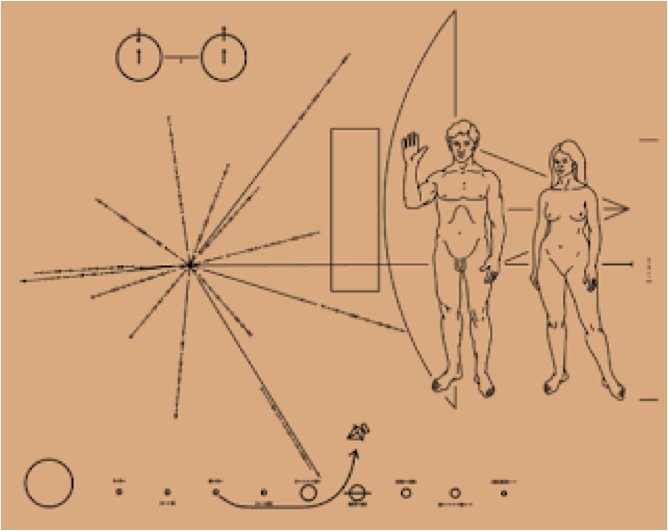
Perhaps the strangest drawing I know of is the one drawn onto the plaque that was fixed onto the side of the Pioneer 10 space craft. Launched in 1972, it was the first manmade object to be sent out into far space, it was designed to be able to travel beyond our solar system and out into the wider galaxy. A wonderful idea, but not so the line drawing of a man and a woman that accompanied the vessel on its journey. The line drawing of both man and woman is from the front, the man holds his arm up in greeting, showing an open hand, the woman, less active of course, stands beside him. The man has short hair and is clean-shaven, the woman has a longer but coiffured hairstyle. 

Pioneer 10 plaque

So many things are wrong with this drawing, from the Eurocentric portrayal of the humans, to the graphic convention of a line representing complex three-dimensional forms. There is no way that any creature on finding this space vehicle entering their star system could deduce any information from these drawings, except that something with some sort of intelligence had had them manufactured. We have been seduced by lines and believe that they can be used to clarify situations. But there is also another problem and that is how lines fix identity and give things a shape that you can put a word to and that word is nearly always a noun. A tree, a stone, a body an arm, a leg. 
Architects' trees

Words are themselves boundaries and although we find them very useful, we also need to be reminded of their limitations. A tree is also a process and as a process it has no edges. It belongs to the soil as much as to the air. As a squirrel takes an acorn away to bury it, the squirrel become part of the tree’s process, as the rain falls, the tree engages with the weather, allowing some waters to pass through its leaves and others to fall around the edges of itself, selectively watering the surrounding soil for other organisms that have become part of its eco system. 

Primary school teaching aid

As you eat that apple, you are participating in the extended process of treeing, your humaning conjoining for a brief time with the life process that we often put a line around and call a tree. But when you use a dot and I use the word dot rather than point deliberately, you can think about these issues differently. 

The edges between things become permeable

A dot has more physical presence than a point. Therefore it can have more of a life of its own and any life form or self-organizing system relies on an ability to interact with its surroundings in order to survive. This ability to self organise is in fact an emergent property of random dynamical systems, that you might think of as chaos. I.e. eventually if you have enough stuff and mix it about long enough at some point order will not just emerge, but a type of order that likes to keep itself in that very order, as well as being able to interact with all the other chaos around it, will come into being. In order to maintain themselves, these orderly systems possess what are called Markov Blankets. If we go back to our tree, there is a core part of the system that is clearly treeing, but there are other parts of the system that are also raining, humaning, soiling and squirreling. That is, that the tree’s Markov blanket touches and enacts with the Markov blankets of other things. These edges between things could be where disaster strikes, but on the whole some form of homoeostasis and autopoiesis emerges, whereby the treeness becomes part of a system that both includes it and other things, helping itself to keep regulating all its internal systems, whilst also forming part of other regulation systems. For example the acorn may help the squirrel survive or the tree's root system may help aerate the soil. 

An amoeba enclosed within a membrane. 

A membrane is a selective barrier; it allows some things to pass through but stops others.

An amoeba on the attack

Why might this idea, that all self-organizing systems need to be surrounded by Markov blankets, be the case? I think it is about the relationship between independence and interdependence. We constantly update our decision making based on past experience and current change. We do this in order to survive or to achieve homoeostasis, but so does an amoeba. We exist like the amoeba in the midst of dynamical changing systems all of which are mediated by certain forces. If these systems are to work together, rather than simply break each other apart, they need to be able to ‘couple’ with each other, in order to create ‘interdependences’. If independence is to be maintained alongside interdependence, then these independencies will need to induce Markov blankets, so that the internal, independent state can be statistically separated from the external state. This enables the minimization of the disturbance of free energy, because the internal states (and their blankets) will engage in active Bayesian inference. I.e. that surrounding area where the tree engages with soil, squirrel and rain is an area of probed uncertainty, whereby updates in decision making based on past experience and current change are made all the time in order to ensure the continuing existence of the core independence, which is also reliant on the continuing existence of the surrounding systems that it finds itself nested within. This process can be statistically modelled and when it is, points are used and not lines. 


We can now get back to drawing again and in particular the issue of collaboration. Perhaps you now have an idea of where all my ramblings are going, I am trying to articulate something about the way artists have to negotiate with each other’s drawings, and that the process is not that dissimilar to the way all life forms have to negotiate with their ever changing environment if they are to survive. Every drawing begins with a dot... the tip of a brush, the point of a pencil, the sharp edge of a broken stick of charcoal or the nib of a pen, touches a sheet of paper, the dot, that material manifestation of the point, becomes the centre out of which will grow more dots, lines and forms, all of which emerge from that initial point. This is the opposite of the point in Euclid. 

The universe as star dots

The point is formed by the coming together of axes of directionality but the dot is the centre from which all forms emerge, it is the cosmic mother of invention. The first imaginative drawing was done in the mind and not scratched into sand or drawn on a cave wall.


The first drawing would have emerged from the field of dots seen in the sky at night, like the Great Bear of astrology / astronomy, it would have consisted of a series of dots that were in someone's mind's eye morphing into forms that emerged from tales of Gods and Goddesses. Dots collaborate with each other to form new things. A broken or dotted line is permeable, it forms a boundary that can be crossed rather than a fence to keep things out. 

A dot doesn’t have to be perfectly round, it can have directionality, it can pulse with life. 

Van Gogh

When Van Gogh draws or Monet paints, their marks or brushstrokes are in effect elongated or distorted fields of dots, rather than filled in lines. The post-impressionists perhaps above all recognised the power of the dot, the importance of a field of marks that were never fixed, but which drifted across the surface and plunged the mind into a floating world of perceptual actions.

Monet

Seurat

If artists were to collaborate with the world they had to allow themselves to dissolve into it. The fixed moment of photographic time had just arrived and like lines, photographs froze boundaries and didn’t engage with process only surfaces. However close on photography’s heels was emerging the technology of the moving image. Initially using drawing to create animations such as in the phenakistiscope and the zoetrope, and then after the pioneering work of Muybridge and others photography itself was allied to movement and as this technology was understood and developed over the next 100 years, it eventually became the norm and the still image was regarded more and more as a technology with severe limitations. However drawing was never really about the frozen moment and its strength was always its ability to simultaneously provide an image for contemplation and provide a surface to unravel. The traces of the maker’s movements captured in the marks and the images made arriving out of the collection of marks as they were developed over a surface. 

Second and third stages of a Drawing Dialogue image

The conjunction of traces of body movement and different marks and lines operates as a simultaneity, and this is what makes the images in the exhibition so interesting, and which opens out opportunities for thoughtful reflection every time it happens. Drawing continues to be done and this exhibition celebrates drawing done as a form of collaboration, each artist beginning each drawing with a point, a dot of intentionality that has at some point to engage with another artist’s field of marks or lines or shapes. The best of these drawings maintain as we do ourselves, a state of homoeostasis, whereby each artist has probed the uncertainty of either a white sheet of paper or the energy fields of other artists’ marks, and engaged in decision making based on their past experience and the new challenge of other artists’ worlds emerging out of the paper. They will partly have to ensure the continuing existence of their core independence, while at the same time allowing the work of others to make total sense, as they build a new world within the one they are nested within. Perhaps this uncertain certainty will open doors, perhaps it will lead to thoughts and imagery unthinkable as solitary endeavours. What is true is that without cooperation and a willingness to soften boundaries and become permeable to other ideas, as people we will become ossified and brittle, easily broken and ripe for being blown away by the winds of change. Collaborative drawing being not just about making weird or strange imagery, but also being a model for survival and a gateway into another world where things are less defined and where words are vowels much more than nouns and where dots are sometimes privileged over lines. 

 See also: