Showing posts with label lines. Show all posts

Friday, 12 September 2025

Desire lines

Drawings are made both consciously and unconsciously, and not always with our hands or by humans. Some drawings are traces of repeated activity and desire paths fall into this category. 

A desire path

Richard Long's walked lines are another type of desire path, but this time with an aesthetic intent. However these lines are not just things that humans make.  A game path is a naturally occurring pathway made by animals. 

A game path

A human/animal desire path heading towards water

Desire lines are paths that speak of wanting to get places or do things and the more we realise animals like ourselves are emotional beings that also have desires, perhaps we can develop an understanding of a reality that links together the lives of animals and humans. It’s been suggested that fifteen journeys are all that’s required to designate a fresh desire path, but I would suggest all that is really needed is one animal to go off in one new direction. Once that has happened, others will follow. However the faint trace of another life moving ahead before us, perhaps offers grace rather than instruction; in the sense that grace is a sort of undeserved favour, a path resulting from another's adventurous spirit, being in effect a gift.

There is a certain timeline to the evolution of the road system. Roads have evolved from animal tracks; first the animals wear down the vegetation, then humans follow these tracks on foot. In another era humans will ride these paths on horse-back before eventually widening them as track ways for horse-drawn carriages and then eventually in times much closer to now, they will have become metalled roads for cars. Eventually what were desire lines become fixed by an ordnance survey as roads on a map.

I've recently returned from West Wittering and we foolishly decided to let the sat nav direct us back to Leeds and we had a very strange journey, it was almost as if the sat nav was arbitrarily deciding which roads to take. It reminded me of being a boy and staring at maps and wondering where those roads might take me and what sorts of experiences they might lead to. The idea that following a road can lead to self-discovery or mystical transformation is a common theme in literature and philosophy. It suggests that the journey, both physical and metaphorical, can be a powerful catalyst for personal growth and spiritual awakening, in particular, the concept of the "road less traveled," means that venturing off the beaten path can lead to unique insights and experiences. Following a road may lead us to discover a lost part of ourselves or help us to undergo a mystical transformation. Each desire line when begun, is indeed a newly beaten path, taking its maker into spaces as yet untrodden.

The road systems of England

In our present time, desire paths are made when we step off Google map and let our intuition decide our fate. They seek out connections between where we are and where we wish to be. Instead of being worn into shape by the pressure of passing feet, they are perhaps unique connections being made between information sets, or possibilities being seen for the first time; they’re indications that there is another way. A desire path is also a trace, often left behind because of someone following an impulse; or a desire to find a new territory. 


Animal paths

If we reverse engineer a road, we might at some point come back to its past existence as an animal track. Most animals are territorial. They walk between places to feed, to drink, to rest and to find others. The landscape itself will direct which route to take, as it provides trees and rocks to move around, gentler and steeper slopes, trees as rain cover or grasses to eat on the way. In effect the landscape wraps itself round the animal. The desire lines animals follow are also in effect, like the lines of an animal 'Wyrd', whereby the invisible lines of each animal's psyche are wrapped around the world as they pass through it and as they do the animal's destiny is woven. The word wyrd comes from the Proto-Germanic word 'wurđiz', a noun derived from the verb werþanan, meaning "to become". As we pass through life we become who we are, this is our fate. This Anglo-Saxon concept, still seems to myself to make sense, like all animals, our life lines are inextricably entangled into the world we inhabit. 

Desire is what shapes us; as we are shaped we begin to define ourselves and to do this we use tools, one of which is the mirror. The mirror allows us to see ourselves from the outside, in effect we become part of the landscape we inhabit. Like all the landscapes we traverse, we can change them by stepping off the desire paths we have chosen and starting a new one. One desire line can be our hair parting and by simply changing the 'normal' line of parting taken by our hair, we can in effect change our personality. 


Hair parting lines

There is a widespread cultural belief concerning how hair partings change a person’s looks. The general consensus seems to be that parting on one’s left makes a person look competent and masculine, whereas parting on the right makes a person look warm and feminine. In the Christopher Reeves Superman films when he was acting the Clark Kent character, his hair was parted on the right, but when he was Superman, his hair was parted on the left. Someone had gone to a lot of trouble to research this and then to persuade the make-up department that this was an essential part of the character transformation.  


Christopher Reeves

For most people, the way you part your hair is instinctive. But there are times in your life when you feel the need to change, just as when you decide to step off the pavement and head out over rough ground to see if you can get to somewhere else. When you do that, eventually the new direction is worn into your path, you in effect own it, it is a sort of 'signature' path.

Desire lines can of course also be found in the markings you make in your own artwork, some drawings reveal traces of repeated activity, certain forms recurring over and over again. 

Theresa Murdza

The wondering wobbly circles that pass through this drawing by 
Theresa Murdza, are her desire lines. Just as desire paths are ones we take as we walk towards something, these lines are ones made as she draws towards something. Once decided upon and enacted we tend to repeat our journeys, which is why artists tend to repeat the types of marks they make.

Brenda Holzke

As we repeat a mark quality, it becomes a sort of artist's signature. I often draw using pen and ink, the thickening and thinning and hand speed associated with the application of these marks forming my own work's 'desire lines'.

A page from one of my sketchbooks

Paul Klee

Page from Klee's Pedagogical Notebook

As Klee takes his lines for a walk, he is in effect developing 'desire lines'. 
There is a certain timeline to the evolution of types of drawing within the art canon. Approaches to drawing have evolved from one artist to another; first of all one artist will wear down the thick vegetation that surrounds the prevailing approaches to drawing, then other humans will follow these tracks. As more and more artists ride these paths they will eventually widen them so that they become roadways. Just as in the paths we follow out in the wider world; following these roads may lead us to discover a lost part of ourselves or even help us to undergo a mystical transformation. A line can take many paths, some short and some long, some straight and some twisted and as metaphors for life, lines are asked to act out a huge multitude of narratives. Each line has though to be finally cut, or as Milton puts it, "Comes the blind Fury with th'abhorred shears, And slits the thin-spun life". Each line scissored by the Fate Atropos, when its story is complete and its owner has fulfilled their destiny.

See also:


Wednesday, 9 October 2024

The Emotional Line

From Vaught's Practical Character Reader

I fear this post may stray into foolish territories and open it with a reminder that lines have in the past often been subject to very debatable readings, so do take what I have to say on this topic with the proverbial pinch of salt. 
I have written about lines as boundaries, as direction, as diagrammatic form and as metaphors such as life lines and knots in string but it is the emotional line that I'm more interested in at the moment. This is very closely associated with the expressive line, the line that appears to come naturally from an artist's feelings or emotions. However it is slightly different in that it is a type of line engineered to communicate a feeling. This feeling might be someone else's rather than something that is inherently within and part of the artist's way of drawing or making things and it is rooted in synaesthetic experiences. For instance if I say the words "kiki" and "bouba" and then show you two images, such as the ones below, I'm pretty sure you will know which one is which.
But can we go further than this? This area of thinking is one whereby artists such as Klee and Kandinsky were supposed to be the original thinkers and even earlier researchers such as Besant and Leadbeater had written extensively about the relationship between colour, shape and what they called "thought forms". However there is always room for one more attempt to get to grips with something that is endlessly fascinating. 

I'm going to start with some examples of 'embodied lines', ones drawn by myself in relation to the way our bodies hold within themselves emotional events and then see where these can be tweaked to vary feeling tone. The first issue anyone familiar with the history of these things is that in the ground initially covered by Klee and Kandinsky, they attempted to strip the language down into its basic elements, point, line, plane etc. For many reasons there is therefore no real reason to go back that far. I'm also by now aware that communication is complex and that in reality we cant experience an isolated line, it will always have colour, texture, direction and all sorts of associations with the interconnected and entangled world around it. I have therefore tended to talk about 'events' rather than 'things'. My attempt to get my head around this is also more to do with poetry than science, each 'line' looked at is part of an experienced event and an attempt to capture that in some way. They are I suppose 'impossible objects', things of the imagination, but in being so, I think they are no more 'real' or 'fictitious' than any of the other things I perceive, whether these be of outer or inner experiences. 

A feeling of anxiety coupled with a tinge of the thrill of the unknown

The line image above was made in response to 'feeling tension in the backbone and how it arcs around and out of a clenched stomach', an awareness of which came via a conversation with someone about how their body was involved in their emotional world. A little like a wave, but a thin one that is more like a lightning strike. This could, I then decided, also be a line that responds to the feeling induced by a 'sublime' experience. 

But how much of the feeling is due to the wave type associations, how much to the texture, how much to the particular shape and how much to the materials of its making? 

The feeling changes slightly as the line/shape morphs.

As the blue drops away the feeling becomes slightly more brittle. 

With less texture, but darker, that thrill of the unknown becomes more fairytale

The feeling is shifting again, perhaps more anxious

Each side of the line/shape has a different emotive effect

These all need road testing, but one thing that is very clear is that slight changes in texture and colour, shift the emotional associations through several different registers.

Anxiety turns to jealousy

As an anxiety is triggered it can open the door to other emotions, such as jealousy. A line's colour only begins to make emotional sense when it is embedded within another colour, and in this case, its energy if grounded at both ends, becomes tautened. 

Confidence through achievement

The pride of a well muscled body that can stand tall lies at the heart of this line. Its verticality being its most powerful formal component. Bone gives this line its strength, off centred muscles suggest possible resistance to being pushed over. It is though still fragile. 
Tired of life

The colour becomes muted and the horizontal of death and things being cut down, replaces the vertical. 

Feeling broken, fragile

Now the line is broken, its former 'rightness' about to be snapped. 

Becoming sad

Colour is required to get closer to a feeling tone for sadness. This line feels like a fallen branch, or a flower, its stem snapped and ready to be thrown out. The line's position within a frame is also vital, sadness is often associated with an awareness of death, which stripped down to its essentials could be simply _______________________________

Holbein: Dead Christ

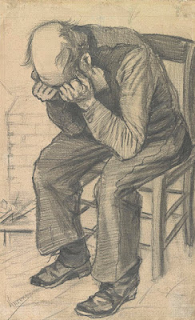
It's interesting to compare this with Van Gogh's attempts to visualise sadness. 


Drawing for Worn Out

I read that the direction and form the line takes that follows the person’s back in this Van Gogh drawing is called a 'grief line'. However I can't substantiate this particular usage of the emotional line, but I can isolate it and present it as something to be tested. 


 The grief line abstracted
The sorrow line abstracted

Floral grief

A line that began within a body and that was thought of as belonging to a series of muscle and bone associations, has gradually been changed to one more associated with plant forms that are beginning to wilt. 
Umbrella handle / bowed head

I used this emotive line when I was making a piece of work for Patching. The lily inspired ceramic flower had a bell clapper hanging inside, so that when the wind blew the flower chimed. 

Memorial ceramic flower / bell

The line of sadness, is as a formal element, very close to the line of grief. However without colour, variation in associated shapes and textures, it might as well be the handle of an umbrella. 

The inverted hemisphere line is another example of an emotive linear form. Not to be mistaken for the smile line, as in an emoticon, this line when used as part of an image's compositional structure can carry another type of emotion similar to sadness, as sort of heartache or sense of things coming to an end.


If you look at Watteau's wonderful painting of a pierrot in the Louvre, it has several inverted hemisphere lines dividing up the image.


Even the creases in the trousers take the form of inverted hemisphere lines

The vertical of the figure feels as if it is dropping down into a pool, colour kept desaturated, makes for an emotional register that feels something like how the world would be experienced if seen from under water. 


An energised line falls 

A basic children's art exercise is to make different line directions – horizontal, vertical, diagonal, and curved, especially when trying to help them to think about differences in emotions, like sad/happy, excited/bored and calm/worried, in particular when autism is suspected. But as students get older the exercise is rarely returned to as something to work on as a way of developing a more sophisticated basis for visual communication. There is a children's book 'The Way I Feel' by Janan Cain that uses colour and composition very effectively to support a growing awareness of an emotional life and I sometimes feel we need an adult version of this. 


From: 'The Way I Feel' by Janan Cain

Cain's book has already been used as a primer to help youngsters think about abstract language and the example above compares a sad line with a silly line. As we get older our emotional lives are though not so easily categorised. 
So I have decided that one of my projects will be to return to these basics and to develop a set of cards that can be used to test out whether or not there are any universal visual language forms that can be used effectively, as well as to provide a starting point for new emotional mixes by the simple expedient of shuffling the card deck once it is made.

Trying to regain balance after frenzied activity

In the meantime I'm off to Porto next week to deliver a workshop looking at issues very closely related to the concepts I have been thinking about in this post.
The workshop, 'Drawing the somatic body: Visual problem solving and imagineering' is introduced by the following abstract:

The fact that human experience is subjective and as much an emotional reality as a logical one, is something that drawing takes in its stride. Constable’s cloud studies are as much scientific observation, as they are an understanding of the impact that the weather has on our emotions. Buckminster Fuller’s drawings of geodesic domes illustrate his architectural philosophy, as well as being plans for buildings.
Drawing can be at its most powerful when visualising the invisible. When words fail us, drawings can provide the space for ideas to become externalised and therefore available to communal perusal.
The research objective is to explore how our bodies become measuring sticks when we come to assess responses to perception, and it is based on an understanding that it is our interoceptive network that is used to enable prediction loops to work; a network that therefore is central to our ability to survive.
Our interoceptual network is linked to an invisible but intuitively well understood neurological map of the body, a map that is the ontological bedrock on which we build images; from diagrams of electrical circuits, to maps of war zones, via how to build it illustrations used to construct the latest purchase from a home furnishing store. However, people often regard photography as the only authentic depicter of reality, which is why when trying to convince people of the power of drawing to depict thought, it is useful to focus on things that we cant photograph. Drawings of invisible but clearly felt interoceptual experiences can not only be used to foster cross disciplinary imagination and invention, the emotional range that drawing also encompasses, allows us entry into a visual engagement with the emotive processes that underlie many of our embodied mind’s conceptual models.
This workshop uses a drawing led methodology that has emerged from attempts to visualise interoception; it will ask participants to make their own drawn explorations of somatic feelings; drawings that will then be used as entry points into ways to understand drawing as a cross disciplinary practice. By using gestural mark and image making techniques, diagrams and mapping, this workshop will demonstrate that drawing is one of the most powerful forms of communication and that it can be used to make us more aware of the inner neurological maps of our own bodies. It will highlight how inner body mapping becomes the basis on which we build other drawn visualisations, as well as being the basis on which we build conceptually embodied concepts, such as the visualisation of justice.
Certain aspects of this work have already contributed to the i2ADS Drawing Across Disciplines seed project, ‘The Observation of Perception, considered through Drawing’ and associated workshop practices have been documented and written up as part of the forthcoming publication SKETCHING STEM: A Hands-On Guide on Drawing-to-Learn Approaches, for the Porto University led initiative, Drawing Across University Borders.

See: 


Drawing Across x Along x Between University Borders to have access to the full conference programme.

Monday, 15 April 2024

Crosshatching as energy carrier

William Blake after Fuseli, Head of a Damned Soul, c1789-90

When looking closely at some of the images in the 'William Blake's Universe' exhibition at the Cambridge University Fitzwilliam Museum, I was entranced by the various uses of cross hatching. In particular Blake's rendering of the image chosen for the exhibition poster, had me gazing closely at its surface and as I did my gaze became lost in the movement of one surface into the next, as the cross hatching overlapped and its curved lines not only made form but produced energy at the same time. 

Hendrick Goltzius 

Some time ago I put up a post on cross contour drawing but when I did I failed to open out how powerfully some artists had used cross hatching to energise surfaces and create energy fields. Some artists in particular, such as Hendrick Goltzius, who was the leading Dutch engraver of the early Baroque period, specialised in using these techniques. Rembrandt for instance encouraged his students to copy Goltzius engravings as a way to learn how to cross-hatch. Notice how the engraved lines both follow the form and give an indication of tone. However it is in pen and ink and chalk drawings that we see the technique used at its most subtlest.  

Head of Mercury: Hendrick Goltzius 

Goltzius had developed his engraving technique by exerting a change in pressure as he pushed the graver through the metal. This meant that as it cut through he could 'swell' the line in order to make it give a better impression of a rounded three dimensional form. He then began to emulate his engravings in pen and ink, the 'Head of Mercury' being an amazing example of expression and control, welded together If you look at the drawing closely, the flow of energy made by surfaces as they follow masses moving, in and out of shadow is quite exhilarating. 

Rubens

Rubens: Detail

If you look at the Rubens drawing above, you can see how the pen strokes create compacted energy, their slight curvature suggesting the soft curves of the body, the depicting of the movement of light to dark necessitates points of overlap, suggesting a constant flow of one field of energy into another. 
Durer uses this technique to both suggest mass and texture. The hair texture dances to one set of rhythmic dynamics, whilst the planes of the head are suggested by another set of rhythmically set out lines. What appears at a distance to be a solidly modelled head, on closer inspection becomes a series of energy fields. 

Durer

Durer: Detail of energy movements

Jean-Baptiste Greuze's drawing, 'The Ungrateful Son', is a very good example of how planar reinforcement using hatched lines, is not just a powerful explainer of how masses work within a complex solid such as a head, but can also be a way to demonstrate how energy fields can interact and overlap.  

Jean-Baptiste Greuze, The Ungrateful Son, ca. 1777

Greuze, The Ungrateful Son: detail

Greuze has a very strong grasp of three dimensional form, each line reinforcing the head's planar structure, but we can also see that complex rhythms are made as these contour hugging lines overlap. The movement of marks as they define the brow, the eye socket, the cheek and the nose, chin and mouth, is not unlike currents or eddies in a stream flowing over rocks. These marks also link one facial form to another; if you begin by looking at the bridge of the nose, you can drop down its side and slide over the cheek, falling towards the mouth and then visually tumble down towards the chin and neck. An idea of the body as landscape emerges the closer you get to the drawing. 

The body's energy field

I have begun to think about how these various energy fields overlap. Perhaps this was triggered in my head by listening to obituaries of Professor Higgs who died last week and the various accounts of the Higgs field. This is a field of energy that is accompanied by the Higgs boson, used by the field to interact with other particles, such as electrons. This interaction gives weight to the particles and hence 'mass' comes into being as well as energy. 

Mapping the energy of a concrete block in the sea wall

Gradually my thoughts about the energy of seeing are becoming fused with the energy inside mass and how it sits within the space that surrounds it. 

Perceptual study of a toy dinosaur found in the woods

I am still working on how to visualise the inner body, so will be trying to add in these thoughts about energy mass, as I try to fuse the ageing awareness of a body into the landscapes that it remembers. But for now this is where that particular strand of thinking has settled. 

The ageing body and a memory

Aways so much to do, always so many things to reconcile, but as always so many exciting things to get involved with.  

See also: