Showing posts with label quantum theory. Show all posts

Thursday, 6 March 2025

The topology of dreams

Visual representation of “Awake state” vs “Dream state” according the Topographic-dynamic Reorganisation model of dreams

At the end of my post on the Borromean Knot I stated that the topology of dreams was perhaps the next thing to explore. There always seems to be a gap between what goes on in the mind and experience. Sometimes it seems as if we measure all experiences in relation to the experience of being in a particular body. Consciousness being a sort of embodied realisation of the process of becoming aware. But when I dream I'm somehow conscious of something but at the same time not conscious, because I'm asleep. It's interesting to see that Dali's work is still used to indicate dream states, his "paranoiac-critical" method, was a very conscious application of a visual methodology, designed to sit between readings, in order to destabilise a viewer's perception. It is the flitting between states that is perhaps what fascinates artists.

Areas of the brain

Northoff, Scalabrini and Fogel, (2023) when explaining why they have developed their current dream model theory, state that it is produced, "In order to bridge the gap between brain and experience". Their theory is a topographic-dynamic re-organisation model of dreams. They state that t
opographically, dreams are characterised by a shift towards increased activity and connectivity in the default-mode network, (DMN). If that gap can be bridged, it might help me to visualise or at least begin to model in my mind, some sort of diagram of the interrelationship between perception and consciousness. 

Raichle (2015) explains that 'the brain's default mode network consists of discrete, bilateral and symmetrical cortical areas, in the medial and lateral parietal, medial prefrontal and medial and lateral temporal cortices of the brain'. Interestingly, as well as this applying to humans, it applies to other primates, cats and rodent brains as well. 

The discovery of the default mode network reignited a longstanding interest in the significance of the brain's ongoing or intrinsic activity, i.e. a growing awareness that it is always active and doing something, even when it would appear that there is no need for it to be active because we are asleep or at rest. Resting-state studies, have indeed come to play a major role in researching the human brain in relation to health and disease. For instance, 'happiness' is very subjective. It has been suggested that unhappy people are prone to ruminate more and therefore Luo, Kong, Qi, You,& Huang. (2016) have posited that unhappiness may be associated with increased default-mode functional connectivity during rest.  The relative hyper-connectivity of the DMN areas may they argue, be associated with higher levels of rumination, which suggests that those of us who take time to rest, think too much when we do so. 

My recent experience working with people who have suffered traumatic spinal injuries, suggests that the less people are able to use their bodies, the more their mind operates to compensate for this. I have been holding conversations with people in a specialist spinal injuries ward, whereby we work together to visualise how they feel pain. The most active images have emerged from conversations with someone paralysed from the neck down. Perhaps some of the images that have emerged from these types of conversations might become starting points for diagrams of the interrelationship between perception and consciousness. 

Conversational image

But what of dreams, the images out of which so many of our inventions arise, all derived from a time when the body is supposed to be at rest?

From an anxiety dream: The visualisation of an inner feeling

Northoff, Scalabrini and Fogel, (2023), suggest that in dreams, there is a shift away from temporal segregation to temporal integration of brain inputs.  This they believe results in 'bizarre and highly self-centric mental contents, as well as hallucinatory-like states'. However, no matter how interesting this research is, it doesn't really deal with the mind and it would seem to me that it is the mind that is conscious, not the brain. 
I like to play table tennis and one of the reasons I do this is that I don't have to think too much about what I'm doing, I simply have to react. In fact if I try to think about what I'm going to do, I will miss my shot. This tells me that when incoming stimulus is focused and in need of a response, that somehow decisions are much simpler for the mind to make. Twenty seven plus thirty five, is a simple sum, and as I do it in my head, I focus on just that, I don't begin to speculate on other things. But when I sleepdream, or when I daydream, little external stimulus is coming in and therefore in order to keep active, my mind goes on to predict other possibilities, some of which are wonderful, some stupid and some frightening. Even when nothing is coming in via external senses, my mind seems to want to keep processing something; it keeps on trying to predict other possibilities. Perhaps this is why at times we need to be bored. If we look at Bayesian inference theory to explain this, we find that subjective probability lies at the core of how our fast response systems operate. Fight or flight mechanisms are driven by these things, so our body believes in their vital necessity and wants to make sure we are always on guard, even when we don't have to be. It would seem that because of this, what could be seen as a wasted energy process, is in fact one whereby wonderful things like dreams are made to happen. As a model, this closely resembles how most of us operate when we develop a working process for making artwork. Both are iterative processes; according to Bayesian inference theory you receive an initial stimulus, test it and then update your model of the world based on the new information; when making art you set down an initial idea, test it out and then update the idea based on what you have discovered. 

No matter how much better neurological visualisation techniques get, they do not seem to get us any closer to an idea of what consciousness is, or what a mind is. The mind is not the brain, it isn't even located in the brain, being it would seem distributed not just into the body as a whole, (the embodied mind) but out into the world itself, (the extended mind). In, 'You Are the Universe' Deepak Chopra and Menas Kafatos, go one step further and suggest that each of us is a co-creator of reality and that we live in a conscious universe. On the way to their current theory they dismiss animism as a way to think about this, but I still have a personal affection for an animist universe, as it allows me to inhabit and talk with and through non-human animate and inanimate things, if only in my imagination. 

Night thoughts: Climbing out of the subconscious

In the image above, ladders and tree roots are extensions of my body/mind; my hand and arm as they extend out from the edge of the frame, are images of my hand and arm as they extend into my field of vision. The rest of my arm is known to me by proprioception, the interoceptual sense that makes us aware of balance and our body parts. This is also true of anyone who looks at the image, their own sense of inhabiting a body, allows them to feel what it might be like to climb out of the space below the edge of the frame. This inner sense is also part and parcel of my sub-conscious, a state that exists inside my body, just as much as consciousness does. They are intertwined sensations. Memories of ladders and tree roots being another set of neurological energy flows that are woven into the arrival of an image such as the one above.  

Dreams are I believe central to my own imagination and I still keep a notebook at the bedside, so that when dreamt images emerge at night, I don't lose them; even if it means that when I wake I find I don't really understand what it was I was seeing during that night's dream state. It's the mystery that intrigues me, the fact that there is no answer, beyond a belief that there is something beyond the everyday and a feeling that underneath the surface of perception lies something deeper and profound. These are wonderful reasons to keep going, to keep looking for that unknown something that is just outside of my perceptual range. I am in making images looking for something I know is there, but I can never touch, something that I suppose is sometimes called reality. 

There is another theory about how consciousness is constructed, called orchestrated objective reduction theory (Orch OR). It was originally proposed by physicist Roger Penrose and anaesthesiologist Stuart Hameroff in the 1990s. It also, like art, seeks to bridge the gulf between physical matter and felt experience. The idea is that consciousness arises when gravitational instabilities in the fundamental structure of space-time collapse quantum wave functions in tiny proteins called microtubules, which are found inside neurons. Rather than being a product of neural connections, Orch OR posits that consciousness is based on non-computable quantum processing performed by qubits (like binary bits, qubits are the basic units of information in quantum computing), formed collectively in cellular microtubules, a process significantly amplified through the neurons themselves. The qubits are based on oscillating dipoles forming superposed resonance rings in helical pathways throughout lattices of microtubules. The oscillations are either electric, due to charge separation from London forces, or magnetic, due to electron spin. Consciousness therefore arising from quantum computations which are connected to the fine-scale structure of spacetime geometry. If this idea has traction, it might explain how 'spooky action at a distance' works to build some sort of cosmic consciousness, or at least free the mind from its prison within our skulls. The idea has reached the point whereby diagrams can be drawn to illustrate how it works, which for myself means that it has more visual momentum.


A: An axon terminal releases neurotransmitters through a synapse and they are received by microtubules in a neuron's dendritic spine
B: Simulated microtubule tubulins switch states.

David Bohm was very interested in these issues and he proposed a solution by looking at what he called 'implicate' and 'explicate' order, which he thought of as ontological bases for quantum theory, and are used to describe two different frameworks for understanding the same phenomenon or aspect of reality. In particular, the concepts were developed in order to explain the bizarre behaviours of subatomic particles, which quantum physics describes and predicts but struggles to explain. In 'Wholeness and the Implicate Order' he described how differing contexts might change the appearance of certain phenomena. The "implicate" (also referred to as the "enfolded") order, is a deep fundamental order of reality. The "explicate" or "unfolded" order includes the abstractions that humans normally perceive. He stated in relation to this, "In the enfolded [or implicate] order, space and time are no longer the dominant factors determining the relationships of dependence or independence of different elements." (Bohm, 1980) 

As space and time become questioned as to their role in our perceptual understanding of the world, a door is opened into a universe within which the spaces and times of dreaming can be enfolded, their topology perhaps more like that of the tessellations and associated optical illusions that Roger Penrose introduced to Escher, which had a direct effect on his making of the print, 'Ascending and Descending'.

Escher: 'Ascending and Descending'

References

Bohm, D. (1980/2002) Wholeness and the Implicate Order London: Routledge

Chopra, D. and Kafatos, M.C., (2018) You are the universe: Discovering your cosmic self and why it matters. London: Harmony.

Davey, C. G., Pujol, J., & Harrison, B. J. (2016). Mapping the self in the brain's default mode network. NeuroImage132, 390–397. https://doi.org/10.1016/j.neuroimage.2016.02.022

Northoff, G., Scalabrini, A., Fogel, S. (2023) Topographic-dynamic reorganisation model of dreams – A spatiotemporal approach, Neuroscience & Biobehavioural Reviews, Volume 148,

Lau, H.C., (2007) A higher order Bayesian decision theory of consciousness. Progress in brain research168, pp.35-48.

Luo, Y., Kong, F., Qi, S., You, X., & Huang, X. (2016). Resting-state functional connectivity of the default mode network associated with happiness. Social cognitive and affective neuroscience11(3), 516–524. https://doi.org/10.1093/scan/nsv132

Raichle M. E. (2015). The brain's default mode network. Annual review of neuroscience38, 433–447. https://doi.org/10.1146/annurev-neuro-071013-014030

See also: 

The Borromean Knot

Paper and skin

Knots

Benjamin Brett and Geometrical Psychology 

Drawing and quantum theory part one

Drawing and quantum theory part two

Quantum entanglement

The geometry of consciousness

Monday, 15 April 2024

Crosshatching as energy carrier

William Blake after Fuseli, Head of a Damned Soul, c1789-90

When looking closely at some of the images in the 'William Blake's Universe' exhibition at the Cambridge University Fitzwilliam Museum, I was entranced by the various uses of cross hatching. In particular Blake's rendering of the image chosen for the exhibition poster, had me gazing closely at its surface and as I did my gaze became lost in the movement of one surface into the next, as the cross hatching overlapped and its curved lines not only made form but produced energy at the same time. 

Hendrick Goltzius 

Some time ago I put up a post on cross contour drawing but when I did I failed to open out how powerfully some artists had used cross hatching to energise surfaces and create energy fields. Some artists in particular, such as Hendrick Goltzius, who was the leading Dutch engraver of the early Baroque period, specialised in using these techniques. Rembrandt for instance encouraged his students to copy Goltzius engravings as a way to learn how to cross-hatch. Notice how the engraved lines both follow the form and give an indication of tone. However it is in pen and ink and chalk drawings that we see the technique used at its most subtlest.  

Head of Mercury: Hendrick Goltzius 

Goltzius had developed his engraving technique by exerting a change in pressure as he pushed the graver through the metal. This meant that as it cut through he could 'swell' the line in order to make it give a better impression of a rounded three dimensional form. He then began to emulate his engravings in pen and ink, the 'Head of Mercury' being an amazing example of expression and control, welded together If you look at the drawing closely, the flow of energy made by surfaces as they follow masses moving, in and out of shadow is quite exhilarating. 

Rubens

Rubens: Detail

If you look at the Rubens drawing above, you can see how the pen strokes create compacted energy, their slight curvature suggesting the soft curves of the body, the depicting of the movement of light to dark necessitates points of overlap, suggesting a constant flow of one field of energy into another. 
Durer uses this technique to both suggest mass and texture. The hair texture dances to one set of rhythmic dynamics, whilst the planes of the head are suggested by another set of rhythmically set out lines. What appears at a distance to be a solidly modelled head, on closer inspection becomes a series of energy fields. 

Durer

Durer: Detail of energy movements

Jean-Baptiste Greuze's drawing, 'The Ungrateful Son', is a very good example of how planar reinforcement using hatched lines, is not just a powerful explainer of how masses work within a complex solid such as a head, but can also be a way to demonstrate how energy fields can interact and overlap.  

Jean-Baptiste Greuze, The Ungrateful Son, ca. 1777

Greuze, The Ungrateful Son: detail

Greuze has a very strong grasp of three dimensional form, each line reinforcing the head's planar structure, but we can also see that complex rhythms are made as these contour hugging lines overlap. The movement of marks as they define the brow, the eye socket, the cheek and the nose, chin and mouth, is not unlike currents or eddies in a stream flowing over rocks. These marks also link one facial form to another; if you begin by looking at the bridge of the nose, you can drop down its side and slide over the cheek, falling towards the mouth and then visually tumble down towards the chin and neck. An idea of the body as landscape emerges the closer you get to the drawing. 

The body's energy field

I have begun to think about how these various energy fields overlap. Perhaps this was triggered in my head by listening to obituaries of Professor Higgs who died last week and the various accounts of the Higgs field. This is a field of energy that is accompanied by the Higgs boson, used by the field to interact with other particles, such as electrons. This interaction gives weight to the particles and hence 'mass' comes into being as well as energy. 

Mapping the energy of a concrete block in the sea wall

Gradually my thoughts about the energy of seeing are becoming fused with the energy inside mass and how it sits within the space that surrounds it. 

Perceptual study of a toy dinosaur found in the woods

I am still working on how to visualise the inner body, so will be trying to add in these thoughts about energy mass, as I try to fuse the ageing awareness of a body into the landscapes that it remembers. But for now this is where that particular strand of thinking has settled. 

The ageing body and a memory

Aways so much to do, always so many things to reconcile, but as always so many exciting things to get involved with.  

See also:


Saturday, 20 August 2022

The wave form

Representing music

Time lapse image of a bird in flight

Every now and again I like to look at those very basic visual forms that are also entoptic images, and wave forms are one of them. I have touched upon wave images before; they are like zig-zags, and are related to the way we try and depict moving water, especially the sea and they are often associated with the various ways that we try to visualise music. As I'm very interested in energy flow and how something that appears to be one thing such as a solid mass can either be converted into energy or represented as an energy field, the wave form is something that helps me to both visually and mentally weave thoughts together about these issues, so forgive me but I'm about to go on another tangental weaving run in order to find out what I am getting at. 

I first became interested in entoptic forms after reading The Mind in the Cave by David Lewis Williams. The text explores ideas in relation to the origins of image-making. He attempts to relate the foundations of art to the nature of our own consciousness and how we perceptually experience the world. In doing so he looks at Upper Palaeolithic European cave painting and he links the development of shamanic rituals with experiencing the world of the dark cave and parallels between the hidden mind and the hidden interior of the earth. A lot of Lewis Williams' text is devoted to passages between things, (energy flows), for instance the wall of the cave that is used to make images on becomes a membrane through which the world of the everyday can touch the world of the spirit. One of the key developments he picks out is that of self generated entoptic images, generated by the brain when derived of normal visual stimuli, such as when we are immersed for long times in darkness, gradually dissolving into hallucinations of remembered forms, such as animals that are vital to the survival of the tribe and becoming the starting point for a type of image making that could operate as a conduit between material and psychic states. In this process he sees the origins of abstract symbols, like dots and zig-zags and waves alongside iconic forms, images that have a physical resemblance to what is being signified, such as drawings of horses, bison and lions and this introduces other issues about representation itself and various approaches to 'realism' or 'verisimilitude' thousands of years before the camera came into being. Did our ancestors 'find' existing images in the rocks and other surfaces they used to depict things on and simply clarify them, or could they render images from scratch? Did they draw from memory or was there any form of observational drawing practice? Many depictions of animals are well observed, so did artists from this time simply have better memories of animal form, or did they take time to look so that they could bring fresh memories of recent perceptions into their cave depictions. I.e. did they actively work on being able to render these forms, or was it simply that some people were better at drawing animals than others? 


The shaman figure became central to this type of experience, being the guide who learnt how to control an environment that flickered between different states of reality and the spirit world. Shamans knew how to re-enact the stages of animism, or the entry of human minds into the lives of the landscape and its inhabitants and the entry of the world's various animal and environmental spirits into the minds and bodies of humans, by using drugs, chanting, drumming and images that would often be found flickering in tallow made lights. In a semi-dreamlike state our ancestors would enter a cave and emerge from it after a shamanic experience as if reborn. In this situation Lewis Williams feels was also born 'art' and as such it would always be associated with transformative experiences. 

The wave form is fascinating for myself because it very elegantly straddles the abstract, the abstracted and the formal issues surrounding representation. In doing so it can carry ideas about energy flow through various disciplinary areas and demonstrate that they are all in fact variations of the same idea, that everything is in reality some sort of vibration, an awareness that supports the interconnectedness of everything and the fluid nature of our experience. Flow is central to this, the continuous change that we experience, being one of constant energy and material exchanges. 

Perhaps if I start with waves in the sea and how we understand how they operate, as this very physical understanding eventually leads on to how we can think about both quantum and sound wave forms. 

Waves in the sea are partly a result of the Earth's relationship with the moon. The moon's gravity pulls the ocean water on the earth towards it. Because the moon rotates around the Earth sometimes the moon is closer to one side of the earth than another, as it changes its relationship, it pulls the ocean water towards it and this constant changing pull results in tidal waves. So the energy of gravity is transformed into the energy of water movement. This monthly cycle is one that can also be seen to affect many other aspects of our life on Earth and is therefore a powerful signifier in itself. 
Most waves are caused by wind. Wind-driven waves, or surface waves, are created by friction between wind and surface water. 
Both gravity; (gravitational energy is the potential energy associated with a gravitational field, which is converted into kinetic energy when objects fall towards each other), and friction; that can also be converted into kinetic energy, can be thought of as types of energy containers and transmitters and waves are created by these energies passing into and through water. Waves transmit energy, not water, across the ocean and that is what is interesting about them. Because this is about the fundamental idea of matter carrying, converting or transmitting energy from one place to another, wave mechanics become useful as a way to think about other forms of energy transmission. A diagram illustrates the issue clearly 

The water stays in one place, revolving on the spot as it bobs up and down, but the energy travels longitudinally, in this case from left to right.  

It is interesting to compare the propagation of waves through a cracking whip with how waves carry energy through sea water. When a whip is cracked, the whipper moves an arm up and down, which imparts energy to the handle end of the whip. This motion of the arm creates a kinetic wave in the whip. This wave propagates through the whip and by the time it reaches the tip of the whip, that tip is moving at supersonic speeds, which is why you get a loud cracking of a whip. There is no way the whip hand can move at the speed of sound but the velocity of the whip's tip as we can see becomes supersonic. It is in some ways easier to think about the whip and energy transfer, than a sea wave, because we know the material of the whip cant go anywhere, it is just moving up and down, but in the up and down movement something complicated is also going on. 

Images of a whip being cracked. 1: The initial curve given by the user's rapid back and forth motion. 2: The curve has moved out toward the end of the whip, and the portion of the whip that is on the outside of this curve has decreased. 3: This is just before the curve reaches the tip of the whip. 4: When the curve does reach the tip, supersonic velocities occur and the whip cracks.

Wow, all that energy coming from a decreasing curve. 


So how does it work? Time for another diagram. Point A represents the end of the whip held by the user and moved with force P(t) at velocity v. Point B represents the tip of the whip. X represents a fixed point on the whip toward the handle. Y represents an expanding section of the whip from X to a point that is at the same position as the tip. Z represents a shrinking section of the whip that is the size of the arc from the tip to the curve. The total length of the whip is X + Y + 2Z. As energy travels along the length of the whip, it has shorter curves to carry it, therefore eventually the short curve of the tip of the whip will move twice as fast as it moves at the loop of the whip. The energy within the big curve of the whip hand's initial movement has to be contained in the small curve of the tip and this is expressed by increased speed. The whip lines as captured in the time lapse photographs are also like drawn lines and you can feel the energy changes in a curve as you draw it. The energy from an arm movement, just like with the whip, is transmitted via the pen, that is itself subject to friction drag as it moves over the paper surface and the energy expenditure captured in the frozen mark, just as the whip energy is captured as it is released by the high speed photography. Each linear mark made can therefore be regarded as a type of wave form carrying energy. 
Energy is also about power. When power is blocked it becomes one sided because the energy cannot flow between the elements. Whip energy has its own history, the way that whips allow energy to be built up to an explosive tip, made them ideal inflictors of ritual pain. The crack that magically speaks as speeds reach supersonic levels, becoming a sound of subjugation. In England the Whipping Act of 1530 authorised the use of the whip on thieves, the insane, blasphemers, poachers as well as something to use on men and women even if only guilty of minor offences. People were tied to the end of a cart with their bare backs facing the punisher up until the 1590s, which was when a dedicated whipping post was introduced. The power of the courts to order a whipping was only finally terminated in England, Scotland, and Wales by the Criminal Justice Act of 1948. As a means of subjugation it is most commonly associated with the history of slavery; sometimes wave forms can have cruel histories. 

Drawing of a tomb, Chapel Allerton cemetery, Leeds

In the pen and ink drawing above, several energy systems are seen to converge. The energy of looking is itself translated into the pen strokes that make up the drawing. The plant life is transferring the sun's energy into starches, whilst at the same time their visual forms are energised by moving air currents, both facts represented by pen strokes that have more arm/hand energy movement in them than the marks representing the tomb. The energy of the marks in this case being more to do with the flicker of the eyes needed to see this complex form. There is also an intellectual awareness that a tomb like this represents another related idea of energy transformation, that that takes place when a body dies. Some peoples believe that at the beginning stages of death, the body's energy field starts to separate. Accounts of near death experiences have alluded to perceived changes in how the body's energy field manifests itself during the advent of death. People experiencing being drawn up, lifted, or sucked from their body. Some people remembered a sensation of their whole body going out through their head, others a sensation of a peeling away of their skin as they are being released from their body. (Peck, Corse & Lu, 2017) However on death itself, finally all the energy leaks out. 

Peck, Corse & Lu, (2017), argue that several non-western conceptual frameworks believe that electromagnetic fields underlie the pattern and organisation of biological systems, including traditional Chinese  and Indian Ayurvedic medicine. 'The putative energy “life force,” referred to as prana in Ayurvedic medicine, and qi in traditional Chinese medicine, it is believed flows through pathways called meridians in the traditional Chinese system, or nadis and chakras in the Ayurvedic system. Free flow of this “life force” through the body is thought to support health, whereas disturbances or blockages in the flow of this energy are thought to cause impaired function in organs and tissues, and ultimately illness.... Putative subtle energy centres, convert fast-moving energy obtained from the environment into slow-moving energy in the body. They serve as collection and transmission centres for both subtle and biophysical energy, interfacing with physical organs'. (Ibid) Whether or not we believe in these types of ideas, underlying them is the concept of energy conservation and transmission. I might look at the body as a chemical energy deposit, that slowly releases its energy back into the surrounding environment on death. A tomb and in this case one that is designed to look like one belonging to a Roman citizen, represents an attempt to hold onto the energy flow in order to preserve the memory of someone who has died. Part of the effect is the making of this tomb out of stone. Spirals and plant forms are carved into it, a way of freezing or solidifying things that are normally fleeting and in constant flow. The whole tomb now however beginning to weather away, as rain and wind and ice and snow expend their relative energies to erode and dissolve the stone away. By drawing the tomb in a field of open wave like rhythmic marks, it is as if all the various energy flows are gathered together in one and in doing this an image is produced that will hopefully communicate existence as more like a vibrating pattern than as a solid reality. 

Wave energy is also a central component of quantum mechanics. 
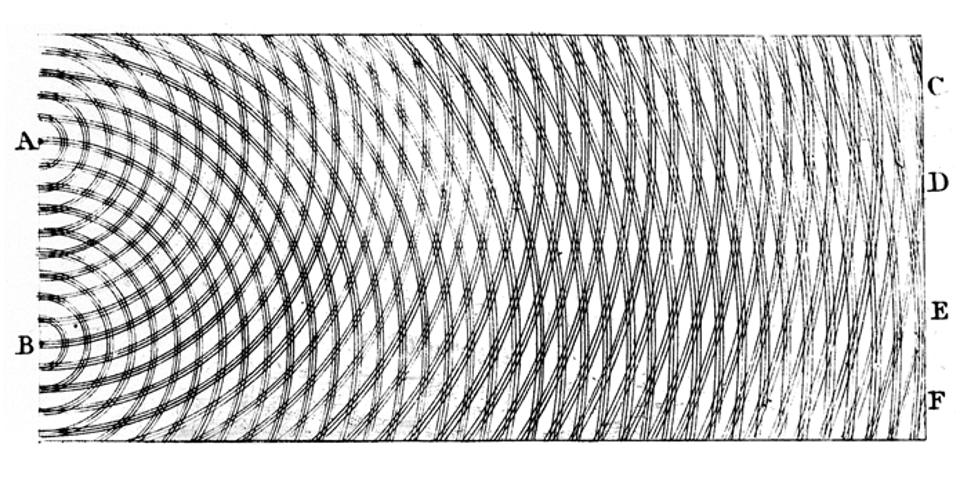
The wave-like properties of light, originally hypothesised by Christiaan Huygens, used an image derived from observations of water. Like waves in water, light waves encountering the edge of an object appear to bend around the edge and into its geometric shadow, which is a region that is not directly illuminated by a light beam. This behaviour is analogous to water waves that wrap around an object, instead of being reflected away.

The combination of an interference pattern with alternating regions of constructive (additive) and destructive (subtractive) interference is a hallmark of wave behaviour and as well as operating in water, it is seen in light and other electromagnetic energy types. However there is the dual nature of quanta to also consider, as they behave as both waves and particles depending on how you interact with them. Experiments have though revealed a wave-like behaviour for many different forms of matter, including forms that are significantly more complicated than the point-like electron. Composite particles, like protons and neutrons, display this wave-like behaviour as well. So the wave goes deep down into the structure of the universe, indeed physicists are looking to mathematically describe the wave function of the universe as a whole. A fluctuation of a quantum wave being perhaps at the heart of how everything began. 


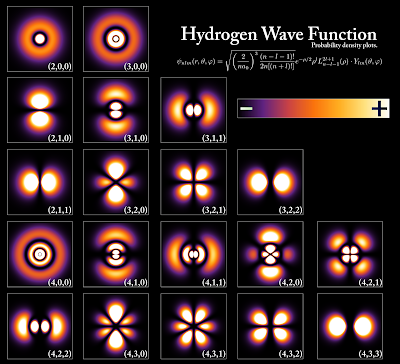
When developing a way of defining wave functions of an electron it was gradually realised that you needed three co-ordinates just as you do when defining a point using an x, y, z axis system. You need a principal quantum number that relates to the average relative distance of an electron from the nucleus and thus its energy level; the Azimuthal Quantum Number, which describes the shape of the region of space occupied by an electron, which in turn will define how the electron sits in the space it occupies and the Magnetic Quantum Number, that describes the orientation of the region of space occupied by an electron with respect to an applied magnetic field. The image above illustrates an electron in a hydrogen atom visualised at different probable energy levels. Quantum mechanics cannot predict the exact location of a particle in space, only the probability of finding it at different locations. The brighter areas represent a higher probability of finding the electron. 

The images that result from the process of visualising quantum wave functions are very similar to those we find when visualising sound or acoustic waves. A visualisation of the wave forms generated by a piano as an octave is played, being very similar to the one used to visualise the wave functions of an electron. Sound is a type of energy made by vibrations. These vibrations create sound waves which move through mediums such as air, water and wood. When an object vibrates, it causes movement in the particles of the medium. This movement is what we call a sound wave.
Sound waves like waves in the sea are longitudinal waves. This means that the propagation of vibration of particles is parallel to the energy wave propagation direction. When the atoms are set in vibration they move back and forth. This continuous back and forth motion results in high-pressure and a low-pressure regions in the medium.
Sound as such doesn't exist, however the rapid mechanical vibrations of various elastic bodies is transmitted to auditory nerves of mammals such as human beings, and are then translated by the brain into what we hear as sound as a way of understanding what is happening. Things need to be moved or struck so as to make them vibrate, and as this happens we observe another energy exchange. 
One of the best visual illustrations of how all this works is the Rubens tube sound wave visualisation, which graphically shows the relationship between sound waves and sound pressure, and which works as a type of sculptural oscilloscope.The original Rubens’ Tube used a four-meter section of pipe that had about two hundred holes across the top which were evenly spaced apart. Both ends of the tube were sealed shut, flammable gas was pumped into the pipe, and a speaker was attached to one of the ends. When the tube was filled with the flammable gas, there was only one route for the gas to escape through, thus creating a row of diffusion flames across the top of the pipe. Since the pressure inside the tube was equalised, the row of flames would stand at the same height. As soon as you play sound through the attached speaker, the height of the flames then changes. The height differences that you see are equivalent to the wavelength of the sound being played. The sounds that we hear are audible vibrations that require a medium to travel through. In the Rubens’ Tube, the sound waves that we hear from the music are traveling through the flammable gas within the tube. As the sound travels down the length of the tube, localised pressure areas will occur. When these areas of pressure are higher, the gas will escape the surrounding holes faster, creating taller flames. When the area of localised pressure is lower, the gas escaping the surrounding holes will cause shorter flames. These high and low-pressure areas are created by the sound waves traveling through the gas. In this way a spoken poem could become a fiery sculpture. 

Rubens tube: the sound wave is changing the internal gas pressure

Most of us are now used to editing sound on a computer and as we do we often see a graphic representation of the sounds we are editing in oscilloscope form. The image of three sound lines at the top of this post is a typical example. However for myself seeing a guitar string vibrating is perhaps the most fundamental idea, reminding me that the mechanical energy in a curving finger can be transferred to a taut metal string, which in turn transfers its metallic vibrational energies via the air to my ear. The fact that I cant see the air, makes the process far more magical, an unseen energy is out there and at times its propagating waves have affected me deeply. 
One of the fundamental things that art can try and do, is to visualise the invisible, be this the spirit world of an animist or the emotive feelings I have when hearing certain music and at the centre of my visual understanding of all this, is the wave form. 


If art is still capable of offering a transformative experience, I suspect it is in the making of structures that allow for the contemplation of this sort of awareness. In particular drawing as a way to make images has a breadth that allows us to communicate a scientific principle with a diagram, use materials as metaphors that reflect the way things operate out in the world, be a symbolic language that can carry ideas, as well as being able to present all these aspects together as a simultaneity; everything, the materials, the image and the way it is drawn, all these things can be seen and perceived at once, a wholeness which is in itself a deep metaphor for existence. Because of this, even at its most basic level, for instance when making an observational drawing of the perceived world around us, drawing can be a wonderful means of capturing a flow of ideas and percepts within a material framework that externalises thought and coheres it within the frame of a small sheet of paper.  


References

Wednesday, 8 April 2020

Faraday's lines of force


In my post on cross contour drawing I tried to explain how by making marks that moved over a form, you could create a much more powerful expression of the underlying mass that you perceived an object to have. However contour mapping is also used in another area of visualisation, that of electromagnetic fields and space/time diagrams. This type of drawing goes back to Faraday's idea of 'lines of force'. Faraday was an experimenter rather than a mathematician, therefore for someone like myself it is easier to see how his mind was working. He was trying to visualise what happens when two magnets are pushed together. If you have ever tried to do this, you will feel a very powerful push back when you bring like poles together. If you imagine thin hoops of springy metal connecting the two magnets at their north and south poles and then think of how they might bend as you try and push the two magnets together, you get the beginning of an idea of what I think Maxwell was thinking about, especially if the springy metal became more resistant the further you bent it. More recent analogies have used elastic nets to show how gravity creates curves in space, but Maxwell was initially thinking about magnets and the electromagnetic force.

Visualisation of electromagnetic lines of force

Faraday believed that reality was made up of force itself and by using model-based reasoning he was able to come up with a way of showing others what this could possibly be.   Maxwell, a mathematician, was then able to work with Faraday's ideas and put them into equations, but without Faraday's insight, we would not have a series of images to allow us to grasp what was being intimated. Faraday used a way of drawing that an artist such as Uccello used back in the 15th century, an approach that in the 19th century was now being used to illustrate some of the most difficult concepts in physics, a method that was to be vital to the way space/time diagrams would be drawn once the concept of relativity was understood. It feels to me as if this was very much an idea waiting for its time. A structural principle of this sort had been visualised several times before, but it never quite found the neat relationship that Faraday's idea of 'lines of force' carried in relation to the way it could be visualised. Instead of using these principles to visualise objects, forces and the way they interconnect things could be visualised. Perhaps Raymond Ruyer's idea that memory is not the property of bodies but that bodies are the property of memory, is more powerful than I thought, and that it drives how we develop ideas about how to visualise the world, as well as how the world itself is structured at a sub-atomic level. (See the next post, which is dedicated to Ruyer's ideas). 
 
Uccello vase


Representation of a cosmic black hole


Lines of force illustrating electromagnetic action

In magnetism the lines of force proceeding from like poles will be turned aside and if the poles are of equal strength, a plane bisecting, at right angles the line joining the poles, will separate the lines of force emerging one from the other, so that no line will cut the plane (Fig. 10). The pressure exerted by the molecular vortices in every direction at right angles to the lines of force will cause an apparent repulsion between the poles.


Once Maxwell had begun to turn these ideas into equations, it was evident that both electricity and magnetism were part of the same force, Einstein then at the beginning of the 20th century realises the same equations could help him think about space/time and eventually these what were separate concepts, also become unified. 

As an artist what interested me was how Maxwell began to visualise his ideas. He began with thinking about how water flows in a river. Then his ideas of how lines of water might flow were thought of as being analogous to lines of electric force, the velocity of the water being analogous to the intensity of that force. He then thought of dividing the volume of river water into tubes, these could then be seen as lines of flow. The advantage of putting the water into tubes is that you can then measure an amount of flow during any specific time. I.e. so many gallons per second. The idea was that where the river bed widens the cross section of each tube increases, Such a system of tubes, therefore, represent both the direction of motion and velocity of the water at every point, and could correspond, with a system of unit tubes of electric force. In my mind I began to think of a combination between the way iron filings can be used to reveal magnetic forces and how an artist like Leonardo began to visualise flowing water. 


Iron filings follow the lines of force between the poles of a magnet


Leonardo: water in motion
This type of visual thinking continued to evolve. Minkowski visualised Maxwell's mathematics and came up with a series of diagrams that would allow people to visualise events happening within fields. It was these diagrams that were then seen as applicable to space/time as well, thus the idea of fields were seen to be the things that lay behind both gravity and electromagnetism. Einstein's father was an electrical engineer, so he was uniquely positioned to recognise the importance of the electromagnetic field diagrams his father had worked with, when visualising other types of energy fields. 
Minkowski diagrams are two-dimensional graphs that depict events as happening in a universe consisting of one space dimension and one time dimension. The distance is displayed on the horizontal axis and time on the vertical axis. Additionally, the time and space units of measurement are chosen in such a way that an object moving at the speed of light is depicted as following a 45° angle to the diagram's axes.
Each point in the diagram represents a certain position in space and time, and is called an event.
The world line (yellow path) of a photon, which is at location x = 0 at time ct = 0.


Spacetime diagram of an accelerating observer in special relativity 

In the moving diagram above, the vertical direction indicates time, while the horizontal indicates distance, the dashed line is the spacetime trajectory ("world line") of the observer. The small dots are specific events in spacetime. 
If we then return to diagrams of black holes we can see both how they relate closely to Uccello's vase drawing and to Maxwell's idea of the way a river widens and narrows to constrict a flow. Even theories about the beginning of the universe can be illustrated by using similar curved nets. 

So when drawing mass, perhaps we are also drawing time, both could also be read as a material capturing of energy, the movements of arm and hand, traced in the left over deposits of graphite or ink or charcoal, an intuition of mass, realised via the capture of photons in a brain consisting of electro chemical exchanges that may or may not be subject to sub-atomic interference. 

Victor Newsome
In Victor Newsome's drawing of a woman in a bath, perhaps we can see an intimation of where these lines of force might take us, the bun of a woman's hair could also be a diagram of a galactic singularity engine, a ripple of water could become a doorway into the way we think about wave/particle duality in quantum mechanics.


I am of course looking at these issues with the mind of an artist not a scientist, but I can intuitively grasp the importance of trying to visualise these concepts and as visualising ideas is what both scientists and artists do, I would like to suggest that we are not people of different worlds but of different words. Take out the nouns and replace them with verbs and we have a series of events.


'A'

'B'

Victor Vasarely

Occasionally Victor Vasarely touches upon these issues, I often find his work too pedestrian,  too much like an art of filling in perspectival shapes in colour but at its best he transcends the process and creates images that are verbs rather than nouns. 

A long time ago I wrote about how we used to use what was then called 'giron and fess point' drawing in order to explore how the perception of a situation could be recorded through drawing. Those old posts have been returned to by Mike Croft in south east Asia, who has seen in them a way to open out an understanding of spatial perception in time. See his recent guest drawing blog posts. Now when I come to think about fess points I can see them as nodes, around which different movements oscillate due to certain attractors and this pattern I see as similar to spin networks within quantum space. This could be what has been called 'granularity'. The 'girons' perhaps being more like the lines linking moving nodes in image 'A', the lines of which at one point would have been seen as a way to visualise curved space. Scientists have long sought to bring together particle/wave theories and it would seem that the idea of nodes and events is helping to do this. In the meantime we have also to respond to the need to engage more with the destruction of the natural world and once again I would hope that the more we understand that we are totally entangled with everything else the more we might be inclined to be sensitive to our own actions and thoughts in relation to events, and be less inclined to measure our worth in terms of objects and possessions. 

Several of my recent posts have pointed towards a rethinking of the way we view objects and things. Instead of viewing the world as consisting of lots of individual things, I am beginning to see that reality could be simply a series of events. What I have been used to thinking about as discrete things actually being moments of encounter between one thing and another. I shall no doubt be returning to these issues again. 

See also: