This is the second post of the year devoted to future plans, (my new year's resolutions) and it is focused on my thoughts in relation to more sculptural concerns. As well as working small, I make objects that could be considered as 'furniture' for the mind. I think of them as furniture, as these are objects made to have a similar size relationship with people and are designed to play out roles within a space in a similar way to how I remember the furniture in our family house when I was a boy. Like actual household furniture, they can support *'tranculments'; objects put in drawers or niches or placed upon the sculptures as if they were shelving units or tables. This secondary display works to enable second order ideas to interact with the main formal construction. I have continued to collect thrown away items from my local streets, and to build constructions around them that shift between animal, vegetable and mineral realities; often using cardboard as the main building material, (a response to the ubiquitous Amazon deliveries and consequential need to dispose of many cardboard boxes). I have now decided that I need to begin varying the surface qualities of the objects I'm making, whilst at the same time preserving my constructions' abilities to have embedded within them or placed upon them, those odd items I find discarded by others, as well as objects that I make myself. (I think I will buy a robust blender to explore making my own paper, as Wangechi Mutu suggests.)
Making forms from cardboard and tape
Hybrid objects with found and made objects placed on them
Drawings of possibilities for 'furniture' sculpture
As I was drawing these forms it occurred to me that I could embed screens into the surfaces and make animations to play on them. I was in particular reminded of a radiogram with TV setup that my father once had.
Radiogram/TV
Idea for an animation insert
I was drawing the furniture/sculpture ideas on brown paper to echo the cardboard aesthetic that I had been dealing with, so I decided to use the same paper to draw a simple animation on, then I could test out how a moving image might sit within the forms I was thinking about, whilst keeping some sort of material connection. The radiogram wasn't the only item of furniture I was thinking about. A table with its crisp folded tablecloth, always sat ready for action in my grandparents' dining room and I wanted to make something that echoed this. The table was also a place where you could play and dream of alternative realities, so I have been making components to set out my own version of my grandparents' table.
Table thoughts
The remembered table objects of my youth animate themselves in drawing
These are in their own ways all imaginary tables
Some of the objects that have been made have forms sitting nicely between animal/human/inorganic ways of being. This ambiguity feels right and as I move on with this area of work, I would like to add in other ideas such as having some items being electroplated whilst also being component parts of larger forms, an idea I was thinking about a few months ago, but which I had to shelve because I was unable to stand to make sculpture due to suffering a severe case of plantar fasciitis.
An object with inserts
Realised objects exhibited
I've written about the animist world view several times, but it is in the making of objects that perhaps it is at its most succinct. A material can talk to you. As you work with it a common language develops that comes from a symbiosis between your own materiality and the demands of whatever material you are working with. It is this 'voice' that speaks with a tongue beyond myself, and that has a wisdom beyond the mind; a material knowledge.
Cardboard form with chair
Objects talk to each other and develop narratives as soon as they are conjoined. In the case above the chair and the cardboard form evoke a missing human and yet within their own realities move on beyond the human, intimating a post-human world, where wood and cardboard will find their own way.
Object built in response to a plastic chair
The 'creature' above evolved from a plastic chair, the arms of which became 'insect legs', another type of hybrid, that eventually had a cascade of plastic artificial ivy emerging from a hole in its carapace.
Sometimes a surface evolves that requires a different type of approach. The construction below began with a push along toy and parts of a Barbie House, both found in my street. The black and white drawings used to cover the surface and respond formally to the discarded toys, came from Steve Carrick's studio, and he brought them to me to use in any way I wanted. A collaboration with another artist, is not that dissimilar to a collaboration with a new material.
An idea begins
The idea evolves
The idea sparks off related ideas
Forms begin to merge
Back in Steve Carrick's studio the process continues
These objects have their own language, one that evolves as they come into being. In this case I realised that the surface had to have its own 'say' and once I allowed this to happen, a totally new (to myself) aesthetic began to emerge and this is why I have decided to explore surfaces far more during this new year.
I am still using clay, and this allows me to have a conversation with the earth. It in effect grounds me and provides me with casts of my fingers, as well as allows me to make objects that can act as inserts or additional forms, that can be implanted or embedded into the 'furniture' as it comes into being. I also use clay to tap into my unconscious. As I squeeze it and pull it, forms suggest themselves and this is another way to find what you were not looking for.
Because this body of work sits to one side of the research I'm doing in relation to the visualisation of interoceptual experiences, I have also decided to collect some of the documentation together and make a small artist's book. In particular, because I use recycled materials and am keen to promote this, I recycle these sculptures once they have been exhibited. Their shelf life is very short, but the ideas live on in the sculpture's documentation. By in one way signalling to myself that this run of thinking has come to a sort of conclusion, it hopefully allows me to take a slightly different tack.
As an artist embedded within a local community, I have also been having conversations and making drawn responses to what I believe are animist modes of thinking; types of behaviour that I particularly find in the ways that people engage with the objects and furniture in their homes. I also want to compare my findings with how people think about possessions who have been totally dispossessed of all their worldly goods and who have had to seek new homes in often strange new environments. These conversations are being made alongside the making of ‘objective’ drawings of people's 'significant objects' in order to come to some sort of ‘understanding’ of what is happening, conversations that when returned to inform the direction in which I take the drawings. The resulting images are then used to help formulate what could be described as imagery for secular myths. The second stage of this work is to merge the ideas emerging from this work into the implications that I think are coming out of the existing three dimensional aspects of my practice. In particular I am hoping that this area of research will effect the types of objects that act as inserts or additional forms, that I will use to engage with the furniture sized 'sentinel' constructions planned. All of which comes under a heading of 'home is a belief', something I'm going to have to write a separate post about.
*Tranculments: a Black Country word meaning 'ornaments and decorative objects typically found on mantlepieces, window ledges and other places around the house where mementoes can be displayed.
Two related ideas have become central to my own art practice and they are both formal and political in their implications. They are 'Hybridity' and 'Permeability'. Both these concepts suggest that a clearly defined, sharp edged, entity with boundaries is a problem and that rather than looking at the world as a collection of things, or atomising experience so that you can break it down into smaller components, you instead look at interrelationships, entanglements and processes that show how systems depend on their different parts working together. This means that for instance an image of a human being is something that needs to acknowledge the fact that it is in reality a hybrid form that is over 50% bacteria and that it is always in a process of becoming, which is an event rather than a thing and that it can never in reality separate itself out from its entanglements with everything else.
Hybridity has in contemporary theory several readings, and I have also had to take on board the fact that certain writers claim 'hybridity' as being of a particular importance to themselves too. I would therefore like to acknowledge all their contributions to various readings of the term as further evidence of 'hybridity' as a fertile term, out of which a more sensitive understanding of life emerges.
Hybridity can be seen as a cross between things, as a formal mixture of elements. This could be biological, for example a cross between a male lion and a female tiger is a 'liger', a hybrid plant emerges from the seed that is the result of a cross pollination between different plant varieties, in order to achieve this the female (pistil) of one plant variety receives pollen taken from the male (stamen) of a different plant variety. Hybridity can also be about human cultures. A hybrid is simply something that is a mixture between one thing and another. Hybridity has been a feature of virtually all civilizations and is created by trade, conquest and the fact that at certain times different people rub up against each other. Cultures borrow ideas that they find useful, this includes religions, philosophies, and science, but also art and languages. Our word 'hybrid' is derived from the Latin 'hybrida' or 'ibrida', which meant the offspring of a tame sow and a wild boar. In music Edward II is a wonderful example of a hybrid fusion between English folk music and Jamaican reggae.
Edward II 'Miles away'
In cultural theory hybridity has been re-appropriated by social and cultural critics as a challenge to fixed or essentialist accounts of identity and culture. Radicalised claims of purity of origins, such as those advocated by nazi theorists are refuted by ideas of hybridity that understand the breaking down of racial and cultural boundaries is a normative feature of societal development. Hybridity as a sociological concept recognises that identity is formed through encounters with difference. In particular, the condition of cultural hybridity has been explored by examining the post-colonial cultures of migrants which are based on fusions and translations between and of different peoples, cultures and places. If you are interested in reading more about this idea, one of the most developed theorisations of hybridity is by Homi K. Bhabha (See: The Location of Culture, Routledge, 1994) which does not consider it as merely the fusing of existing cultural elements. For Bhabha, hybridity refers to the process of the emergence of a culture, in which its elements are being continually transformed or translated through continuous encounters.
My own interest in the term also embraces how it was thought about by Mikhail Bakhtin, who used notions of hybridity to celebrate the idea of multi-vocal stories. This polyphony of voices was part of his idea of the 'carnivalesque' as (Clark and Holquist in Mikhail Bakhtin,1984: p. 4) put it, ‘a boundless world of humorous forms and manifestations opposed the official and serious tone of medieval ecclesiastical and feudal culture’. So yes, a hybrid can also be transgressive and funny and in being funny it helps to break down the rigid boundaries between things. Bhabha's ‘Third Space of enunciation’ (1994:37), is also a space for jokes, for freudian slips and a bit of daftness.
Permeability has traditionally been a term more related to science than art. It is defined as the ability of a substance to allow another substance to pass through it, especially the ability of a porous rock, sediment, or soil to transmit fluid through pores and cracks. However I have been rethinking it as a term that is essential to all life and its ability to maintain independence whilst at the same time acknowledging that interdependence is the only possible condition if that life form is to survive. If I look at myself, I am very permeable. I have a skin that surrounds me that is permeable, I intake solids, liquids and gases through the various mechanisms that my body has evolved to ensure that I am being constantly interpenetrated by the environment around me. I am designed to be very permeable. The science of Markov blankets suggests that all life forms or self-organising systems rely on an ability to interact with their surroundings in order to survive. It is argued that this ability to self organise is in fact an emergent property of random dynamical systems, which means that at some point order will not just emerge, but a type of order that likes to keep itself in that very order, as well as being able to interact with all the other chaos around it, will come into being. It has been argued that in order to maintain themselves, these orderly systems need to possess Markov Blankets, permeable surrounding areas that allow for interchange between various states of order and disorder. Therefore a human being's Markov blanket touches and interacts with the Markov blankets of other things and becomes part of a system that both includes it and these other things, in order to help itself self-regulate, whilst also forming necessary parts of other regulation systems that in turn help in the process of maintaining a state of homeostasis.
The formal consequence of this for my own thinking is that hard sharp edges between and around things are suggestive of organisms that are cut off from each other and therefore liable to die off and softer more open or vibrating edges that allow for things to pass through them are more likely to suggest permeability and states of entanglement with other systems and events.
Amoeba
The amoeba has a flexible permeable membrane, this allows it to exchange and interact with its surrounding environment, sometimes extending itself to surround 'food' whilst at the same time being able to allow waste products to pass back out into the surrounding waters. In order to visualise this it is better to use a dotted or dashed line to represent its edge or boundary rather than a hard continuous line.
Body as flux and spatial movement
One way of thinking about larger organic forms is to treat them in a similar way to how you might draw an amoeba, however very quickly the independence of the body begins to dissolve into its interdependence with the surrounding environment. This has created for myself a conundrum, and this is how far do I take the visual implications of my thinking? Hybridity might mean that I bring together different ways of visually representing an idea and this is where I am at the moment, making a series of images whereby I explore how hybrid visual methodologies can be used to create what I see as perceived images, or perceptions of the imagination. My current project is an attempt to set out an idea that suggests that images that arrive from or come from imaginative play, have exactly the same status for our decision making processes as images that arrive as direct perceptions.
An amoeba human hybrid
Hybrids meet
Our skin is not only porous it is a surface with embedded hair follicles and these are organised in such a way that the hairs take patterns or directions over the body. These patterns have evolved over millions of years as the best way to quickly direct rain water off a moving mammal's body.
Hair direction, front and back
We rarely think of this pattern when making representations of humans, but it is a reminder of our animal nature as well as visually a way of thinking about the dynamics of movement over and around a body. As an image it is both an imaginative interpretation of empirical research and a representation of perceived experience. I was very interested in how by keeping the two halves apart, this allowed the space surrounding the body to dramatically enter it from above and below as both invisible penis/anal hole and extension of the head's crown chakra down into the body. The previous idea I had of the body as a form of Klein Bottle would only work in four dimensional space but I still like the idea of it, perhaps though it needs to be animated so that time is more clearly present.
From worm to human Klein bottle to walking amoeba
As thoughts about forms evolve, so do thoughts about life itself, the one allowing the other to become what it becomes. This is a sort of evolutionary philosophy, a way of developing a reason for formal invention that is also a way of developing an attitude towards the world. It is not though a fixed idea, more a process that perhaps we all go through at some point, some people going through similar thought processes at a very early stage in their life and others much later on. In this case I'm reflecting on my own process at quite a late stage in life, and I am aware that it is a way of working that is idiosyncratic and which is no more 'right' than the millions of other similar processes other humans are also engaged with at this very moment. Perhaps by comparing and contrasting with your own approaches to these things it may help you become more aware of your own working methods, what it is unlikely to do is advance your analytical thinking and be useful as a 'proper' research methodology; this is art and not science and one of my personal guides in this process is whether or not it could also be funny.
Gerard E Cheshire is a writer I follow avidly. His interests are the deciphering of ancient languages and medieval plant biology. These interests bring together drawings of plants from a time well before both photography or 'scientific' illustration techniques, and a way of writing about nature that doesn't separate out daily human life experience, from nature observation and a need to embed thinking into wider cosmic narratives. There is a wonderful holistic experience to be gained from every one of the pages he studies. Cheshire is also very generous, he sends links out to his work in order to update his followers , such as myself, and every time I look to see what he is doing I am rewarded by fresh insights into how to approach something as apparently simple as drawing a plant.
This juxtaposition below is typical of Cheshire.
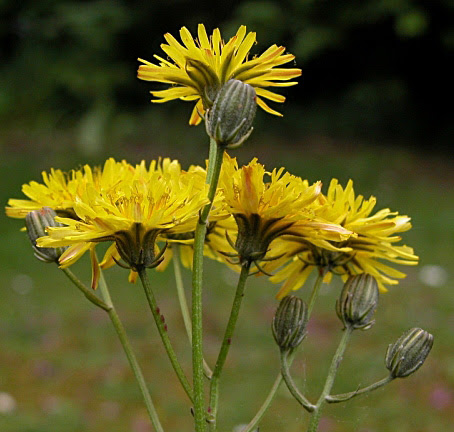
A photograph of the root of beaked hawksbeard, compared with its drawing from Manuscript MS408
On the left we have the reality of the photographic image, but the drawing takes us into much deeper realms. My first thoughts on seeing a field full of beaked hawksbeards this morning when I went for my walk, was how like suns these flowers were.
Hawksbeard
The flowers like dandelions radiate out from a centre, the evolutionary design for these flowers echoing the sun itself. You cannot escape the connection, as you walk through a field of these flowers and then look up at the sun, they are in many ways one indivisible experience of yellowness and radiance. Hold a flowerhead in your hand and it will turn your skin yellow as it radiates reflective light.
Cheshire then reminds us that the drawing of the root is done in such a way that we are imaginatively intertwined with four braids of Persephone's golden hair and that these represent earth, air, fire and water. Empedocles the philosopher invented the idea of the four elements in his text, 'The Doctrine of the Four Roots'; thus linking in imaginative terms, the base from which everything emerges to plant roots. The world itself, like a plant, grows. What a wonderful idea. Persephone of course had to spend half the year underground, the myth of her abduction and return to the surface representing her functions as the embodiment of spring and the personification of vegetation.
If we then look at the way the flowers have been drawn we see another wonderful complexity visualised.
The sun rising over the flower bud
When you see a beaked hawksbeard, it may or may not be in full flower. Sometimes it will take the form of a seed-head or an as yet unopened bud. A photograph will like the one at the top of this post perhaps be able to show us a couple of states at once. However the artist in this case has drawn a rising sun, emerging from behind the seed pod/flower bud. The flower will be a sun when it has emerged, and like the sun it will disappear during winter, only to emerge again next summer. What a wonderful image.
The full page depicting beaked hawksbeard
In the image above the leaves begin to move across the page as if their form is morphing between plant leaf and insect life and the text that accompanies the drawing is itself of great interest, and the deciphering of texts like this is another of Cheshire's skills.
From this plant can be derived, doses of ichor, the wisest medicine, and it can be beneficial to midwives and child bearing women, the sun's rays as caught in the plants flower, bringing benefits of health and happiness.
The text also operates as a poem, and as a cross between medical information, cosmic connections and everyday need. Please remember, this is also just one page, from one manuscript and Gerard E Cheshire continues to find these old manuscripts and translate them and publish his findings. I think in his quiet academic way, he is offering us something marvellous.
This one hundred year old camera has darkroom procedures embedded into itself and as its owner takes a photograph you begin to see the magic of drawing with light revealed all over again. Occasionally we need to remind ourselves how things work and how equipment that we take for granted is actually made. As we do so perhaps we will become aware that many of these devices are actually extensions of our own bodies. The stomach of this light machine being recycled plastic bottles, that now hold the developer and fix. The body of the camera is just that, a body. But it is also a room, a camera obscura or 'dark chamber', a room that morphs in size, so that when a hand enters into it, it compacts down to form a chest, but when looked at through the viewfinder that sits in its ceiling, it becomes the size of an art gallery. Its legs are adjustable, it can kneel as well as stand upright, tilting in sympathy with what it gazes at. As the photographer's hand enters the camera's side through a many times repaired flexible tube, we are confirmed in our awareness that this camera is the body's extension; the man and the camera becoming one. They are in effect folded into each other. Haji Meerzaman 'wears' his camera like a second skin.
The eye of this camera is based on the ones in our heads and as it opens itself to its user it reveals all the traces of their life long intimate connection. A clothes peg becomes a second pair of fingers to hold an extension in place, a black and white patterned fabric a second skin to envelop the hybrid animal as it transforms into the 'cameraman'.
A red filter is used so that the inside of the camera is lit with a red safety light, as any normal darkroom would be, but it also reminds us that our insides too are red.
Haji Meerzaman tilts the camera in order to get a better composition.
The developer and fix sit in the bowels of the camera
This sliding attachment is used to mount the photographic paper and to move it forwards and backwards in order to focus the image on the paper surface.
Haji Meerzaman's hand feels as old as his camera. We can just see the red glow of the safety filter light to the left.
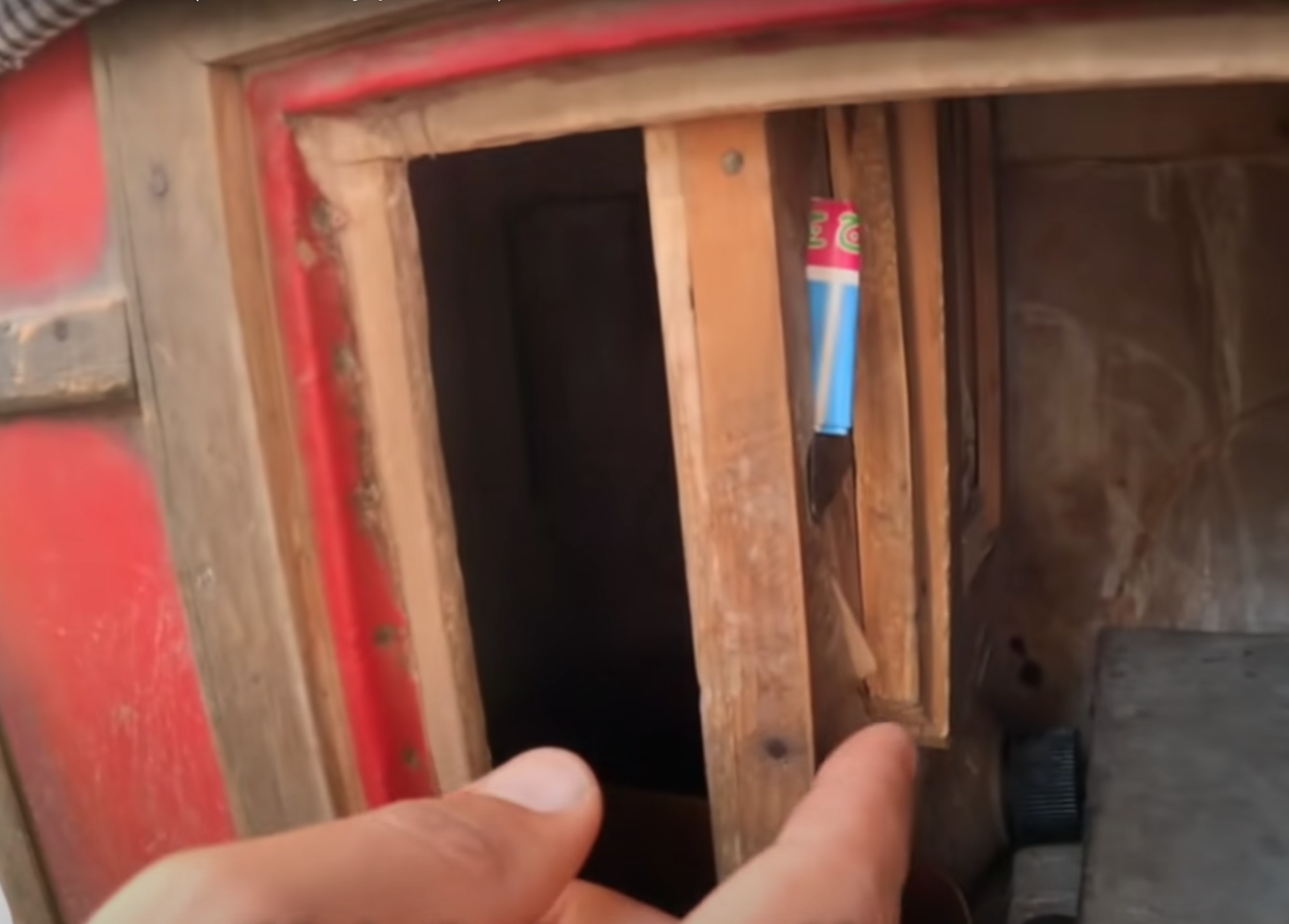
Two cardboard inserts are used to hold the bottom of the photographic paper in place, one of many repairs and adjustments that have been made to the camera over the years.
A many times repaired flexible tube emerges from the side of the camera. Haji Meerzaman's arm is fully covered as he feels his way into the dark enclosure of the camera, so that he can position the photographic paper and after his shot is taken, he will again snake his arm through into the camera's belly, this time to develop the paper negative.
The side of the camera is opened to show how the hand emerges into the operating space
Haji Meerzaman checks the focus while sliding the paper holder backwards and forwards.
As you pick up your digital camera or mobile phone, perhaps you can sense a similar thing happening. You are in effect extended into your device, a coupling of animate and inanimate beings creating a new hybrid. This is a form of contemporary animism, on old idea that has been with us for thousands of years, but which perhaps now requires revisiting. This man and his camera have grown old together. As the camera has broken through the normal wear and tear of use, he has repaired it over and over again. The popularity of BBC One's 'Repair Shop' testifies to the fact that we recognise the need to preserve things and that the life of things is deeply entwined with our own. As artists and makers everything we produce is similarly an extension of ourselves into inanimate matter, each artwork 'speaking' for us and continuing to speak for us even as we return back into the earth from which we came. The participants in 'the Repair Shop' often speak of their objects as family, as if their grandmother or grandfather in some way remains alive in the object brought in for repair. This is of course about love. If we are to value the world beyond ourselves, we need to be able to develop affection for all those things that are not us; trees, birds, streams, pebbles, pigs, landscapes and clouds, as well as old cameras and our mobile phones.