Showing posts with label permeability. Show all posts

Wednesday, 24 September 2025

The edges of drawings and things

I gave a talk recently to the Drawing Research Network, it was their 2025 conference entitled: 'Drawing Negation: Emergence' and was part of an online symposium. 

This is how my talk was introduced in the blurb that advertised what was going to be delivered:

Garry Barker’s presentation, 'The Emergence of Distinction in the Visualisation of Interoception: Drawing as a Boundary-Making Act', will explore the parallels between the inception of drawing as a distinction between one thing and something else, the evolution of human territoriality, and the conceptualisation of the universe’s origin. It argues that during workshops designed to help participants visualise interoceptual experiences; that it became important to develop an understanding of drawing as a primary act of distinction. Defining a somatic feeling is linked to the introduction of fundamental mathematical logic and biological processes observed in nature. By examining the philosophical underpinnings of Spencer-Brown’s 'Laws of Form' alongside the evolutionary context of boundary-making in animals, and the visualisation of embodied thinking through drawing, this presentation seeks to articulate how drawing reflects an intrinsic human impulse to mark territory and create meaning from the void of our own bodies.

The presentation posits the significant parallels between the moment a drawing begins, the territorial nature of human and animal existence, and our understanding of the inception of the 
universe itself and that the mark making that lies at the centre of the act of drawing, is in its most elemental form, a distinction-making process.

Using images made in response to the visualisation of interoceptual experiences, alongside images of mathematical set theory and animal territorial marking, the presentation will unfold relationships that are designed to illustrate how an evolution of signalling, from unicellular organisms to human art forms, reflects an intrinsic animal as well as material need to mark distinctions as we attempt to articulate our existence within the universe.

Reading the introduction again after a few weeks makes me cringe, but the core of what I was going to talk about is there. I was trying to get at some sort of ontological core, an attempt to look at what underlies certain types of abstract thinking and to suggest that deep down underneath their conception lies some form of reality that stems from how things are. In particular I was thinking about the idea of edges between things and boundaries.

A long time ago I put up a blog post about edges, which was where at the time my thinking was and as I've moved on somewhat since then, thought it time to revisit a pretty fundamental question, where are the edges of a drawing? A question that is inseparable from another one; where are the edges of anything?

This is not as simple a question as it might seem and in my presentation I explored the idea of a drawing's edges being about boundaries and I further argued that boundaries were themselves concepts that had emerged from the evolution of all animal species. So what did I mean?

Diagram of an amoeba

In my drawing of an amoeba above I have used a dashed line to define its edges, rather than a continuous one. This is to suggest that an amoeba's boundaries are permeable. If not the amoeba would not be able to catch food and eat it, it would also not be able to remove waste. On the other hand if it had no boundaries it would simply dissolve out into the water it lives within. We are as a biological entity, very similar to the amoeba and we also need to bring certain things into our bodies, such as air and nutrients as well as have ways to remove waste materials. Our bodies are constantly being interpenetrated by sweat, urine, liquids, food, faeces, snot, air, wax and mucus, there being a constant going into and coming out of the world into which we are embedded. 


I thought this diagram of the body was interesting, as it transforms it into a flat rectangle. It is now in essence no different to a sheet of paper. All drawings of the body flatten it out, but they often include visual clues that remind us that the body is in reality a three dimensional object. Greenberg reminded us that when engaged in making art on a flat surface, any form of illusion designed to make us think that what we are looking at is 'real', is in effect a lie. I suspect therefore that he would have far preferred the drawing of the body above to the one below.

Max Brodel: The throat

I have written about Max Brodel's work in an earlier post and I commented upon his attempts to give heightened realism to his images by developing unique methods of textural manipulation, so that his surfaces resembled the 'wetness' of our insides. These images in effect 'suck us into' the paper on which they are made. We are pulled through the paper's boundary by an act of illusion. 

However information still needs to flow in and out of a drawing and as its edges are where it meets the rest of the world, we can in our minds, begin to see a close analogy with the amoeba drawing above, as well as with the flattened out image of the body's various systems whereby it interacts with the exterior world. 

Every drawing sits within the world

As it is looked at a drawing is constantly in some sort of exchange with the perceiver and the surrounding world. There will also, as in any communication, be a lot of wastage, whether we like it or not. What interests me in this instance, is the fact that what is percolating in and out of the drawing is often unknown, but you sense it is something. The drawing is in effect changing the world, just as the drawing's situation in the world changes it. 

The space between the edge of a drawing and the world

Deridda has written extensively about the space between the edge of a drawing and the surrounding 'real' world and he uses the term ‘the parergon’ to describe it. He understands this space as one that is always coming “against or beside, the work that has been done", he states that "it touches and cooperates within the operation, from a certain outside, but neither simply outside nor simply inside”. He uses, after looking at drapery and colonnades, an example of the frame to explain what he means. (Derrida, p. 24, 1979) The space indicated by a frame being the boundary between the way we think about art and the way we act within the world. In my 'frame' drawing above, the space/frame includes traces of the marks I used to indicate various passages between a drawing and its environment, the space/frame being activated by the exchanges. 

Edges are strange things. As I look around me I see a table top, it has edges, the sort that are defined by an abrupt change in direction. My eyes sweep horizontality across the desk surface,  and then as I come to its edges, each one stops with a dramatic vertical drop. This experience is a common one associated with furniture. On the table top is a laptop computer. It too is seen to lie in a horizontal plane and has a vertical drop at the edges of its now closed screen, but the  drop is no more than a centimetre, therefore I see the laptop as belonging in some way to the table, it sits within a shallow space that appears to unify several other items that are also lying on the table. A book, some sheets of paper, an old I-pod. They are all rectangular and have edges. Their horizontality is defined by the table top, if the table top had been raised on one side to form a steep angle, all of these objects would also have had to follow suit, until they began to slide down the table top and fell onto the floor. They are also all perceptually permeable. Each one acting in a slightly different manner as it interacts with the wider world. 

For instance the book is something that as an object can be opened and closed. It is clearly entitled 'Picasso's Animals'. As I open it I'm faced with a text about Picasso's relationship with goats. For his 75th birthday he wanted a goat and although one did not arrive on his actual birthday, two did eventually materialise. Why do I remember this, perhaps because it is my 75th birthday this week and I have had great difficulty thinking about what people could get me. A goat was not on my birthday list and if I had put one on it I doubt if anyone would have responded. Once closed the book presents me with an image of a Picasso drawing of an owl, its eyes made from a photographic collage of cut out human eyes,  eyes that I suspect came from a cut up photograph of himself. The book is an object with very clear boundaries or edges, but it is leaking into my mind, because my perceptual apparatus embraces it within a visual and tactile framework, that is wired into all my brain's existing preconceptions. 


The lap top computer is now open, it has to be open so that I can type the words I'm typing. I had to break or cross a boundary to get in. I needed to put in a password on opening the computer by raising its lid, which itself contains its screen. It's edges or boundaries appear to be very different to the book. It is linked to invisible things such as the Internet and an electricity supply. I can push a memory stick into one of its ports and pull information out of it and interact with it myself directly by pushing down on the various keys in front of me. Like the book I can read text as it appears on the screen, as I do from an open page, but I can also create text, as I do now. I am sucked into the interface by a variety of engaging interactive components and it feels even more porous than the book. It not only seems to leak into my mind, it seems to be feeling out other minds too, this blog page, will as soon as it is published be available to all sorts of people, many of whom I have never met. 

There is a drawing on the desk, it is drawn on an open right side notebook page and sits next to couple of written notes that were made on the left hand page. The writing states:

He will live on in memories.
Order sealing wax. 
To send off a skimming stone for Oscar. 
Ken tells me Oscar is dead.
He does not publicly mourn his son.

The writing reminds me of something I need to do. A private ritual that will mean nothing to anyone else but myself. The words on that page, leaving the table and yet not leaving the table. They can be read by others but without an understanding of the full context. It's getting dark and I'm going to stop typing for a while, I shall return tomorrow morning and when I do, as I walk into the room I will again see these items lying on a table top, initially inert, reserved within their respective boundaries, their edges though begin fraying, as soon as I enter the room.

The edges of these things are their surfaces, but most surfaces when you get very close to them become full of holes. In particular paper is extremely perforated. 

Microscopic view of a 'flat' paper surface

In order to contain an image, we often put a frame around it. The frame reinforces our awareness of the edge in two directions. A frame puts glass or transparent perspex material over the top surface of a drawing and a wooden surround around its four edges. The surface acts as a type of boundary membrane, but so do the edges, which can also be seen as a type of boundary. In fact if we hold up the drawing within a frame such as those devised by Lina Bo Bardi, we can see clearly that the back of a drawing is also permeable to our gaze. 

Lina Bo Bardi: Glass easels

As I have already pointed out, Derrida used the word 'parergon' to define a sort of "supplement" to the main thing. Think in this case of a drawing being the main thing and its frame a secondary object. However Derrida being Derrida, decides that this relationship between the core and the periphery can be reversed. The supplement, the outside or secondary object, can be seen to be the centrepiece. Without a frame, the thing framed "cannot distinguish itself from itself". In my mind Derrida's frame is a sort of psychic space around an object that allows it to be itself and yet also interact with the rest of the world. This is the amoeba solution. Its boundaries need to be permeable. If not the object or drawing or thing, would not be able to nourish or maintain itself and if it had no boundaries it would simply dissolve into the surrounding environment. This is I realise another animist interpretation, but as a materialist, everything has I believe at some point to be able to merge and interconnect with everything else. 
Derrida as a writer often thinks of things as bookish realities, at one point describing the parergon as a book's liminal text. A liminal space is one such as a doorstep, a place between things, a space you need to pass through in order to get from one space to another. It can be thought of as a mediator, something that helps us to become engaged with the main event. In Derrida's mind perhaps a title, a foreword, a preface or even an index or commentary. In this case the help may become a far more potent item 
than the original text, by being more succinct and therefore more understandable, the supplement now becoming the driver. Lina Bo Bardi's glass easels are sometimes more visually powerful than the drawings or paintings they are meant to display, by framing the artworks in a new way, we are encouraged to approach them differently, we may for instance spend as much time exploring the back of an image as its front.
 
Thinking about the edge of things, eventually opens out an issue about 'thingness'. The idea of a thing is that it is separate from other things. But as I have pointed out, all things are in constant interconnection. Communication between things suggests that the edges of things are always frayed and that things bleed into one another. If we get close enough to things we can see how porous they really are, all living things requiring points for the surrounding world's entry and exit and all inorganic matter needing to engage in the quantum flux of spacetime, which enfolds everything in its various energy fields. The edge is therefore a boundary that is in reality simply an idea, a concept that allows us to decide where one thing begins and ends, rather than it being any sort of fixed reality. 

We should never forget that when animals set out to define their territory, that boundary within which they live most of their lives, many of them do so by using their body's waste products, either defecating or urinating to mark out the perimeters. The micro project of an amoeba, becoming an evolutionary reinvention on a macro scale. Once a territory is defined an animal can begin to think about doing other things, as they are no longer having to constantly think about how to defend borders, their olfactory signs doing that for them. Perhaps these signs can be thought of as first drawings, being both markers and definitions of physical space, that are also intimations of a creature's need for a mental space within which to do something more than just survive. 

Rhino marking territory

Reference:

Derrida, J. & Owens, C. (1979)The Parergon October, Vol. 9 (Summer, 1979), pp. 3-41 (39 pages) https://doi.org/10.2307/778319

A recording of the Drawing Research online symposium, where you can listen to the talks given, including my own.

See also:

Edges


Monday, 2 August 2021

Hybridity and permeability

Two related ideas have become central to my own art practice and they are both formal and political in their implications. They are 'Hybridity' and 'Permeability'. Both these concepts suggest that a clearly defined, sharp edged, entity with boundaries is a problem and that rather than looking at the world as a collection of things, or atomising experience so that you can break it down into smaller components, you instead look at interrelationships, entanglements and processes that show how systems depend on their different parts working together. This means that for instance an image of a human being is something that needs to acknowledge the fact that it is in reality a hybrid form that is over 50% bacteria and that it is always in a process of becoming, which is an event rather than a thing and that it can never in reality separate itself out from its entanglements with everything else. 

Hybridity has in contemporary theory several readings, and I have also had to take on board the fact that certain writers claim 'hybridity' as being of a particular importance to themselves too. I would therefore like to acknowledge all their contributions to various readings of the term as further evidence of 'hybridity' as a fertile term, out of which a more sensitive understanding of life emerges.

Hybridity can be seen as a cross between things, as a formal mixture of elements.  This could be biological, for example a cross between a male lion and a female tiger is a 'liger', a hybrid plant emerges from the seed that is the result of a cross pollination between different plant varieties, in order to achieve this the female (pistil) of one plant variety receives pollen taken from the male (stamen) of a different plant variety. Hybridity can also be about human cultures. A hybrid is simply something that is a mixture between one thing and another. Hybridity has been a feature of virtually all civilizations and is created by trade, conquest and the fact that at certain times different people rub up against each other.  Cultures borrow ideas that they find useful, this includes religions, philosophies, and science, but also art and languages. Our word 'hybrid' is derived from the Latin 'hybrida' or 'ibrida', which meant the offspring of a tame sow and a wild boar. In music Edward II is a wonderful example of a hybrid fusion between English folk music and Jamaican reggae.  

Edward II 'Miles away'

In cultural theory hybridity has been re-appropriated by social and cultural critics as a challenge to fixed or essentialist accounts of identity and culture. Radicalised claims of purity of origins, such as those advocated by nazi theorists are refuted by ideas of hybridity that understand the breaking down of racial and cultural boundaries is a normative feature of societal development. Hybridity as a sociological concept recognises that identity is formed through encounters with difference. In particular, the condition of cultural hybridity has been explored by examining the post-colonial cultures of migrants which are based on fusions and translations between and of different peoples, cultures and places. If you are interested in reading more about this idea, one of the most developed theorisations of hybridity is by Homi K. Bhabha (See: The Location of Culture, Routledge, 1994) which does not consider it as merely the fusing of existing cultural elements. For Bhabha, hybridity refers to the process of the emergence of a culture, in which its elements are being continually transformed or translated through continuous encounters. 

My own interest in the term also embraces how it was thought about by Mikhail Bakhtin, who used notions of hybridity to celebrate the idea of multi-vocal stories. This polyphony of voices was part of his idea of the 'carnivalesque' as (Clark and Holquist in Mikhail Bakhtin,1984: p. 4) put it, ‘a boundless world of humorous forms and manifestations opposed the official and serious tone of medieval ecclesiastical and feudal culture’. So yes, a hybrid can also be transgressive and funny and in being funny it helps to break down the rigid boundaries between things. Bhabha's ‘Third Space of enunciation’ (1994:37), is also a space for jokes, for freudian slips and a bit of daftness. 

Permeability has traditionally been a term more related to science than art. It is defined as the ability of a substance to allow another substance to pass through it, especially the ability of a porous rock, sediment, or soil to transmit fluid through pores and cracks. However I have been rethinking it as a term that is essential to all life and its ability to maintain independence whilst at the same time acknowledging that interdependence is the only possible condition if that life form is to survive. If I look at myself, I am very permeable. I have a skin that surrounds me that is permeable, I intake solids, liquids and gases through the various mechanisms that my body has evolved to ensure that I am being constantly interpenetrated by the environment around me. I am designed to be very permeable. The science of Markov blankets suggests that all life forms or self-organising systems rely on an ability to interact with their surroundings in order to survive. It is argued that this ability to self organise is in fact an emergent property of random dynamical systems, which means that at some point order will not just emerge, but a type of order that likes to keep itself in that very order, as well as being able to interact with all the other chaos around it, will come into being. It has been argued that in order to maintain themselves, these orderly systems need to possess Markov Blankets, permeable surrounding areas that allow for interchange between various states of order and disorder. Therefore a human being's Markov blanket touches and interacts with the Markov blankets of other things and becomes part of a system that both includes it and these other things, in order to help itself self-regulate, whilst also forming necessary parts of other regulation systems that in turn help in the process of maintaining a state of homeostasis. 

The formal consequence of this for my own thinking is that hard sharp edges between and around things are suggestive of organisms that are cut off from each other and therefore liable to die off and softer more open or vibrating edges that allow for things to pass through them are more likely to suggest permeability and states of entanglement with other systems and events. 

Amoeba

The amoeba has a flexible permeable membrane, this allows it to exchange and interact with its surrounding environment, sometimes extending itself to surround 'food' whilst at the same time being able to allow waste products to pass back out into the surrounding waters. In order to visualise this it is better to use a dotted or dashed line to represent its edge or boundary rather than a hard continuous line. 

Body as flux and spatial movement

One way of thinking about larger organic forms is to treat them in a similar way to how you might draw an amoeba, however very quickly the independence of the body begins to dissolve into its interdependence with the surrounding environment. This has created for myself a conundrum, and this is how far do I take the visual implications of my thinking? Hybridity might mean that I bring together different ways of visually representing an idea and this is where I am at the moment, making a series of images whereby I explore how hybrid visual methodologies can be used to create what I see as perceived images, or perceptions of the imagination. My current project is an attempt to set out an idea that suggests that images that arrive from or come from imaginative play, have exactly the same status for our decision making processes as images that arrive as direct perceptions. 

An amoeba human hybrid

Hybrids meet

Our skin is not only porous it is a surface with embedded hair follicles and these are organised in such a way that the hairs take patterns or directions over the body. These patterns have evolved over millions of years as the best way to quickly direct rain water off a moving mammal's body. 

Hair direction, front and back

We rarely think of this pattern when making representations of humans, but it is a reminder of our animal nature as well as visually a way of thinking about the dynamics of movement over and around a body. As an image it is both an imaginative interpretation of empirical research and a representation of perceived experience. I was very interested in how by keeping the two halves apart, this allowed the space surrounding the body to dramatically enter it from above and below as both invisible penis/anal hole and extension of the head's crown chakra down into the body. The previous idea I had of the body as a form of Klein Bottle would only work in four dimensional space but I still like the idea of it, perhaps though it needs to be animated so that time is more clearly present. 


From worm to human Klein bottle to walking amoeba

As thoughts about forms evolve, so do thoughts about life itself, the one allowing the other to become what it becomes. This is a sort of evolutionary philosophy, a way of developing a reason for formal invention that is also a way of developing an attitude towards the world. It is not though a fixed idea, more a process that perhaps we all go through at some point, some people going through similar thought processes at a very early stage in their life and others much later on. In this case I'm reflecting on my own process at quite a late stage in life, and I am aware that it is a way of working that is idiosyncratic and which is no more 'right' than the millions of other similar processes other humans are also engaged with at this very moment. Perhaps by comparing and contrasting with your own approaches to these things it may help you become more aware of your own working methods, what it is unlikely to do is advance your analytical thinking and be useful as a 'proper' research methodology; this is art and not science and one of my personal guides in this process is whether or not it could also be funny. 

See also:


Monday, 5 July 2021

Paul Klee and Markov blankets

The mind in the body in the world (study for stained glass)

Biological systems are autonomous, or self regulating. We tend to think of the things inside a biological system, such as a forest as being lots of separate things, but they are all interdependent, however when each of the elements is looked at it can appear as if it has boundaries. For example an individual tree can be thought of as just that, a tree. But it cant exist as that, its roots tap down deeply into the soil and its leaves are breathing in carbon dioxide. I.e. although for the sake of identification it might be useful for us to be able to nominate a tree as a separate thing, in reality it is an event or aspect of a process. But we can also think of a collection of atoms we call a tree being nested within another set of atoms we call a forest. The boundaries of biological systems, from individual cells to trees (or indeed people) can be thought of as the supporters of free energy, or places where that energy meets other forms of energy and where interactions take place that help to stabilise the entity. If so, something called a Markov blanket can be used to define its boundaries in a statistical sense, i.e. instead of a solid wall you have a series of probabilities whereby something is and isn't at the same time, called in this instance, the active inference scheme. You can infer something is in existence but when you look at it directly it hardens up and becomes a fixed probability. If this sounds like something from quantum mechanics, well it sort of is. For a long time physicists have realised that things are only fixed as they are if you look for them. On a larger scale a collective of Markov blankets can self-assemble into a global system that itself has a Markov blanket that links it to the larger universe; these linked autonomous systems can therefore be understood as having layers of nested and self-sustaining but permeable boundaries. It has been proven mathematically that any living system can be described as a Markov blanketed system and, this is the interesting thing, that the boundaries of such systems need not be co-extensive, or extending over the same area as the biophysical boundaries of a living organism that exists within it. I.e. there is a certain amount of give and take. If you look at the diagram below try to think of the dark spots as a tree, or at least the tree event or fluctuating core of what we tend to think of as a tree. However as part of a Markov blanketed system the edges of 'tree-ness' are not that clear and the tree extends out into the surrounding system, lets say the air or the soil, whereby it is hard to differentiate tree-ness from soil-ness or air-ness. Moving the light grey dots about will eventually disturb the pattern of the dark dots, but on a good day the pattern is pretty predictable statistically and on the whole the dark dots are stable enough for long enough to be at times seen as a tree or whatever else words try to isolate from the situation. Everything is though never static, hence the animated gif version. 


Object/space folding into Markov blankets

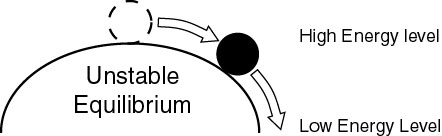
If you randomly generate a mess of dots, apparently after a time these dots begin to form patterns, i.e. free energy systems eventually appear to become self regulating. As I'm into diagrams at the moment perhaps another diagram might help. If I place a ball on top of a smooth curved hill as in the diagram below, it is unstable and will seek stability by rolling down until it reaches the ground and a state of stable equilibrium.


But as a human being you tend to take your ball, (your head) and have it kept in a vertical position. If it was up to physics we would be always be lying flat on the ground (lowest energy level), i.e. we tend to spend most of our lives in a state of unstable equilibrium. This is because we are part of a system. If you look at things as separate entities they work as separate entities. We know a lot about parts but very little in comparison about wholes. But a tree is as we have seen, a part of a system. This situation is called an open systems exchange. Energy, matter and information all enter and leave the system, forms can change, interactions occur and energy can be stored and released. These systems are regulated by feedback loops, which can be either positive or negative. Earth as a whole is warming up and cooling because of these systems, and we have seen this as part of our awareness of how global warming works. If the ice caps are large they form bright, reflective surfaces and they will reflect more of the sun's energy back into space, therefore less heat remains on the Earth's surface; thus cold conditions lead to more cold. However, when air cools, it holds less moisture and relative humidity goes up and condensation will occur. Condensation is water changing from its gas to its liquid state. In a gas there is a lot of energy being used to keep all those atoms flying around at a distance from each other, but as the situation cools down the gas becomes a liquid which needs less energy to maintain its form and the energy has to go somewhere. This energy is known as the latent heat of condensation. The latent heat of condensation then starts to heat up the surrounding air and leads to subsequent temperature increases. Our bodies operate very like this, interconnected feedback loops allow us to regulate our body temperature, blood sugar levels etc.


The diagram immediately above is a different way of representing a Markov blanketed system, but the one made of dots is more like the real situation. The boundary between one thing and another is never a nice sharp line, it is a permeable membrane that is constantly in movement as it adjusts to an ever changing world, so perhaps its better to think of the line of curvature more like the curved line in the image below, something rhythmically punctuated and permeable. 
Representation of an outer edge of a Markov blanket

The image above is an image whereby I was trying to visualise a body immersed into its environment with a permeable boundary allowing information to pass from one part of the system to another. The image at the top of this post was a different attempt at making an image whereby the figure and ground distinction was removed by thinking about the image as a design for stained glass. The floor, the bodies and the surrounding room space, interpenetrate each other as flat planar structures. I have also been thinking about scale and our bodies can be scaled in a variety of ways. For an ant climbing up my leg it is a huge landscape, and when I look out over my chest and down to my legs and my toes, I find another landscape type experience. But as I step away from myself, (an interesting idea in itself) I can see myself as a body, and I'm in portrait mode or human scale. However as you move out and away from the situation my body becomes a mere speck on the horizon. I am in relation to much larger visions, such as world, solar system or galaxy totally insignificant. (See this earlier post for details as to how this works)

This ability to think about scale changes is helpful because it allows us think about different types of boundaries. For instance at a molecular scale our bodies are composed of elements such as sodium, potassium, calcium, and magnesium, and each has a specific electrical charge. Our cells use these charged elements, called ions, to generate electricity. The contents of a cell are protected from the outside environment by a cell membrane. This cell membrane is made up of lipids that create a barrier that only certain substances can cross to reach the cell interior. (I have looked at lipids before in a post about why ink sticks to paper and I thought then that there were deep metaphors that could be constructed from the way they operate) Not only does the cell membrane function as a barrier to molecules, it also acts as a way for the cell to generate electrical currents. Resting cells are negatively charged on the inside, while the outside environment is more positively charged. This is due to a slight imbalance between positive and negative ions inside and outside the cell. Cells can achieve this charge separation by allowing charged ions to flow in and out through the membrane. The flow of charges across the cell membrane is what generates electrical currents. Cells then control the flow of specific charged elements across the membrane with proteins that sit on the cell surface and create an opening for certain ions to pass through. These proteins are called ion channels. When a cell is stimulated, it allows positive charges to enter the cell through open ion channels. The inside of the cell then becomes more positively charged, which triggers further electrical currents that can turn into electrical pulses, called action potentials. These action potentials are what we think of when we become aware of ourselves doing things. Our bodies use certain patterns of action potentials to initiate movements, thoughts and behaviours. Which is great, but when it goes wrong we have a disruption in our network of electrical currents, which we usually call illness. This is something I'm particularly aware of because I have a heart condition, for my heart to pump, cells must generate electrical currents that allow the heart muscle to contract at the right time. Irregular electrical currents can prevent heart muscles from contracting correctly, and this is why I have an irregular heartbeat.

 
Memory of a feeling tone

As we become aware of interroception a fusion occurs between the memory of exterior perception and an interior somatic awareness. The image above was constructed as part of a series of responses to remembering how it felt to have a painful bunion. This was then contrasted (below) with an image made when actually in pain.

Image of a pain

Paul Klee suffered from scleroderma an autoimmune condition that happens when the body’s immune system starts to attack itself. Damage by the immune system causes excessive inflammation and increased production of collagen, leading to scarring or fibrosis of the body’s tissues and organs, hence the name, 'scleroderma'. His own artwork you could think of as a way of visualising the internal working and structures of art itself. His 'Pedagogic Sketchbook' being a sort of Gray's Anatomy of the visual world. It was as if he wanted to reveal what lay under the skin of all that Victorian figurative painting.  

I have been returning to Klee's work as a loadstone or check-in to help me with my next steps in trying to visualise the invisible. How to translate the feeling tones that emerge from the inner body into visual images and it has been a back to basics experience, and has forced me to get rid of a lot of visual baggage.

Klee: Äliup, 1931. Watercolor and pencil on paper on cardboard, 47.9 x 31.4 cm

Klee's world begins with the potential of a dot. More than one dot creates energy, either a balance or an in-balance is created and as these two situations are created and uncreated 'life' begins to emerge from the surface of the paper. As the surface becomes animated moments of more concentrated energy occur, in the case above forms emerge picked out in dark lines, and in the image below shapes become intimated, they drift one into the other and occasionally pop into being, such as the archway or the circle. 

Klee: Ad Parnassum 100 x 126 cm

I found that by returning to Klee's work after many years, that it seemed as fresh and as inspiring as it did all those years ago when I first encountered it. In the image below we find lines now taking over the image making load, they gradually become signs, but are still also just lines, nothing is fixed but at the same time we can see forms emerging. These images feel very like music, they touch us with their rhythmic pulse, like small creatures, we can feel their heartbeat as we hold them.  

Klee: untitled. 

Last week I was able to visit the Pallant House Gallery in Chichester and they had a Paul Klee image on exhibition. Titled 'Clouds' it was stunning. A delicate line image was constantly emerging from the centre of a floating cloud of darkness. The tonality was handled so subtly, that it was hard to see how it was achieved, until you realised that he must have used layer after layer of thin washes to achieve an effect as if the darkness was an integral part of the paper rather than something applied to it. The thin ink lines that drifted in and out of the dark, were like so many of Klee's lines 'going for a walk', lines that were looking for an idea to become, a form to make, always in a moment of becoming rather than an idée fixe. The image was far too delicate to photograph, so you will have to imagine it, and perhaps that's a good thing, we are looking at too many images on line at the moment and we can tend to think that's how they are, but only certain things look good on a screen and it's important that we don't forget that. 


From a series of drawings of the body as a self-aware entity

See also:

A growing series of posts that follow the evolution of an idea