Showing posts with label memory. Show all posts

Saturday, 8 November 2025

The art of memory


From: An Intuition of the Bare Two Oneness

I was thinking about Frances Yate's wonderful book, 'The Art of Memory' the other day. I haven't read it for many years but I was reminded of it because not long ago the artist Rosie Vohra had been asked to make a personal selection for exhibition within the Leeds Arts University library and she had chosen an artist's book that I made over 40 years ago, 'An Intuition of the Bare Two Oneness'. I wrote the text for it at a time when I was under the influence of Yates' book and some of the images directly reflect the types of structures she used as illustrations in the book. Looking at the images again I was reminded of the fact that I was also trying to make sense of computer technology. We had been trying out a new type of wax printer, that took wax coated paper sheets of cyan, magenta, yellow and black and ran them one after the other through a series of rollers that passed underneath a heater, whilst at the same time thousands of pins  pushed down on the sheets in the areas designated by your design, that had been converted into CMYK separations, thus transferring the wax to the print paper. It was a clumsy process and we only ever had that one printer and it was never replaced. However, because there were now four layers of wax, there was a certain richness to the surfaces laid down and I wanted to make use of that. The final images were printed off and bound together with a text that I had typeset also using a computer and that I thought was it. At the time I thought it was a very good piece of work, but now on re-examining the book I realise that I ought to have bound glassine paper into the book between pages, because over the years the wax has begun to rub off onto the facing pages. However the fact that the book was out on display gave me a chance to photograph it and of course rethink what I might be able to do if I revisited the idea. 

From: An Intuition of the Bare Two Oneness

Frances Yates introduced me to several ideas that have cropped up again and again in my work; in particular because memory enhancement was part of rhetoric training and rhetoric was about getting your ideas across to other people in memorable ways. Something that as an artist I'm constantly having to think about and as a former lecturer who used to introduce students to communication theory, I owe it to myself to always remain aware of these issues. 

Playing with the idea of what comes where in terms of a visual hierarchy

Since making the book, I have become much more interested in animism and ideas that touch upon a 'flat ontology' or level playing field, when we come to look at our relationships with other things. The medieval idea of the great chain of being, a hierarchy with God at the top, followed by angels, humans, animals, plants, elements (fire, water, etc.) and finally, inanimate objects like rocks at the bottom, is still in many ways how human beings think of the world and how it relates to them. Perhaps because of the spread of atheism, God and angels no longer have pride of place, but that often means that we humans then take top spot. In my watercolour image above, a cow has reached the top of the stairway but is about to fall down, leaving a field of wheat in top spot. I was playing with hierarchies, trying to subvert the order of things as usually pictured by humans.

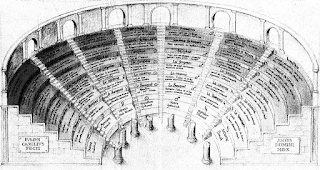
However going back to Yates and her explication of how memory training was used, in particular in relation to Cicero's work on rhetoric, one of the big issues was making images that were startling in their appearance and also linked to what you want to remember by some sort of likeness. For instance, testis is a Latin word for “witness” and was used in Cicero's time in relation to witnessing one's manhood, therefore the words testify, testimonial and testament share a common etymology with the word testicle. Cicero at one point suggests that in a speech, if you want to remember that now is the time to speak about certain legal matters, you could mentally place a giant pair of testicles at a particular spot within a building that you were in your mind walking through, to help you remember the various components of your speech. It's a good image and one I must try out as a drawing at some point. We have all at one time or another tried to remember stuff and have realised that we can do this much easier if we can find a link to something else, especially a link that also takes a memorable shape and locates what we are trying to remember in a pictured space that you can mentally hold in your mind. For instance; if you want to remember a shopping list, you can visualise each item in its place on the shelves of a supermarket. Then you can picture yourself walking through the various aisles and picking up what you need. A renaissance memory theatre operates in a similar way; theatres, such as the Globe, were places most people knew, just as a supermarket is now. Therefore in people's minds they could visualise the structure. Aisles and rows of seating could be set out in a way we are all familiar with and to this day we still go to a theatre or cinema, expecting to make our way to row H, seat 12 etc. It was a space that was easily cross referenced and particular spots pinpointed. Within this space, you could then place the various things you wanted to remember. However certain theorists at the time, such as Giulio Camillo, went further and decided that they could control the system and give it an overall structure that related to that idea of the great chain of being, a hierarchical system, that fixed into place and ordered all things.

Giulio Camillo's Memory Theatre

This is how Frances Yates describes Giulio Camillo's Memory Theatre; 

“The Theatre rises in seven grades or steps, which are divided by seven gangways representing the seven planets. The student of it is to be as it were a spectator before whom are placed the seven measures of the world ‘in spettaculo’, or in a theatre. And since in ancient theatres the most distinguished persons sat in the lowest seats, so in this Theatre the greatest and most important things will be in the lowest place. That there would be no room for an audience to sit between these enormous and lavishly decorated gangway gates does not matter. For in Camillo’s Theatre the normal function of the theatre is reversed. There is no audience sitting in the seats watching a play on the stage. The solitary ‘spectator’ of the Theatre stands where the stage would be and looks towards the auditorium, gazing at the images on the seven times seven gates on the seven rising grades."

My present day version would be the memory supermarket, shelves stacked with knowledge packets instead of cereals or frozen foods, the fresh food aisles being now places to find new untested ideas, the cleaning products section perhaps devoted to philosophy and ways of thinking, such as the use of Occam's Razor. The bread shelves might be devoted to staple knowledge and the cake section where you might find titbits of information. The science of electro-magnetic fields might begin with the electrical goods section, whilst chemistry was located in the cooking supplies area and biology located where potted plants are. I think you get the drift.

James Joyce was fascinated by Giordano Bruno, who was one of the inventors of the art of memory. In Ithaca, the 17th part of Joyce's Ulysses, Leopold Bloom stops “chanting” a Jewish “anthem… in consequence of defective mnemotechnic”; a reminder that in his mind Joyce was both trying to bridge between the everyday and the mythic and build a memory structure in order to do this. He uses everyday events as a series of triggers to reference Homer's Odyssey; this final chapter of Ulysses recounts the very mundane events that happen as Leopold Bloom takes Stephen Dedalus home to number 7 Eccles Street for a cup of cocoa and to discuss the night's experiences; the chapter's title being an allusion to Odysseus's return home to Ithaca. Joyce suggests that every day is a journey and in its own way that journey can be as eventful as the voyages of Ulysses. 

The chapters of Ulysses in their own way are also therefore a type of memory structure, the important issue for myself being that everyday events and things can be used to help us think about big issues. I have written a blog post about the hand as a memory system, (as always check out the 'see also' section at the end of each post), a reminder of how much of our thinking is embodied.
The linking of things by finding connections is also something that can be used in the construction of magic and is the reason ritual objects have the power they have. In order to work, magic objects must have a point of contact with something that gives them traction or meaning, the contact if not directly physical, usually being a likeness of some sort. This process is termed the 'Law of Similarity' or 'Sympathetic Magic'. It can also operate by 'touch' which is a very physical connection. For instance a witch doctor could curse the ground that you might walk on; if so you will need protection, to stop that curse getting into your body. This is why historically in India and China and in many other cultures, people used to wear ankle bracelets. A curse would need to pass up and through the ankle, in order to get into the torso, which is the seat of all our vital organs and a charm bracelet worn around the ankle could prevent this. The bracelet also acting as a physical reminder of the need to be mindful of psychic attacks. 


My work developing contemporary votives at one time overlapped with the design of charms, each one a response to a conversation about someone's worries. The charm bracelet above was designed as a type of three dimensional memory object, each charm shaped to reassure the wearer that some sort of psychic protection was in place. Gradually I was becomming aware of things like memory beads, rosaries and South American quipu, all external to the body and operating as recording or memory devices that began with touch and yet were also to be seen. They were of course operating as external brains.

References:

Barker, G. (2023) Votives and Charm Bracelets Materialising Health-Related Experiences Through ‘Sacred’ Objects. In: Wearable Objects and Curative Things: Materialist Approaches to the Intersections of Fashion, Art, Health and Medicine. Palgrave Studies in Fashion and the Body: Palgrave Macmillan, London

Joyce, J. (2010) Ulysses Wordsworth Editions

Lakoff, G., & Johnson, M. (2008). Metaphors we live by. London: University of Chicago press

Yates, F. (2014) Giordano Bruno and the Hermetic Tradition London: Routledge

Yates, F. (2014) The Art of Memory London: Bodley Head

See also:


Friday, 11 April 2025

Drawing the dead and the dying


Images from the time of my mother dying

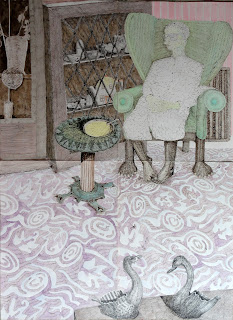
When my mother was dying I used to go down to my home town every weekend to see her and sit with her. I drew her several times and when she finally passed away I made images from the drawings as a way to come to terms with how I felt about her death. She was always surrounded by her 'tranculments', which had by then mainly been placed in glass fronted cabinets, but several, such as the swan vases or a toby jug, still adorned any spare surface, such as the top of the TV. I could find myself dizzy with the carpet pattern, often just looking for somewhere to rest my eyes, and when they rested on her, she seemed the most insubstantial thing in the room. I have a drawing of her where she literally dissolves into her chair and others where she becomes manic in her distress or lost in her bed. One drawing I made of her in bed, shows her dissolving into the pillow, whilst the bedspread becomes a repository of stories from her life. I drew all sorts of events that she had told me about, including the time when her sister Mary had trapped her foot in a rail line junction point, and how they were terrified a train would come. I tried to remember when she was happy and times when we were together, but there were many sad times too. Eventually the bedspread was covered with memories. 
When I first met Paulo Luís Almeida, he was giving a talk about his own response to a parent dying. He drew his father during the last years of his life as he succumbed to Parkinson’s disease, and Paulo spoke about the erosion of language and the disappearance of his father's world. Paulo went on to say that drawing 'incited a memorialising function of the trace'. Empathy was in his case the key issue, whilst for myself it was simply loss.

Paulo Luís Almeida: Untitled 2011

Maggie Hambling drew both her mother and her father as they were dying. 


Maggie Hambling

Hambling's drawings use a searching line that I feel attempts to give back life to the dead. Her own energy of looking is locked into these images forever, and when she has herself passed on, she will still exist in the frozen moments of her looking. 

Occasionally Foundation students used to ask me if they could get to draw dead people and the only person I knew at the time that had a way in to do this was Brian Holmes. I remember that I drew his portrait at one time, as he used to live just around the corner from where I lived in Kirkstall, however where that drawing is now I haven't a clue and he is now long dead, a reminder that every portrait ever made is in fact a memento mori. Brian was at one point commissioned by the School of Medicine of the University of Leeds to paint a mural detailing the history of Leeds Medical School and that meant he had access to their facilities, including the dissection area.

Brian Holmes: Detail of Leeds Medical School 

Brian Holmes: Foot: Etching

Brian used to go in to the anatomy area and draw bodies and could occasionally, if asked, get a student to go in with him. One of the students that asked me if he could get access was Damien Hirst, who always asserts that he was influenced by his visits to the anatomy department of Leeds Medical School and that he made anatomical drawings there. None of these drawings seem to have surfaced, but the photograph 'With dead head' has become an iconic part of his oeuvre. I'm not even sure if Brian was able to get Damien in and Damien may well have found a different way to get access, the point being that it was his association with the ever present idea of death, that to some extent signalled him out at the time as an artist of significance. 

Charles Emile Callande de Champmartin
Théodore Géricault was well known for painting and drawing the dead. In fact the image above was thought to be by him until a cleaning revealed the signature of his friend and follower Charles Emile Champmartin. Ironically the painting actually depicts Géricault himself on his deathbed. At the time, he was such an iconic trope of the tragic Romantic artist, that copies of his death mask were often found in young artists’ studios. 

Géricault: Deathmask

We all have to confront death at some time, it is a normal part of life and most cultures have embedded within them ways to come to terms with this fact. Except I feel our own, where we rarely see dead people.  Perhaps we all need to remember that we are dying, and in doing so, we might value life that much more. 

Head of the dead Christ: Durer

During the many years that Christianity formed the dominant religion of the Western World, images of the dead or dying Christ were available for everyone to see. People were constantly therefore being reminded of how death was a central fact of life. In traditional Buddhist teachings, contemplating death is an integral part of meditation. Buddha states that death is “the greatest of all teachers”; it teaches us to be humble, destroys vanity and pride and crumbles all the barriers of caste, creed and race that divide humans, for all living beings are destined to die. 

Kusôzu

Perhaps we need a return to the old Japanese Buddhist tradition of Kusôzu, whereby images were made of the sequential decay of a cadaver; not pretty but a clear message. The Roman Egyptian idea of encaustic "Fayum portraits," which were placed over the heads of mummies in coffins, is an interesting take on mortality and portraiture. These were not only realistic depictions of the deceased, the images were kept on the walls of the houses of the living and then when someone died they would be transferred to the coffin. So you would have been very aware that when the artist came to do your portrait, that its final resting place would be the same as yours. Being made in encaustic, which is an amazingly long lasting paint material, your image would like Dorian Gray stay youthful, whilst you would decay like Gray's portrait. Wilde's neat role reversal idea, in many ways highlighting our mortal condition.

A Fayum portrait

If I had to show one image that transcended the genre it would be the one below by Käthe
 Kollwitz. Kollwitz drew the workers that she met, particularly women who struggled to keep themselves alive under the most harsh conditions. In this image the woman you feel can see her own death in a not very far off future, a black ghost already sitting at her shoulder. But at the same time Kollwitz has found a deep humanity in this woman, she is a solid yet wonderfully delicate presence, on the one hand to be blown away by the trials of a hard life and yet on the other she is preserved, rock like, in all her dignity within Kollwitz's drawing. She is always in that moment that she appeared to Kollwitz, time past, present and future unravel and we are forever in the now of her being. 
 
Käthe Kollwitz

See also:

Dat

Artis

Sunday, 28 April 2024

Home is a belief

I'm very interested in the idea of belief. So much of my work with interoception relies on belief. Votives can only work if someone believes in them, and so do charm bracelets. When people begin to talk to animals and plants, they implicitly believe that some sort of communication is being made and belief lies at the core of an ability to think like an animist. 

So where do we encounter these beliefs in an everyday situation? How many of us rub a particular object 'for luck', or have special plates or knives and forks that we always choose just because they feel right? We wear odd socks to interviews because we believe that this brings us some sort of hidden advantage, or at least did do once. Objects remind us of special occasions or stories. They operate as doorways into the past, or even as some type of ancestor worship. 

'Shrine' object made for a collaborative project

If homes were temples, they might evolve various alters, special holy of holy sites or shrines. As homes evolve, family members will organise spaces to reflect some sort of belief systems; children in particular will build 'shrines' with actants within them consisting of various soft toys or creatures that they have built up a deep, almost spiritual relationship with, but the adults will also organise spaces where they put family mementoes or examples of past sporting triumphs or memories of holidays taken. 

When we were all confined to our homes because of the covid emergency and associated lockdown, there were articles written to help us come to terms with the home as a sanctuary. (E.g. https://www.hildacarroll.com/treating-your-home-as-a-temple/) It was suggested that people 'think of their homes more along the lines of temples'; they were asked to think about setting a home up as "your (and your family’s) personal sanctuary for your mind, body and spirit." I found this approach fascinating, people were even told that they could, "smudge their space by burning incense or herbs."  The opening of windows it was suggested allowed fresh air (energy or chi) to circulate through a home and that plants would bring vital living energy into a home's spaces. People were also asked to review the art and other knick-knacks around their home. In particular they were asked "do they symbolically support the journey you wish to take going forwards?" How important the home surroundings were was summed up by the need for being "uplifted by the space." In these popular articles it was intuitively understood that a house and its contents were psychically active and that these things affected the people that engaged with them deeply. 

I am also aware that many people of different faiths have home shrines and that these might be built alongside structures arising from more quotidian activities such as the clustering and building of collections of ceramic animals. Some of these activities can seem very like 'animist' belief systems, but they can happily exist alongside more formal religious systems. My initial attention has been focused on those people like myself, that profess no formal religion, but who still seek to achieve some sort of spiritual or psychic relationship with the world we inhabit. In both cases, formal religious activity or an identifiable spiritual need, a material focus can be used to help us meditate or contemplate on things beyond the everyday. 

A vessel for contemplation: Terracotta bowl, filled with water up to the level of inbuilt boat

The vessel above was made to help with my personal contemplation of world events; in this case I made a terracotta bowl, with an attached boat centrepiece. When I poured water into the bowl from a jug, sometimes I could judge the level correctly and water would sit at exactly the level of the side of the boat, but if I judged the amount wrongly, then it would in effect 'sink' the boat. I had to pour the water very carefully if I was not to 'soak' the tiny terracotta figures that crowded together in the centre of the boat shape. This handmade vessel in effect operated as the focal point of a personal 'shrine'. 

I recently delivered a talk to the 5th 'Drawing Conversations' conference about 'Home' as a belief, whereby several strands associated with this aspect of thinking were drawn together. 

In the presentation, two sets of images were compared, both of which emerged from conversations. One set of drawings had been made almost 10 years ago after talking with a refugee living in a repurposed high-rise block of flats and another set of images were recent ones made in response to conversations made in relation to how someone felt about a ‘special’ object they had set out in an important place within their domestic environment. I have been talking to people about their collections of special objects, or the placing of significant things within their homes, to get an idea of how intuitions sometimes need to use material objects as ways to focus or make real, unidentified feelings. These objects were chosen because they meant something spiritually important to the people that lived with them. In both cases drawing was used to reveal narratives that had emerged from human/object relationships and as these narratives unfolded, two different world views were articulated, and revealed as being as much to do with fiction as reality. If felt at times as if the people spoken to had travelled in opposite directions as imaginary travellers, but both had also in different ways had to face a harsh reality.   A third ‘life story’, this one happening in real time, was then interjected, both as an example of how the threads of stories about ‘home’ could be drawn together and of how life events are inseparable from political realities. 

The first story opened out an idea that visualised a tower block as a fictional home. A story told to myself as the image of an actual tower block was drawn in a small sketchbook. This story became the starting point for a series of drawings that attempted to visualise a refugee's dawning awareness of how unwanted immigrants are. The images were also an attempt to show how utopian ideas, such as the Modernist architecture of the tower block, could become inverted, and things that once symbolised hope, now seemed to symbolise despair.

Home

The Mythic Tower

Cut adrift and pushed out

Tipped back into the sea

The invisible ceiling 

The sea

Arrival

The Last of England

As migrants arrive after surviving the harsh realities of various sea crossings, they are mentally tipped back into the seas they crossed by the very people that they thought would welcome them. 

In the intervening years I have returned to this and similar stories several times. Hopefully with more care.

Tales of protection and prayer and the loss of lives.

More recently, a story is told of a long gone trip to Thailand, of a wooden baby that came back from that trip and how the baby lives on in the imagination of a post stroke victim, who remembers better days and a magical time spent in the jungle. 

Tales of a wooden baby and flying fish

A tale of a man who found a wooden baby and flying fish

During the night the jungle changes the baby

The baby in the jungle became a metaphor for something emerging from the subconscious

The baby and Buddha

The baby grown old

I was told a story whilst I made drawings, by a man who when young had experienced the 'hippy trail' in South East Asia, a story focused on memories that were triggered by a wooden carving of a baby Buddha that sat on a coffee table in the middle of his living room. I was also during this time, on evenings, reading another story, one that was focused on an exotic jungle, Chris Beckett's 'Beneath the World, a Sea'. In my mind the stories became fused, Beckett's vision seemed to me, to be of the unconscious mind becoming a landscape reality, as if the strange jungle described in the book, with its pools of other worldly waters, was a physically manifest unconscious, that was tapping into and revealing the subconscious desires of any character that entered it. Perhaps I thought, the remembered jungles of Thailand were like this too. The prints that then emerged from the drawings, became more and more hallucinatory; the passage of an ever growing old baby through imaginary jungles, becoming a journey into the subconscious. 

But suddenly, because of events happening, there was other story to respond to, one that was far more urgent, that needed immediate actions to be taken, in order to resolve the issues arising. 

A neighbour from the Gambia has been picked up by the police and sent to Yarl's Wood detention centre and has been told he will be deported to Rwanda. Our community is a small but tightly knit one in times of trouble and we begin the process of contacting local councillors and MPs, finding specialist immigration solicitors and trying to reassure our now locked away neighbour and tell him that help is on its way. He has already witnessed an attempted suicide. A situation made even worse, because he was then beaten up by the man he tried to save from hanging. Life in the detention centre, or so it seemed to the man our neighbour saved, was worse than death. 

This is no home; this is a Hellhole

Eventually after a concerted effort of several people in the local community, our neighbour is released from Yarl's Wood on bail and he has returned to live in our street. He has horror stories to tell of a system that is in total disarray, one that is used by government to reassure the population that the administration is tough on immigration. Sound bites such as 'stop the boats', covering a reality that is about human misery and suffering on a scale that we have yet to get an idea of. I was happy to join in with my other neighbours, writing letters and badgering important people in order to effect his release, but a series of threats to his wellbeing still remain. In particular, there is a perception of gender in many African countries, that still operates in a similar way to how it was in England before homosexuality was legalised. The difference is that punishment in relation to any perceived deviation from the norm, is often far more draconian. These serious issues mean that any further attempts to return our neighbour to Africa, will need to be resisted forcibly.  

Another group of drawings begins to emerge; I am still making images of what I'm told and these often become surreal depictions of life experiences, however I do realise making a drawing isn't going to release someone from custody, but what it might do is raise someone's awareness of a situation, or these drawings might begin another story, a story that makes people aware of the continuing struggle that many people face, in order to be just who they are. 

Tuesday, 1 August 2023

The Magic Slate

Magic Slate

Today is the first day of my retirement and of course at the end of any period of your life you tend to reflect back on what you have achieved. As I reflected I automatically checked to see if I had any work e mails, and was reminded of how quickly you are wiped away by the institution you have worked with. My work e mail had already been taken down, I no longer had an electronic presence and if course all of those files that record the many and various activities I have worked on over the last 48 years are no longer accessible and have probably been wiped. It was I realised rather like I had been working on a Magic Slate for all those years. However, as always I shall try to turn my experience into a post about something to do with drawing. 

The Magic Slate is a children's drawing toy that was invented in the USA by R. A. Watkins in 1923. Besides being a toy, it is also often used as an erasable message board and communication device for people unable to speak.

A stylus is used to write or draw on a transparent plastic sheet which when pressed down creates an impression on the layer beneath. This layer transfers itself to the back of the plastic sheet where the stylus has pushed it into the waxy backing. The “magic sheet” is lightly attached to the card surround, so that it can be lifted away from the wax backing by a sliding bar when you have completed your drawing or writing and need to erase it. The most interesting aspect of this arrangement is that the resinous wax layer that exists behind the plastic sheet retains etched into itself traces of all the previous impressions. 

Sigmund Freud once wrote an essay about this very process, 'A note upon the Mystic Writing Pad'.  He wrote the essay to explain his theory of memory and used what he called the 'Wunderblock' (the German name for a magic slate) to illustrate his ideas. The outer coating or transparent sheet on which we read the writing or drawing represented for him the protective layer of the mind. He writes that the layer protects the mind from too much excitation and that if this thin layer is torn or contaminated (in Freud's day thin transparent paper was used instead of transparent plastic), the Wunderblock would cease to work, in the same way that trauma can irreparably damage the psyche. The stylus for Freud representing a stimulus from the outside world. The papery layer is the conscious mind and the wax resin is representative of the unconscious.

Freud thought that the mind retained impressions of memories in the unconscious. This is why a forgotten trauma can still effect how we emotionally operate, even long after an event. The main difference between the magic slate and the mind being that the mind's traces can come back and disrupt psychic life, especially in dreams and after trauma. 
Freud wrote, "The permanent trace of what was written is retained upon the wax slab itself and is legible in suitable lights." Therefore it could be argued that Mystic Pads have a particular kind of memory. Freud went on to state, "I do not think it is too far-fetched, to compare the celluloid and waxed paper cover with the system of Pcpt-Cs. (Perception-Consciousness) and its protective shield, the wax slab with the unconscious behind them, and the appearance and disappearance of the writing with the flickering-up and passing-away of consciousness in the process of perception."

A writer on the Electronic Labyrinth website takes the idea further and points out that Derrida in 'Freud and the Scene of Writing,' states that perception is itself a kind of writing machine like the Mystic Writing Pad. The marks on the pad are not visible due to the stylus leaving a deposit on the sheet of plastic, the marks only becoming visible because of the contact the wax has on the reverse side of the sheet of plastic, which Derrida argues, is also the case in perception. None of us apprehend the world directly, but only retrospectively; our sense of that which is beyond ourselves is the product of previous memories, previous writings. "Writing," says Derrida, "supplements perception before perception even appears to itself" (Writing and Difference 224). Accessed from: http://www2.iath.virginia.edu/elab/hfl0257.html

The Mystic Writing Pad, then, is for Derrida a model of the primacy of writing, of the way in which we can only ever experience the world after the fact, through traces of previous experiences and through the signifiers which are for Derrida in effect the condition of being.

What is intriguing about this is that a process of image making can also become a metaphor for how the mind works. In my recent post on drawings as storage devices I was trying to articulate  a similar concept, if drawings are thought about in a certain way they can also be seen as a type of battery as well as a material metaphor. The process of making drawings produces something far more than just the mechanics of how they are made. By extending Freud's metaphor, another insight from the Mystic Pad essay could be that what makes the human mind distinct isn't just its "layers" for perception and storage, it is also about the nature of traces and how they can be understood. Because a trace is by its very nature only a fragment that is left by contact with a much more complex entity; these traces have to be interpreted and in their interpretation we rarely achieve accuracy. This could be a even deeper metaphor for how perception operates.

Using a magic slate to make a small animation

Because the transparent plastic sheet that overs a magic slate is very reflective, any drawing you do is hard to see and your body is reflected in its watery like surface. In trying to make this basic animation, I began to realise that it had another potential metaphorical direction, one that was about trying to write on water, a concept akin to walking on water, but with the vague presence of the author appearing to float around and mingle with the images. Something to return to perhaps another time. 

References:

Derrida, J. (2001) Writing and difference. London: Routledge.

Freud, S. (1991) A Note upon the Mystic Writing-Pad, General Psychological Theory.

The Electronic Labyrinth 

See also:

Drawings as aesthetic transducers 

Drawing devices

More drawing devices

Using viewfinders

Saturday, 4 February 2023

Memory Drawing and hands

An old memory drawing test exercise

Memory drawing used to be a vital part of an artist's training. The image above is of a glass slide found in a skip in Newport recently. I would have been really interested to have seen what the rest of the slides looked like, but this found image conjures up a pretty good idea of how one particular examination worked.
Many years ago I read a biographic novel about the life of the artist Gainsborough. In the novel, (whether this was based on fact I don't know) Gainsborough had set up a still life in his cellar and had put a canvas on an easel in his attic. He hated climbing stairs, so this meant that if he was to minimise his climbing time, he would have to memorise the still life really clearly when down in the cellar, so that painting time in the attic was productive. This scenario has stayed in my head, so it must have had some use as a mnemonic. When I tried to work with the same situation myself, I found it almost impossible to carry in my head the necessary detail to make a good accurate drawing in the top floor studio. The process of climbing four flights of stairs demanded a lot of physical effort and this seemed to drain away the energy needed to hold an image in the mind. Like many things, if you are to develop the muscles, (both physical and mental) you need to train regularly.

However there are many other ways of developing memory as a useful mechanism in relation to image making, most of which involve the image maker providing helpful memory frameworks for the audience. This being the case, I would like to remind everyone who is making drawings or images of any sort, that visual memory training is a discipline with a long tradition and that it is one well worth looking at if you are to become more astute when making decisions as to how your images will become memorable.


Drawing on paper from Mogao Caves

In the past our own bodies have often been used as memory machines, and they are much easier to work with than full blown memory theatres as described in Frances Yates' wonderful book, 'The Art of Memory'. A book that everyone should read, simply because it helps us to understand how our brains need structures within which to save memories and even more importantly, that memory structures need images associated with them if they are to become 'memorable'.

Guillo Camillo's Memory Theatre

Memory theatres are though huge and costly things and there are other ways to achieve similar ends, in particular our hands can be used very like mini versions of these theatres, fingers replacing the aisles that were placed between rows of information seating. The process of bringing together certain associations or particular images in order to trigger memories, quickly begins to create bizarre forms, and hands in particular seem to lend themselves to both imaginative play and to support materialised thinking in relation to numerical ideas and visual representations of structural principles. 

One of the most ambitious of hand mnemonics was presented by Girolamo Marafioti of Calabria in a 1602 treatise on the arts of memory. The system consists of a map of ninety-two manual loci; twenty-three on the front and back of each hand, each housing a different geometric symbol: a crescent moon, a chalice, a circle with horns and what looks like a lemon. To use the system, one assigns a to-be-remembered thing to each locus. One might, as Marafioti suggests, use it to remember a group of people arranged by status, age, or other characteristics. The system compresses the features of a memory palace and makes the whole edifice fit into the shape of a hand. 

From Girolamo Marafioti’s 17th-century treatise on the art of memory, De Arte Reminiscentiae, demonstrating the use of loci 

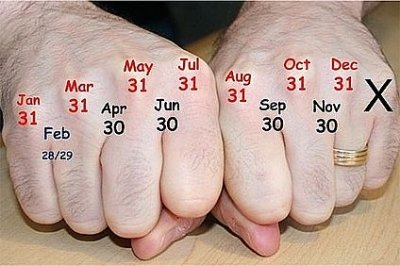
Using hands to visualise numbers of days in months

We have all played this one: 
Here's the church and there's the steeple, open the doors and there's the people

What began as a post to remind everyone of how important visual memory is, is now becoming a post about hands and how they can become the starting point for memorable image invention. So I'll save the stuff about artists' visual memory teaching for another post and look at hands and how they have been used as memory devices. Yes my mind flits around all over the place, but it's the way it operates best for me and hopefully, eventually all these diversions will make some sort of sense. 

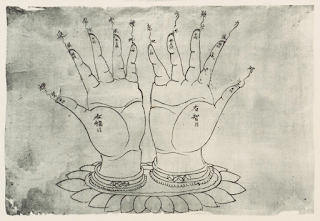
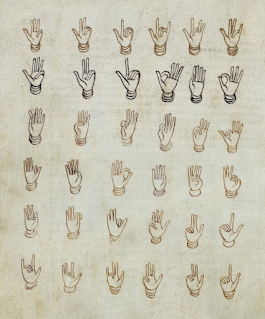
The hands (above) of the Chinese image from the Mogao Caves were drawn over a thousand years ago and are annotated with Chinese characters on the fingertips that give a specific name to each digit; above that, on a second row we find the names of the five Buddhist elements: space, wind, fire, water and earth and a final tier, floating upwards as if on kite strings, lists the ten virtues. The drawing illustrates a mnemonic system, that helps the viewer to make connections between elements and virtues. At about the same time in England, the monk Bede came up with a treatise called 'The Reckoning of Time', in which he laid out a method for determining when Easter would fall on any given year. These two systems both deal with the issue of materialising thought. As Barbara Tyersky puts it, "When thought overwhelms the mind, the mind puts it into the world". Those of you that regularly follow this blog will be well aware of how important I believe 'materialising thought' is; without a way to externalise thought we become trapped in our own minds and making images is one of the best ways of doing this.

Bede. Diagram from 'The Reckoning of Time'

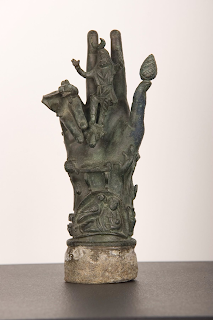
In ancient Pompeii a bronze sculpture of the Hand of Sabazius held images of protective symbols for the house owner. Sabazius, the god of vegetation and the guardian of women in labour, is often depicted in the palm of a hand, but it is the other symbols that emerge from the hand including a nursing mother, a crow, a table with offerings and a serpent, that make these hands such fascinating objects. These strange hands are memorable precisely because of the fact that they are strange, but their strangeness is one driven by a very normal desire, the need to seek divine protection. 

Hand of Sabazius

Cicero wrote about the importance of memory as an aspect of rhetoric and he introduces us to the idea of memory devices and provides a lasting image with which to remember how memory devices work. Cicero connects the training of memory with sight and like other classical rhetoricians he used the mind’s recollection of visual space to act as a guide to the memorisation of ideas. A mythic story of the invention of the art of memory by the poet Simonides, is told by Cicero and as it not just describes how the art of memory works, it is itself a memory device, I shall repeat it again. 

The poet Simonides created the art of memory when, after he was the lone survivor at a crowded banquet, he was asked to identify the bodies. During the banquet, he had been asked to step outside because he had to receive an urgent message. While taking the message, there was a rumbling sound as an earthquake shook the building, the roof then collapsed, crushing everyone inside beyond recognition. Simonides was shocked but safe. Very soon the distraught relatives of the other diners arrived at the scene and according to custom they needed to bury their dead relatives within the day, but there was a problem, the diners had been badly crushed and disfigured, so no one could tell who was who. Simonides however came to everyone's aid, he had a way of remembering the names of all the corpses by remembering who was sitting where. The shape and layout of the room and its tables and chairs were clear to him in his memory and as the people in the room were of great importance, their positions in relation to the room's layout had been sharply impressed upon his mind. 

This association with location, meant that many early memory methods involved walking around a building and things that were to be remembered were then distributed around the building in significant places and you walked through these spaces in your mind, each location triggering a memory because something was positioned that was designed to set off an association with what you were trying to memorise. The hand is like a small building and can be used in the same way. 

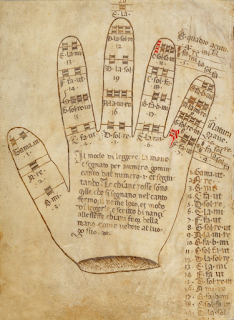
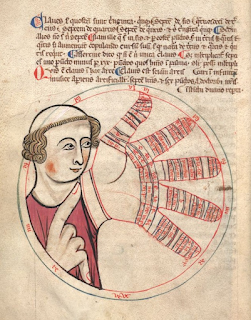
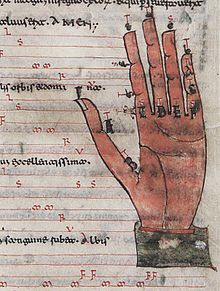
I have looked at hands as a way of remembering musical notation in an earlier post, but a good idea is always worth revisiting. In this hand image (below) made in response to ideas supposedly set out by the 11th-century Italian monk and music-theoretician Guido from Arezz, we can see how he uses the hand image to memorise the names of tones and their relationships by linking them to the natural divisions that we make when drawing hand images.

16th-century diagram from the manuscript of an unknown author depicting musical notes scored across a hand in the method attributed to Guido

Manuscript illustration of a 'Guidonian hand' 1274 
The solmization sequence ut-re-mi-fa-sol-la appears both on the enclosing circle and on the hand itself

In the drawing above the artist has been able to break totally away from normal conventions of spatial depiction, The near hand is big and powerful, but the far hand is gigantic, it spreads out until it is big enough to contain the idea. 


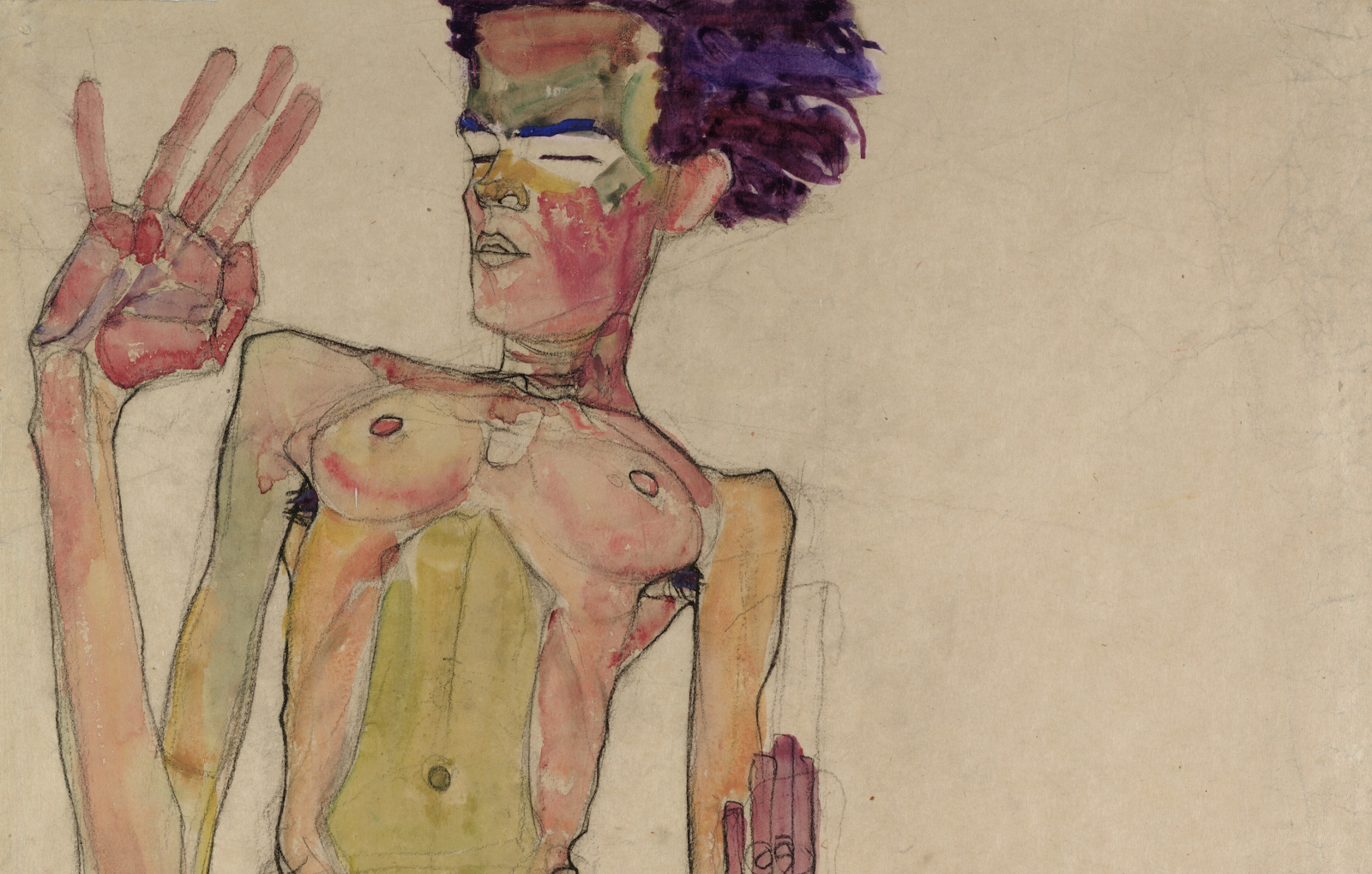
It's amazing how different hands can become. The one above also illustrating Guido's ideas could belong to an Egon Schiele of the Medieval artist world.
 
Egon Schiele

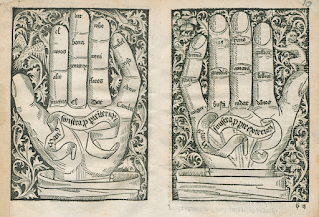
These woodcuts of chunky hands below, are totally different in sensibility. They are heavy and solid, the sort of hands that if engaged in making karate chops would do some serious damage. 

From Anianus’ Compotus cum commento (1492), an adaptation of Bede’s computus system

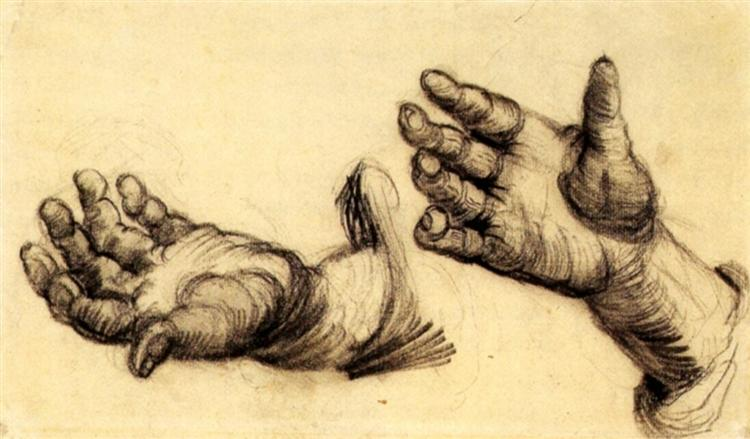
Van Gogh: Hands

Van Gogh's drawing of hands, is an image of hands that know how to do hard work; these are peasants hands. Whilst the hand below is meant to be much more spiritual. 

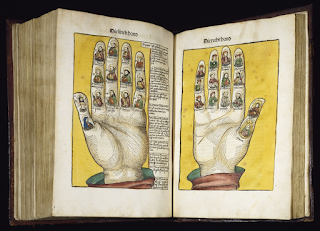
Hand-coloured woodcut: The Hand as the Mirror of Salvation

El Greco

El Greco's hand above, is a fascinating one. It is in fact quite strong, and yet at the same time it is sensitive and definitely a hand that has spiritual intent.  

From Stephan Fridolin’s 'Treasury of the true riches of salvation': 1491 

The hands above contain numbers that correspond to meditations in the book, in effect creating a table of contents. I like these hands as the little fingers have a kink in them, and so do my own fingers, a fact that makes me think that the artist, may have like myself, had arthritic fingers. However in the same book, we have a pair of more solid hands, hands with much broader fingers that can carry busts of the apostles, saints, Mary and Christ. 

.
From Stephan Fridolin’s 'Treasury of the true riches of salvation': 1491 

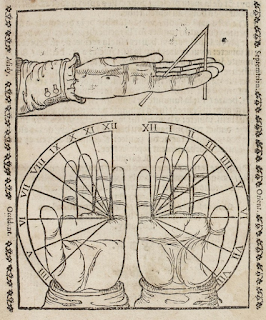
Of course we can use our hands for many other purposes, they are as versatile as we want them to be. From the shadow puppet of childhood to the fist of adulthood, the hand morphs into what we want it to be. As in the case below where the hand becomes a 'handy' sundial.

Thoinot Arbeau 1582 volume of practical astronomy: How to convert the hands into a sundial 

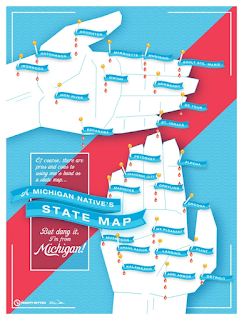
For the people of Michigan, the hand becomes a map.


You are supposed to know something really well if you know it like the back of your hand. A phrase I never really understood. As a boy I had spent many hours with my gran who would often hold my hand and carefully trace out my lifeline or prod my Venus Mount, she seemed to know all there was to know about the palm of my hand, but she never spoke to me about the other side. 

Chart of the Hand from Dr Alesha Sivarth's Book of Life 1898


References:

The public domain review  A wonderful source of images

Tyersky, B. (2019) Mind in Motion: How action shapes thought London: Basic Civitas Books

See also: