Showing posts with label guest blogger. Show all posts

Wednesday, 15 April 2020

Patrick S. Ford: A Dialogue with the Landscape.

Guest drawing blogger: Patrick S. Ford

A Dialogue with the Landscape.

I Grew up in England, with its long tradition of landscape art, and studied at Jacob Kramer College (as Leeds Arts University was known at the time). I first studied there from 1977-78 and then again from 1980-81.

Among the many wonderful and unforgettable experiences I had at Jacob Kramer, the week-long drawing trip to Wharfedale was arguably the high-point for me. I could never forget sitting up on the hills in the cold for hours on end making marks, erasing marks, making new marks, struggling to capture the particular character or personality of a specific section of the valley. The search for the appropriate marks that could express weight and convey distance and form in the landscape were the goals of those drawings. I quickly became aware that the resulting drawings were not simply an objective recording of the chosen landscape, nor were they merely an attempt to depict the landscape as a two dimensional image. The final images were more than that, they seemed to be a struggle to find a way of conveying a physical experience by recording that experience as a specific collection of marks, in a similar way to how binary code stores complex sets of information about the world.   

‘Wharfedale’, 1981

As I made these drawings I first had to ignore the temperature and the fact that I had not dressed appropriately for a day on the hills. I sat on a plastic sheet, with snow lying all around me. As I drew a stick of compressed charcoal across the sheet of paper, I followed the lines of the drystone walls I could see on the opposite side of the valley. I imagined myself walking there, hugging the walls for protection against the wind, climbing the hill towards the crest. As my imagination walked across the hillside, the piece of charcoal in my hand scraped correspondingly across the paper surface.
The resulting drawn image may not have been an exact visual copy of that part of Wharfedale but that would only be apparent if the drawing were held at arm’s length to the valley beyond. Once a drawing has left the location that triggered its creation it must work as an independent, resolved image able to exist on its own merit and not reliant on any comparison with a particular place and in my case a particular part of Yorkshire.

Fast forward now around 40 years and I found myself living on Cheung Chau Island, part of the territory or Hong Kong. During the 6 years I had been living on the island I had developed a regular late afternoon walk which I undertook every Saturday and Sunday unless it was raining heavily. Along the route of the walk I had noticed numerous boulders that lay in various parts of the island. Some of them lay very close to the path I traced and as I walked quite slowly I had time to look at them closely. On many of them the surface had been eroded by the wind and water into a texture that resembled miniature vermiculation reminiscent of the type to be seen on the lower stories of renaissance buildings. One in particular attracted me due to a large crack that ran vertically down the rock. The combination of the fissure in the rock and the surface texture I thought was quite striking. It could almost have been sculpted deliberately.
At the time, in my notebooks, I had been testing various drawing materials, such as willow and compressed charcoal, pastels, soft pencils and so on by laying thin sheets of paper onto the floor on my balcony to see which materials picked up the details of the floor surface in a more effective way. I was investigating different methods of mark making although at the time I did not have a particular application in mind. When I saw the fissured rock on my weekend walk I put the two together and decided to trace the wonderful texture of the rock with the most effective materials I had determined from my tests. 

The next weekend I took out a few sheets of thin, Chinese ink painting paper, some willow charcoal and located a few rocks that could serve as experimental subjects.
I spent a few minutes deciding which part of the rock to lay the paper on and then laid out my materials to be at arms-length while I worked. I would be holding the paper with one hand and pressing the charcoal onto the paper with the other. I carefully picked up the texture of the rock by utilising the frottage technique, the kind often used to record brass memorials in old churches. Care was needed and some practice required as I found that a certain amount of pressure was needed to pick up sufficient texture from the rock, but not too much pressure as that would tear the thin Chinese ink paper. I worked on 3 different rocks before moving on to the one with a distinctive crack running through it. This I felt to be the best of the group as it had an individual, distinct character. Although I was picking up the natural texture of the rock by rubbing the charcoal across the paper, I found that I could intensify certain parts of the emerging image in order to create emphasis. I therefore realised that I could exert some control over the marks being made and it was not simply a matter of recording the rock texture mechanically. The hand that held the paper in place while I drew was forced to move as I concentrated the drawing on different parts of the paper and through that hand I could sense the texture and temperature of the rock beneath.

In this way, as I used my hands to sense the form of the rocks, I gained an understanding of their make-up and which allowed me to respond later in an empathetic way. I had already expected that I may then have to work further on these initial images in order to clarify the visual imprint the rocks had left.

The drawings were the end result of a direct tactile interaction between the natural landscape and my hands. The experience was quite sculptural in a way, almost as though I was physically shaping the rocks in clay or a similar malleable material. It was as if the activity I was engaged in would somehow record the residue of the rocks’ presence onto the paper. Paul Klee would suggest that this residue would be generated by the naturally occurring energy of the rocks. Although the scale was different, I now realise that this ‘presence’ was what I was attempting to record onto paper back in Warfedale.

Reviewing my first round of drawings on Cheung Chau, I sensed that some drawings seemed to be almost fully resolved while others required some further work in order to resolve them. This further work was completed back in my studio and it was important for me to reflect on the experience I gained out in the landscape, so that my responses in the studio would be sympathetic with the marks made out in the field.
My overall aim was to combine the natural marks and textures created by the technique of ‘frottage’ and the sympathetic application of marks and tones added later in the studio.

Relief Drawing A – 33(h) x 22cm(w)

Relief Drawing B – 29.5(h) x 34.5cm(w)

Relief Drawing C – 32.5(h) x 35cm(w)

Relief Drawing D – 31.5(h) x 34.5cm(w)

Following this initial experimentation, I decided to move on to the next stage.
For this second round of experiments I chose a spot on a local beach. Here I found horizontal rocks emerging from the sand, full of character and ideal for my project. As these rocks formed the ground I walked upon it was therefore easier to lay out larger sheets of paper and use rocks as weights, rather than relying on my left hand to hold them in place while I worked.
On the day I chose to make my drawings it was very hot. I wore a straw hat from Okinawa that gave me shelter from the sun and allowed air to circulate through the weave. During the session that day I aimed to make two drawings. I took the roll of Chinese paper and a large square of paper that was not as sensitive as the Chinese ink paper, but being much larger it allowed me to experiment on a larger scale. It made sense to document the process and Nina, Yiu Lai Lei made the video recording for me.

Video: the making of relief drawing1


Working on the beach: Relief Drawing 1

Video: the making of relief drawing2


Working on the beach: Relief Drawing 2

Back in the studio I laid out the two drawings and reviewed them. The one I had made using the roll of Chinese ink paper seemed to me to be fully resolved. It had recorded quite a lot of the surface texture and the overall image had a strong personality. It seemed there was nothing missing and therefore nothing for me to add that could have improved it.
The larger, square sheet seemed a little unresolved so I felt I had to work more on it. Perhaps as this sheet of paper was not as sensitive it had not picked up as much of the surface texture. The contrast in the marks was greater (fewer half-tones had been created) and the marks seemed quite linear when compared to the other drawing. At first I was disappointed. I had been so pleased with the first drawing I assumed the larger drawing to be similar but more extensive. However, as I began work on it I realised my assumption was wrong. The paper surface was different, it was thicker and smoother and had not picked up as much of the delicate texture, only recording the main lumps and bumps beneath. I was mistaken to think that this paper could result in an image similar to the other paper that had such different qualities. Instead of being disappointed I embraced the larger drawing and as I continued to work I began to sense this drawing’s own personality. The image that began to emerge was not as three dimensional, the marks were almost calligraphic in nature and did not merge together so much in places as had happened in the previous drawing. Once I had found the new direction for this work I found the work much more enjoyable.
I tried to find equilibrium between the marks that were directed by the textures and fractures in the rocks and my own, considered response to them. The rocks led the way by setting out a basic structure, the scope of the drawing, and I then later followed their lead by responding to their clues and hints.

In order to make these drawings I had to adapt my usual method of working that would eventually allow me to make an honest and direct response to the form of the rocks. It is so easy to impose preconditions on a drawing and then attempt to push it in that direction rather than allowing the work’s specificity to dictate one’s working methods. 
I have always found experimentation exciting and I enjoy the thrill I receive when I am not in control and don’t fully understand where a particular project is headed. In future I now plan to explore this topic more and test the specificity of this method through the use of different surfaces and different types of drawing support. The fact that the results of such a project would be unpredictable is what drives me on. 

Relief Drawing 1: Chinese ink paper drawing – 138(h) x 35cm(w)

Relief Drawing 2: Layout paper drawing – 119(h) x 88cm(w)

Patrick S. Ford’s contact details

Friday, 3 April 2020

Drawing mutations: Megan Needham

Guest drawing blogger: Megan Needham

Megan Needham is today’s guest blogger. Megan was a Fine Art student at Leeds College of Art from 2012 to 2015, her practice at the time being concerned with repetition, seriality and order found within everyday objects. The visual qualities of these ubiquitous structures would become the starting point for heavily repetitive and time-intensive drawings which often centred around the formation of a grid. 


Since leaving, she has exhibited in various group shows across Leeds, Manchester and York. In 2016 she completed a PGCE in secondary Art & Design at Manchester Metropolitan University and continues to teach. In 2018 she was awarded a sketchbook prize at Manchester School of Art and more recently won the People’s Choice Award in MADE IT --Short Supply’s (an artist-led initiative and curatorial collective operating in Salford) graduate show. She has recently completed her MA in 2019 at Manchester School of Art.

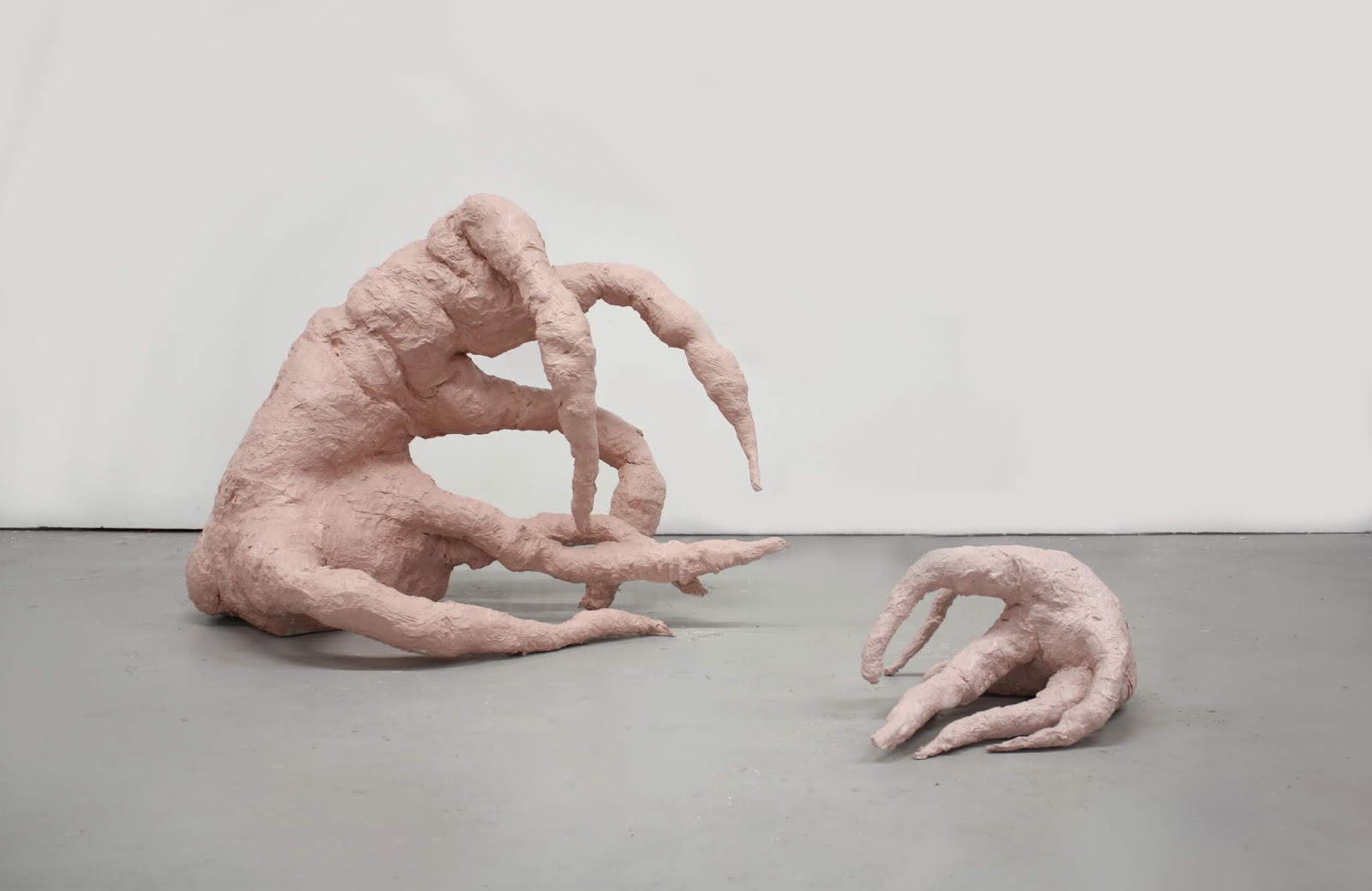
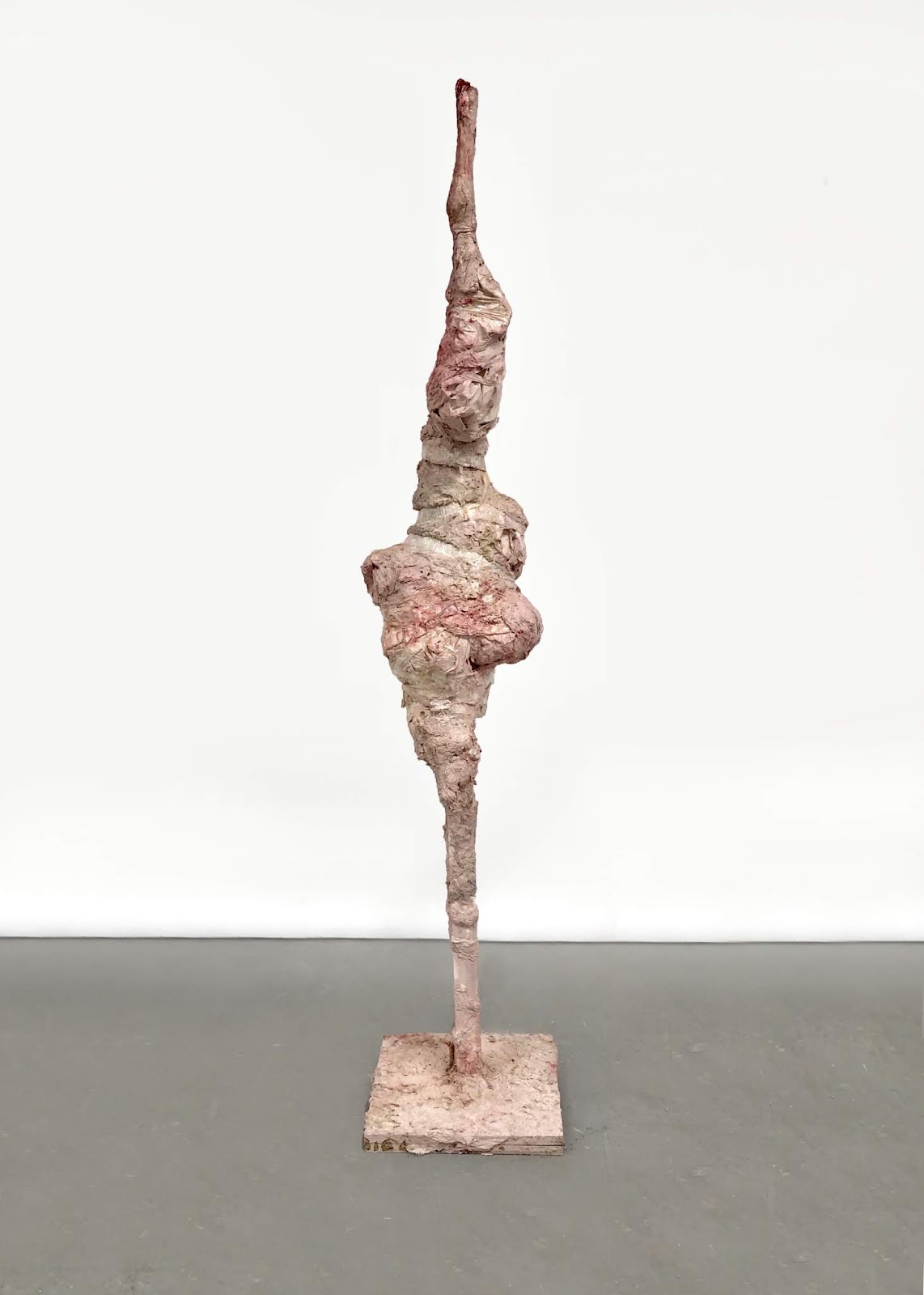
She is currently working at Rishworth School and continues to develop her art practice, a practice that has become much more sculptural and organic. Recent work has seen her responding to a series of forms that mutate and evolve as if they were embryos, each ‘mutation’ having anthropomorphic qualities reminiscent of the human body. 

Megan’s blog post describes what drawing means for her and it explains how her approach to drawing has changed as her practice has evolved.

Drawing mutations: Megan Needham

I was always encouraged to keep a sketchbook whilst a student at Leeds College of Art. Working in a sketchbook format became an important part of how I developed my practice and it was a way of collecting my thoughts together. It became habitual and comfortable to work at an A6 sketchbook size and consequently lots of my work produced around this time was of a small scale. It taught me how valuable drawing was and how drawing could operate as an overlap between disciplines, as I started to consider more three dimensional possibilities, such as objects with linear qualities existing in space or coming out of the paper.   

Various Sketchbooks 2012-2015

Typical sketchbook pages from my time at LCA


Examples of LCA student work

Whilst studying for an MA at Manchester School of Art I was encouraged to leave the safe confines of the sketchbook and I started to realise some of the forms I had been obsessively drawing, as sculpture. As my sculptural work was developing, I found myself returning to a sketchbook to plan, to think, to visualise and record my ideas of how to resolve the sculpture in progress or develop ideas for new works. As I progressed some of these works on paper stayed as drawings and others became information from which I was to develop sculptural forms. For me there is a symbiotic relationship between drawing and sculpture; each informs and generates momentum from the other. 

Contained Form. Mixed Media on Fabriano 100x200cm approx. (in progress)

Contained Form. Pencil Crayon on paper 7x15cm

Slob (right) 2019. Paper mache, tissue, paint, wood. 120x70x90cm
Baby (Left) 2019. Paper mache, tissue, paint. 35x30x22cm

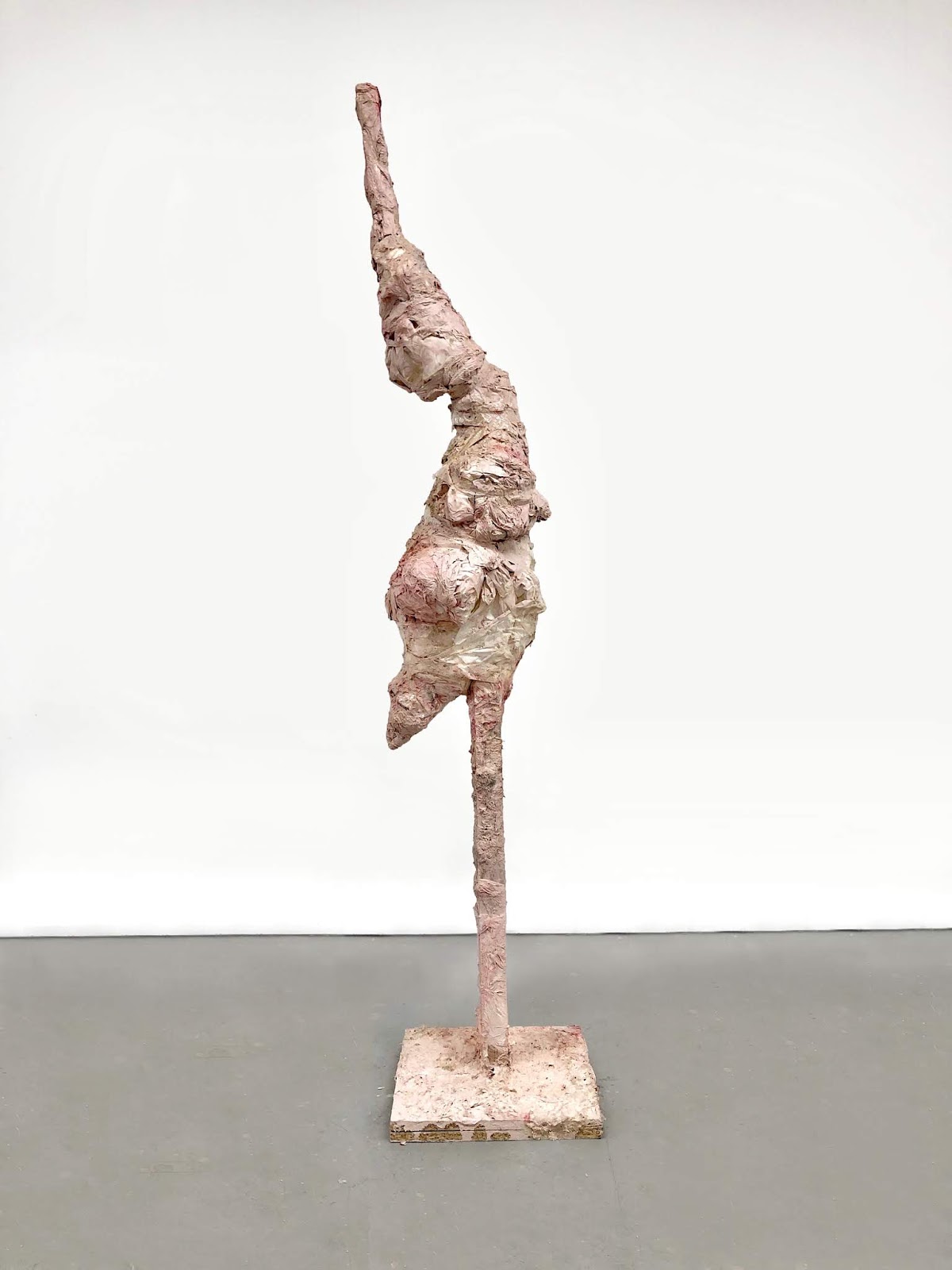
Untitled. Paper mache, tissue, paint, wood (in progress) 90x50x120cm

Untitled. Paper mache, tissue, paint, Sellotape, varnish, wood (in progress)


Pupa. 2019. Paper mache, tissue, paint, Sellotape, varnish, wood. 20x32x130cm


Chewing Gum Study. 2019. Gum, Fabriano paper. 15x15cm

As I was thinking about how and what materials to use when making sculptures, the thought processes also emerged in my works on paper. In particular I began using chewing gum as a way to ‘sculpt’ forms and shapes within the space of the paper. For the materials I am now working with I look for softer qualities that can easily be manipulated. 

Contained Forms is a series of works on paper where the resulting outcomes are abnormal, organic, mutated forms that are repetitive, obsessive and that continue to evolve throughout the series of work. They have anthropomorphic qualities, are reminiscent of embryonic limbs, folds of flesh, wrinkles of skin and curls of hair. I am interested in allowing the forms to develop intuitively but I also want them to share a quality of being restricted and contained within the confines and edges of the paper. 


Contained Forms. 2019. Hardground Etchings on Steel. Printed on Fabriano Rosapina. 15x30cm

These works range in size, which changes the way I physically make the work. On a smaller
scale, marks are made using the flick of my wrist and are limited to the range at which it can flex back and forth. When working on a larger scale the drawing becomes much more rhythmical and relies on the whole movement from my shoulder and the range of movement from my elbow. The forms in these larger drawings are of a similar size to my sculptures and are also related to human proportions, creating an uneasy relationship with the viewer that can at times be almost confrontational. 
Henry Moore: Shelter Drawing: Underground Study: 1940 
Gouache, brush and grey wash, coloured wax crayons, pen and black ink over pencil on paper. 12.3 x 17.7 cm.

To reveal mass and the three dimensional nature of form, I make use of a network of fine, curved, cross contour lines. This was a style adopted by Henry Moore who used these types of marks in combination with wax crayon, ink and wash to produce his series of Blitz drawings. Mixing and layering materials is something I do both when making drawings and sculpture, to create tactile and visceral surfaces. It is also a tool sculptors use to indicate weight as well as form in a preliminary sketch
. 
During this period of social distancing, I have downsized my studio quite significantly to the space of a desk. This is changing the nature of my work but I am working with what I have to hand and embracing new ideas. I have started a sketchbook; a continuation of the contained forms series, exploring drawing and being experimental with combinations of materials and approaches to mark making. I’ll be sharing on my Instagram how these drawings develop: @megan__needham


Recently, with so much advice on how to wash your hands properly to reduce the spread of coronavirus, I have been thinking about how the virus is passed on from person to person by physical contact. This is a very sculptural concept, touch being central to our idea of form. When something is touched traces are left behind from the natural oils in your fingertips. You can see the layer upon layer of greasy prints if your phone is left on lock and you hold it up to the light. These invisible latent fingerprints are made of water, fatty acids, amino acids and triglycerides—in other words, they result from the oil and sweat that your skin produces naturally. The reoccurring messages from PHE about handwashing make you more aware of how many surfaces each day we touch. I have been thinking of mapping these traces as drawings.

See this link for the exercise. 

These images of traces reminded me of some of the work made by the artist Jack Brown, who would collect the grease marks left by passengers’ hair rubbing against the glass windows on public transport. 

Jack Brown: Traces from a bus window

Some traces are invisible and others are much easier to see, whether or not the trace is something left at a microscopic level or is something that exists in our macro universe, it will be the result of things coming together and as they do a change is made. The police when recording a crime scene are very aware of Locard's exchange principle, "Every contact leaves a trace". As an artist when you begin to research these traces, you could be thought of as a type of crime scene investigator, something that feels very appropriate when thinking about how the corona virus spreads. 


Earlier this month I took this photo of the back of a lorry which interested me because of the mark making qualities and how the stained cloth resembles a prepared ground on which you might make a drawing. This is a found drawing, like Jack Brown’s work, it can be thought of as a residue of an event or series of events involving someone and something. Which is giving me some food for thought…

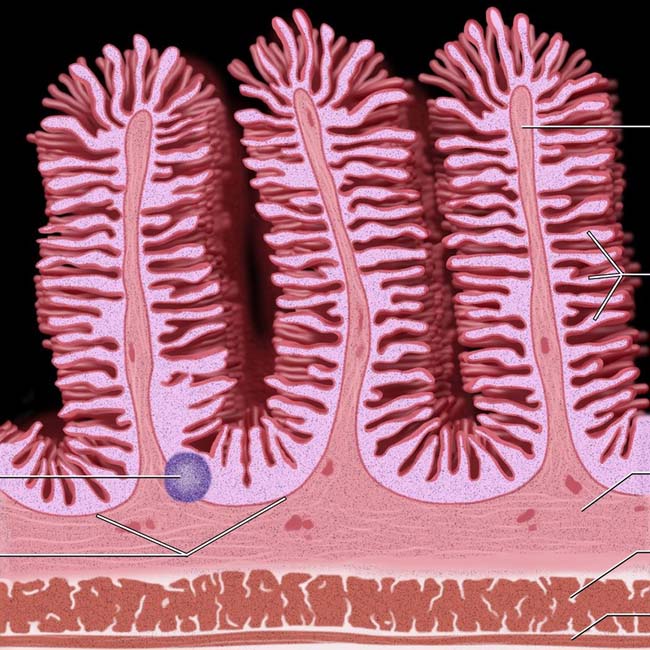
Scientific imagery of the internal human body has in the past acted as a reference and starting point for new drawings. The formations in my earlier etchings were inspired by the microscopic structures within our bodies. For example in our digestive system we have villi on the surface of the colon; small finger like projections that increase the surface area to uptake nutrients from digested food. Although invisible to us, they are an essential aspect of our lives and without them we could not function. The forms that villi take were seen by myself as electron microscope photographs and as images made by specialist scientific and medical illustrators. My own drawings then extended these ideas, trying to lend mass and weight to them, in order to give the concept of their invisibility and yet purposefulness, a certain gravity as well as mystique. 


Contained Form 2019. Hardground Etching on Steel. Printed on Fabriano Rosapina. 15x30cm

The corona virus

During this last month, many images were being shared in news articles of the visual structure of the coronavirus. These images have shown how the spiked projections on the surface of the virus binds on to the host cell and infects it. They adhere to various surfaces because of their pairing with the receptor site and can be loosened by the application of soap. The images of the virus differ between a 2D or 3D image depending on what sort of microscope has been used.  From these microscope derived photographs, 3D illustrations have been digitally rendered, each one designed to pick out certain ideas about the virus. These illustrations will have been produced in response to a dialogue between scientists and illustrators.  I have been looking a lot at these kinds of images and drawing from them to generate new work, whilst I do this I am thinking about how I might take a flat image into a sculptural form. This has been something I have struggled with recently – because the drawings have been produced from my imagination as well as from 2D imagery derived from secondary sources, and not from direct observation. This means that when trying to realise them as objects they don’t quite work in the same way I envisaged them in my mind. 
It is always interesting to have a dilemma to solve. Do I make models to work from? Do I insert x, y and z axis into and through existing drawings so that I can rotate them in my mind and on paper? Do I make drawings that I then cut up and reassemble? Do I gradually extend my drawings by adding more and more 3D materials to them? Do I create drawings on the surface of 3D forms and then re-draw them? Do I develop a process of working with materials that reflects the way a virus is transmitted or how it is broken down by lipids? 

See also:

These are a few posts that touch upon some of the issues raised. 


Wednesday, 1 January 2020

Mike Croft: The Observation of Perception

Guest drawing blogger: Mike Croft

For the starting post of the new year I'd like to introduce Mike Croft who is the first of my guest drawing bloggers. I first met Mike in the early 1980s when he was making a series of large drawings of cathedrals. These were impressive studies of the types of complex spaces that you find in buildings that have been built on organic principles rather than to an architect’s plan. We were both working on the Foundation Course at what was then the Jacob Kramer College and because of the importance of drawing in the curriculum at that time, we found ourselves constructing situations whereby certain different aspects of observational drawing practices could be explored. Mike left to move to London and then on to S.E. Asia, teaching on various design-based programmes in universities. His most significant pedagogic experience being developing an exploration of the perception of movement with the first year students of a new design programme in South Korea. Movement and the question of time, of which movement is of course an expression, have been abiding interests within Mike’s work for several years and being able to explore this with a group of students who already had strong drawing skills was a cathartic experience. 
Mike has this to say about the changes he has experienced when teaching and making drawings. “Thinking back to the days of Jacob Kramer College, the emphasis seemed much more on the image, and a degree of investment of rigour in drawing to ensure that the image was well founded. What may have changed, and has certainly been my more recent experience of teaching through drawing, is an emphasis on drawing as a research tool that students use while not necessarily being interested in drawing as its own medium, or a medium of fine art”. I would suggest that the change is more one of philosophical positioning here at Leeds. Drawing as process is of course important, but perhaps we are now looking more at drawing as a thinking tool rather than observational record. 
Mike points to his work as having “a certain cursory character compared with what you might imagine as being a ‘well founded’ image” and points to Henri Bergson’s distinction in ‘Matter and Memory’ ([1912] 2004), between what he calls the ‘present image’, as opposed to the ‘represented image’. ‘Representation is always there, but always virtual – being neutralized, at the very moment when it might become actual, by the obligation to continue itself and to lose itself in something else’ (2004: 28). Mike loves this quote, pointing out, “concerning conscious perception, because through it one can acknowledge and build into an image one’s own sense and feelings of movement, and the drift and development of thought and action while drawing. The ‘present image’ may be considered the image in its sense of passing through, and conveys in essence a degree of insubstantiality but in the affirmative sense. Of course, in the sense of difference between say, the sketch and the finished work, this is nothing particularly new”. He points to the recent drawing blog post on ‘clouds’ stating, “what more beautiful instances of ephemeral insubstantiality than clouds!”
When I look at Mike’s drawing research, I’m always impressed with his focus and clarity; recent drawing experiments whereby he explores how to respond to changing perceptions in relation to movement, as always reflect his desire to be accurate, minimalist and systematic in response to the overwhelming amount of experience that sense data provides us with. 
Mike’s blog posts are designed to help you as drawers think more carefully about movement. (He has crafted two, but because there is a lot of information to digest, they will be separated by a few days) As he points out, “working with and through movement in drawing may possibly be a way of attending more to how we see, perception itself, rather than perception’s resulting observations, while attending no less to whatever is the motif, the object of observation”. 
When drawing, going back to hard earned thoughtful and measured looking is always worthwhile and Mike helps us approach the process with fresh insight. 

Bergson, H. (2004) Matter and Memory (first published 1912) New York, NY: Dover
Link to TRACY where Mike has made some of his earlier research publicly available.

The Observation of Perception: Mike Croft

What I’d like to say relates to drawing that concerns observation of the external world, but through the filter of perception. Of course, that there is a relation of the latter to the former is obvious, yet we may tend not to notice, let alone see, perception’s role in the process. Also, conventionally, we mostly select objects for drawing that are still or slow moving enough to enable what we assume will be some degree of representation of them. Notice that I’ve used ‘some sort of’, ‘may tend not to’, ‘mostly select’, and ‘some degree of’, which suggests that nothing I’ve so far said can be really concrete; it’s all open to interpretation.  However, insofar as what I’ve said is relatively true, the facility of observation, in this case primarily visual, is automatically challenged and even sometimes contradicted by aspects of our innate biological and physiological facility of perception. 
Perception may be said to work both for and against objectification of the object of vision, mostly in ways that are either automatic to, or beneath our awareness. How I happen to think this is due to at least two pivotal realisations – points of learning – neither of which happened in art school drawing classes. This is not to say that the classes did not provide the potential for such realisations, just that they were not theoretically articulated at that time. The situation may be somewhat different now. The first realisation was back in the 1970s’ when I was first a student. I happened upon a large-format book on psychology, in which was a photo of a girl’s face and next to it a semi-abstract rendition of it that transformed the face into a continuous kind of line map comprised of tiny flicks and dashes. (The phenomenon of drift and flickyou might, yourself, wish to look up on the Internet in relation to visual perception.) The rendering of the face turned out to be a printout from a non-digital eye-scanning portal, a device invented by the Russian psychologist Alfred L. Yarbus (1914 - 1986) in the 1960s’. The device would record eye movements of a person attached to the device while looking at an image, usually a photograph, for a short period of time. The limitation of this is that the observed material does seem to be photographic, and therefore flattened, but I was quickly extending the visual characteristics of Yarbus’s findings to objects in three-dimensional space.
There are now digital equivalents of eye-scanning portals, but they work very differently. The useful point about Yarbus’s device that relates it to drawing is that it recorded in line, by means of a stylus, which looks similar to and is practically adaptable to drawing. It is however a mechanism, and like any medium imposes its own behaviour to some extent on the user’s intentions. What I learned from it, which caused it to be a pivotal influence, is that in perception we do not incessantly inscribe contours around objects, either on a page or in space, however eloquently we might use the phenomenon of contour in aesthetically inspired drawing. The oval of a human face, for example, does not register in perception except in a fragmentary sense, or even when we are giving it special attention. What is more likely to happen is that we register points and intersections of things in a hierarchy of importance according to whatever are our intentions of looking, Figure 1.

Figure 1. 
Photograph and resulting eye-scanning reading from an eye-scanning portal by 
A. L. Yarbus, and a contrasting portrait drawing by the author. 

In the above trio of photos, I’m comparing the Yarbus photo and printout that I originally noticed with a portrait drawing of mine that is made according to certain drawing conventions, especially that of the closed contour. It’s not necessarily a bad drawing, but to make a bald statement that is therefore open to challenge, it’s not how we look from either the point of view of the observer or the observed! If you compare the Yarbus printout with drawings by the British artist Frank Auerbach, for example, you may feel that Auerbach has arrived at similar knowledge to that provided by the Yarbus, although through the progress of his own experience. At the time of this discovery, especially the examples from Yarbus that concerned the various scanning of an image of figures in a room, this knowledge helped me to understand the kind of scanning across space that is a characteristic of drawings by an artist such as Giacometti, Figure 2.


 Figure 2: A Yarbus eye-scanning experiment where the participant was asked to scan the photo, above left, for a range of specified reasons.  

The eye-scanning’s element of science may help underline the fact that drawing can and often does have an investigative basis. In those early student days, the eye-scanning images enabled me to loosen up line and conceive the depiction of objects more in terms of marks and dashes and, most importantly, sense that space could be traversed through the drift of one’s vision during perception, with or without mapping objects in its course. Currently, I find that the more popular literature of quantum theory on the question of space provides some basis for untethering such marks and dashes almost entirely from the object, so that they start to say something, albeit as a very crude analogy, about the structure of space itself. In this respect, you may be interested in investigating such contemporary research in quantum physics as loop theory(Rovelli, 2017, for a clearly explained introduction). 
            So, to conclude this first point of discovery, the Yarbus findings challenged and in some respects even negated some of the conventions that I was being taught in the context of structuring visual observational experience. 

**********
The second realisation concerns a very recently read comment on the Italian Renaissance theorist Leon Battista Alberti (1404 – 1472) concerning the optical pyramid, which is an attempt to conceptualise how the eye reads three-dimensional objects in space.
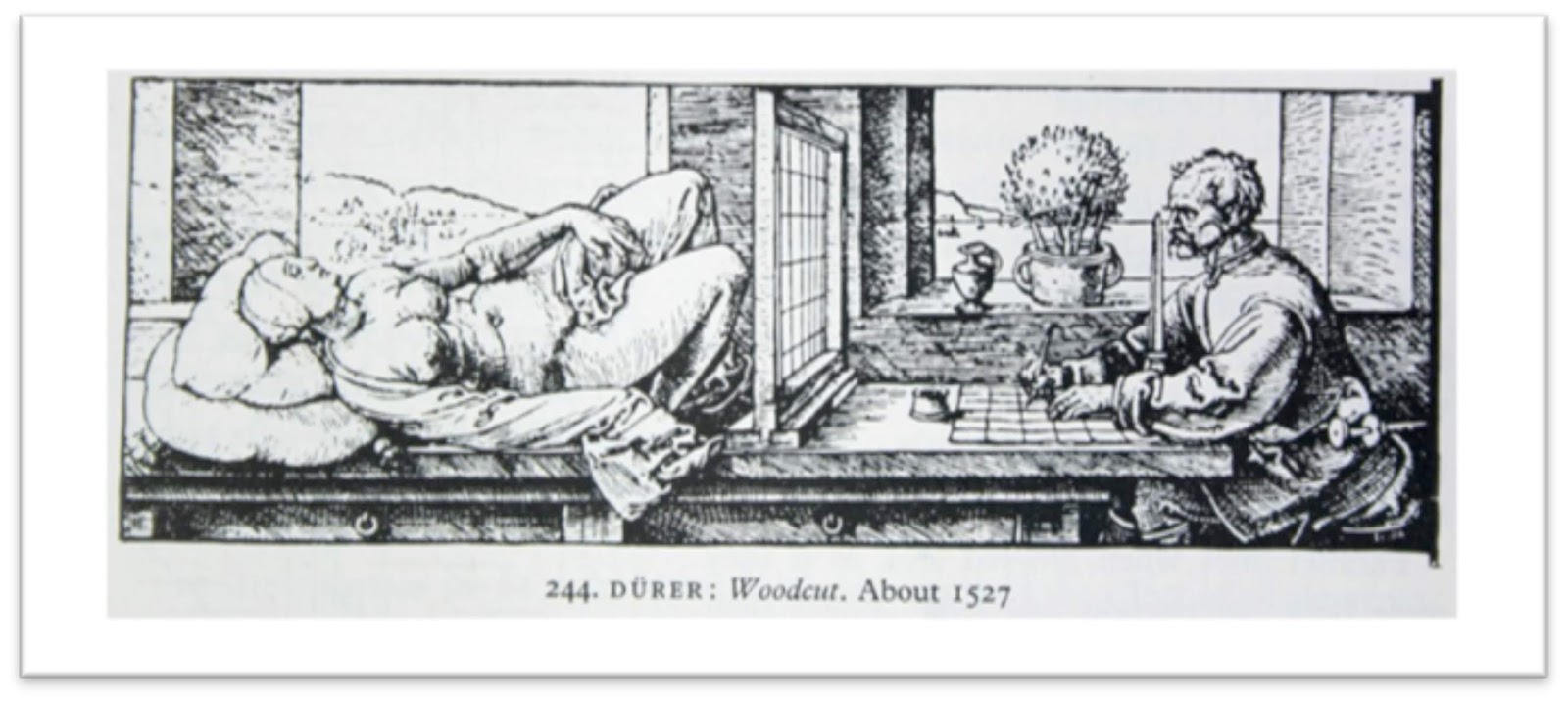
Alberti invented a device known as a netor veilto enable the precise depiction of objects through the extraction from them of a structure of coordinates plotted onto a semi-transparent net stretched taut on a plane in front of them. A derivation of this as a gridded frame is shown clearly in use, in a woodcut by the German Renaissance artist Albrecht Durer (1471 – 1528). The artist can be seen plotting such coordinates from the frame relating to a human figure lying in front of him (Gombrich, 1977: 259), Figure 3.

Figure 3: Woodcut by Durer, showing a painter using the device of a gridded frame to aid observation.

The point in relation to what I want to say about this concerns the fact that the gridded frame is positioned midway between the figure being drawn and the drawing plane. According to Dahl (2003: 5), Alberti gave ‘ontological status’ to a non-visible essence somewhere in the middle of the optical pyramid, a kind of plane of being, where Alberti suggests that there’s something more than visual going on in the experience of looking. Coincidentally, and in a sense incongruously, considering that it is such a material device, the net, veil or grid is positioned in just such a middle space between the artist/observer and the human figure or object/s observed. If perception is both the facility that enables observation and something other than observation, then Alberti was suggesting that there could be a sense or realisation of beingcoming through one’s striving to render the appearance of objects in space accurately. 
The Alberti device has since been developed as a more synthetic means that incorporates the slight curvature of the eyes’ lens through the skill that many of us will have learned of holding a pencil or straight-edge at right angles to our outstretched arm, variously perpendicular or horizontal to vision. When used correctly, this system of establishing proportional relationships between objects in three-dimensional space can be very accurate. It’s the scope for the convention’s inaccuracyhowever, while nonetheless striving for accuracy, or through noticing anomalies in the system, that interests me, Figure 4.

Figure 5: The author plotting positions of objects from four slightly differing viewpoints, and the resulting drawing, Dermatograph pencil on white laminated cardboard, 119 x 84cm, 2018. 


The above process of mine concerns making a measured drawing from four very slightly differing colour-coded positions of a single open eye, using a thread held taut between a vanishing point on the drawing set-up and the eye. The resulting reading of the drawing is one aggregate configuration comprised of several mismatched layers. How this relates to Alberti’s idea of the in-between is that – perhaps – the ontological value comes through in the very impossibility of absolute correctness, in which the drawing as a presentationis to be found in a sense of its oscillating somewhere between its referenced objects and its agent, the drawer. It’s paradoxical that the Alberti device is so material, when what it and its derivations presents is an embodiment of less tangible aspects of life.  
Drawing can in this respect be a relationship almost in the manner of a hologram result of an otherwise two-way process of looking and the return to one of what’s being viewed. Since the basis of the hologram is in a certain projected interferenceof the object, this idea of interference is the key – the interference of aspects of perception on observation. To give you an example – although this doesn’t necessarily reflect my current approach to drawing – I relatively recently drew a single figure slowly rotating in a chair through 360°, and shifted the drawing of the figure across to the right at the moment the actual figure crossed a midway diameter demarcated on the floor. While the drawing reads as two separate seated figures, the schematic marks between them are an attempt to conceptualise both moving the figure and keeping it linked to itself. If I speak of an energisedspace between the two apparent figures, this is not so much observed as conceptualised through gestural marks as restless eye movement back and forth, in regard of space itself rather than surrounding infrastructure that one might otherwise reference. Such visualisation of space at least suggeststhat what’s going on is a change in looking at the figure conceived as its back view, to one conceived as its front view at a certain moment when a shift in consciousness of the situation takes place, which is debatably more a question of perception than observation, Figure 5.

Figure 5: Two drawn versions of a single rotating figure, pencil on paper, 84 x 59cm, by the author, 2013.

The idea of an intangible and non-visible in-between plane as a source of interference has been adapted by the psychoanalyst Jacques Lacan (1901 - 1981) where, in the context of discussion of internal psyche, the mid-way of the optical pyramid is a metaphorical ‘stain’ or ‘decoy’ that muddies any assumed clarity of observation (Harari, 2004: 121-31) – but this would have to involve a more extended discussion. In terms of my own albeit limited adaptation, imagine that, when drawing, the drawn object falls somewhere between oneself and whatever is the actual object, and in the process it’s observed basis is as much confounded as enabled by one’s perception. This is the idea that I’d like to introduce in the second blog entry, particularly through links to a couple of video clips that show such a drawing in process and simultaneously explain it through speech. 
There will undoubtedly be plenty of existing artistic work and research on this subject of discussion, but a third and overriding key point is that one tends to engage in and with drawing from wherever one is with one’s own interests at the present time, Drawing as a medium in any case often exerts a degree of autonomy that sets it apart from whatever are one’s expressed intentions.

References

Dahl, T. (2003) The Transformation of Space and the Construction of Engineering Knowledge and Practice—From Renaissance Perspective Thinking to Gaspard Monge’s Descriptive Geometry. Hård, M. et al (ed) Transforming Spaces. The Topological Turn in Technology Studies.(http://www.ifs.tu-darmstadt.de/gradkoll/Publikationen/transformingspaces.html

Gombrich, E. (1977) Art and Illusion. (First published 1960) United Kingdom: Phaidon 
Harari, R. (2004) Lacan’s Four Fundamental Concepts of Psychoanalysis: An Introduction. New York, NY: Other
Rovelli, C. (2017) Reality Is Not What It Seems. (First published in English 2016) United Kingdom: Penguin   
Yarbus, A, L.